Where this fits
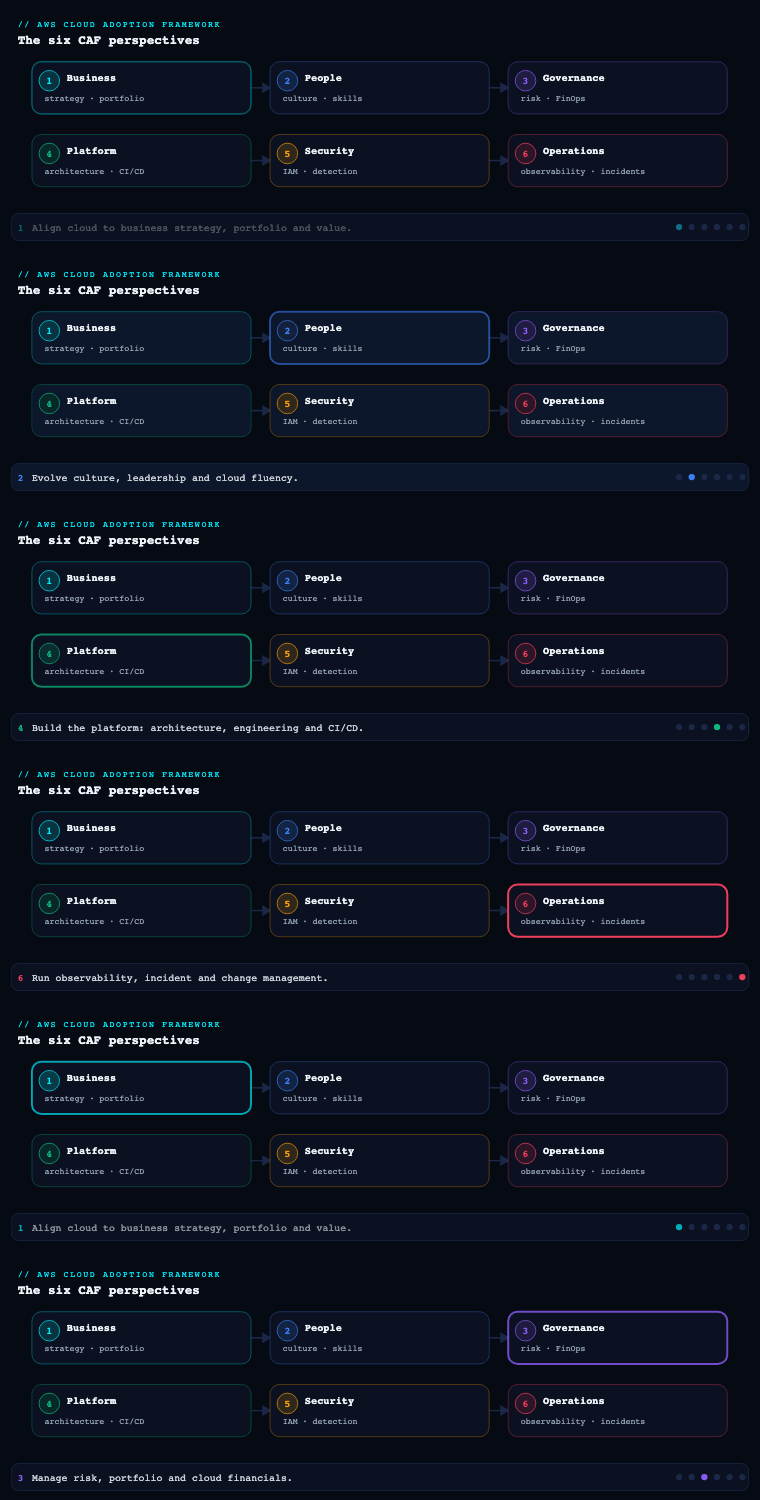
The AWS Cloud Adoption Framework organizes cloud transformation guidance into six perspectives — Business, People, Governance, Platform, Security, and Operations — each a collection of foundational capabilities owned by a recognizable set of stakeholders. The Business perspective is the one that answers why you are investing in the cloud and what business outcomes justify the spend; its common stakeholders are the CEO, CFO, COO, CIO, and CTO. It comprises eight capabilities, and this article goes deep on seven of them — strategy management, portfolio management, innovation management, product management, strategic partnership, business insights, and data monetization — leaving data science for the analytics-heavy follow-on. The Business perspective is what keeps the other five honest: the People perspective restructures the org to deliver the products Business prioritized, Platform and Operations build and run them, and Governance and Security keep them compliant — but if the Business perspective is weak, you ship a technically immaculate platform that nobody asked for and cannot trace to a P&L line.
Strategy management
What it is. Strategy management is the capability of leveraging the cloud to accelerate your business outcomes — deciding how the cloud supports and shapes long-term business goals rather than treating it as an infrastructure swap. AWS frames it around four moves: support long-term goals, retire technical debt, explore new cloud-enabled value propositions and revenue models, and reach new customers or market segments. Critically, strategy is not a one-time document; you prioritize strategic objectives and evolve them as technology and your business environment change.
Why it matters. Strategy is the root from which the other seven capabilities inherit. Portfolio management prioritizes “in line with strategic intent” — if intent is undefined, prioritization degenerates into whoever shouts loudest. Innovation initiatives are selected “in line with strategic priorities.” Data monetization must be “aligned with your strategic intent.” A vague strategy (“move to the cloud to save money”) under-specifies every downstream decision; a sharp one (“exit two data centers by FY28 and launch a usage-billed data product to a new SMB segment”) tells you exactly how to sequence migration against innovation.
How to do it well. Separate the two engines of cloud value and fund them differently. Cost-out (technical-debt retirement, data-center exit, run-rate reduction) is measured on time-to-vacate and unit-cost reduction. Growth (new value propositions, new segments, new revenue models) is measured on time-to-market and adoption. Conflating them is the classic failure: gating a revenue product behind a two-year lift-and-shift starves it, while judging a migration on “AI features shipped” declares a success a failure. Write the strategy as testable objectives with target dates and owners, and revisit it on a cadence (quarterly is typical) as a living artifact.
Artifacts, decisions, and AWS tooling.
| Artifact / decision | What it captures | AWS input |
|---|---|---|
| Strategic objectives register | Cost-out vs growth objectives, target dates, executive owners | AWS Cloud Economics, Executive Insights for CEOs/CFOs |
| Technical-debt inventory | Workloads to retire/replace and the renewal costs avoided | AWS Migration Evaluator, AWS Application Discovery Service |
| Cloud Value Framework view | The four value sources: cost savings, staff productivity, operational resilience, business agility | AWS Cloud Value Framework (Cloud Economics) |
| Strategy review cadence | When and how objectives are re-prioritized | CAF Action Plan, AWS Enterprise Strategy team engagement |
A common, useful starting point is a CAF Assessment workshop facilitated by AWS or an APN partner: it scores each capability’s current vs target maturity and produces an Action Plan that ties strategic objectives to specific capability uplift. The decision that comes out of strategy management is not a Terraform module — it is a funded, time-bound list of objectives every later capability can point to.
Portfolio management
What it is. Portfolio management prioritizes cloud products and initiatives in line with strategic intent, operational efficiency, and your capacity to deliver. It is where strategy becomes a sequenced, evidenced plan: which applications move when, which get modernized, which get retired, and which net-new initiatives get funded — all balanced against resource, financial, and schedule constraints.
Why it matters. This is the capability that operationalizes strategy and most directly drives time-to-value. Two ideas from AWS make it concrete. First, rationalize the existing estate with the 7 Rs — the seven common migration strategies — so every application has a disposition backed by data, not opinion. Second, balance the portfolio across short- and long-term outcomes and low-risk (proven) vs higher-risk (experimental) bets, spanning migration, modernization, and innovation, and weighing both financial (lower cost, higher revenue) and non-financial (customer/employee experience) benefits.
The 7 Rs. Every workload in the estate is assigned one disposition:
| Strategy ® | What it means | When to choose it |
|---|---|---|
| Retire | Decommission; nobody uses it | Low/no usage found in discovery |
| Retain | Leave on-premises for now (revisit) | Hard dependency, recent investment, or compliance hold |
| Relocate | Move at the hypervisor level, no OS/app change | VMware estates via VMware Cloud on AWS |
| Rehost | “Lift and shift” to EC2 unchanged | Speed/datacenter-exit priority; optimize later |
| Repurchase | Drop and move to SaaS | Commodity capability (e.g., self-hosted CRM → SaaS) |
| Replatform | “Lift, tinker, and shift” — small optimizations | Move a DB to Amazon RDS/Aurora without re-architecting |
| Refactor | Re-architect to cloud-native | Strategic app where agility/scale justify the cost |
How to do it well. Build a data-driven business case before committing budget. AWS Migration Evaluator (formerly TSO Logic) analyzes on-premises utilization and projects a right-sized AWS cost and Quick Wins, while AWS Application Discovery Service and Migration Hub inventory servers and map dependencies so you assign Rs from evidence, not a spreadsheet guess. Resist front-loading only low-risk rehosts — a portfolio that is 100% lift-and-shift never realizes the modernization or innovation value the strategy promised. To compress time-to-value, AWS explicitly recommends increasing planning-cycle frequency or adopting continuous planning rather than an annual big-bang plan.
Artifacts, decisions, and AWS tooling.
| Artifact / decision | AWS input |
|---|---|
| Application portfolio with 7 Rs disposition per workload | Application Discovery Service, Migration Hub, Migration Evaluator |
| Dependency maps / move groups (migration waves) | Migration Hub, Application Discovery Service Agentless Collector |
| Data-driven business case (run-rate, right-sizing, Quick Wins) | AWS Migration Evaluator, AWS Pricing Calculator |
| Prioritized, balanced backlog (migrate / modernize / innovate) | AWS Migration Acceleration Program (MAP) assess phase |
| Planning cadence decision (continuous vs periodic) | CAF Action Plan |
The output is a wave plan: prioritized move groups, each with a disposition, a business case, and a target window — the contract between the Business perspective and the Platform/Operations teams who will execute it.
Innovation management
What it is. Innovation management is leveraging the cloud to develop new — and improve existing — processes, products, and experiences. Its premise is that the ability to provision and shut down resources instantly reduces time-to-value and the cost and risk of experimentation, so the rational response is to run more experiments cheaply, not to gate a few expensive ones.
Why it matters. Cloud agility is only realized if you have a mechanism to convert it into shipped change. Without an explicit innovation strategy, the elasticity advantage leaks away — teams still queue ideas behind annual planning and over-provision “just in case.” AWS prescribes a deliberate mix: incremental innovation that optimizes existing products, processes, and experiences, and disruptive innovation that enables new business models. You need both pipelines plus a way to choose between ideas and a way to scale the winners.
How to do it well. Stand up two mechanisms. (1) An idea funnel: solicit and select ideas in line with strategic priorities — many AWS customers adopt the Amazon Working Backwards method, starting each idea as a press release and FAQ (PR/FAQ) so the customer outcome is defined before a line of code. (2) An experiment-to-scale pipeline: an end-to-end process for taking a successful pilot to production. Make experiments genuinely cheap and disposable — separate sandbox accounts via AWS Control Tower Account Factory, hard budget caps via AWS Budgets, and tear-down automation so a failed experiment costs days and dollars, not quarters. Amazon’s own “two-pizza team” and bias-for-action mechanisms exist precisely to keep the cost of trying low.
Artifacts, decisions, and AWS tooling.
| Artifact / decision | AWS input |
|---|---|
| Innovation strategy (incremental + disruptive mix) | AWS Executive Insights, Working Backwards / PR-FAQ |
| Idea intake + selection mechanism | PR/FAQ templates, AWS Digital Innovation / Experience-Based Acceleration (EBA) |
| Disposable experiment environment | AWS Control Tower Account Factory, AWS Budgets, IaC tear-down (CDK/CloudFormation) |
| Rapid-build services for pilots | AWS Lambda, Amazon Bedrock, Amazon SageMaker, AWS Step Functions |
| Pilot-to-production pathway | Migration/modernization backlog, MAP modernize phase |
The decision that matters here is how a pilot graduates: define the metric, threshold, and owner that promote an experiment into a funded product before you run it — otherwise winners stall in “perpetual pilot.”
Product management
What it is. Product management is managing data- and cloud-enabled offerings that deliver repeatable value to internal and external customers as products through their lifecycles. The shift is organizational: from project teams that disband after a delivery to small, enduring, empowered, cross-functional teams that own a product end to end. AWS lists the moves explicitly — develop a balanced product portfolio aligned to strategy; stand up two-pizza-style teams that champion customer needs; identify product owners; understand customer journeys; define product roadmaps; manage end-to-end lifecycles and value streams; iterate fast on the cloud platform; and reduce inter-team dependencies via well-defined interfaces.
Why it matters. A migration that lands workloads but keeps a project-and-handoff operating model squanders cloud agility — every change still routes through a central queue. Product orientation is what makes “you build it, you run it” real and lets value-stream metrics (lead time, deployment frequency) actually improve. The emphasis on well-defined interfaces between products is not cosmetic: it is how you decouple teams so they ship independently, which on AWS maps cleanly to API contracts and account/VPC boundaries.
How to do it well. Treat internal platform capabilities as products too — a landing zone, a CI/CD paved road, or a data platform each has an owner, a roadmap, and consumers. Give each product team its own AWS account(s) so the blast radius and cost are naturally bounded, and expose capabilities through stable contracts: Amazon API Gateway for synchronous interfaces, Amazon EventBridge for event-driven integration, and AWS Service Catalog to publish self-service products other teams consume. Wire DORA-style metrics from the delivery toolchain (AWS CodePipeline/CodeBuild or third-party CI) so each product’s value stream is measured, not asserted.
Artifacts, decisions, and AWS tooling.
| Artifact / decision | AWS input |
|---|---|
| Product taxonomy + balanced product portfolio | CAF Action Plan, Working Backwards |
| Product team / ownership model (two-pizza teams) | People perspective alignment; per-product AWS accounts via Control Tower |
| Product roadmaps and value-stream maps | DevOps tooling; DORA metrics |
| Inter-product interface contracts | Amazon API Gateway, Amazon EventBridge, AWS Service Catalog |
| Lifecycle/run model (“you build it, you run it”) | Operations perspective; CloudWatch, X-Ray observability |
The key decision is the product boundary: drawing it around a customer-meaningful capability (and a value stream) rather than around an existing org chart is what makes the rest of the model work.
Strategic partnership
What it is. Strategic partnership is building or growing your business through a strategic partnership with your cloud provider. It applies when you sell cloud-hosted software, cloud-integrated products, or cloud-related professional/consulting/managed services — i.e., when AWS is not just your supplier but your route to market. The partnership lets you build cloud expertise, promote solutions to AWS customers, and drive successful customer engagements.
Why it matters. For an ISV or services firm, the economics of go-to-market shift materially once you engage the AWS Partner Network (APN): promotional credits and funding lower the cost of building and proving solutions, co-selling puts your offering in front of AWS’s field and customers, and AWS Marketplace becomes a transactable channel with private offers and consumption-based billing that can draw down a customer’s existing AWS commitment. Ignoring this capability means leaving demand-generation and funding on the table that competitors are using.
How to do it well. Treat the partnership as a journey with concrete milestones rather than a logo:
| Stage / lever | What it does | AWS program |
|---|---|---|
| Validate expertise | Prove technical competence in a domain | AWS Competency Program, Service Delivery / Service Ready |
| Designate skilled staff | Recognize certified, specialized teams | AWS Specialization & certification tracks |
| Co-sell with AWS | Share pipeline, engage AWS field on deals | APN Customer Engagements (ACE) |
| Fund build & proof | Offset POC, migration, and build cost | AWS Partner funding (e.g., MAP, POA, migration funding) |
| Mature SaaS products | Architect and harden multi-tenant SaaS | AWS SaaS Factory |
| Transact at scale | Sell via a global channel, private offers | AWS Marketplace (Channel Programs) |
| Prove outcomes | Build credibility with references | Joint case studies |
Artifacts, decisions, and AWS tooling. You produce an APN tier/competency plan (which competencies and specializations to pursue and by when), a co-sell motion registered through ACE (opportunity pipeline shared with AWS), a Marketplace listing (public and/or private offers with metering), and joint case studies that highlight specific business challenges solved. The decision is strategic: is AWS a supplier or a channel? If your revenue depends on AWS customers, the partnership is itself a product line that the Business perspective must resource, not an afterthought for the procurement team.
Business insights
What it is. Business insights is the capability to gain real-time insights and answer questions about your business. AWS positions near-real-time descriptive analytics as the part of your data monetization strategy that lets you track business performance, improve decision-making, and optimize operations — the “what is happening now / what just happened” layer beneath predictive data science.
Why it matters. Descriptive insight is where most measurable value is realized first and fastest, and it is the feedback loop for every other Business-perspective capability: it tells you whether a migration wave hit its cost target, whether an innovation pilot is being adopted, and whether a product’s KPIs are moving. AWS is explicit that success here is as much non-technical as technical — visualization and communication matter alongside statistics — and that analytics must be aligned to business goals and KPIs, not produced for its own sake.
How to do it well. Establish cross-functional analytics teams that genuinely understand the business context (not a walled-off BI silo). Use a Data Catalog to locate governed data products, then visualization to find trends and relationships — big picture first, drill down as needed. On AWS this is a recognizable stack: AWS Glue Data Catalog (with AWS Lake Formation governance) to discover and permission data products; Amazon Athena and Amazon Redshift (including Redshift Spectrum/Serverless) to query the lake and warehouse; Amazon QuickSight for dashboards and natural-language Q via QuickSight Q; and Amazon OpenSearch Service or Managed Service for Apache Flink / Amazon Data Firehose when “near real-time” means streaming. Tie each dashboard to a named KPI and an owner.
Artifacts, decisions, and AWS tooling.
| Artifact / decision | AWS input |
|---|---|
| KPI tree mapped to business goals | Strategy objectives register |
| Governed, catalogued data products | AWS Glue Data Catalog, AWS Lake Formation |
| Self-service dashboards + NL querying | Amazon QuickSight, QuickSight Q |
| Query/warehouse layer | Amazon Athena, Amazon Redshift (Serverless/Spectrum) |
| Near-real-time pipeline (where needed) | Amazon Data Firehose, Managed Service for Apache Flink, Amazon OpenSearch Service |
The decision is which questions the business must answer in near-real-time — that scoping prevents a sprawling dashboard estate nobody reads and focuses the analytics team on KPIs that drive action.
Data monetization
What it is. Data monetization is leveraging data to obtain measurable business benefit. The cloud makes collecting, storing, and analyzing vast data economical; the capability is turning that into a comprehensive, long-term, strategy-aligned monetization plan. AWS frames the value you pursue in three forms — transactional (understand and complete business transactions), informational (describe past performance, infer conclusions), and analytical (automate activities, guide decisions, predict outcomes) — and gives a clear sequencing rule: monetize data internally first, then consider external monetization (for example, selling data via a marketplace).
Why it matters. Data monetization is the capability that most directly creates new revenue and efficiency, and it is the umbrella under which business insights (descriptive) and data science (predictive/prescriptive) deliver. The internal-before-external rule is a guardrail against the common mistake of building a data-products business before the organization can even act on its own data — and before governance, lineage, and consent are mature enough to externalize anything safely.
How to do it well. Start with internal use cases that compound: AWS cites customer-behavior insights driving hyper-personalization, localization, micro-segmentation, subscriber retention, and loyalty/rewards — measurable on retention, conversion, and operating cost. Treat data as a product with a lakehouse foundation: store in Amazon S3, catalog and govern with AWS Glue and Lake Formation (row/column/cell-level permissions and tag-based access), and query with Athena/Redshift. Adopt a data mesh so domains own and publish data products through governed interfaces, optionally using Amazon DataZone to publish, discover, and subscribe across domains with governance. Only when internal value, governance, and consent are proven do you externalize — packaging governed datasets as AWS Data Exchange products for sale through AWS Marketplace, or exposing them via APIs.
Artifacts, decisions, and AWS tooling.
| Value type | What you produce | AWS service |
|---|---|---|
| Internal informational/transactional | Governed lakehouse + catalog; domain data products | Amazon S3, AWS Glue, AWS Lake Formation, Amazon DataZone |
| Internal analytical | Personalization, segmentation, recommendations | Amazon Personalize, Amazon SageMaker, Amazon Redshift ML |
| External (later) | Licensed/published data products in a marketplace | AWS Data Exchange, AWS Marketplace |
| Governance backbone | Lineage, access control, consent, residency | Lake Formation, AWS Glue, IAM, AWS Clean Rooms |
A decision worth calling out: when you do externalize or share data with partners, AWS Clean Rooms lets you collaborate on combined datasets without either party copying or exposing the raw data — the difference between a compliant data-collaboration revenue stream and a privacy incident.
Real-world enterprise scenario
Helios Retail Group is a fictional mid-market omnichannel retailer: ~$2.1B revenue, 480 stores across India and Southeast Asia, an e-commerce site, two on-premises data centers (one lease expiring in 18 months), and roughly 640 application instances. The CIO sponsors a CAF Assessment; the CEO, CFO, COO, and CTO form the steering group. Here is how each Business-perspective capability plays out.
- Strategy management. The steering group writes four objectives: (1) exit the lease-expiring data center within 16 months; (2) cut run-rate 22% via right-sizing and retirement; (3) launch a usage-billed merchandising-insights product for Helios’s CPG suppliers (a new revenue model and segment); (4) lift e-commerce conversion 8% through personalization. Objectives 1–2 are cost-out; 3–4 are growth, funded separately. Artifact: a strategic objectives register with owners and FY targets, reviewed quarterly. AWS Cloud Economics validates the run-rate thesis.
- Portfolio management. Application Discovery Service + Migration Hub inventory the 640 instances; Migration Evaluator produces the business case. Dispositions: 96 Retire (zero-usage), 70 Retain (compliance/recent-spend holds), 300 Rehost to hit the data-center deadline, 90 Replatform (SQL Server → Amazon Aurora PostgreSQL, self-managed Kafka → Amazon MSK), 60 Repurchase (self-hosted HR/ITSM → SaaS), 24 Refactor (the merchandising platform that powers Objective 3). Five migration waves are scheduled. Artifact: a wave plan with 7 Rs and a business case showing a projected 24% run-rate reduction — beating the 22% target.
- Innovation management. A PR/FAQ funnel opens; the supplier-insights idea wins because it maps to Objective 3. Engineering spins up disposable accounts via Control Tower Account Factory with $5,000 AWS Budgets caps, and builds the pilot on Amazon Bedrock + Lambda + Step Functions in six weeks. Graduation rule, set up front: ≥3 paying supplier design partners ⇒ promote to funded product. Artifact: innovation strategy + a graduated pilot.
- Product management. Helios stands up three two-pizza teams: Storefront, Supplier Insights, and an internal Cloud Platform paved-road team. Each gets its own AWS accounts; teams integrate only through Amazon API Gateway and EventBridge contracts, and consume the platform via AWS Service Catalog. Artifact: a product portfolio, ownership model, and interface contracts, with DORA metrics wired from CodePipeline.
- Strategic partnership. Because Supplier Insights is sold to third parties, Helios joins the APN, pursues the Retail Competency and SaaS Factory track, registers the new product as a Marketplace private-offer listing for suppliers, and opens an ACE co-sell pipeline. Artifact: an APN competency plan + Marketplace listing.
- Business insights. A cross-functional analytics squad builds QuickSight dashboards over a Glue-catalogued, Lake Formation–governed lake, querying via Athena and Redshift Serverless. Each dashboard maps to a KPI (conversion, basket size, wave run-rate). Artifact: a KPI tree + governed dashboards, with QuickSight Q for ad-hoc questions.
- Data monetization. Internally first: Amazon Personalize drives storefront recommendations (toward the 8% conversion goal). Externally next: governed merchandising datasets are published as AWS Data Exchange products, and joint analyses with suppliers run in AWS Clean Rooms so raw customer data never leaves Helios. Artifact: a data monetization strategy with internal-then-external sequencing.
Measurable outcome (12 months in): data center exited two months early; run-rate down 24%; e-commerce conversion up 6.4% and climbing; Supplier Insights at 11 paying suppliers generating its first $1.4M ARR — a clean, traceable line from each Business-perspective capability to a number the CFO recognizes.
Deliverables & checklist
Common pitfalls
- Treating the Business perspective as paperwork. Teams skip it to “start migrating.” Without strategic objectives, the 7 Rs become guesses and the portfolio becomes 100% rehost. Avoid it by making the strategic objectives register a gate the wave plan must reference.
- Conflating cost-out with growth funding. Judging a revenue product on cost savings (or a migration on features) kills good initiatives. Avoid it by funding and measuring the two engines separately from the start.
- Lift-and-shift everything, modernize never. A pure-rehost portfolio realizes none of the agility value the strategy promised. Avoid it by reserving explicit Replatform/Refactor capacity in every wave and protecting an innovation track alongside migration.
- Perpetual pilots. Experiments are cheap to start but never graduate because no one set the threshold to promote them. Avoid it by defining the graduation metric, owner, and funding before the experiment runs.
- Externalizing data too early. Selling data products before internal use, governance, lineage, and consent are mature invites compliance incidents. Avoid it by enforcing AWS’s internal-first rule and using Lake Formation governance and AWS Clean Rooms before any external sharing.
- A BI silo disconnected from the business. Dashboards built without business context go unread and untrusted. Avoid it with cross-functional analytics teams and a strict rule that every dashboard maps to a named KPI and owner.
What’s next
Part 3 of this series moves to the People perspective — culture, organization, leadership, and the workforce transformation that staffs and runs the products this phase prioritized.