Where this fits
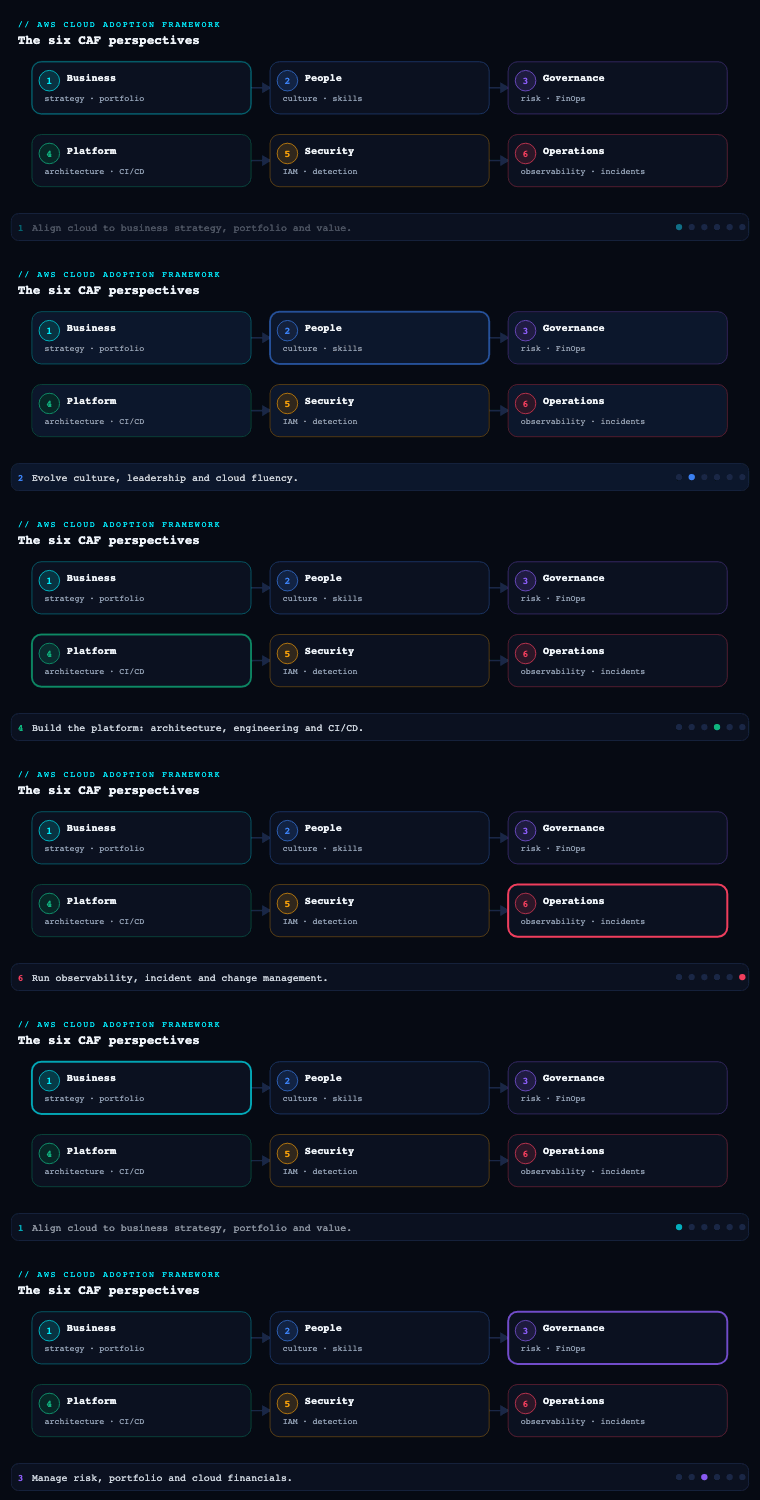
The AWS Cloud Adoption Framework organizes transformation guidance into six perspectives — Business, People, Governance, Platform, Security, and Operations — each a collection of foundational capabilities owned by a recognizable set of stakeholders. The Governance perspective is the one that orchestrates cloud initiatives so the organization maximizes the benefits it set out to capture while minimizing transformation-related risk; its common stakeholders are the chief transformation officer, CIO, CTO, CFO, CDO (chief data officer), and CRO (chief risk officer). It comprises seven capabilities — program and project management, benefits management, risk management, cloud financial management, application portfolio management, data governance, and data curation — and this article goes deep on all of them. Governance sits in tension with everything else by design: the Business perspective decides what to build and why, People and Platform and Operations build and run it, Security keeps it safe — and Governance is the connective tissue that makes sure those concurrent, interdependent initiatives stay aligned to outcomes, on budget, inside acceptable risk, and backed by trustworthy data. Too little governance and business and technology risk creep in unmanaged; too much and red tape stalls the very transformation it was meant to accelerate. The whole perspective is a balancing act between control and velocity.
Program and project management
What it is. Program and project management is the capability of delivering interdependent cloud initiatives in a flexible and coordinated manner. Cloud-powered transformation is never a single project — it is dozens of cross-functional initiatives (landing-zone build, migration waves, modernization tracks, net-new product builds, security uplift, org change) that must be run as a cohesive long-term program rather than a pile of disconnected projects. AWS is explicit that program management matters more than individual project management here, because many of the interdependencies between initiatives only become visible during delivery, not during planning.
Why it matters. In traditionally structured enterprises, the hardest part of cloud transformation is not any single workload — it is the coordination overhead between teams who have never had to sequence their work against each other. A migration wave depends on the landing zone being ready; a modernization track depends on the migration finishing; a data-product launch depends on data governance roles being staffed. Miss one of those dependencies and the whole roadmap slips. The program function is what surfaces those dependencies early, aligns multiple initiatives for optimized or integrated cost, schedule, effort, and benefit, and drives the accountability and transparency that keep senior leadership confident enough to keep funding the program.
How to do it well. AWS prescribes an agile operating model precisely to avoid the trap of making far-reaching predictions you cannot keep: structure work as epics and stories in well-prioritized backlogs, learn from each increment, and adapt the roadmap as you go rather than committing to a two-year Gantt chart you will re-plan anyway. The non-negotiable mechanics are: regularly validate the roadmap with business sponsors, and escalate issues to senior leadership in a timely fashion so blockers get removed instead of festering. The single most useful artifact is a living transformation roadmap that makes inter-initiative dependencies explicit, paired with a lightweight cadence (sprint reviews, a program-level steering forum) where the roadmap is re-validated against the benefits it is supposed to deliver. Run the program around outcomes, not output: a wave that ships on time but doesn’t move a benefit metric is not a success.
Artifacts, decisions, and AWS tooling.
| Artifact / decision | What it captures | AWS input |
|---|---|---|
| Transformation roadmap | Sequenced initiatives with explicit interdependencies, owners, and target dates | AWS CAF Action Plan, AWS Migration Acceleration Program (MAP) phases |
| Prioritized program backlog | Epics and stories across migration, modernization, platform, and innovation | CAF Assessment workshop output |
| Governance/steering cadence | Sponsor validation rhythm and escalation path | AWS Enterprise Strategy / AWS Professional Services engagement |
| Cloud Center of Excellence (CCoE) charter | Who owns coordination, standards, and reuse across initiatives | AWS CCoE guidance |
| RACI across initiatives | Responsibility split between program, platform, workload, and security teams | — (org artifact) |
The decision that comes out of this capability is not a tool choice — it is a funded, sequenced, dependency-aware roadmap with a named program owner (often a Cloud Center of Excellence) and an escalation path the sponsors actually use.
Benefits management
What it is. Benefits management is the capability of ensuring that the business benefits associated with your cloud investments are realized and sustained. AWS frames the success of the entire transformation as being determined not by activity (workloads migrated, accounts created) but by the business benefits that result. This capability identifies those benefits up front, quantifies them, tracks them over time, and adjusts expectations as reality lands.
Why it matters. Cloud programs die in the gap between the business case and the board’s memory of it. A CFO who approved a program on the promise of “30% infrastructure cost reduction and a new revenue stream” will, eighteen months in, ask whether either materialized — and if no one has been measuring, the honest answer is “we don’t know,” which is how funding evaporates. Benefits management closes that gap. Clear up-front identification of desired benefits also lets you prioritize cloud investments (fund the initiatives with the biggest benefit-per-rupee first) and track transformation progress against something the business actually values, rather than against an engineering output metric nobody on the board cares about.
How to do it well. AWS prescribes a concrete loop: identify metrics, quantify desired benefits, and communicate them to relevant stakeholders; align the timing and life-span of benefits with strategic goals; incorporate benefits delivery into a benefits realization roadmap; then regularly measure realized benefits, evaluate progress against the roadmap, and adjust the expected benefits as required. Anchor the quantification in AWS’s Cloud Value Framework, which spans four value dimensions so you don’t reduce everything to raw infrastructure cost:
| Cloud Value Framework dimension | Example benefit metric | How it’s evidenced |
|---|---|---|
| Cost savings | Unit cost per transaction; run-rate reduction; data-center exit savings | AWS Pricing Calculator, AWS Cost Explorer, Migration Evaluator business case |
| Staff productivity | Hours reclaimed from undifferentiated heavy lifting; deploy frequency | DORA-style delivery metrics; reduced ops toil |
| Operational resilience | Reduction in unplanned downtime; MTTR improvement | Incident metrics; availability SLOs |
| Business agility | Time-to-market for new features; new revenue from cloud-enabled products | Product launch cadence; revenue attribution |
The artifact is a benefits realization roadmap — a time-phased plan that maps each benefit to a metric, a baseline, a target, an owner, and a date — reviewed on the same cadence as the program roadmap so the two stay coupled. Critically, establish the baseline before you migrate: you cannot claim a 40% cost reduction if you never measured the “before.”
Risk management
What it is. Risk management in the Governance perspective is the capability of leveraging the cloud to lower your risk profile — and of continuously identifying and managing the residual risks the transformation itself introduces. AWS asks you to identify and quantify two classes of risk: operational risks (infrastructure availability, reliability, performance, and security) and business risks (reputation, business continuity, and your ability to respond quickly to changing market conditions). This capability is the Governance-perspective home of risk and compliance; the deep technical security controls live in the separate Security perspective, but the decision of which risks matter and how much governance they justify is made here.
Why it matters. Done well, the cloud is a risk-reduction lever, and AWS wants you to treat it as one rather than as a new risk to be feared. Three concrete reductions AWS calls out: you reduce the need for large up-front infrastructure expenditure (and the financial risk of stranded capital); you reduce the risk of buying assets that are no longer needed by provisioning on demand; and you mitigate procurement-schedule risk by instantly provisioning and deprovisioning resources instead of waiting on hardware lead times. The counterweight is that an unmanaged cloud estate introduces new risks — uncontrolled spend, configuration drift, data sprawl — which is exactly why risk management is iterative and embedded in your agile cadence rather than a one-time sign-off.
How to do it well. Maintain a risk register that is re-assessed as part of the regular program cadence (AWS explicitly says to “continue to iteratively identify and manage risk as part of your agile cadence”). Quantify each risk — likelihood and impact — so you can prioritize, and tie each material risk to a concrete control. The platform-level tooling that operationalizes risk management on AWS:
| Risk area | Mitigation pattern | AWS tooling |
|---|---|---|
| Account/config drift & unsafe actions | Preventive and detective guardrails across all accounts | AWS Organizations, AWS Control Tower (controls/guardrails), service control policies (SCPs) |
| Compliance posture & misconfiguration | Continuous configuration assessment against standards | AWS Config (rules + conformance packs), AWS Security Hub, AWS Audit Manager |
| Operational/architectural risk | Structured review against best-practice pillars | AWS Well-Architected Framework + Well-Architected Tool |
| Resilience & business continuity | Backup, DR, and fault-tolerance validation | AWS Backup, AWS Elastic Disaster Recovery, AWS Resilience Hub, AWS Fault Injection Service |
| Audit evidence | Automated, continuous evidence collection | AWS Audit Manager, AWS Artifact (compliance reports) |
The key decision is risk appetite per domain — how much guardrail (preventive Deny via SCPs vs detective via Config) each risk justifies — captured as policy and enforced through Organizations and Control Tower so it scales across every account without per-account effort.
Cloud financial management
What it is. Cloud financial management (CFM) — the discipline the industry calls FinOps — is the capability of planning, measuring, and optimizing your cloud spend. AWS frames it as combining the ease and agility of on-demand provisioning with genuine financial accountability for each team’s spend, so teams continuously optimize their workloads and use the best pricing models. It is the most operationally detailed capability in the Governance perspective, and the one with the deepest dedicated AWS tooling.
Why it matters. Self-service provisioning without financial accountability is how a cloud bill triples in a quarter and the CFO loses trust in the whole program. CFM is what gives finance, business, and engineering a shared understanding of cloud cost — clear financial roles and responsibilities, a forecasting and budgeting process that actually reflects variable consumption, and the ability to catch cost variances and anomalies fast rather than at month-end close. It is also where a large share of the program’s promised cost-out benefit is actually captured or lost.
How to do it well. AWS prescribes a layered approach, and the foundation is cost allocation: align your account structure and tagging strategy with how your organization and products map to the cloud, so every resource is attributable to a team, project, or initiative. The major levers:
| FinOps lever | What you do | AWS tooling |
|---|---|---|
| Cost allocation & visibility | Multi-account structure + cost allocation tags + cost categories for custom showback/chargeback rules | AWS Organizations, cost allocation tags, AWS Cost Categories, AWS Cost and Usage Report (CUR) |
| Billing & volume discounts | Consolidated billing to simplify and aggregate for volume tiers | AWS Organizations consolidated billing |
| Forecasting & budgeting | Dynamic, usage-based forecasting; budgets with alert thresholds | AWS Budgets, AWS Cost Explorer (usage-based forecasting) |
| Anomaly detection | ML-based detection of unexpected spend, with alerts | AWS Cost Anomaly Detection (via SNS/Chime/Slack) |
| Pricing-model optimization | Right pricing model per workload: Savings Plans, Reserved Instances, Spot | Savings Plans, Reserved Instances, EC2 Spot, AWS Pricing Calculator |
| Right-sizing & waste elimination | Find and remove idle/underutilized resources; right-size | AWS Compute Optimizer, AWS Trusted Advisor, Cost Explorer right-sizing recommendations |
| Demand/time-based provisioning | Pay only for what you need via scaling and scheduling | Auto Scaling, Instance Scheduler |
| Guardrails | Govern usage at scale with minimal impact to agility | AWS Control Tower guardrails, SCPs, AWS Budgets actions |
| Software license management | Track and control owned vs included licenses; avoid overage and non-compliance | AWS License Manager (rules, dashboards, real-time non-compliance alerts) |
Two AWS emphases are worth pulling out. First, define cost categories to organize cost-and-usage data with custom rules so showback/chargeback maps to your org, not to raw account IDs. Second, avoid accruing technical debt by ensuring workloads are Well-Architected and operated cost-effectively — demand-based (Auto Scaling) and time-based (Instance Scheduler) provisioning so you pay only for what you need, and active elimination of idle spend via Trusted Advisor and Compute Optimizer. License management is its own sub-discipline: centralize on-premises and cloud licenses in AWS License Manager, distinguish licenses included with cloud resources from licenses you own (BYOL), set rule-based hard/soft limits on consumption, and use dashboards plus real-time alerts to accelerate vendor audits and catch non-compliance.
The decisions that come out of CFM are an account-and-tagging map, a cost allocation / chargeback model, a pricing-commitment strategy (how much to cover with Savings Plans vs leave on-demand), and budget + anomaly thresholds wired to alert the right owners.
Application portfolio management
What it is. Application portfolio management (APM) is the capability of managing and optimizing your application portfolio in support of your business strategy. Applications are what link business capabilities to the underlying cloud resources, and AWS’s core premise is that an accurate, complete application inventory is the precondition for everything downstream: identifying opportunities for rationalization, migration, and modernization, minimizing application sprawl, enabling lifecycle planning, and keeping the portfolio aligned to the transformation strategy over time.
Why it matters. You cannot rationalize, migrate, or modernize what you cannot see. Most enterprises massively underestimate how many applications they run, how those applications depend on each other, and which ones are dead weight. Without a trustworthy inventory, the Business perspective’s 7 Rs dispositions are guesses, migration waves hit undiscovered dependencies, and “modernize” gets applied to applications nobody actually uses. A well-run portfolio is what turns a wall of servers into a prioritized, owner-assigned list of business applications you can make decisions about.
How to do it well. AWS gives a clear method: start with your most critical applications, define each in terms of the overarching business capability it supports, and map it to the underpinning software products and associated resources. Build a complete picture by sourcing data from related enterprise systems — enterprise architecture, IT service management (ITSM), and project & portfolio management — rather than relying on a single spreadsheet. Identify key technology and business stakeholders (including application owners) and have them periodically enrich and validate application metadata, and assess the health of the portfolio on a regular basis to maximize the value derived from application investments.
| APM activity | What it produces | AWS tooling |
|---|---|---|
| Discovery & dependency mapping | Inventory of servers/apps with utilization and inter-dependencies | AWS Application Discovery Service, AWS Migration Hub |
| Business-case rationalization | Cost/effort modeling to support 7 Rs dispositions | Migration Evaluator, Migration Portfolio Assessment |
| Application registry & metadata | A canonical record of each application + its associated AWS resources | AWS Service Catalog AppRegistry, AWS resource groups + tagging |
| Migration tracking | Wave status across the portfolio | AWS Migration Hub |
| Ongoing health assessment | Periodic review of value, cost, and architectural fitness | Well-Architected Tool, Trusted Advisor, Cost Explorer per-application views |
The pivotal artifact is the application portfolio register: every application defined by the business capability it serves, its owner, its 7 Rs disposition, and a link (via AppRegistry and tags) to the concrete AWS resources that implement it — so cost, risk, and modernization decisions can be made at the application level, not the raw-resource level. This capability is the natural extension of the Business perspective’s portfolio management: Business decides the dispositions, APM keeps the inventory and metadata that make those dispositions and their lifecycle real.
Data governance
What it is. Data governance is the capability of exercising authority and control over your data to meet stakeholder expectations. AWS frames it around treating data as a strategic asset and building the competences to use it effectively — so that the business processes and analytics that depend on accurate, complete, timely, and relevant data can be trusted. Done well it reduces data duplication and sprawl, improves data quality and decision-making, drives organizational efficiencies, and accelerates business outcomes on the way to becoming a data-driven organization.
Why it matters. Every downstream analytics, ML, and reporting investment inherits the quality of the data beneath it — garbage in, garbage out, at enterprise scale. Without clear ownership, standards, and quality controls, the same “customer” exists five different ways across five systems, dashboards disagree, ML models train on dirty data, and regulators ask questions nobody can answer. Data governance is also the backbone the Business perspective’s data monetization capability depends on; you cannot responsibly share or sell data you do not govern.
How to do it well. AWS prescribes a structured build-out across roles, standards, policies, access, and quality:
- Roles and operating model. Define and assign data owners, stewards, and custodians, respecting segregation of duties. Data owners are recognized at an organizational level spanning both technology and business; data stewardship is a responsibility of all data-facing business personnel. Align individual goals to data governance objectives and define KPIs that are measured and reported. As you mature, establish data governance councils/committees. AWS explicitly suggests considering a federated (data mesh) approach for larger organizations.
- Standards. Specify data dictionaries, taxonomies, and business glossaries; identify the datasets that need to be mastered (master data) and model the relationships between master-data entities.
- Policies. Define, document, and communicate data classification, purging, archiving, retention, encryption, and protection policies, plus data lifecycle policies, then monitor and enforce compliance and acceptable use.
- Access. Define a data access request process approved by security teams, data owners, and stewards, adopted org-wide. AWS’s central capability here is AWS Lake Formation, which lets you centrally define and manage security, governance, and auditing policies and apply uniform, fine-grained access control across your data lake and purpose-built stores from a single place.
- Quality. Prioritize quality efforts to strategic/operational needs; establish quality standards (key quality attributes, business rules, metrics, targets); monitor quality at every step of the data value chain; find and fix root causes upstream; capture lineage, profile and cleanse; and build data quality dashboards for critical data products.
| Data governance dimension | Standard / control | AWS tooling |
|---|---|---|
| Catalog & metadata | Technical catalog, schemas, crawled metadata | AWS Glue Data Catalog, AWS Glue crawlers |
| Fine-grained access & sharing | Centralized, auditable lake permissions (table/column/row, tag-based) | AWS Lake Formation (incl. LF-Tags) |
| Federated governance (data mesh) | Domain-owned data products with central guardrails | Amazon DataZone, Lake Formation + AWS Glue |
| Data quality | Rules, scoring, profiling, monitoring | AWS Glue Data Quality (DQDL), Glue data profiling |
| Lineage & business glossary | Provenance and shared business definitions | Amazon DataZone, AWS Glue |
| Classification & PII handling | Discover and protect sensitive data | Amazon Macie |
| Lifecycle / retention | Tiering, archival, expiry | Amazon S3 lifecycle policies, S3 Glacier |
The artifacts are a documented data governance strategy aligned to business goals, a RACI of data owners/stewards/custodians, the standards set (dictionaries, taxonomies, glossary, master-data model), the policy set (classification/retention/protection/lifecycle), the access-request process, and data quality standards with dashboards for critical data products.
Data curation
What it is. Data curation is the capability of collecting, organizing, accessing, and enriching metadata and using it to organize an inventory of data products in a Data Catalog. Where data governance sets the authority and standards, curation is the hands-on practice of making data findable and understandable — building and moderating the catalog so consumers can locate relevant data products and understand their context, such as provenance and quality. AWS positions a well-curated catalog as the enabler of both data monetization and self-service analytics.
Why it matters. A governed-but-undiscoverable data estate still fails its consumers: if analysts can’t find the right dataset, understand where it came from, or trust its quality, they rebuild it themselves — recreating exactly the duplication and sprawl governance was meant to eliminate. Curation is what turns raw, governed data into a product catalog people actually shop in, which is the whole point of self-service analytics and the precondition for selling or sharing data externally.
How to do it well. AWS gives a specific playbook:
- Assign lead curators responsible for moderating the Data Catalog.
- In line with your data monetization strategy, catalog key data products, including both structured and unstructured data.
- Capture relevant technical and business metadata, including lineage.
- Leverage standard ontologies, business glossaries, and automation (including machine learning) to tag, index, and auto-classify data — then augment with manual tagging where needed, and appropriately handle any PII.
- Consider crowdsourcing enrichment through social curation — empower data consumers to rate, review, and annotate data products.
| Curation activity | What it does | AWS tooling |
|---|---|---|
| Technical metadata harvesting | Crawl sources to populate schema/table metadata | AWS Glue crawlers → AWS Glue Data Catalog |
| Business catalog & data products | Publish/subscribe data products with business context, lineage, glossary | Amazon DataZone (business data catalog, projects, subscriptions) |
| Auto-classification & PII tagging | ML-based discovery and classification of sensitive data | Amazon Macie; DataZone automated metadata generation |
| Social curation | Consumer ratings, reviews, annotations, access requests | Amazon DataZone (data portal) |
| Discoverability & querying | Search and serverless query over catalogued data | DataZone search, Amazon Athena |
The artifact is a moderated Data Catalog of data products — each entry carrying technical metadata, business definitions from the glossary, lineage, quality indicators, and PII handling — with named lead curators and a social-curation loop. In practice on AWS, the AWS Glue Data Catalog is the technical metadata layer and Amazon DataZone is the business-facing catalog and governance portal that fronts it for consumers.
Real-world enterprise scenario
Vantage Retail Group, a mid-to-large omnichannel retailer (~9,500 staff, headquartered in Bengaluru with e-commerce and ~340 stores across India and the GCC), has completed the Business and People perspectives. The board funded transformation on three promises: exit two leased data centers by FY28, cut infrastructure run-rate by 35%, and launch a usage-billed merchandising insights data product to suppliers. They are PCI DSS-bound (the checkout estate) and ISO 27001-certified. The CIO sponsors a Cloud Center of Excellence (CCoE) to own the Governance perspective.
Program and project management. The CCoE publishes a single transformation roadmap with explicit dependencies — landing zone → migration wave 1 (back office) → wave 2 (checkout/PCI) → modernization of the merchandising platform → the supplier data product — and runs it as an agile program with epics/stories in a prioritized backlog. A bi-weekly steering forum re-validates the roadmap with business sponsors; an escalation path to the CIO is used (and visibly works) the first time wave 2 is blocked by an undiscovered mainframe dependency.
Benefits management. Each board promise becomes a tracked benefit on a benefits realization roadmap: data-center exit (baseline ₹/month captured before migration), 35% run-rate reduction (unit cost per order), and supplier-product revenue. The CCoE quantifies them against the Cloud Value Framework (cost savings, staff productivity, operational resilience, business agility) and reviews realized vs. target every program cadence.
Risk management. A re-assessed risk register drives controls: AWS Control Tower lands a multi-account org with preventive SCPs; AWS Config conformance packs and Security Hub give continuous posture; AWS Audit Manager auto-collects PCI/ISO evidence; AWS Resilience Hub and AWS Backup validate continuity for checkout. Risk appetite is set per domain — checkout accounts get hard Deny guardrails, the sandbox OU gets detective-only.
Cloud financial management (FinOps). A FinOps analyst inside the CCoE aligns the AWS Organizations account structure and a mandatory tag set (costCenter, app, env, owner) so spend is attributable; AWS Cost Categories drive supplier-style showback to each merchandising team. AWS Budgets alert owners; AWS Cost Anomaly Detection posts to Slack; Compute Optimizer and Trusted Advisor drive right-sizing; a Compute Savings Plans commitment covers the steady-state migrated estate, with Spot for batch. AWS License Manager governs the SQL Server and middleware licenses carried over as BYOL.
Application portfolio management. AWS Application Discovery Service + Migration Hub build the inventory and dependency map; Migration Evaluator backs the 7 Rs business case. The CCoE maintains an application portfolio register — each of ~210 applications defined by business capability, owner, disposition, and linked to its AWS resources via Service Catalog AppRegistry and tags. Wave status is tracked in Migration Hub.
Data governance & curation. A newly appointed CDO assigns data owners/stewards/custodians and stands up a federated data mesh: each domain (merchandising, supply chain, store ops) owns its data products under central guardrails. AWS Lake Formation centralizes fine-grained, tag-based (LF-Tags) access across the lake and Redshift; AWS Glue Data Quality enforces rules on the merchandising dataset feeding the supplier product; Amazon Macie flags PII for handling. Amazon DataZone is the business catalog where lead curators publish governed data products with lineage, glossary terms, and consumer ratings — and where suppliers will subscribe to the insights product.
Measurable outcome (two quarters). Tagged/attributable spend 18% → 96%; infrastructure run-rate down 22% and on track to the 35% target (Savings Plans + right-sizing); PCI evidence collection moved from a 6-week manual scramble to continuous via Audit Manager; the application register reached 100% of in-scope apps with owners and dispositions; the merchandising data product passed its Glue Data Quality gates (>99% conformance) and shipped to a 12-supplier pilot through DataZone. No migration wave was blocked beyond the single escalated mainframe dependency, which the program forum resolved in nine days.
Deliverables & checklist
Common pitfalls
- Managing projects, not the program. Running each initiative in isolation means cross-initiative dependencies surface only at the worst moment. Avoid it by making the dependency-aware transformation roadmap the single source of truth, owned by a CCoE, with a sponsor cadence and a live escalation path.
- No baseline, no benefits. Claiming cost or resilience benefits you never measured “before” destroys CFO trust. Avoid it by capturing baselines pre-migration and reviewing the benefits realization roadmap on the same cadence as delivery.
- Self-service spend without accountability. On-demand provisioning with no tagging or chargeback is how the bill triples unnoticed. Avoid it by aligning the account structure and a mandatory tag set first, then wiring Cost Categories, Budgets, and Cost Anomaly Detection before scaling.
- Optimizing too late / leaving waste on. Treating FinOps as a month-end report rather than a continuous practice leaves idle resources and on-demand workloads bleeding money. Avoid it with continuous right-sizing (Compute Optimizer/Trusted Advisor), Auto Scaling + Instance Scheduler, and a deliberate Savings Plans commitment.
- Migrating without an application inventory. Without a validated portfolio register, 7 Rs dispositions are guesses and waves hit undiscovered dependencies. Avoid it by running Application Discovery Service + Migration Hub and maintaining an owner-validated register linked via AppRegistry.
- Governing data but never curating it (or vice versa). Standards with no discoverable catalog — or a catalog with no ownership and quality — both recreate data sprawl. Avoid it by pairing Lake Formation governance and Glue Data Quality with a moderated DataZone catalog that has named lead curators and lineage.
What’s next
Part 5 of this series moves to the Platform perspective — building an enterprise-grade, scalable, and well-architected cloud platform (landing zone, platform architecture, and modern engineering practices) on which the governed, benefit-tracked initiatives of this phase actually run.