Where this fits
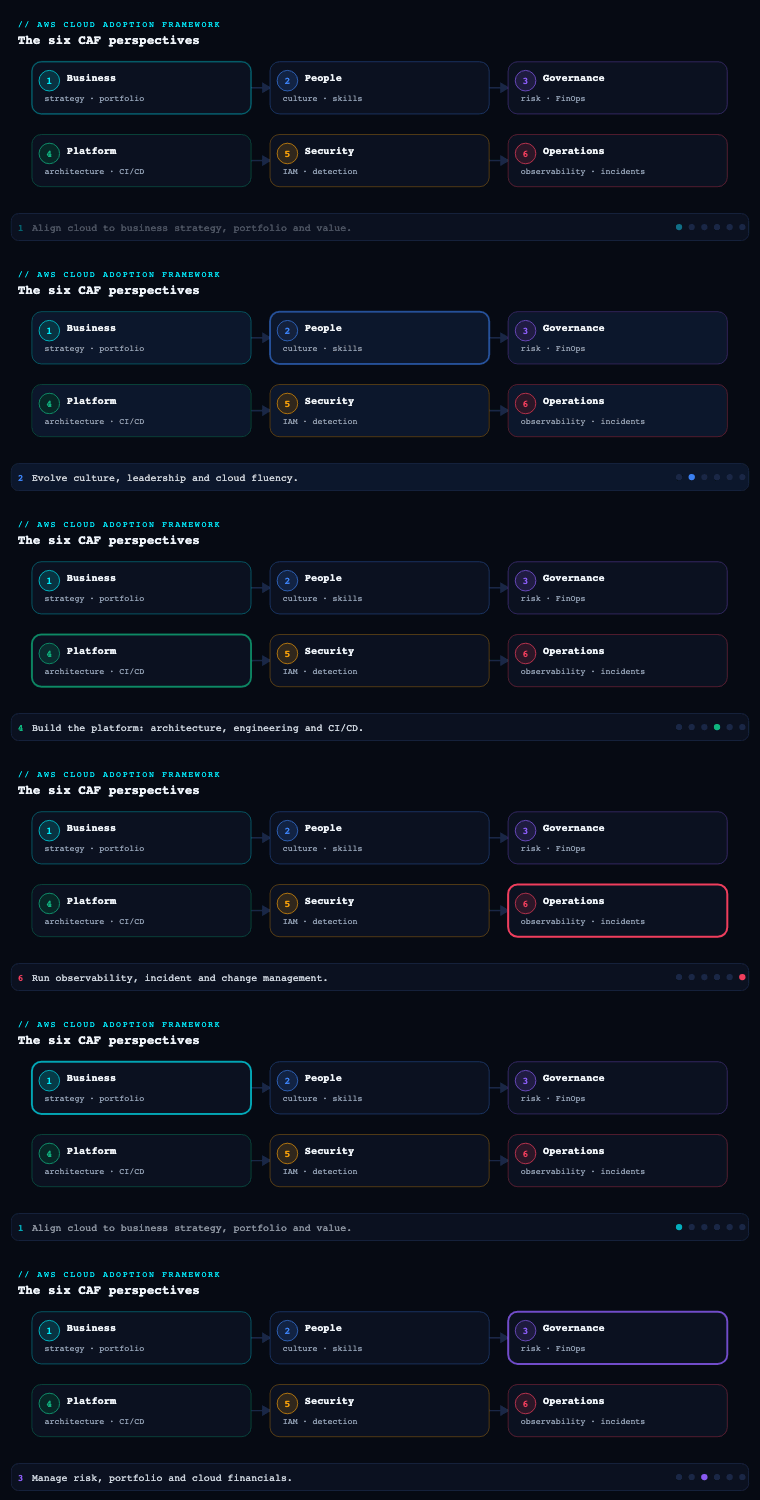
The AWS Cloud Adoption Framework (CAF) organizes the capabilities you need to adopt the cloud into six perspectives — Business, People, Governance, Platform, Security, and Operations — and the People perspective is the bridge between technology and the organization that has to run it. Where the Business perspective sets the why and the Platform, Security, and Operations perspectives build and run the what, People answers the harder question: can your organization actually absorb this change? It is owned primarily by leaders in HR, organizational change management, training, and the cloud program itself, and it accelerates the cloud journey by closing the gap between current and future organizational capabilities. CAF describes adoption as moving through four iterative phases — Envision, Align, Launch, and Scale — and the People perspective is the one that most often determines whether you stall at Align (everyone agrees on the plan but nobody is equipped to execute it) or sail through to Scale. This article goes deep on the six People-perspective capabilities: Culture Evolution, Transformational Leadership, Cloud Fluency, Workforce Transformation, Change Acceleration, and Organization Design and Alignment.
Culture Evolution
What it is. Culture Evolution is the capability of deliberately evolving your organization’s shared beliefs, norms, and behaviors so they support agile, product-oriented, cloud-native ways of working. AWS CAF frames it as progressively developing a culture of continuous growth, learning, and improvement — moving from a project-and-handoff culture (where Dev throws code over a wall to Ops, change is feared, and failure is punished) toward a product culture (where small two-pizza teams own a service end to end, deploy many times a day, and treat incidents as learning opportunities). It is distinct from training: you can teach someone how to write a CloudFormation template, but culture is whether they feel safe deploying it on a Friday.
Why it matters. Almost every stalled cloud program is a culture failure wearing a technology costume. Teams lift-and-shift to EC2 but keep the same quarterly change windows, so they get cloud bills without cloud agility. Or a central team builds a beautiful landing zone that nobody uses because builders don’t trust that they’re allowed to self-serve. Culture determines your real cycle time, your blast-radius tolerance, and whether psychological safety lets engineers surface problems early — which is exactly what makes blameless post-incident analysis (the Operations perspective’s Incident and Problem Management) function at all.
How to do it well. Treat culture as something you measure and shape, not exhort. Define the target behaviors explicitly (self-service over tickets, automate over toil, you-build-it-you-run-it, blameless retrospectives, mechanisms over good intentions). Identify the friction that makes the old behavior rational — if the only way to get an environment is a three-week ServiceNow ticket, “self-service” is a poster, not a culture. Then remove the friction with platform capabilities (an AWS Service Catalog portfolio, automated account vending) so the desired behavior is the easy behavior. Run a culture baseline survey, re-run it each quarter, and tie executive incentives to the trend. AWS’s own working-backwards and two-pizza team operating norms are a useful reference model, codified in the Amazon Leadership Principles, which many enterprises adapt rather than adopt wholesale.
| Culture dimension | “Project / handoff” anti-pattern | Cloud-native target behavior | Enabling mechanism |
|---|---|---|---|
| Ownership | Ops owns production; Dev disengages after release | You-build-it-you-run-it; team holds the pager | On-call rotations, service-level SLOs, AWS Service Catalog self-service |
| Failure | Blame, RCA used to assign fault | Blameless correction-of-error (COE); failure is data | COE template, error-budget policy, game days |
| Change | Big-bang quarterly change windows | Small frequent deploys, automated rollback | CI/CD with AWS CodePipeline, canary deploys |
| Experimentation | “Get it right the first time” | Cheap reversible experiments | Sandbox accounts, budget guardrails |
| Decision speed | Consensus and approval boards | Single-threaded owners, written narratives | Working-backwards docs, decision logs |
Artifacts, decisions & AWS tooling. Concrete outputs are a culture baseline assessment and recurring pulse survey, a target operating-norms charter (the explicit behaviors you reward), a blameless correction-of-error (COE) template, and an error-budget / blast-radius policy. The key decision is which behaviors you will make easy and which you will make hard via guardrails. AWS levers include AWS Service Catalog and AWS Control Tower Account Factory (to make self-service the default), AWS Budgets and SCPs (so experimentation is safe), and game days run against fault injection with AWS Fault Injection Service (FIS) to normalize failure as something you rehearse rather than fear.
Transformational Leadership
What it is. Transformational Leadership is the capability of leaders to set a compelling cloud vision, model the new behaviors, and steer the change with conviction and consistency. In CAF terms it is the progressive realization of your transformation aspirations through leadership that aligns the organization, removes obstacles, and sustains momentum across the multi-year journey. It is not a one-time kickoff speech — it is the sustained, visible sponsorship that keeps the program funded and prioritized when the novelty wears off and the hard re-platforming work begins.
Why it matters. Cloud transformation is a leadership problem before it is an engineering problem. Industry change-management research and AWS’s own field experience converge on the same point: visible, active executive sponsorship is the single largest predictor of transformation success. Leaders control the three things that make or break adoption — funding (sustained investment vs. a pilot that gets cut), prioritization (is the migration the org’s top-three goal or a side project?), and air cover (who absorbs the political cost when a re-platform is harder than the slide said). Without an empowered, single-threaded executive owner, the program dies of a thousand competing priorities.
How to do it well. Establish a single-threaded leader — one accountable executive whose primary job (not a 10% side responsibility) is the transformation. Stand up a cross-functional Cloud Center of Excellence (CCoE) or Cloud Business Office with an executive steering committee that meets on a fixed cadence and owns the adoption roadmap and KPIs. Make leadership behavior visible: executives attend game days, read the COEs, celebrate the team that safely caused (and recovered from) a failure. Invest sponsors in the AWS Executive Insights and AWS Executive Briefing Center (EBC) experiences, and use an AWS Migration Acceleration Program (MAP) engagement — whose Assess/Mobilize/Migrate-and-Modernize phases explicitly require named executive sponsorship and a mobilized CCoE — as a forcing function for leadership commitment.
| Leadership decision | Weak signal (program at risk) | Strong signal (program healthy) |
|---|---|---|
| Sponsorship model | Sponsor is a part-time figurehead | Empowered single-threaded leader, full mandate |
| Governance cadence | Ad hoc steering, slips quarterly | Fixed CCoE steering rhythm with published KPIs |
| Funding | One-off pilot budget | Multi-year committed investment + MAP funding |
| Conflict resolution | Escalations stall for weeks | Clear decision rights, fast unblock path |
| Visibility | Vision in a deck, never referenced | Vision tied to OKRs, reviewed in every QBR |
Artifacts, decisions & AWS tooling. Outputs include a named single-threaded owner and RACI, a CCoE charter with membership and decision rights, an executive sponsorship plan, a transformation vision statement tied to measurable OKRs, and a steering-committee operating cadence. Decisions: who is accountable, what the CCoE can decide vs. escalate, and how funding flows. AWS programs that operationalize this are AWS MAP (sponsor and CCoE are entry requirements), the AWS Executive Briefing Center, Executive Insights thought-leadership content, and AWS Professional Services / AWS Partner transformation advisory to coach the leadership team.
Cloud Fluency
What it is. Cloud Fluency is the capability of building, at scale and at the right depth for each role, the skills and knowledge needed to adopt cloud-based services effectively. AWS CAF describes it as progressively building the cloud skills your organization needs across technical, business, and security roles — not just turning sysadmins into AWS engineers, but giving finance the FinOps literacy to read a Cost Explorer report and giving product managers the vocabulary to scope cloud-native solutions. Fluency is role-differentiated: a developer, a security analyst, a finance partner, and a board member each need a different altitude of the same shared language.
Why it matters. The cloud skills gap is the most cited barrier to adoption in every industry survey, and it bites in non-obvious places. The shortage is rarely “we can’t find someone who knows EC2” — it’s the long tail: nobody on the team can reason about IAM trust policies, or read a VPC flow log, or right-size a Savings Plan. A thin layer of certified architects sitting atop a workforce that can’t operate what they build creates a permanent bottleneck and a key-person risk. Fluency converts a handful of cloud experts into an organization that is collectively fluent enough to self-serve safely.
How to do it well. Start with a skills gap assessment mapped to your target operating model and role taxonomy, then build role-based learning paths rather than a generic “everyone gets AWS Cloud Practitioner” mandate. Blend modalities — self-paced AWS Skill Builder, instructor-led AWS Classroom Training, hands-on AWS Jam challenges and AWS GameDay, and immersive multi-day programs. Use AWS Certifications as milestones and signals, not the goal itself, and pair them with on-the-job application so knowledge sticks. Fund it through structured programs like AWS Skills Guild (an enablement-at-scale engagement that builds an internal community of cloud champions and a self-sustaining learning culture) and tap free workforce-development pipelines — AWS re/Start for career-changers, AWS Academy and AWS Educate for the early-career talent funnel.
| Role | Target fluency depth | Primary AWS learning vehicle | Milestone credential |
|---|---|---|---|
| Executive / sponsor | Strategic literacy, value & risk | Executive Insights, EBC, Cloud Practitioner Essentials | AWS Certified Cloud Practitioner (optional) |
| Product / business analyst | Solution vocabulary, FinOps basics | Skill Builder learning plans | Cloud Practitioner |
| Software engineer | Deep build/run on AWS | Skill Builder + Classroom + Jam | Developer / DevOps Engineer – Professional |
| Cloud / platform engineer | Architecture, landing zone, IaC | Classroom + Architecting on AWS + GameDay | Solutions Architect – Professional |
| Security engineer | IAM, detection, response | Security learning plan + Security Jam | Security – Specialty |
| Finance / FinOps partner | Cost visibility & optimization | Cost Explorer enablement, FinOps learning plan | Cloud Practitioner + FinOps cert |
| Data / ML practitioner | Data platform, MLOps | Data & ML learning plans, DeepRacer | Machine Learning – Specialty |
Artifacts, decisions & AWS tooling. Deliverables: a skills gap assessment, a role-to-learning-path map, a certification target plan with funding, and a skills dashboard tracking learners, completions, and certifications over time. Key decisions are build vs. buy vs. partner for each skill set and which roles need depth vs. literacy. AWS tooling: AWS Skill Builder (including Team subscriptions and the Skill Builder dashboard for tracking), AWS Training and Certification, AWS Jam / GameDay, AWS Skills Guild, and the talent pipelines re/Start, Academy, and Educate.
Workforce Transformation
What it is. Workforce Transformation is the capability of building a high-performing, cloud-ready workforce — getting the right people, in the right roles, with the right skills, at the right time. Where Cloud Fluency is about skills, Workforce Transformation is about the broader talent system: defining new role profiles (Cloud Platform Engineer, SRE, FinOps Analyst, Cloud Security Engineer), deciding how to source those roles (upskill, redeploy, hire, or partner), reshaping career paths and compensation bands, and managing the human reality that some traditional roles (datacenter operations, storage admins, manual change managers) shrink while new ones grow.
Why it matters. Cloud doesn’t eliminate work — it moves it, and if the talent system doesn’t move with it you get attrition of exactly the people you need and resentment from those who feel displaced. The mainframe operator who fears redundancy will not champion the migration. Without redesigned career ladders, your best engineers see no growth path in the new model and leave for a competitor who built one. Workforce Transformation is how you retain institutional knowledge while re-pointing it at cloud-native work, and how you make the internal labor market your first hiring channel.
How to do it well. Build a target workforce plan: enumerate future-state roles, map current employees to them via a skills inventory, and classify each person as upskill in place, redeploy to a new role, or backfill/hire. Prefer redeployment over redundancy — it preserves domain knowledge and signals safety to the rest of the org. Redesign career frameworks and compensation so cloud roles have credible ladders, and create cloud apprenticeships / academies that move people from legacy roles into cloud roles with a structured runway. For net-new hiring and partner gaps, stand up an AWS Skills Guild internal academy and use AWS re/Start to convert non-traditional candidates into job-ready cloud talent, supplemented by certified AWS Partners for surge capacity while internal capability ramps.
| Sourcing strategy | When to use | Trade-off | Supporting program |
|---|---|---|---|
| Upskill in place | Strong fundamentals, transferable domain knowledge | Slowest to productivity; needs runway | Skill Builder, internal academy |
| Redeploy | Role shrinking but person is high-value | Requires new role design & change support | Workforce plan, career framework |
| Hire externally | Scarce specialized skills (e.g., ML platform) | Cost, time-to-hire, culture onboarding | AWS re/Start pipeline, certified hires |
| Partner / managed | Surge or transient capability needs | Knowledge-transfer risk if permanent | AWS Partners, Professional Services |
Artifacts, decisions & AWS tooling. Outputs: a target workforce plan and future-state role catalog, a skills inventory and person-to-role mapping, redeployment and reskilling pathways, redesigned career ladders and comp bands, and a retention/attrition risk register. Decisions: the upskill/redeploy/hire/partner mix per role, and which legacy roles wind down on what timeline. AWS support: AWS Skills Guild (internal academy model), AWS re/Start (job-ready talent pipeline), AWS Academy/Educate (early-career funnel), and AWS Professional Services / certified Partners for transitional capacity and knowledge transfer.
Change Acceleration
What it is. Change Acceleration is the capability of driving and sustaining the organizational change required for cloud adoption — proactively planning and managing the human side of change so the transformation lands and sticks. It is structured change management applied to the cloud program: stakeholder analysis, a change-impact assessment, a communications strategy, a network of change agents, resistance management, reinforcement, and feedback loops. CAF positions it as the discipline that turns a technically successful migration into an adopted one.
Why it matters. You can migrate a workload flawlessly and still fail if the people who use or operate it revert to old habits. Change Acceleration is what prevents the classic “we moved to AWS but everyone still raises tickets and waits” outcome. It manages the adoption curve deliberately — surfacing resistance early (where it’s cheap to address) rather than at cutover (where it derails go-lives) — and it reinforces new behaviors so they survive the inevitable moment when the program team’s attention moves on.
How to do it well. Apply a recognized framework (ADKAR, Kotter, Prosci, or Lewin) consistently rather than improvising. Run a stakeholder analysis and change-impact assessment per affected group — Dev, Ops, security, finance, and the business units consuming the new platform each experience a different change. Build a communications and engagement plan with the right cadence and channels, and recruit a distributed change-agent network (often the same cloud champions identified through the Skills Guild) so the message has local credibility. Plan resistance management and, critically, reinforcement mechanisms — recognition, success stories, and metrics — so behaviors persist. Many organizations run Change Acceleration as a workstream within the CCoE and engage AWS Professional Services’ Organizational Change Management (OCM) specialists or a specialist Partner to bring rigor.
| Change framework | Best suited to | Core construct |
|---|---|---|
| ADKAR (Prosci) | Individual-level adoption tracking | Awareness, Desire, Knowledge, Ability, Reinforcement |
| Kotter 8-step | Large enterprise-wide urgency-building | Guiding coalition, short-term wins, anchoring change |
| Lewin | Discrete, bounded changes | Unfreeze, Change, Refreeze |
| Bridges Transition | Heavy emotional / role-loss impact | Ending, Neutral Zone, New Beginning |
Artifacts, decisions & AWS tooling. Deliverables: a stakeholder map, a change-impact assessment, a communications and engagement plan, a change-agent network roster, a resistance and reinforcement plan, and adoption metrics (active builders, self-service adoption rate, ticket-deflection, sentiment). The decision is which change framework you adopt and how you measure adoption (not just deployment). AWS support: AWS Professional Services OCM practice and specialist AWS Partners, with adoption signals instrumented from AWS Service Catalog usage, account-vending throughput, and CCoE engagement data.
Organization Design and Alignment
What it is. This pair of CAF capabilities covers how you structure teams and how you align them around shared goals. Organization Design is the deliberate shaping of your operating model — the move from siloed function-based teams (a server team, a network team, a DBA team) toward cross-functional, product-aligned two-pizza teams that own a service end to end, supported by enabling structures like a Cloud Center of Excellence and platform teams. Organizational Alignment ensures those teams, and the wider organization, are pulling in the same direction — shared objectives, clear decision rights, and incentives that reward cloud outcomes rather than local optimization.
Why it matters. Structure drives behavior (Conway’s Law: your systems will mirror your org chart). If you keep functional silos, every change requires coordination across team boundaries and your “agile” cloud delivery inherits waterfall hand-offs. Misalignment is just as corrosive: if the platform team’s incentive is stability and the product team’s is velocity, with no shared objective, they fight instead of collaborate. Good organization design and alignment is what lets autonomous teams move fast without fragmenting into chaos — autonomy bounded by shared guardrails and goals.
How to do it well. Choose an operating-model archetype deliberately and write it down. A widely used reference is the Team Topologies model — stream-aligned teams (own a product/value stream), a platform team (provides the internal cloud platform as a product), enabling teams (the CCoE, coaching others), and complicated-subsystem teams — with well-defined interaction modes. Decide the centralized vs. decentralized vs. federated balance: most enterprises land on a federated model (central CCoE/platform setting guardrails, decentralized product teams building within them). Codify decision rights so teams know what they own vs. what they escalate, and align everyone with shared OKRs that cascade from the Business-perspective outcomes. Implement the platform-as-a-product idea concretely with AWS Service Catalog, AWS Control Tower (multi-account governance and account factory), and AWS Organizations (OUs and SCPs) so structural boundaries are enforced by the platform, not by meetings.
| Operating-model dimension | Centralized | Decentralized | Federated (common end state) |
|---|---|---|---|
| Platform & guardrails | Central team owns all | Each team owns its own | Central CCoE/platform sets guardrails |
| Build & run | Central team builds for others | Teams fully autonomous | Teams build within guardrails (you-build-it-you-run-it) |
| Speed vs. consistency | Consistent, slower | Fast, inconsistent | Fast within consistent guardrails |
| AWS enforcement | One account, heavy approvals | Sprawl risk | Control Tower + Organizations OUs/SCPs |
| Best for | Early adoption, high regulation | Mature, high-trust orgs | Scaling enterprises |
Artifacts, decisions & AWS tooling. Outputs: a target operating model and team topology design, a CCoE / platform-team charter, an AWS Organizations OU and account structure with SCP guardrails, a decision-rights / RACI matrix, and cascaded OKRs linking team goals to business outcomes. Decisions: centralized vs. federated balance, where the CCoE sits and what it owns, and how product teams map to AWS accounts/OUs. AWS tooling that enforces the design: AWS Organizations (OUs, SCPs), AWS Control Tower (account factory, guardrails, landing zone), AWS Service Catalog (platform-as-a-product self-service), and AWS IAM Identity Center for federated, role-aligned access.
Real-world enterprise scenario
Context. Meridian Mutual is a fictional mid-size insurer (₹-equivalent aside, think ~6,500 employees, ~30 % in IT-adjacent roles) running a legacy estate across two leased datacenters whose primary lease expires in 22 months. Leadership has approved an AWS Migration Acceleration Program (MAP) engagement to exit the datacenters and modernize the claims and policy-admin platforms. The CIO knows from a previous failed “cloud-first” memo that technology alone won’t carry it — so the program is anchored on the CAF People perspective, run as a workstream inside a newly chartered CCoE. The current state: rigid functional silos (separate server, storage, network, DBA, and change-management teams), a quarterly change-advisory-board, an RCA process used to assign blame, and roughly 40 datacenter-operations staff whose roles will shrink.
Culture Evolution. Meridian runs a baseline culture survey (scored quarterly thereafter) and publishes a target operating-norms charter: self-service over tickets, you-build-it-you-run-it, blameless COEs, small frequent deploys. To make the desired behavior the easy one, the platform team ships an AWS Service Catalog portfolio and Control Tower Account Factory so a team can get a guardrailed sandbox in minutes instead of a three-week ticket. They adopt a blameless correction-of-error (COE) template and run their first game day using AWS Fault Injection Service — and deliberately celebrate the team that caused and cleanly recovered from a simulated AZ failure. Quarterly survey “psychological safety” score rises from 41 to 68 over three quarters.
Transformational Leadership. The CIO appoints a single-threaded leader — a VP whose full-time mandate is the transformation — and stands up a CCoE with an executive steering committee meeting biweekly against a published KPI scorecard. Sponsors attend an AWS Executive Briefing Center session and the steering cadence becomes the forcing function for unblocking decisions within days, not weeks. Because MAP requires named sponsorship and a mobilized CCoE, the leadership commitments are concrete, not aspirational.
Cloud Fluency. A skills gap assessment against the future operating model drives role-based learning paths on AWS Skill Builder (Team subscription), supplemented by instructor-led Architecting on AWS and Security Jam sessions. Certifications are milestones: targets of 25 Solutions Architect – Associate, 8 SA – Professional, 6 Security – Specialty, and Cloud Practitioner for all product managers and the two sponsoring executives within nine months. An AWS Skills Guild engagement builds an internal community of ~30 cloud champions and a self-sustaining learning culture; a Skill Builder dashboard tracks completions.
Workforce Transformation. A target workforce plan defines new roles (Cloud Platform Engineer, SRE, FinOps Analyst, Cloud Security Engineer) and maps the ~40 datacenter-ops staff: 22 upskill/redeploy into platform and SRE roles via a 12-week internal cloud academy, 11 redeploy into adjacent ops, and 7 backfilled through attrition — explicitly redeployment over redundancy to retain domain knowledge and signal safety. Career ladders and comp bands for cloud roles are redesigned, and an AWS re/Start cohort seeds five net-new junior engineers.
Change Acceleration. The CCoE runs ADKAR-based change management: a stakeholder map, a change-impact assessment per group, a communications plan, and a change-agent network drawn from the Skills Guild champions. AWS Professional Services OCM specialists bring rigor. Adoption is measured (active builders, self-service adoption rate, ticket deflection), and reinforcement comes through recognition and published success stories. Monthly ticket volume for environment requests drops 73 % as self-service adoption climbs.
Organization Design and Alignment. Meridian moves from functional silos to a Team Topologies model: a platform team offering the internal cloud platform as a product, stream-aligned teams owning claims and policy-admin services, and the CCoE as the enabling team. They land on a federated operating model enforced by AWS Organizations (OUs + SCPs) and Control Tower, with IAM Identity Center for role-aligned access. A decision-rights/RACI and cascaded OKRs tie each team’s goals to the datacenter-exit and modernization outcomes.
Measurable outcome. Within 11 months Meridian retires the first datacenter on schedule, deployment frequency on the modernized claims platform goes from quarterly to multiple times per week, change-failure rate falls because deploys are small and automated, voluntary attrition among the redeployed ops staff is below the company average (a retention win, not a loss), and 92 % of new environment requests are fully self-service. The People perspective, not any single piece of technology, is what made the timeline credible.
Deliverables & checklist
Common pitfalls
- Treating People as training only. Buying everyone a Skill Builder license and declaring victory. Fluency without culture, leadership, and structure change produces certified engineers stuck in a ticket-driven, silo’d org. Avoid it by running all six capabilities as one program, not just the learning track.
- Figurehead sponsorship. A “sponsor” who lends a name to a kickoff and then disappears. Programs die when the empowered single-threaded owner is actually a 10 % side responsibility. Avoid it by making transformation someone’s primary job and using MAP’s sponsorship requirement as leverage.
- Redundancy before redeployment. Reaching for layoffs of datacenter/ops staff first. This destroys institutional knowledge and signals to everyone else that change is dangerous. Avoid it by defaulting to upskill/redeploy via an internal academy and reserving backfill for genuine attrition.
- Certifications as the goal. Optimizing for a certification count rather than applied capability. People pass exams and still can’t operate the landing zone. Avoid it by treating certs as milestones paired with on-the-job application (Jam, GameDay, real ownership).
- Change management bolted on at cutover. Discovering resistance at go-live, where it’s most expensive. Avoid it with stakeholder analysis and change-impact assessment from day one, plus reinforcement mechanisms so new behaviors persist after the program team moves on.
- Org design left implicit. Keeping functional silos and hoping for agility — Conway’s Law guarantees your hand-offs survive the migration. Avoid it by deliberately choosing a federated, product-aligned operating model and enforcing the boundaries with AWS Organizations, Control Tower, and Service Catalog.
What’s next
Part 4 of the AWS Cloud Adoption Framework series moves to the Governance perspective — orchestrating cloud initiatives while managing risk, with capabilities spanning program and risk management, cloud financial management, data governance, and the guardrails that let the empowered, fluent organization you just built move fast without losing control.