Where this fits
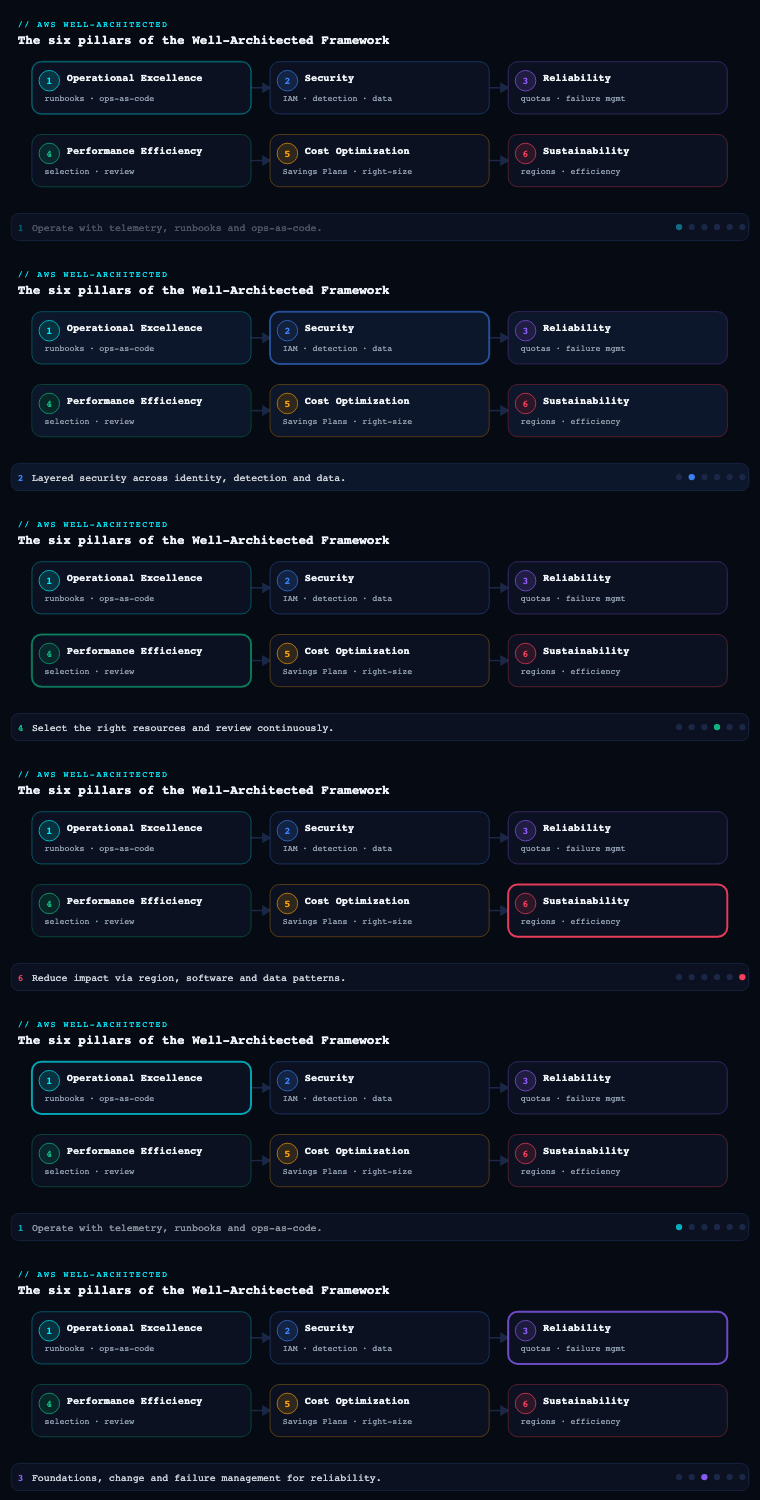
The AWS Well-Architected Framework is organised into six pillars — Operational Excellence, Security, Reliability, Performance Efficiency, Cost Optimization, and Sustainability. Reliability is the pillar that ensures a workload performs its intended function correctly and consistently when it is expected to, and recovers quickly from failure to meet demand. It is anchored by the design principles automatically recover from failure, test recovery procedures, scale horizontally to increase aggregate availability, stop guessing capacity, and manage change through automation. This article — part 3 of the series — drills into the five practice areas the pillar uses to operationalise those principles: foundations, workload architecture, change management, failure management, and the cross-cutting concerns of backup/DR and distributed-system resiliency.
Foundations — service quotas and network topology
Foundations are the prerequisites that sit beneath the workload and are usually outside any single team’s control: account-level service limits, the IP address space, the connectivity fabric, and the AWS regional/AZ footprint. Get these wrong and no amount of clever application code will save you — you will hit a hard ceiling or a network black hole that you cannot engineer your way out of at 2 a.m.
Service quotas (limits). Every AWS account carries soft and hard quotas per service, per Region. The classic reliability incident is a horizontal scale-out event that stalls because you ran out of Elastic IPs, VPC security-group rules, Lambda concurrent executions, or EC2 vCPUs in that Region. The discipline is to (a) inventory the quotas that gate your critical scaling paths, (b) request increases ahead of need (not during an incident), and © monitor utilisation against the limit. Service Quotas is the canonical service; it integrates with AWS Trusted Advisor service-limit checks and emits Amazon CloudWatch usage metrics (AWS/Usage) so you can alarm at, say, 80% of a quota. Use a CloudWatch alarm on the ResourceCount metric versus the SERVICE_QUOTA value rather than discovering the ceiling empirically.
Network topology. Reliability of the network layer means non-overlapping, sufficiently-large CIDR ranges, redundant connectivity, and a topology that survives the loss of an Availability Zone or even a Region.
| Concern | Reliable pattern | AWS services |
|---|---|---|
| IP address planning | Allocate non-overlapping CIDRs centrally; leave headroom for growth and for future peering | Amazon VPC IPAM, RFC 1918 plan |
| Hybrid connectivity | Dual Direct Connect connections from different locations, with Site-to-Site VPN as automatic backup | AWS Direct Connect (+ DX Gateway), Site-to-Site VPN |
| Multi-VPC / multi-account routing | Hub-and-spoke instead of a mesh of peering connections | AWS Transit Gateway (with cross-Region peering) |
| Scaling private connectivity to AWS services | Avoid public-internet egress; keep traffic on the AWS backbone | VPC endpoints (Gateway + Interface/PrivateLink) |
| AZ redundancy | Subnets in ≥3 AZs; one NAT gateway per AZ to avoid a cross-AZ single point of failure | Multi-AZ subnet layout, per-AZ NAT Gateway |
The decisive foundational decision is how many Availability Zones and which Regions the workload spans, because that sets the ceiling on the availability you can ever achieve. Subnets are AZ-scoped; design for at least three AZs so that losing one still leaves a quorum (critical for systems like etcd-style or majority-vote clusters). Artifacts to produce: an IP/CIDR allocation plan (managed in VPC IPAM), a network topology diagram, a quota inventory mapped to scaling paths, and Trusted Advisor / Service Quotas alarms wired into your monitoring.
Workload architecture — designing for failure from day one
Workload architecture is how you decompose the application into services and dependencies so that the failure of any one component is contained rather than cascading into a full outage. This is where availability is won or lost in the design, before a single packet of production traffic flows.
Segmentation. Decide between monolith, micro-services, or cell-based architecture. The reliability win of micro-services and cell-based architecture is fault isolation: a poison-pill request or a hot tenant degrades one cell, not the fleet. Within a service, depend on highly-available managed primitives — Amazon SQS, Amazon SNS, Amazon DynamoDB, Amazon S3, Elastic Load Balancing, Amazon Route 53 — rather than re-inventing them.
Interaction patterns that prevent cascading failure. These are the load-bearing decisions:
- Throttling and load shedding — reject excess work early (HTTP 429, API Gateway usage plans, token buckets) instead of toppling under it.
- Retry with exponential backoff and jitter — naive fixed-interval retries synchronise into a thundering herd; jitter de-correlates them. The AWS SDKs implement this by default; keep it.
- Idempotency — make write operations safe to retry (idempotency keys, conditional writes in DynamoDB) so that backoff-driven retries don’t double-charge or double-ship.
- Circuit breakers and fail-fast — stop hammering a dependency that is already down; degrade gracefully to a static or cached response.
- Constant work / “no bimodal behaviour” — systems that do the same amount of work in steady state and under stress (e.g., always pushing a full configuration rather than deltas) avoid the cliff where recovery load exceeds normal load.
Make all responses degrade gracefully. Prefer eventual consistency and asynchronous, queue-decoupled processing where the business allows it, so a slow downstream becomes a deeper queue rather than a user-facing 500. Artifacts: a dependency map (with criticality and the blast radius of each dependency), documented retry/timeout/idempotency policies per integration, and an explicit segmentation decision (monolith vs micro-service vs cell) with the rationale recorded.
Change management — making change safe and reversible
Most outages are self-inflicted: a deployment, a config push, a scaling event, or a feature flag. Change management is the discipline of knowing what changed, controlling how it changes, and being able to undo it quickly. The Well-Architected principle is manage change through automation — humans clicking in consoles is the enemy of reliability.
Three classes of change to govern:
- Deployment changes. Use deployment strategies that limit blast radius and enable fast rollback. AWS CodeDeploy supports canary and linear traffic shifting for Lambda, ECS, and EC2; AWS CodePipeline orchestrates the release with manual-approval and automated-rollback gates. Immutable infrastructure (replace, don’t patch) via AWS CloudFormation or the AWS CDK means a bad change is rolled back by redeploying the previous, known-good template.
| Strategy | Blast radius | Rollback | Best for |
|---|---|---|---|
| All-at-once | Whole fleet | Redeploy previous | Dev/test only |
| Rolling | Batch at a time | Stop + reverse | Stateless web tiers |
| Blue/green | Zero to old fleet | Flip traffic back | High-stakes, instant rollback |
| Canary / linear | Small % first | Auto-rollback on alarm | Customer-facing APIs |
-
Demand changes (scaling). Stop guessing capacity. Use EC2 Auto Scaling with target-tracking, step, or predictive scaling; Application Auto Scaling for ECS/DynamoDB; and serverless (Lambda, Fargate, Aurora Serverless v2, DynamoDB on-demand) so capacity tracks demand automatically. Always set maximum limits so a runaway scale-out doesn’t blow your quotas or your budget, and validate that your quotas actually permit the max.
-
Configuration & drift. Detect and prevent unmanaged change. AWS Config records resource configuration history, evaluates compliance rules, and flags drift; CloudFormation drift detection catches out-of-band edits to managed stacks. AWS CloudTrail answers “who changed what, when” for forensic and audit purposes.
Artifacts: CI/CD pipeline definitions with automated rollback on CloudWatch-alarm breach; IaC templates (CloudFormation/CDK/Terraform) under version control; auto-scaling policies with documented min/max; Config rules and drift-detection on critical stacks.
Failure management — detect, recover, and learn
You cannot prevent every failure, so you must plan to fail. Failure management covers how the system detects faults, recovers automatically, and how the organisation learns so the same failure doesn’t recur. This is the operational counterpart to the architectural choices above.
Detect failure. Instrument with CloudWatch metrics, alarms, and composite alarms; use CloudWatch Synthetics canaries to detect failures from the customer’s perspective before customers do; trace cross-service calls with AWS X-Ray. Alarm on symptoms users feel (latency, error rate, success rate) — not only on resource health.
Recover automatically. The gold standard is recovery with no human in the loop:
- EC2 Auto Scaling with ELB health checks replaces unhealthy instances; spreading the group across AZs gives automatic AZ-failure recovery.
- Amazon RDS Multi-AZ performs automatic failover to the standby; Aurora promotes a replica.
- Route 53 health checks with DNS failover (and Application Recovery Controller routing/readiness checks) shift traffic away from an impaired endpoint or Region.
- Auto Scaling instance health and EC2 instance auto-recovery handle hardware faults transparently.
Test recovery — chaos and game days. A recovery procedure you have never exercised is a hypothesis, not a control. Use AWS Fault Injection Service (FIS) to inject real faults — terminate instances, throttle APIs, blackhole an AZ, inject latency — and verify the system recovers within its objectives. Run game days on a schedule; treat failed game days as findings, not failures.
Learn from failure. Blameless post-incident analysis (COE / correction-of-error) feeds back into the dependency map, runbooks, and Config rules. The metric to watch is recurrence: the same root cause should never cause two incidents.
| KPI | What it tells you | Typical source |
|---|---|---|
| RTO (Recovery Time Objective) | Max tolerable downtime | DR design + game-day timing |
| RPO (Recovery Point Objective) | Max tolerable data loss | Backup/replication interval |
| MTTR (Mean Time To Recovery) | How fast you actually recover | Incident records |
| MTBF (Mean Time Between Failures) | How often you fail | Incident records |
| Availability (e.g., 99.95%) | SLA compliance | Synthetics + CloudWatch |
Backup and disaster recovery
Backup protects against data loss; DR protects against the loss of an entire site or Region. They are distinct: a backup that you cannot restore within your RTO is not a DR strategy. The two governing numbers are RPO (how much data you can afford to lose) and RTO (how long you can afford to be down) — they drive the cost/complexity trade-off directly.
Backup. Centralise with AWS Backup to apply backup plans, lifecycle, and cross-Region/cross-account copy across EBS, RDS, Aurora, DynamoDB, EFS, FSx, and more. Make backups immutable and isolated with AWS Backup Vault Lock (WORM) and a separate, restricted account so ransomware or a compromised admin cannot delete them. Crucially: schedule restore tests. An untested backup is Schrödinger’s backup.
Disaster recovery strategies, in increasing order of cost and decreasing order of RTO/RPO:
| Strategy | RTO / RPO | How it works | Relative cost |
|---|---|---|---|
| Backup & Restore | Hours / hours | Restore data and redeploy infra (IaC) in the recovery Region after a disaster | $ |
| Pilot Light | 10s of minutes | Core data replicated live; minimal services running, scaled up on failover | $$ |
| Warm Standby | Minutes | Scaled-down but fully-functional copy always running; scale up + shift traffic | $$$ |
| Multi-Site Active/Active | Near-zero / near-zero | Full capacity serving in multiple Regions simultaneously | $$$$ |
Enabling services: cross-Region read replicas and Aurora Global Database (typically sub-second cross-Region replication, fast promotion) for databases; DynamoDB global tables for active/active NoSQL; S3 Cross-Region Replication; Route 53 ARC for tested, dependency-free failover routing. Artifacts: a DR plan naming the strategy per workload tier, documented RTO/RPO per workload, a runbook for failover and failback, and evidence of the last restore/failover test.
Distributed-system resiliency — fault isolation boundaries
Distributed systems fail in ways monoliths don’t: partial failures, network partitions, gray failures (a node that’s “up” but misbehaving), and correlated failures across shared dependencies. Resiliency here is about choosing fault isolation boundaries and making the system tolerant of partial failure.
Static stability is the principle that a system should keep working using pre-provisioned resources even when its control plane or a dependency is impaired. The canonical example: an Auto Scaling group spread across three AZs, over-provisioned so that if one AZ fails, the surviving two already have enough capacity — no need to launch new instances (a control-plane action that may itself be failing during the event). Rely on the data plane during failures, not the control plane.
Bulkheads and cells. Partition resources so a failure is contained. Cell-based architecture routes each customer/tenant to one self-contained cell; a bad deployment or a hot tenant takes down at most one cell. Shuffle sharding goes further: assign each tenant a random combination of workers so that even when one shard is poisoned, the probability that any two tenants share the same full set of workers is tiny — dramatically shrinking the blast radius of a single bad actor.
Fault domains to design around, smallest to largest: instance → AZ → Region. Match your isolation boundary to the failures you must survive. Quorum and consensus: for stateful systems requiring strong consistency, span an odd number of AZs (3 or 5) so a majority survives the loss of one. Avoid two-AZ designs for quorum systems — losing one AZ leaves you without a majority.
Avoid correlated failure: don’t let every service depend on the same single resource (one config bucket, one DynamoDB table, one auth service) without isolation, or that resource becomes a shared fate that turns a local fault into a global one. Artifacts: documented fault isolation boundaries, a static-stability analysis per critical path (does it survive AZ loss without control-plane actions?), and a cell/shard routing design where multi-tenant blast radius matters.
Real-world enterprise scenario
NorthBridge Logistics is a fictional pan-Asian freight and last-mile delivery company. Their flagship platform, TrackPort, exposes real-time shipment tracking, a driver dispatch API, and a customer notifications engine. Peak load hits 40,000 requests/second during the daily 18:00–21:00 delivery surge across India and Southeast Asia. A 90-minute outage during this window in the previous year cost an estimated ₹2.1 crore in SLA penalties and lost merchant trust. The board mandated a target of 99.95% availability (≈4.4 hours/year) for the tracking path and a 15-minute RTO / 5-minute RPO for the dispatch database. NorthBridge runs in ap-south-1 (Mumbai) as primary, with ap-southeast-1 (Singapore) as the DR Region.
Foundations. The platform team adopts VPC IPAM to carve non-overlapping /16s per Region and per environment, leaving room for two future Regions. They deploy across three AZs in ap-south-1, with one NAT Gateway per AZ and Transit Gateway hub-and-spoke replacing an old peering mesh. A quota audit reveals their Lambda reserved concurrency and ENIs-per-Region limits would cap them at ~28,000 rps — well below peak. They raise quotas via Service Quotas to 2× projected peak and wire CloudWatch alarms at 80% of each gating limit. Two Direct Connect links from separate Mumbai facilities back the merchant integrations, with Site-to-Site VPN as automatic backup.
Workload architecture. TrackPort is re-segmented from a near-monolith into a cell-based architecture, sharding merchants across 8 cells so a poison-pill payload from one large merchant degrades only ~12% of traffic. The notifications engine is decoupled via SQS and SNS so a slow SMS provider deepens a queue instead of returning 500s to the tracking UI. Every external integration gets documented timeouts, exponential backoff with jitter, and idempotency keys (DynamoDB conditional writes) to make retries safe.
Change management. Releases move to CodePipeline + CodeDeploy with canary shifts (5% for 10 minutes, auto-rollback on a composite CloudWatch alarm covering p99 latency and 5xx rate). All infra is CDK; AWS Config rules enforce encryption, multi-AZ, and tagging, and flag drift. The dispatch fleet uses EC2 Auto Scaling predictive scaling primed for the 18:00 surge, with hard max limits validated against the new quotas.
Failure management. CloudWatch Synthetics canaries probe the tracking API from three regions every minute; X-Ray traces dispatch calls. Recovery is automated: Auto Scaling + ELB health checks, RDS/Aurora Multi-AZ failover, and Route 53 ARC readiness checks. They run a monthly game day using AWS FIS — terminating instances, injecting 300 ms latency, and blackholing an AZ — and discovered (then fixed) a circuit breaker that wasn’t tripping fast enough.
Backup and DR. The dispatch store moves to Aurora Global Database (Mumbai → Singapore, sub-second replication) to meet the 5-minute RPO; failover promotion plus Route 53 ARC traffic shift meets the 15-minute RTO. They choose Warm Standby for the dispatch tier and Pilot Light for analytics. AWS Backup with Vault Lock writes immutable copies to a locked-down audit account, and a quarterly restore test is now a calendar event with a named owner.
Distributed-system resiliency. The dispatch cluster spans three AZs for quorum and is statically stable — provisioned to 150% so the loss of one AZ needs no new launches. Shuffle sharding assigns each of the 8 cells a random subset of worker pools, shrinking the blast radius of any single bad tenant.
Outcome. Over the following two quarters TrackPort recorded 99.97% measured availability, survived a real ap-south-1 single-AZ impairment with zero customer-visible downtime (static stability did its job), and cut MTTR from 47 minutes to under 9 minutes. The one DR drill executed during the period completed failover in 11 minutes, inside the 15-minute RTO.
Deliverables & checklist
Common pitfalls
- Discovering service quotas during an incident. Teams scale out and hit a hard wall on EIPs, ENIs, Lambda concurrency, or vCPUs at peak. Avoid it: inventory quotas on every scaling path, request increases proactively, and alarm at 80% of the limit via Service Quotas/CloudWatch.
- Backups that have never been restored. Backup jobs are green for years; the first real restore fails or blows the RTO. Avoid it: schedule periodic restore and DR-failover tests with named owners, and make Vault Lock copies immutable and isolated from production credentials.
- Two-AZ designs for quorum systems. Losing one of two AZs leaves no majority, so a “highly available” cluster halts. Avoid it: span an odd number of AZs (3 or 5) for any consensus/quorum workload.
- Relying on the control plane during a failure. Recovery depends on launching new capacity or creating resources precisely when those control-plane APIs are degraded. Avoid it: design for static stability — pre-provision spare capacity across AZs so survival needs only data-plane actions.
- Retries without jitter (thundering herd). Synchronised fixed-interval retries amplify a brief blip into a self-inflicted DDoS. Avoid it: use exponential backoff with jitter (SDK defaults) plus throttling, circuit breakers, and idempotency.
- Manual, mutable change. Console clicks and in-place patches create drift no one can reproduce or roll back. Avoid it: manage change through automated, immutable IaC pipelines with canary deploys, automated rollback, and AWS Config drift detection.
What’s next
Part 4 of the AWS Well-Architected Framework series turns to the Performance Efficiency pillar — selecting and right-sizing compute, storage, database, and networking resources, and evolving them as requirements and AWS capabilities change.