Migrate moves what you have. Innovate builds what you do not yet have — and, crucially, builds it the cheap, falsifiable way. The mistake I see most often is teams treating Innovate as “the greenfield app project,” scoping a twelve-month build against a requirements document nobody validated, and shipping a polished product into market silence. The CAF Innovate methodology exists specifically to prevent that. It is a discipline for turning a customer hypothesis into the smallest possible thing that can prove or disprove it, measuring real behaviour, and only then deciding whether to invest. This article is how I run Innovate on Azure: the five innovation disciplines, the build-measure-learn loop and what an MVP actually is (and is not), and the cloud-native and AI/ML services that let you iterate in days instead of quarters.
Where this fits
Innovate is the fourth and final methodology in the CAF lifecycle, sitting after Strategy → Plan → Ready → Adopt (where Adopt splits into Migrate and Innovate), and running in parallel with the ongoing Govern, Secure, and Manage disciplines. Where Migrate is the right path for existing workloads with a clear destination, Innovate is the path when the business outcome is a hypothesis — a new customer experience, a data product, an AI-assisted process — and the job is to learn whether it creates value before you over-build. It still lands on the same governed platform: every MVP runs inside a CAF landing zone, under the same policy, identity, and cost guardrails as everything else.
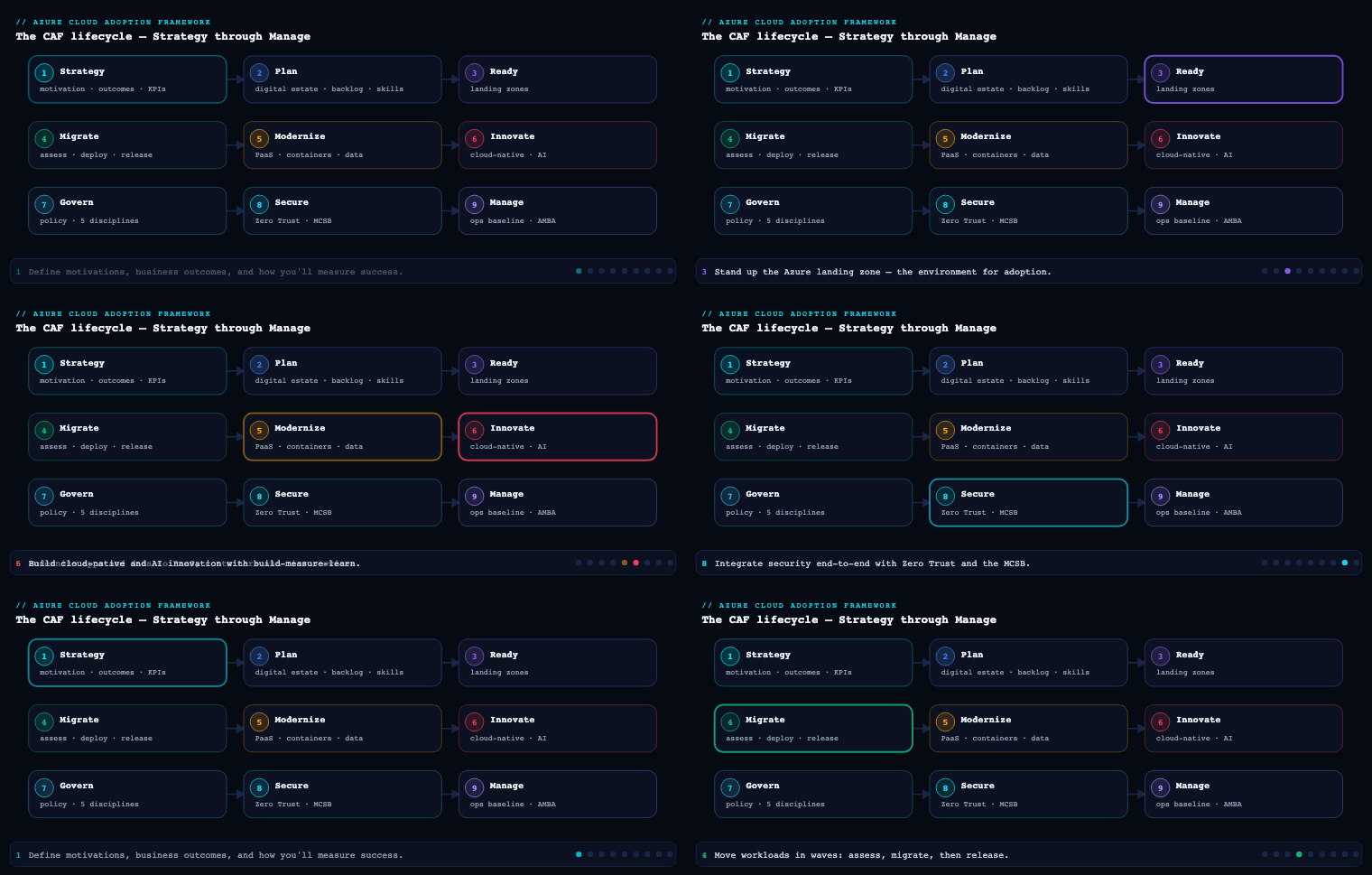
The Innovate methodology: the five innovation disciplines
The Innovate methodology decomposes “build a digital invention” into five disciplines. They are not phases — you rarely need all five, and you almost never start with all five. The art is identifying which discipline is on the critical path to your invention’s value proposition and investing only there. Each discipline maps to a question, a value-creation mechanism, and a distinct set of Azure services.
| Discipline | Core question it answers | Primary Azure services | Key artifact |
|---|---|---|---|
| Democratize data | Can people who have the problem get to the data that solves it, themselves? | Microsoft Fabric (OneLake, Lakehouse), Azure Data Lake Storage Gen2, Synapse, Azure SQL, Power BI, Azure Data Share, Microsoft Purview | Governed, discoverable data product + access model |
| Engage via apps | Does the customer experience pull people in and keep them? | Azure App Service, Azure Container Apps, Static Web Apps, AKS, API Management, Azure Front Door, Power Apps | Customer-facing app + experience instrumentation |
| Empower adoption | Can we ship and scale safely, fast enough to keep learning? | Azure DevOps / GitHub Actions, Azure Deployment Environments, Bicep/Terraform, App Configuration + feature flags, Azure Load Testing | CI/CD pipeline, feature-flag framework, IaC |
| Interact with devices | Does the experience need to reach into the physical / ambient world? | Azure IoT Operations, IoT Hub, Azure Digital Twins, Azure IoT Edge, Azure Stack Edge, HoloLens / Mixed Reality | Device-to-cloud telemetry + edge logic |
| Predict and influence with AI | Can we anticipate intent and shape the next action? | Azure AI Foundry, Azure OpenAI, Azure AI Search, Azure Machine Learning, Azure AI Services (Vision, Document Intelligence, Language) | Trained/grounded model + inference endpoint |
A few principles I hold to when applying the disciplines:
- Start from the value proposition, walk backward to the discipline. If your invention’s value is “we tell the customer which invoice will be disputed before they send it,” the critical-path discipline is predict and influence with AI, and the supporting one is democratize data (you need clean invoice + dispute history). Interact with devices is irrelevant — do not build IoT because the platform offers it.
- Democratize data is upstream of almost everything. AI predictions, app personalization, and digital-twin models all starve without accessible, trustworthy data. In practice this is the discipline most often skipped and most often the reason the MVP stalls.
- Empower adoption is the one discipline you always need. You cannot run build-measure-learn without the ability to deploy a change, behind a flag, to a slice of users, in minutes. If your delivery pipeline takes a week, your learning loop takes a week, and the methodology collapses.
Democratize data
What it is. Removing the gatekeepers — human and technical — between the people who have a question and the data that answers it, while keeping the data governed. The CAF framing is deliberate: democratize, not dump. Self-service without governance is a breach and a compliance finding waiting to happen.
Why it matters. Every other Innovate discipline is data-bound. An AI model is only as good as its features; an engaging app personalizes only if it can read behaviour; a digital twin is fiction without sensor history. When data lives in a warehouse only the BI team can query, the innovation loop runs at the speed of the BI team’s backlog.
How to do it well on Azure. I standardize on Microsoft Fabric as the data foundation for new inventions because OneLake gives one logical lake (open Delta-Parquet) across the org, and Fabric’s Lakehouse, Data Warehouse, Real-Time Intelligence, and Power BI all read the same copy — no ETL sprawl just to make data usable in a new tool. Shortcuts let an MVP reference existing ADLS Gen2 or even cross-cloud data without copying it. Crucially, governance is not bolted on: Microsoft Purview catalogs and classifies the data, lineage is tracked, and access is enforced through the lake’s security model plus row/column-level security, so “self-service” means self-service within policy. The concrete decisions and artifacts:
- The data product, not the dataset. Package data as a product with an owner, an SLA, a schema contract, and documentation in the Purview catalog. The MVP team subscribes; they do not negotiate a one-off extract.
- Access model up front. Decide standing vs. just-in-time access, the entitlement groups (Entra ID), and masking for PII before the data is discoverable. Use Azure Data Share when democratizing across org or partner boundaries.
- Real-time vs. batch. If the invention reacts to events (fraud, telemetry), stand up Real-Time Intelligence (eventstreams + KQL) rather than forcing everything through a nightly batch.
Engage via apps
What it is. Building the customer experience that delivers the invention and — equally important — instrumenting it so you can see whether it engages. CAF is explicit that the goal is not “an app” but engagement: measured, repeat, value-creating interaction.
Why it matters. The app is where the hypothesis meets reality. It is also your richest measurement surface — every click, drop-off, and return visit is a signal feeding the learn step. An app you cannot measure is an MVP you cannot learn from.
How to do it well on Azure. Choose the thinnest hosting that fits, because the experience will change weekly:
| Need | Service | Why |
|---|---|---|
| Server-rendered web app, simple ops | Azure App Service | Fastest path, slots for blue/green, built-in auth |
| Microservices / event-driven, scale-to-zero | Azure Container Apps | Dapr + KEDA, cheap idle, no cluster to run |
| Static frontend + API | Azure Static Web Apps | Global edge, free/cheap, ideal for SPA MVPs |
| Full control, existing K8s investment | AKS | Only when you genuinely need it — it is operational tax during Innovate |
| Low-code internal experience | Power Apps | When the “app” is a business workflow, not a product |
Front it with Azure Front Door (global routing, WAF, caching) and API Management (versioning, throttling, the seam you swap implementations behind). The non-negotiable artifact is experience instrumentation: Application Insights for funnels and the engagement metrics that test your hypothesis (activation, retention, task completion), plus Azure App Configuration feature flags so the app itself is the experiment harness — you toggle the new experience for a cohort and compare.
Empower adoption
What it is. The delivery capability — pipelines, environments, feature flags, automated testing — that lets you ship safely and fast enough to keep the learning loop tight. CAF positions this as the discipline that scales a validated invention from MVP to production reliably.
Why it matters. Innovate’s whole premise is iteration speed. The build-measure-learn loop turns only as fast as you can deploy a change and expose it to users. Empower adoption is therefore the enabling discipline: weak here, and every other discipline’s experiments queue behind a slow, risky release process.
How to do it well on Azure. The artifacts I insist on for any Innovate effort:
- IaC from day one — Bicep or Terraform, so every environment (including throwaway experiment environments) is reproducible. Pair with Azure Deployment Environments to give developers self-service, governed, on-demand environments without ad-hoc clickops.
- CI/CD with progressive exposure — GitHub Actions or Azure Pipelines deploying to App Service deployment slots or Container Apps revisions, with deployment rings / canary so a change hits 1% → 10% → 100% gated on health.
- Feature flags as the experiment primitive — Azure App Configuration feature management decouples deploy from release. You ship code dark, then flip it on for a cohort. This is what makes A/B testing and safe rollback real.
- Load and chaos validation — Azure Load Testing before you scale a winning experiment; Azure Chaos Studio to confirm the architecture survives the failure modes you will hit in production.
Interact with devices
What it is. Extending the experience into the physical and ambient world — sensors, machines, wearables, mixed reality — and bringing that interaction back into the innovation loop. CAF spans the spectrum from cloud-only to fully ambient (the user interacts without consciously “using an app”).
Why it matters. For a large class of inventions — manufacturing, logistics, energy, healthcare, retail floor — the most valuable signal and the most natural interaction are off-screen. Ignoring devices caps the invention at what a phone can see.
How to do it well on Azure. Decide the cloud/edge boundary first, then pick the stack:
| Pattern | Service | When |
|---|---|---|
| Device telemetry → cloud, bidirectional | Azure IoT Hub | Connect and command millions of devices securely |
| Modern, K8s-native edge data plane | Azure IoT Operations (Arc-enabled) | New deployments wanting MQTT broker + edge processing on Arc |
| Low-latency / disconnected logic at the edge | Azure IoT Edge | Run modules (incl. AI) locally; sync when connected |
| Heavy edge compute / inference appliance | Azure Stack Edge | Edge GPU, local ML, store-and-forward |
| Live model of a physical environment | Azure Digital Twins | Reason over relationships (DTDL), not just point telemetry |
| Spatial / immersive interaction | HoloLens / Mixed Reality | First-line worker, design review, guided tasks |
The artifacts: a device-to-cloud telemetry contract, the edge-vs-cloud processing decision (latency, bandwidth, sovereignty drive it), and the twin graph when the invention reasons about how physical things relate. Telemetry lands back in the data platform (often Fabric Real-Time Intelligence), closing the loop into measurement.
Predict and influence with AI
What it is. Using ML and generative AI to anticipate intent or outcomes and shape the next interaction — recommendations, forecasts, anomaly detection, copilots, document understanding. In CAF this is the discipline that turns data + apps into foresight.
Why it matters. This is where many modern inventions actually create their differentiation. But it is also the discipline most prone to expensive failure: a model built before the data is democratized, or shipped without a way to measure whether its predictions change behaviour, is pure cost.
How to do it well on Azure. Match the build to the maturity of the problem:
- Generative / language-centric → Azure AI Foundry as the platform, with Azure OpenAI models and Azure AI Search for retrieval-augmented generation (ground responses in your democratized data, not the model’s training set). Use prompt flow and Foundry’s evaluation tooling to measure quality, groundedness, and safety; wire in Azure AI Content Safety.
- Prebuilt cognitive tasks → Azure AI Services (Document Intelligence for forms, Vision for images, Language for text) when the problem is common and you want an API, not a training project.
- Custom predictive ML → Azure Machine Learning for the full lifecycle: feature engineering off the lakehouse, training, MLOps (registered models, managed endpoints, drift monitoring). This is the right tool for forecasting, churn, risk scoring — bespoke models on your data.
- Responsible AI is an artifact, not a slogan. Produce a Responsible AI scorecard, document grounding sources, set human-in-the-loop checkpoints, and (critically) define the business KPI the prediction must move so you can prove influence, not just accuracy.
Build-measure-learn and the MVP
The five disciplines tell you what you might build. Build-measure-learn tells you how to build it so each cycle is cheap and each decision is evidence-based. This is the operational heart of Innovate, lifted from Lean Startup into the CAF and grounded in Azure tooling.
The loop. You start with a hypothesis — a specific, falsifiable statement of customer value (“Mid-market controllers will adopt automated dispute-risk flagging because it cuts write-offs; we’ll know if ≥30% of flagged invoices get reviewed before sending”). You build the minimum thing that tests it, measure real behaviour against the hypothesis, and learn — which resolves to one of three decisions:
| Decision | Meaning | Trigger |
|---|---|---|
| Persevere | Hypothesis supported; invest in the next iteration | Metrics moving toward target |
| Pivot | Core hypothesis wrong, but a learning points to a better one | Strong signal in an unexpected direction |
| Stop | No path to value; reallocate the spend | Flat metrics, no engagement, after honest effort |
What an MVP actually is. The most common and most expensive misunderstanding. An MVP is the minimum product that can viably test the hypothesis — and CAF (echoing Ries) is blunt that “viable” sometimes means barely a product at all. It is not a smaller version of the final product, not a quality-compromised v1 you are ashamed of, and not a tech demo. It is an experiment whose only job is to generate validated learning at the lowest cost. The two failure modes:
- Over-building the MVP — adding the features, polish, scale, and edge-cases of a real product before you have proven anyone wants the core. This is the default failure of well-funded enterprise teams. The discipline: ruthlessly cut everything not on the critical path to this iteration’s hypothesis.
- Under-building so it cannot test — an MVP so thin it produces no real signal (a clickable prototype that no real user touches with real stakes). It must reach real users doing real tasks, or “measure” yields nothing.
How the loop maps to Azure. This is where Empower adoption earns its keep. Each turn of the loop is concretely:
- Build → IaC provisions a governed experiment environment; code ships through CI/CD to a slot/revision behind an App Configuration feature flag.
- Measure → Application Insights captures the hypothesis metric (funnel, activation, task completion); A/B cohorts are split by the feature flag; Fabric/Power BI dashboards make the result legible to the business.
- Learn → review the metric against the threshold defined before the build, and record the persevere/pivot/stop decision as a durable artifact.
The single highest-leverage discipline in build-measure-learn is writing the success metric and its threshold before you build. If you decide what “good” looks like after seeing the data, you will always rationalize persevere, and you will never stop a losing bet. The threshold is a pre-commitment device.
The learning metrics that matter. Innovate teams should be governed by innovation KPIs, not delivery KPIs:
| Metric | What it tells you | Why it beats vanity metrics |
|---|---|---|
| Cycle time (loop duration) | Days from hypothesis to validated learning | Your real innovation throughput |
| Activation / aha-rate | % of users reaching the core value moment | Engagement, not raw signups |
| Retention (cohort) | Do users come back? | The truest test of value |
| Validated-learning count | Hypotheses resolved (any direction) | Rewards learning, including disproof |
| Cost per experiment | Azure spend per loop | Keeps MVPs genuinely minimal |
Cloud-native patterns and AI/ML innovation
Build-measure-learn demands that the architecture itself be cheap to change and cheap to run when idle. That is precisely what cloud-native patterns deliver, which is why Innovate and cloud-native are natural partners — and why I rarely build an Innovate MVP on a monolithic VM.
Cloud-native patterns that serve the loop:
- Serverless and scale-to-zero — Azure Functions and Container Apps mean an experiment that nobody is using costs almost nothing, and a winning experiment scales without re-architecting. This directly protects cost per experiment.
- Microservices behind an API gateway — small, independently deployable services behind API Management let you swap or A/B a single capability (say, the recommendation service) without redeploying the app. The gateway is the seam your experiments hide behind.
- Event-driven architecture — Azure Event Grid / Service Bus / Event Hubs decouple producers from consumers, so adding a new reaction to an event (a new model, a new notification) is additive, not invasive.
- Containers + GitOps for reproducibility — even minimal MVPs benefit from containerization so the experiment environment is identical to production-bound code.
- Managed data services — Azure Cosmos DB (global, schema-flexible — ideal when the data model is still in flux) or Azure SQL Hyperscale remove operational drag during rapid iteration.
AI/ML innovation patterns, layered onto that cloud-native base:
| Pattern | Azure building blocks | Innovate fit |
|---|---|---|
| RAG (grounded GenAI) | Azure AI Foundry + Azure OpenAI + AI Search over OneLake/ADLS | Ship a copilot grounded in your data without training a model |
| Fine-tuning / custom models | Azure OpenAI fine-tuning; Azure ML | When prompt + RAG plateau and the domain is narrow |
| Classic predictive ML + MLOps | Azure ML pipelines, managed endpoints, model monitoring | Forecasting, churn, risk — bespoke on lakehouse features |
| Prebuilt AI APIs | Document Intelligence, Vision, Language | Common tasks where an API beats a project |
| Edge inference | IoT Edge / Stack Edge running models locally | Low-latency or disconnected prediction at the device |
The connective tissue across all of it is the data platform: Fabric/OneLake is the feature source for Azure ML, the grounding source for RAG via AI Search, and the telemetry sink for measurement — which is exactly why democratize data keeps showing up as the upstream dependency.
Real-world enterprise scenario
Helvetia Freight Systems (HFS) — a fictional mid-market European logistics provider, ~3,400 employees, running cross-border road freight. They have already completed CAF Strategy, Plan, Ready, and migrated their core TMS to Azure. Their Customer & Data Innovation unit (a 9-person product squad: 1 PM, 4 engineers, 1 data engineer, 1 ML engineer, 1 designer, 1 platform engineer borrowed from the CCoE) is chartered with one outcome: reduce the rate of “detention & demurrage” disputes, where customers contest charges for trucks held at loading docks. These disputes consume €4.1M/year in write-offs and an estimated 6 FTE in back-office handling.
The hypothesis. “If we surface a real-time, explainable dispute-risk score to customers and ops at the moment a shipment is booked and while it is in transit, the customer-side dispute rate on flagged shipments will fall by ≥20% within the pilot, because both sides act on the warning before charges crystallize.” Success threshold for the first MVP iteration: on flagged shipments, ≥25% trigger a documented pre-emptive action (re-slotting, customer notification, or proactive credit), and disputed-amount on that cohort drops ≥15% vs. control — both committed before any code is written.
Decisions by discipline:
- Democratize data (critical-path upstream). The squad does not build a new pipeline. They publish a “Detention Events” data product in Microsoft Fabric — a Lakehouse fed by shortcuts to the existing ADLS Gen2 landing of TMS gate-in/gate-out events, dock telemetry, and the historical disputes ledger. Microsoft Purview classifies customer PII; access is via an Entra ID entitlement group with row-level security so the squad sees only pilot accounts. Artifact: a catalogued, SLA-backed data product the ML model and dashboards both consume.
- Predict and influence with AI (critical path). The ML engineer trains a gradient-boosted dispute-risk model in Azure Machine Learning on lakehouse features (lane, customer, dock, historical detention, seasonality), registers it, and serves it from a managed online endpoint. For the explanation that customers actually read, they wrap the score with Azure OpenAI via Azure AI Foundry, generating a plain-language “why this shipment is flagged and what to do” message grounded (via AI Search) in the shipment’s own detention history — RAG, not hallucination. A Responsible AI scorecard and a human-review checkpoint for any proactive credit are mandatory artifacts.
- Engage via apps. Rather than touch the monolithic customer portal, they ship a thin Azure Static Web Apps widget (“Dispute Risk”) embedded in the booking flow and a Container Apps backend behind API Management. Application Insights instruments the exact funnel: flag shown → explanation opened → action taken. Artifact: experience instrumentation tied directly to the hypothesis metric.
- Empower adoption. The borrowed platform engineer stands up Bicep-defined environments via Azure Deployment Environments, a GitHub Actions pipeline deploying to Container Apps revisions, and — the linchpin — Azure App Configuration feature flags that expose the widget to a 15% cohort of pilot customers, with the other 85% as control. This is the experiment harness.
- Interact with devices. Explicitly descoped for the MVP. Live dock-sensor feeds exist, but the team decides historical gate events are sufficient to test the hypothesis; real-time IoT (IoT Hub + Fabric Real-Time Intelligence) is parked as a fast-follow only if they persevere. This is the methodology working — refusing a discipline that is not on the critical path.
The loop in practice. Iteration one ships in 4 weeks (not the 9-month portal release the business first proposed). Over a 6-week pilot, Application Insights + a Power BI dashboard on Fabric show: on flagged shipments, 31% triggered a documented pre-emptive action (threshold was 25%) and disputed amount on the flagged cohort fell 18% vs. control (threshold 15%). Two learnings emerge: customers open the explanation far more than they act on the score (the GenAI narrative, not the number, drives behaviour), and ops users want the flag pushed to them, not pulled. Decision: persevere, with a scoped pivot — invest the next iteration in the explanation experience and an ops push-notification path; promote the descoped IoT real-time feed into the backlog. Extrapolated, an 18% reduction maps to roughly €740K/year in avoided write-offs, justifying the next investment cycle — a number the team can defend because the threshold was set in advance and measured against a real control group.
Deliverables & checklist
By the end of an Innovate iteration you should be able to produce:
Common pitfalls
- Treating the MVP as “v1 of the product.” Teams build for scale, polish, and edge-cases before proving the core, burning the budget on a product nobody validated. Avoid: cut everything not on the critical path to this hypothesis; let “embarrassingly minimal but real” be acceptable.
- Deciding success after seeing the data. Without a pre-committed threshold, every result rationalizes persevere, so losing bets never stop. Avoid: write the metric and threshold into the hypothesis before any code, and treat it as a pre-commitment.
- Building AI before democratizing data. A model trained on inaccessible or ungoverned data is expensive and unshippable. Avoid: make democratize data the explicit upstream dependency; no model work starts until the data product is catalogued and accessible.
- A learning loop bottlenecked by slow delivery. If a change takes a week to ship, the loop turns weekly and the methodology dies. Avoid: invest in empower adoption first — feature flags, CI/CD with canary, on-demand environments — so each loop is measured in hours.
- Adopting disciplines because the platform offers them. Bolting on IoT or a custom-trained model that the hypothesis does not need is gold-plating disguised as innovation. Avoid: justify every discipline against the value proposition; descoping is a sign the method is working.
- Vanity metrics over engagement metrics. Counting signups, page views, or model accuracy instead of activation, retention, and whether the prediction changed behaviour. Avoid: govern Innovate teams on cohort retention, validated-learning count, and the business KPI the invention must move.
What’s next
With Innovate complete, the series turns to Part 7 — Govern, the cross-cutting discipline that keeps every migrated and innovated workload compliant, cost-controlled, and secure as the estate scales.