Where this fits
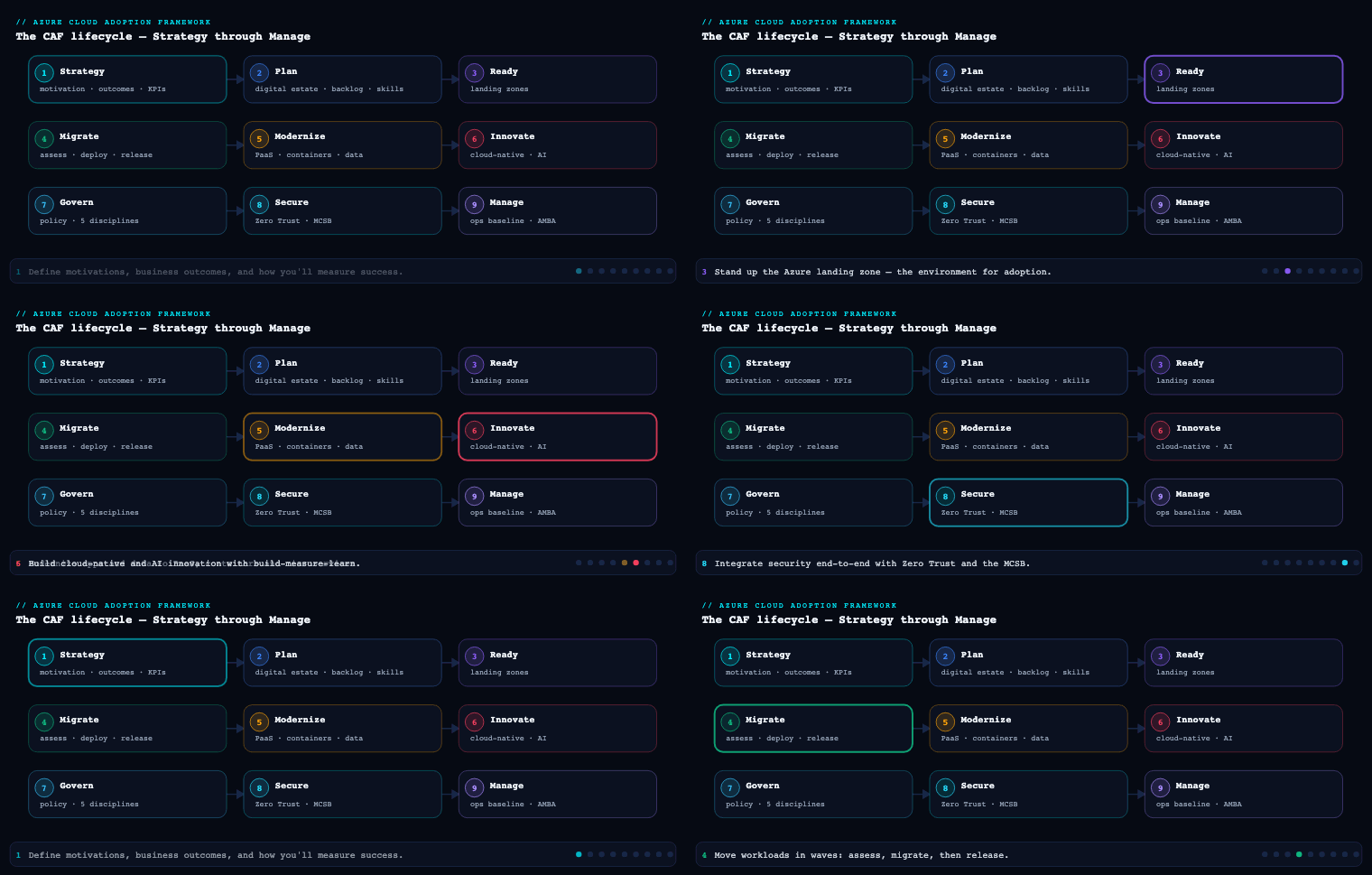
The Azure Cloud Adoption Framework (CAF) is Microsoft’s end-to-end lifecycle for adopting the cloud, and Strategy is its first methodology — the one that comes before Plan, Ready, Adopt (Migrate and Innovate), Govern, Secure, and Manage. Strategy is where executive intent becomes a written, testable artifact: why you are moving to or expanding in Azure, what business outcomes define success, and what investment you are willing to make to get there. Everything downstream inherits from it — the Plan phase converts your objectives into a backlog and skilling plan, Ready turns your guardrail decisions into a landing zone, and Govern and Manage measure operations against the KPIs you set here. Get Strategy wrong and you build a technically perfect platform that nobody asked for; get it right and every later phase has a north star to steer by.
Motivations: migration triggers vs innovation triggers
What it is. Motivations are the underlying business reasons that justify cloud adoption at all. CAF groups them into three families — Reduce business risk, Accelerate innovation, and Enhance agility and efficiency — but for decision-making it is sharper to read them through a second lens that the framework leans on heavily: are you driven by a migration trigger (something is pushing you off where you are) or an innovation trigger (something is pulling you toward a new capability)? The distinction matters because the two lead to genuinely different first phases of work, different funding models, and different success metrics.
Why it matters. Migration-led and innovation-led programs fail in different ways and are funded differently. A migration program justified on a datacenter-exit deadline lives or dies on time-to-vacate and run-rate reduction; if you measure it on “number of new AI features shipped” you will declare a successful program a failure. An innovation program justified on a new revenue stream lives or dies on time-to-market and adoption; if you gate it behind a two-year lift-and-shift you will starve it. Naming the dominant trigger is what keeps the Plan phase honest.
Migration triggers are events with dates and costs attached:
- Datacenter exit / lease expiry — a colocation contract or owned facility is ending and renewal is uneconomic.
- Hardware end-of-life and refresh avoidance — a SAN, hypervisor fleet, or network gear is due for a capital refresh you would rather not fund.
- End-of-support software — Windows Server / SQL Server version going out of Extended Support, where Azure offers Extended Security Updates at no additional charge for migrated workloads.
- Datacenter modernization — reducing hardware footprint and operations staffing.
- Mergers, acquisitions, or divestitures — a forcing function to consolidate or cleanly separate estates.
- Capacity and resiliency gaps — you cannot get multi-region DR or burst capacity from the current facility.
- Compliance or data-residency pressure — a regulator or customer requires controls the current estate cannot demonstrate.
Innovation triggers are capabilities you cannot build economically where you are:
- AI and data platform access — Azure OpenAI / Azure AI Foundry, Microsoft Fabric, and managed analytics you cannot stand up on-premises.
- Cloud-native capabilities — elasticity, managed PaaS, and serverless that have no on-prem equivalent.
- New customer-facing solutions — building SaaS or consumer apps with global reach.
- Data democratization — making governed data self-service to drive data-driven decisions.
- Cost flexibility for experimentation — pay-as-you-go proof-of-concept work you can shut down and stop paying for.
- Developer velocity — self-service, compliant dev/test environments on demand.
How to do it well. Do not stop at listing motivations — classify them. CAF prescribes three steps: assess needs (which motivations map to strategic goals), prioritize (assign priority and urgency per line item), and iterate and review (revisit as the business changes). The output is a simple but decisive table.
| Motivation category | Consideration | Trigger type | Priority | Urgency |
|---|---|---|---|---|
| Reduce business risk | Datacenter exit (lease ends Q3-2027) | Migration | High | High |
| Reduce business risk | SQL Server 2016 end-of-support | Migration | High | High |
| Reduce business risk | Compliance / data residency | Migration | High | Medium |
| Accelerate innovation | Azure OpenAI–based product | Innovation | High | Medium |
| Accelerate innovation | Data democratization (Fabric) | Innovation | Medium | Medium |
| Enhance agility and efficiency | Self-service dev environments | Innovation | Medium | Low |
The pattern of High/High in the top rows tells you the program is migration-first with an innovation track running alongside — a very common and healthy shape. If the High/High rows were all innovation, you would sequence the work the other way.
Artifacts & Azure tooling. The deliverable is a classified motivations register. The most useful Azure tool at this stage is Azure Migrate — its discovery and dependency analysis turns “we think we have ~900 VMs” into an evidenced inventory that confirms (or kills) a migration trigger before you commit budget. For innovation triggers, a time-boxed proof of concept on Azure consumption credits is the equivalent evidence.
Mission and objectives: turning intent into OKRs
What it is. The mission statement is a single sentence that fixes the role of the cloud in your organization. The objectives are the inspiring, qualitative goals that serve the mission, and each objective is decomposed into key results — measurable, time-bound targets. CAF explicitly uses the Objectives and Key Results (OKR) structure for the worked examples, while noting you can use any goal-setting framework you already run.
Why it matters. A mission you cannot act on is a poster. The value of this sub-component is the chain it creates: motivation → objective → key result → KPI → accountable owner. That chain is what lets you defend an investment trade-off two years later (“we cut this workload’s spend because it served the cost-efficiency objective, key result KR-3, owned by the FinOps lead”) and what lets the Govern and Manage phases report against something real.
How to do it well. Derive the mission from three questions — Why are you moving to/expanding in the cloud, What are the business objectives, How will you measure success — then write objectives that are clear and aspirational and key results that are numeric and dated. CAF’s own example mission is a good calibration point:
“Use cloud technologies that align with our business and IT goals to empower our organization to innovate, scale, and deliver secure, high-quality services.”
Then the decomposition, following CAF’s structure precisely:
| Motivation | Objective | Key result | Success metric / KPI |
|---|---|---|---|
| Reduce business risk | Security — use advanced security offerings to protect assets | 35% reduction in security incidents within 12 months | Incident reports and response times |
| Reduce business risk | Reliability — improve availability of cloud apps | 50% reduction in P1 incidents within one quarter | SLA compliance, incident tickets, help-desk volume |
| Enhance agility & efficiency | Investments — optimize through cloud scalability | Reduce IT infrastructure spend 20% in 12 months | Cost Management and resource-usage reports |
| Accelerate innovation | AI — access cutting-edge AI capabilities | Launch two AI-driven products within 18 months | Product development time, market feedback |
| Enhance agility & efficiency | Developer velocity — self-service dev/test | Automated compliant dev-environment deployment | Time from request to environment readiness |
Artifacts, decisions, and tooling. The artifact is the cloud adoption strategy document containing the mission, the OKR set, and an owner per key result. The non-obvious decisions are: cadence (CAF recommends reviewing key results and KPIs quarterly), accountability (every key result gets a named accountable role, not a team), and clarity (objectives and owners must be accessible to everyone, not buried in a steering-committee deck). Microsoft hosts a CAF Strategy and Plan template (an Excel/Word workbook in the CAF tooling) you can adopt rather than invent your own format.
Business outcomes: the five families
What it is. Business outcomes are the categories of value the program promises the business, stated in business language rather than IT language. CAF organizes them into five families: fiscal, agility, reach (global/market), customer engagement, and sustainability. Each outcome links upward to a motivation and downward to one or more key results.
Why it matters. Outcomes are the translation layer between engineers and the board. A CFO does not fund “managed PaaS”; she funds “reduce IT run-rate 20% while shortening time-to-market by a quarter.” Stating outcomes in these five families forces you to articulate value the business already cares about, and it stops the program from being measured purely on activity (VMs moved) instead of impact (cost down, revenue up, carbon down).
How to do it well. Write one or two concrete, measurable outcomes per family and refuse vague ones. The test: could finance independently verify it from a system of record?
| Outcome family | What it captures | Concrete example outcome | Where it is measured in Azure |
|---|---|---|---|
| Fiscal | Cost, revenue, OpEx shift, margin | 22% datacenter run-rate reduction; CapEx→OpEx shift | Microsoft Cost Management, invoices |
| Agility | Speed of delivery and change | New service time-to-market down from 12 weeks to 3 | DevOps lead-time / deployment-frequency metrics |
| Reach | New regions, markets, scale, performance | Launch in two new geographies via paired Azure regions | Azure region footprint, latency telemetry |
| Customer engagement | Experience, satisfaction, retention | CSAT +10 points via AI-assisted support | App Insights, CSAT instrumentation |
| Sustainability | Carbon and green-IT compliance | 20% emissions reduction from optimized operations | Azure Carbon Optimization / emissions reports |
Artifacts and tooling. The artifact is a business outcomes statement — typically a one-page table exactly like the above, signed off by the executive sponsor. Two Azure capabilities are directly relevant: Microsoft Cost Management for fiscal outcomes (actuals, budgets, anomaly alerts), and the Azure Carbon Optimization experience in the portal (which surfaces estimated emissions per subscription and rightsizing recommendations) for sustainability outcomes. Reach and agility outcomes are usually evidenced from your own delivery telemetry (Azure DevOps / GitHub) and Azure Monitor.
Measuring success: KPIs and learning metrics
What it is. Two distinct measurement types, and conflating them is a classic mistake. KPIs measure whether you hit the business outcome — they are lagging, business-facing, and tied to key results (incidents down 35%, run-rate down 20%, CSAT +10). Learning metrics measure whether the program itself is on track — they are leading, internal, and tell you early that an outcome is at risk (skilling completion, percentage of estate assessed, time from environment request to readiness, migration velocity in VMs/sprint).
Why it matters. KPIs alone are a rear-view mirror — by the time the run-rate KPI moves, you are 18 months in. Learning metrics are the dashboard: if “VMs migrated per sprint” stalls in month two, you know the 22% run-rate KPI is in danger long before the invoice proves it. Mature programs report both side by side so leadership can act on the leading indicator rather than mourn the lagging one.
How to do it well. For every key result, define the lagging KPI and at least one leading learning metric, name the owner, and set the review cadence (quarterly for KPIs, often per-sprint for learning metrics during active migration).
| Measure type | Example | Leading / lagging | Source |
|---|---|---|---|
| KPI | IT infrastructure spend −20% | Lagging | Microsoft Cost Management |
| KPI | P1 incidents −50% in a quarter | Lagging | Azure Monitor / ITSM |
| Learning metric | % of estate discovered & assessed | Leading | Azure Migrate |
| Learning metric | VMs migrated per sprint (velocity) | Leading | Migration tracker / Azure Migrate |
| Learning metric | Skilling: % team certified | Leading | Microsoft Learn / credentials |
| Learning metric | Dev-env request → ready time | Leading | Platform pipeline telemetry |
Artifacts and tooling. The artifact is a measurement plan / KPI dashboard mapping each key result to its KPI and learning metric. Microsoft Cost Management budgets and anomaly alerts cover fiscal KPIs; Azure Monitor workbooks and Azure Migrate progress views cover reliability and migration-velocity metrics; Microsoft Learn credential tracking covers skilling. Many teams surface the lot in a single Azure Monitor workbook or Power BI report so the steering committee sees one pane.
Financial and economic justification: building the business case
What it is. The business case is the quantified argument that the program is worth funding — the TCO comparison (cost of staying put vs. running in Azure), the ROI / payback timeline, and the explicit CapEx-to-OpEx shift. CAF frames this as the bridge from the traditional CapEx model (big upfront hardware spend capitalized on the balance sheet) to an OpEx, consumption-based model (pay for actual usage), and it folds cost discipline into the FinOps framework from day one.
Why it matters. This is the artifact that gets the program funded and the one most likely to be wrong. The two failure modes are equal and opposite: a naïve “lift-and-shift on-demand pricing vs. depreciated on-prem hardware” comparison makes the cloud look expensive and kills good programs; an optimistic case that ignores dual-running costs, egress, and skilling makes the cloud look free and detonates trust at the first true-up. A credible case models commitment discounts, licensing benefits, and the messy transition costs.
How to do it well. Build the case on evidence, not estimates, and bake in the levers that change the economics:
-
Discover before you cost. Run Azure Migrate discovery and let it generate a business case — it produces a TCO/ROI comparison from your actual inventory and utilization, including right-sizing recommendations, rather than from a guess.
-
Model the commitment and licensing levers explicitly:
Lever What it does Typical magnitude Azure Hybrid Benefit Reuse on-prem Windows Server / SQL Server licenses with Software Assurance Large savings on licensed compute Reservations (1- or 3-year) Commit to capacity for steady-state workloads Up to ~72% vs pay-as-you-go Azure savings plans for compute Commit to hourly spend, flexible across services/regions Up to ~65% vs pay-as-you-go Extended Security Updates Free ESU for migrated end-of-support Windows/SQL Server Avoids on-prem ESU fees Right-sizing Match SKU to real utilization from discovery data Often 20–40% off naïve same-size mapping -
Include transition and run costs honestly — parallel dual-running during cutover, data egress, migration tooling/labor, and skilling. These are what optimistic cases omit.
-
Use the right calculators for the right job. The Azure pricing calculator prices a specific target architecture; the Total Cost of Ownership (TCO) calculator compares on-prem vs Azure at portfolio level; Microsoft Cost Management then tracks actuals against the forecast once you are live.
-
Stand up FinOps as a practice, not a spreadsheet — accurate forecasting, budgets on top-spending services, and showback/chargeback so application owners see (or are billed for) their consumption. CAF points to the FinOps Framework and a FinOps Review assessment to benchmark your maturity.
The headline decision baked into this section is the funding model: central funding vs. showback vs. chargeback. Central funding is simplest to start; showback creates cost awareness without billing friction; chargeback drives the hardest accountability but needs mature tagging and a cost-allocation design. Choosing now shapes your subscription and tagging strategy in the Ready phase.
Artifacts and tooling. Deliverables: the Azure Migrate business case, a TCO model, an ROI / payback statement, the funding-model decision, and a FinOps operating-model outline.
Stakeholder alignment: sponsorship and the operating model
What it is. Strategy is a cross-functional contract, and this sub-component is about getting the right people to sign it. CAF’s “prepare the organization” step is explicit: secure leadership and executive buy-in, align organizational strategies (business, IT, security, finance pulling the same way), assess your operating model’s readiness for cloud, decide whether to shift from a project model to a product model, and identify and define partner relationships.
Why it matters. The single largest predictor of cloud-program failure is not technology — it is the absence of an empowered executive sponsor and the persistence of siloed, project-funded teams. Without a sponsor, cross-cutting decisions (network design, identity, policy) stall in committee. Without alignment, security treats the program as a threat, finance treats OpEx as a budget breach, and the business treats IT timelines as someone else’s problem. This is also where the Cloud Center of Excellence (CCoE) and the strategy team are seeded.
How to do it well:
- Name a single accountable executive sponsor with budget authority and the standing to break ties — not a steering committee, a person.
- Form the strategy team / CCoE spanning business, IT/platform, security, finance/FinOps, and key application owners. CAF treats “define your strategy team” as its own step for exactly this reason.
- Map stakeholders deliberately — who is accountable, who must be consulted, who merely informed (an RACI), so the network, identity, and policy decisions in later phases have clear owners.
- Confront the operating-model shift. Project funding (“fund a migration, disband the team”) is incompatible with a product-oriented cloud platform that is owned and improved continuously. CAF asks you to decide now whether you are moving toward a product model, because it reshapes funding, team topology, and the platform team you build in Ready.
- Define partner relationships — which Microsoft (or MSP) partners fill capability gaps, and the boundaries of their engagement.
Artifacts and tooling. Deliverables: a signed executive sponsorship statement, a strategy team / CCoE charter with named roles, a stakeholder RACI, an operating-model decision (project vs product), and a partner engagement plan.
Real-world enterprise scenario
NorthBank Mutual is a fictional mid-size building society: ~2,400 employees, a single owned datacenter plus a colocation site, ~880 VMs, a core banking platform on SQL Server 2016, and a five-person “innovation” group with no production cloud footprint. Two forces collide on the calendar: the colocation lease expires in Q3-2027, and SQL Server 2016 is out of Extended Support, exposing the core platform. Simultaneously, the CEO wants an AI assistant for the contact centre live within 18 months. The CTO sponsors a CAF Strategy engagement.
Motivations. Discovery via Azure Migrate confirms 868 VMs with heavy over-provisioning (average CPU utilization 14%). The classified motivations register lands as migration-first with an innovation track: datacenter exit and SQL end-of-support are both High/High migration triggers; the contact-centre AI is a High/Medium innovation trigger. This single classification settles the sequencing argument — lift-and-reshape the estate on a deadline, run the AI product as a parallel, separately funded track rather than gating it behind the migration.
Mission and objectives. The strategy team writes the mission: “Adopt Azure to exit our owned infrastructure safely by Q3-2027, modernize our regulated core, and deliver AI-assisted member services — securely and within a transparent OpEx model.” Key OKRs: vacate the colocation by Q3-2027 (KR owned by the platform lead); cut infrastructure run-rate 23% within 12 months of steady state (FinOps lead); reduce P1 incidents 50% within a quarter of migrating the core (operations lead); launch the contact-centre AI assistant within 18 months (innovation lead).
Business outcomes. Stated across the five families: fiscal — 23% run-rate cut and full CapEx→OpEx shift; agility — environment provisioning from 6 weeks to 2 days; reach — active-passive DR across the UK South / UK West region pair (impossible in the single colo); customer engagement — contact-centre CSAT +8 points via the AI assistant; sustainability — 25% emissions reduction, evidenced through Azure Carbon Optimization.
Measuring success. The measurement plan pairs lagging KPIs with leading learning metrics in a single Azure Monitor workbook: run-rate (Cost Management) backed by VMs migrated per sprint (Azure Migrate); P1 incidents (Azure Monitor) backed by % of core platform cut over; AI launch backed by % of contact-centre staff trained and RAG evaluation pass rate. Skilling is tracked via Microsoft Learn credentials — target 25 staff Azure-certified before wave one.
Business case. The Azure Migrate business case models a right-sized target (collapsing the 14%-utilization sprawl) and applies Azure Hybrid Benefit for Windows/SQL, 3-year reservations for the steady-state core, and savings plans for compute for the variable tier; the SQL 2016 workloads qualify for free Extended Security Updates once in Azure. The headline: a 24-month payback and ~31% lower three-year TCO than refreshing hardware and renewing the colo — but only after honestly loading in nine months of dual-running and a £140k skilling budget. The funding decision is showback for year one, chargeback from year two, which sets the tagging strategy for the Ready phase. FinOps maturity is benchmarked with the FinOps Review assessment.
Stakeholder alignment. The CTO is the named sponsor with budget authority. A CCoE charter seats platform engineering, the CISO’s office, Treasury/FinOps, and the core-banking application owner. NorthBank commits to a product operating model — a permanent platform team owning the landing zone rather than a disbanding migration squad — and signs an MSP partner for the core-banking cutover. Outcome: with Strategy ratified, the program enters Plan with an evidenced backlog, a funded business case, named owners on every KPI, and zero ambiguity about why the colo is being vacated — the artifact every later phase steers by.
Deliverables & checklist
By the end of the Strategy phase you should hold:
- ☐ Classified motivations register — motivations tagged by category and by migration/innovation trigger, with priority and urgency.
- ☐ Azure Migrate discovery output evidencing the estate and confirming (or killing) migration triggers.
- ☐ Mission statement and a complete objectives → key results (OKR) set, each key result with a named accountable owner.
- ☐ Business outcomes statement across the five families (fiscal, agility, reach, customer engagement, sustainability), sponsor-signed.
- ☐ Measurement plan / KPI dashboard pairing each key result with a lagging KPI and at least one leading learning metric, plus review cadence.
- ☐ Cloud business case — Azure Migrate business case, TCO model, and ROI/payback statement with commitment and licensing levers applied and transition costs included.
- ☐ Funding-model decision — central vs showback vs chargeback — and a FinOps operating-model outline.
- ☐ Executive sponsorship statement and a strategy team / CCoE charter with named roles.
- ☐ Stakeholder RACI and an operating-model decision (project vs product), plus a partner engagement plan.
Common pitfalls
- Skipping classification — listing motivations without prioritizing. A flat wish list gives the Plan phase no sequencing signal. Always assign trigger type, priority, and urgency so the High/High rows declare whether you are migration-first or innovation-first.
- Confusing KPIs with learning metrics. Reporting only lagging KPIs means you discover failure 18 months late. Pair every business KPI with a leading learning metric (migration velocity, skilling completion, assessment coverage) so you can intervene early.
- A business case built on naïve pricing. Comparing on-demand cloud list price against depreciated on-prem hardware makes Azure look expensive and kills good programs. Model Hybrid Benefit, reservations, savings plans, right-sizing, and free ESU — and load in dual-running, egress, and skilling so the case survives the first true-up.
- No single empowered sponsor. A steering committee cannot break ties on network, identity, or policy, so those decisions stall for months. Name one accountable executive with budget authority before you proceed.
- Funding a project instead of a product. Project funding disbands the team at go-live, leaving an unowned platform that decays. Decide for a product operating model now, because it reshapes the platform team you build in Ready.
- Treating Strategy as a one-time document. CAF is explicit that Strategy is iterative. Set a quarterly review of OKRs and KPIs; a strategy frozen on day one drifts from the business within two quarters.
What’s next
With motivations classified, outcomes and KPIs defined, the business case funded, and stakeholders aligned, the next article in the Azure Cloud Adoption Framework series moves into the Plan methodology — converting these objectives into a digital-estate assessment, a prioritized adoption backlog, an organizational alignment, and a skilling plan.