A national health-insurance payer runs Open Enrollment for six weeks every autumn, and for those six weeks its contact center is the company. Call volume triples overnight, members ask the same forty questions about plan tiers and deductibles, and the legacy on-premises ACD it has limped along on for a decade has exactly the capacity it was sized for in a normal February — no more. Last enrollment season the queue hit a forty-minute hold, abandonment crossed 30%, and the VP of Member Services spent the quarter explaining the CSAT drop to the board. The hardware refresh quote to add seats for a six-week peak was seven figures of telephony gear that would sit idle for ten months. The mandate this year is blunt: “Handle the peak without buying the peak, deflect the routine calls, and put a real number on agent occupancy and member sentiment.” This article is the reference architecture for building that on Amazon Connect — an elastic, pay-per-use cloud contact center with self-service, live CRM context, and analytics a member-services VP and a CFO will both sign.
The pressures in a regulated payer stack the way they always do. Elasticity means absorbing a 3× seasonal surge and an unforecast Monday-morning spike without a capacity project. Compliance means every call recording and transcript is PHI under HIPAA, so storage, access, and retention are not negotiable. Deflection means the routine “what’s my copay” calls should never reach a human, because a member who self-serves in twenty seconds is cheaper and happier than one who waits in a queue. And measurement means the executive team wants agent occupancy, first-contact resolution, and sentiment as live numbers, not a spreadsheet assembled three weeks after the season ends. A cloud-native contact center is the pattern that satisfies all four at once: telephony, IVR, routing, recording, and analytics become managed services you scale on demand and pay for by the minute, instead of a rack you size for a peak you hit six weeks a year.
Why not the obvious shortcuts
The naive fixes each fail predictably, and naming why matters because someone on the project will propose all three.
Adding seats to the on-prem ACD solves nothing structural — you buy hardware for a six-week peak, depreciate it for ten idle months, and still have no path to self-service or modern analytics. A bare SIP trunk to a softphone fleet gives you dial tone but no skills-based routing, no IVR, no recording-with-redaction, and no compliance story — you have rebuilt 1998. A generic CCaaS suite with a closed data model handles calls fine but locks your transcripts and metrics inside a vendor’s walled garden, so the data-lake analytics and the CRM-context screen-pop your executives actually asked for become an integration project the vendor charges you for twice.
Amazon Connect threads the needle. It is a pay-per-use cloud contact center where the telephony, the contact flows (the visual IVR/routing logic), recording, and the Contact Lens analytics are managed, and — critically — it is built to be extended with your own Lambda functions for CRM lookups and your own streaming exports for analytics. You get the elastic managed core and an open data plane, which is exactly the combination a closed suite denies you.
Architecture overview
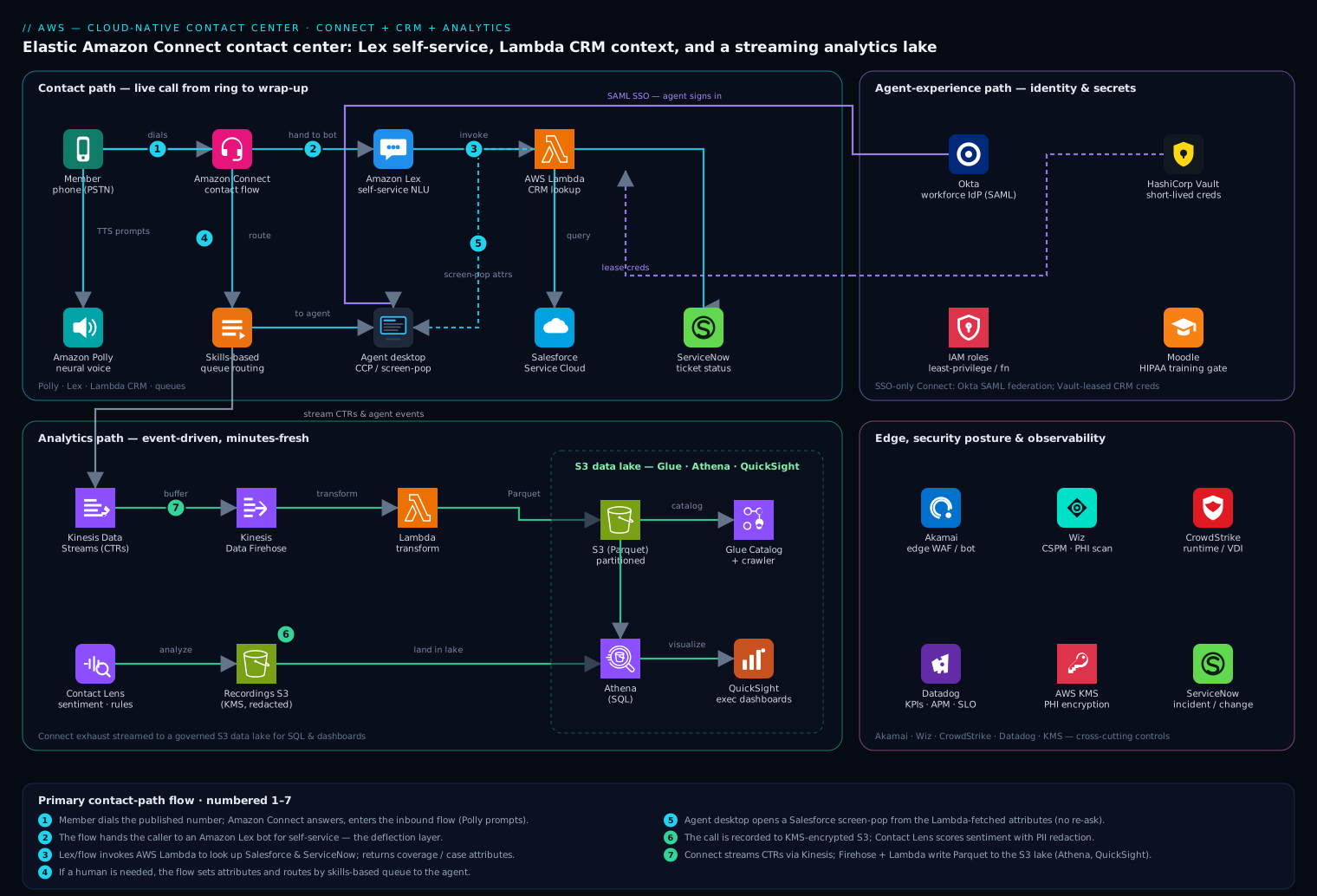
The platform runs three distinct paths that share an instance but live on different schedules: a synchronous contact path that handles a live call from ring to wrap-up, an agent-experience path that authenticates and equips the human, and an event-driven analytics path that turns every completed contact into governed, queryable data. Keeping them separate in your head is the first step to operating this well.
The defining property of the topology is that Amazon Connect is the orchestrator, not a monolith — it owns telephony, the contact flow, queues, and recording, and at every decision point it invokes your code (Lex for understanding, Lambda for data) and streams its exhaust (events, metrics, transcripts) to AWS services you control. That separation is what makes self-service, CRM context, and a data lake additive features rather than vendor change requests.
Contact path, following a member’s call:
- A member dials the published number; Amazon Connect answers on a claimed phone number and enters the inbound contact flow. Amazon Polly speaks prompts in natural neural voices, so there is no recorded-prompt studio to maintain.
- The flow hands the caller to an Amazon Lex bot for natural-language self-service: “I want to check my deductible.” Lex resolves intent and slots (member ID, plan year) and, for the routine questions, answers entirely in the bot — this is the deflection layer that keeps the forty routine questions off the agent queue.
- To answer with real data, the Lex bot — or the flow directly — invokes an AWS Lambda function that performs the CRM lookup: it calls Salesforce (Service Cloud) for the member’s case and coverage record and ServiceNow for any open IT/benefits ticket, then returns the deductible, plan tier, and case status as flow attributes. Lambda is the integration seam where Connect meets your systems of record.
- If the member needs a human, the flow sets a contact attribute (intent, member tier, language) and routes to the correct queue by skills-based routing. A high-tier member or a clinical question lands in a specialized queue; everyone else flows to the general enrollment pool.
- The call connects to an available agent in the Connect Contact Control Panel (CCP), embedded in a custom agent desktop. A screen-pop — driven by the same Lambda-fetched attributes via the Connect Streams API — opens the member’s Salesforce record before the agent says hello, so no one asks “can I get your member ID” a second time.
- The conversation is recorded (with consent capture in the flow) to Amazon S3, and Contact Lens transcribes and analyzes it in real time — sentiment, talk-time, silence, and rule-based alerts (a detected escalation phrase can flag a supervisor live).
Agent-experience path: agents do not get a Connect-local password. They sign in once through Okta as the workforce IdP, which federates via SAML to the Connect instance, so joiners and leavers are provisioned and de-provisioned in Okta and a terminated agent loses contact-center access the instant HR disables their identity. The agent desktop pulls any third-party API tokens it needs (a Salesforce connected-app secret, a ServiceNow integration credential) from HashiCorp Vault rather than baking them into Lambda environment variables, so secrets are short-lived and centrally rotated.
Analytics path, independent and event-driven: Connect streams Contact Trace Records (CTRs) and agent events through Amazon Kinesis Data Streams; Contact Lens output (transcripts, sentiment, categories) and the call recordings land in S3. A Kinesis Data Firehose + Lambda transform writes the records as partitioned Parquet into the data lake (S3 + AWS Glue Data Catalog), where Amazon Athena and QuickSight answer the executive questions — occupancy, FCR, deflection rate, sentiment trend — on data that is at most minutes old. That streaming export, not a nightly batch, is what turns “how are we doing right now” into a live dashboard.
Component breakdown
| Component | Service / tool | Role in the platform | Key configuration choices |
|---|---|---|---|
| Contact center core | Amazon Connect | Telephony, contact flows, queues, routing, recording | Claimed DID + toll-free; skills-based routing; recording to encrypted S3 |
| Self-service NLU | Amazon Lex | Intent/slot resolution, conversational deflection | Bot per domain; confidence threshold to fall back to an agent |
| Text-to-speech | Amazon Polly | Natural neural voice prompts in the flow | Neural voices; SSML for numbers/dates; no recorded-prompt studio |
| CRM / system-of-record glue | AWS Lambda → Salesforce + ServiceNow | Member/coverage lookup, ticket status, screen-pop data | Per-function least-privilege role; VPC egress; secrets from Vault |
| Identity / SSO | Okta | Agent and supervisor SSO into Connect | SAML federation; SCIM provisioning; MFA + conditional access |
| Secrets | HashiCorp Vault | Salesforce/ServiceNow API creds, signing keys | AWS IAM auth method; dynamic short-lived leases; per-function policy |
| Conversation analytics | Contact Lens | Real-time + post-call transcript, sentiment, rules | Real-time on enrollment queues; PII redaction in transcript & audio |
| Streaming | Kinesis Data Streams + Firehose | Export CTRs, agent events, analytics to the lake | Shard sizing to peak TPS; Firehose buffering to Parquet |
| Data lake | S3 + AWS Glue + Athena + QuickSight | Governed store + SQL + executive dashboards | Partition by date/queue; Lake Formation grants; Glue crawler |
| Edge / web | Akamai | TLS, WAF, bot protection for the agent desktop & web chat | WAF on the desktop origin; bot mitigation on chat widget |
| CSPM / posture | Wiz (+ Wiz Code) | Cloud posture, PHI-exposure & attack-path detection; IaC scanning | Agentless scan of S3/Lambda/Connect; Wiz Code gate in the pipeline |
| Runtime security | CrowdStrike Falcon | Runtime protection on agent VDI and Lambda-adjacent compute | Sensor on VDI fleet; detections to the SOC |
| Observability | Datadog | Contact-center KPIs, Lambda traces, synthetics, alerting | Connect metrics via integration; APM on Lambda; SLO monitors |
| ITSM / approvals | ServiceNow | Incident records, change approval for flow/bot changes | Change gate before a flow goes live; auto-ticket on Contact Lens alert |
| CI / IaC | GitHub Actions / Jenkins + Argo CD + Terraform / Ansible | Pipeline build/test; flows-as-code; infra and config | OIDC to AWS (no stored keys); Argo CD syncs desktop app to EKS |
| Agent enablement | Moodle | Onboarding & compliance training for seasonal agents | HIPAA + product courses; completion gate before queue assignment |
A few of these choices deserve the why, because they are the ones teams get wrong.
Why Lex deflection is the economic core, not a gimmick. The cheapest call is the one a human never takes. If Lex resolves “check my deductible” end to end, that contact costs a fraction of an agent-handled minute and the member is done in twenty seconds. The discipline is the confidence threshold: set Lex to fall back to a human the moment intent confidence drops, because a bot that confidently mis-answers a benefits question during enrollment does more reputational damage than a queue. Deflection rate is a headline metric precisely because it moves both cost and CSAT in the same direction.
Why CRM context lives in Lambda, not in the flow. It is tempting to wire small lookups directly into the contact flow. Don’t let real integration logic live there — flows are for routing decisions, and business logic embedded in a flow is untestable and unversionable. Put the Salesforce/ServiceNow calls in Lambda, where they get unit tests, a least-privilege IAM role, VPC egress to reach private CRM endpoints, and Vault-leased credentials. The flow passes an identifier in and reads attributes out; the how stays in code you can test and roll back.
Why stream to a lake instead of using only the built-in reports. Connect’s historical metrics are fine for an operations view, but the executive questions — deflection by intent, sentiment by plan tier, occupancy correlated with hold time — need joins across CTRs, Contact Lens output, and your own member data. Streaming CTRs and analytics into an S3 data lake with Athena gives you that open, joinable surface; the closed-suite alternative is to ask the vendor for a report and wait.
Implementation guidance
Provision with Terraform and treat identity and the network as the first deliverables. Stand up the Connect instance, claim numbers, and define queues and routing profiles as code so the whole contact center is reproducible across a dev and prod instance — flows promoted by export/import in the pipeline, never hand-edited in prod. A minimal Terraform shape for the instance communicates the intent — SSO-only, no Connect-local directory:
resource "aws_connect_instance" "cc" {
  identity_management_type  = "SAML"   # agents come from Okta, not a Connect directory
  inbound_calls_enabled     = true
  outbound_calls_enabled    = true
  contact_lens_enabled      = true
  auto_resolve_best_voices_enabled = true
}

resource "aws_connect_routing_profile" "enrollment" {
  instance_id               = aws_connect_instance.cc.id
  name                      = "open-enrollment"
  default_outbound_queue_id = aws_connect_queue.general.queue_id
  media_concurrencies { channel = "VOICE" concurrency = 1 }
  media_concurrencies { channel = "CHAT"  concurrency = 3 }  # one agent, three chats
}
The pipeline that applies this runs in GitHub Actions (or Jenkins where the payer standardizes on it), authenticating to AWS via OIDC so there is no stored access key to leak — a hard lesson the platform team intends never to repeat. Argo CD syncs the custom agent desktop (the React app embedding the CCP) to the EKS cluster, Ansible configures the agent VDI image, and Wiz Code scans the Terraform and Lambda packages in the pipeline so a public S3 bucket or an over-broad IAM policy is caught before it deploys, not by an auditor afterward.
Identity: kill the local accounts, federate the agents. Set the instance to SAML identity management so the only way an agent reaches the CCP is through Okta — single sign-on, MFA, conditional access, and SCIM provisioning mean a seasonal-hire cohort is onboarded in Okta groups and a terminated agent loses access the instant HR disables the identity. Lambda functions assume least-privilege IAM roles (one per function, only the API actions it needs), run in the VPC to reach private Salesforce/ServiceNow endpoints, and pull third-party credentials from HashiCorp Vault via the AWS IAM auth method as short-lived leases, so no long-lived CRM secret ever sits in a Lambda environment variable.
Contact-flow and bot wiring. Keep flows lean: greet, consent, Lex self-service, Lambda lookup, set attributes, route. Version the Lex bot and the flow exports in git, and promote them through the pipeline with a ServiceNow change approval — a mis-routed flow during enrollment is a production incident, so it gets a documented gate. Carry the member’s identifiers and the Lambda-fetched context as contact attributes so the screen-pop and any downstream transfer inherit full context and no one re-asks for a member ID.
Enterprise considerations
Security, compliance & Zero Trust. Every recording and transcript is PHI, so the architecture is built to a HIPAA bar: Connect runs under a signed AWS BAA, recordings and Contact Lens output are encrypted with KMS in S3, and Contact Lens PII redaction masks member identifiers in both transcript text and the audio itself. Access is identity-based and least-privilege end to end — Okta-federated agents, per-function Lambda roles, Lake Formation grants on the analytics tables so an analyst sees de-identified columns unless explicitly entitled. Layer on top: (a) Akamai at the edge for TLS, WAF, and bot mitigation on the agent desktop and the web-chat widget; (b) Wiz running continuous CSPM and PHI-exposure scanning across S3, Lambda, and the Connect data plane, alerting the moment a bucket drifts to public or an IAM policy widens — with Wiz Code shifting that check left into the pipeline; © CrowdStrike Falcon sensors on the agent VDI fleet and Lambda-adjacent compute for runtime threat detection feeding the SOC; (d) a Contact Lens compliance-rule hit or a Falcon detection auto-raises a ServiceNow incident, so security has a ticket, not just a log line.
Cost optimization. Connect bills per-minute and per-feature, so cost moves with volume and with how much you deflect.
| Lever | Mechanism | Typical effect |
|---|---|---|
| Self-service deflection | Resolve routine intents in Lex before an agent | Each deflected contact avoids agent-minute cost entirely |
| Right-sized Contact Lens | Real-time analytics only on enrollment queues; post-call elsewhere | Real-time is priced higher per minute than post-call |
| Lambda efficiency | Tune memory/timeout; cache hot CRM reads | Cuts per-invocation cost on every contact |
| Lifecycle on recordings | S3 lifecycle to Glacier after the retention window | PHI retention met without standard-tier storage forever |
| No idle hardware | Pay-per-use telephony vs. an always-on ACD | The whole point — capacity for six weeks, billed for six weeks |
Meter cost by queue and intent in Datadog so member-services owns its spend and the CFO sees deflection translate directly into dollars.
Scalability. Each tier scales independently and this is the headline win. Amazon Connect absorbs the 3× enrollment surge with no capacity project — it is the managed core that exists so you never size for the peak. Lex and Lambda scale on concurrency automatically; the only knob that needs forethought is Lambda reserved/provisioned concurrency on the CRM-lookup path so a Monday spike doesn’t cold-start every screen-pop. Kinesis scales by shards — size them to peak contacts-per-second so the analytics stream never throttles under load. The agent desktop on EKS scales pods on concurrency. The natural ceilings to plan for are Connect service quotas (concurrent calls, queues, claimed numbers) — raise them before the season, because a quota request mid-peak is the failure that pages you.
Failure modes, and what each one looks like. Name them before they page you.
- A Lambda CRM-lookup timeout or Salesforce 429 — the screen-pop is empty and the agent flies blind, or the flow stalls mid-call. Mitigation: a short Lambda timeout with a graceful fallback branch in the flow (“we couldn’t load your record, the agent will pull it up”), provisioned concurrency to kill cold starts, and a circuit breaker so a CRM outage degrades to manual lookup instead of dropping calls.
- Lex over-confidence — the bot mis-answers a benefits question it should have escalated. Mitigation: a conservative confidence threshold and a fast path to a human, with mis-resolutions mined from Contact Lens transcripts to retrain.
- Kinesis shard throttling at peak — CTRs back up and the live dashboard goes stale exactly when executives are watching. Mitigation: size shards to peak TPS and alarm on iterator age in Datadog.
- Recording / redaction gap — a consent or redaction misconfiguration writes un-redacted PHI to S3. Mitigation: enforce redaction in the flow and the Contact Lens config, and let Wiz independently verify no un-redacted exposure exists.
- Regional outage — see DR below.
Reliability & DR (RTO/RPO). Decide the numbers per tier. Amazon Connect is a regional, highly available managed service; for true regional DR, stand up a second Connect instance in a paired region with flows and queues deployed identically by the same Terraform, and fail telephony over by re-pointing the carrier/DID or a Route 53 / SIP failover — flows-as-code is what makes that warm standby real rather than aspirational. The S3 data lake and recordings replicate cross-region (CRR) as the durable source of truth, giving near-zero RPO on the analytics and compliance data. A pragmatic target for this platform: RTO 30 minutes, RPO near-zero for recordings and analytics, with live-call continuity handled by carrier-level failover. Akamai health checks drive edge failover for the agent desktop and chat.
Observability. Instrument the contact center end to end in Datadog: pull Connect’s real-time and historical metrics via the integration, run APM on the CRM-lookup Lambdas (so a slow Salesforce call shows up as a span, not a mystery), and add synthetics that place a test call and walk the IVR every few minutes so a broken flow is caught by a monitor, not a member. Emit the metrics the business actually cares about — deflection rate, first-contact resolution, agent occupancy, average sentiment, abandonment, and p95 hold time — and wire SLO monitors with alerting so a regression pages on-call. A Contact Lens real-time rule (a detected escalation phrase, a sustained negative-sentiment call) can alert a supervisor live and auto-open a ServiceNow ticket. Seasonal agents only join a queue after completing the HIPAA and product courses in Moodle, so the completion gate is itself an auditable control.
Governance. Treat flows, Lex bots, and Lambda as versioned artifacts — exported, reviewed in git, and promoted through the pipeline with a ServiceNow change gate, never hand-edited in production. Apply IaC policy (via Wiz Code in the pipeline and AWS config rules) to deny a public bucket or an un-encrypted recording store, with Wiz as the independent check that the controls are real. Retain recordings and transcripts for the regulatory window with an S3 lifecycle policy and a documented right-to-be-forgotten path, since member conversations are PHI under the same regime that governs the whole platform.
Explicit tradeoffs
Accept these or do not build it. A cloud-native contact center trades capital telephony gear for a web of managed services and integration code you must own — Lambda functions to test, contact flows to version, a streaming pipeline to keep flowing, and Lex bots whose quality you must measure and retrain. Per-minute billing means your cost is now coupled to volume and to feature choices (real-time Contact Lens is not free), so an un-tuned deployment can surprise the CFO in the other direction. The Okta SAML federation adds an identity hop the simpler single-directory shops won’t need, and the open data lake that gives you those executive dashboards is itself a system to govern, secure, and pay for. None of this is the “plug in a softphone” weekend; it is a platform.
The alternatives, and when they win. If you are a very small or seasonal-only team that just needs overflow capacity for a few weeks, a lighter CCaaS subscription with built-in reports may be enough — graduate to this when CRM context, a data lake, and HIPAA-grade control matter. If your differentiation is a deeply custom agent and routing experience, you may push more logic into your own application tier and use Connect mainly as elastic telephony — more control, more code. And if you are mid-migration off an on-prem ACD, a hybrid period — Connect for new/overflow queues while the legacy system drains — is the pragmatic on-ramp, with this architecture as the destination.
The shape of the win
For the payer’s member-services org, the payoff is not “calls in the cloud.” It is that on the first Monday of Open Enrollment the queue does not melt: routine deductible and copay questions resolve in Lex in twenty seconds and never reach an agent, the calls that do reach a human open with the member’s Salesforce record already on screen, supervisors see sentiment and occupancy live instead of three weeks late, and not a single rack of telephony hardware was bought for a six-week peak. That combination — elastic capacity, real deflection, live CRM context, governed analytics — is what lets a VP of Member Services, a CISO, and a CFO each say yes to the same architecture. Everything upstream, the Okta federation, the Vault-held CRM secrets, the Lambda screen-pop, the Contact Lens redaction, the Kinesis-to-lake pipeline, the Datadog SLOs, exists to make that first Monday boring. Start narrower if you must — a single queue, a few intents — but this is where a regulated, seasonal, at-scale contact center has to land.