IoT projects rarely die on the demo. They die eighteen months later, when the pilot of 200 sensors becomes a fleet of 80,000, when a field technician needs to push firmware to a substation that is occasionally offline, when the data scientist asks “what was the inlet temperature on pump P-4471 the last time its downstream valve threw a fault,” and the answer involves three exports and a spreadsheet. The hard part of industrial IoT is almost never ingesting a number. It is the device lifecycle — provisioning, identity, configuration, updates, and disconnection handling — and the context — knowing that this number came from that sensor, on that machine, in that building, feeding that line.
This article is the architecture I reach for when an enterprise needs to do IoT properly on Azure: a managed, identity-first ingestion plane (IoT Hub + Device Provisioning Service), a clean split between time-sensitive decisions (Stream Analytics) and queryable history (Azure Data Explorer), and — the piece most teams skip and then regret — a live digital model of the physical estate in Azure Digital Twins that turns a firehose of anonymous telemetry into “Line 3’s compressor is overheating.” The shape holds whether you run 500 devices in one factory or 2 million meters across a country; what changes is the IoT Hub tier and partition count, not the topology.
The business scenario
Start with a manufacturer, a utility, or a smart-building operator who already has some telemetry. PLCs and sensors exist on the plant floor; a SCADA historian holds tags; someone wired a few gateways to a cloud endpoint for a proof of concept. The proof of concept worked — and that is precisely the problem, because now the business wants to scale it and discovers the PoC has none of the things a fleet needs.
The questions that force a real architecture are not “can we read a sensor.” They are operational and lifecycle questions:
- Manufacturing (predictive maintenance): “Across 14 plants and 80,000 sensors, page a reliability engineer before a bearing fails — and when we ship a new vibration-analysis model, roll it out to 6,000 edge gateways in waves, automatically rolling back the cohort that starts crash-looping.”
- Utilities (smart metering / grid): “Ingest 15-minute interval reads from 2 million meters, detect a feeder-level consumption anomaly that signals an outage or theft, and securely provision a replaced meter in the field with zero manual key entry by the technician.”
- Smart buildings / real estate: “Show building operations a floor-by-floor live view of temperature, occupancy, and CO₂; let them ask ‘which zones are out of comfort band right now’ and also ‘how did this floor’s energy use change after we re-commissioned the AHU in March.’”
- Logistics / cold chain: “Track reefer container temperature and door events; if a container’s compressor degrades, know which shipment and which customer SLA is at risk — not just which anonymous device ID misbehaved.”
Every one of these shares the same structural requirements, and they are different from a generic streaming pipeline:
- Per-device identity and trust — each physical thing needs its own credential (X.509 cert or TPM, not a shared key), must be enrollable at scale without a human typing secrets, and must be revocable the instant it is compromised or decommissioned.
- Bidirectional control, not just ingestion — the cloud must read telemetry and push desired configuration, invoke commands, and deploy firmware/edge modules to devices that are intermittently connected.
- Two consumers of the same stream — an operations console needs seconds-fresh state over the last minutes-to-hours (the hot path); engineers, analysts, and data scientists need to slice months-to-years of the same readings interactively (the historical path). On one engine they fight.
- Physical context — telemetry is near-useless as a bare
deviceId, value, timestamptuple. The business reasons about assets, spaces, and relationships: pumps in lines, rooms on floors, meters on feeders. Something has to hold that graph and keep it live.
The architecture below resolves all four. IoT Hub owns identity and the bidirectional channel; DPS owns zero-touch onboarding; Stream Analytics owns “decide in seconds”; Azure Data Explorer owns “the truth over time, queryable”; and Azure Digital Twins owns “what does this number mean in the physical world.” It pays off at a few hundred devices and scales — without a redesign — into the millions.
Architecture overview
End to end, a reading travels through six stages: provision → ingest (device plane) → process (hot path) → contextualise (twin graph) → historise (analytical store) → serve. Crucially, two things flow in both directions here — telemetry up, and configuration/commands/firmware down — which is what separates an IoT architecture from a one-way streaming one.
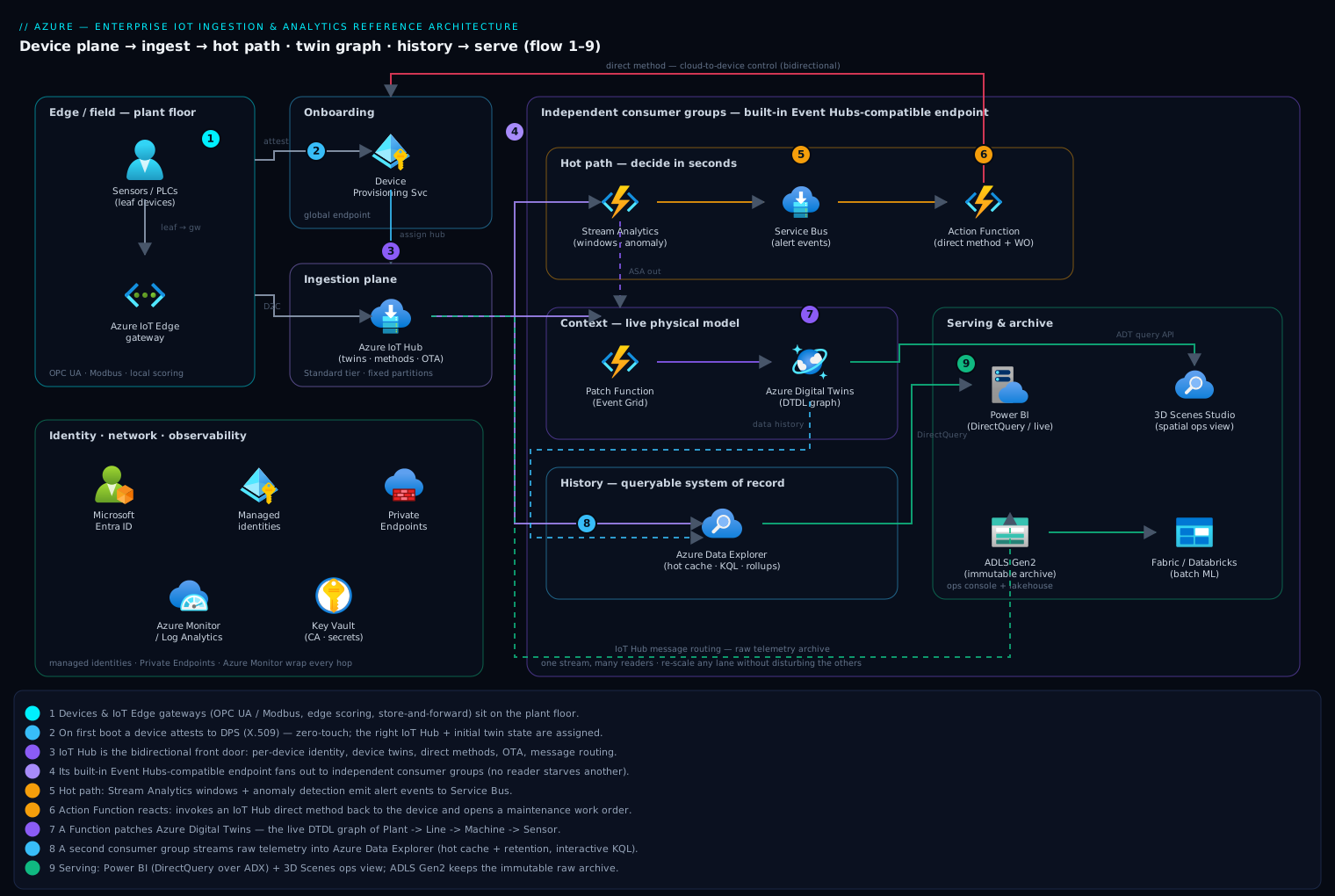
The data and control paths, in words:
-
Devices and the edge. Constrained sensors, PLCs, and gateways live on the plant floor or in the field. Where local processing, protocol translation (OPC UA, Modbus), store-and-forward during disconnection, or low-latency control is needed, an Azure IoT Edge runtime runs on a gateway, hosting containerised modules (including downsized Stream Analytics jobs or ONNX/ML models that score locally). Leaf devices talk to the gateway; the gateway is the single cloud-facing identity.
-
Zero-touch onboarding — Device Provisioning Service (DPS). A device is never hard-coded to a hub. On first boot it contacts its DPS global endpoint, attests with its X.509 certificate (or TPM endorsement key / symmetric key), and DPS — based on an enrollment group — assigns it to the right IoT Hub (load-balanced across a fleet, or geo-nearest) and writes its initial twin state. This is how a technician can swap a failed meter and have the replacement self-register with no keys typed in the field, and how you onboard hundreds of thousands of units from a factory line.
-
The ingestion and device-management plane — Azure IoT Hub. IoT Hub is the front door and the control plane. Every device has a per-device identity in the hub’s registry; it authenticates per-device (ideally X.509), and the hub enforces it. Beyond ingesting device-to-cloud (D2C) telemetry, IoT Hub provides the things a fleet cannot live without: device twins (a JSON document per device holding reported state and desired configuration), direct methods (request/response commands like “run self-test now”), cloud-to-device messages, and integration with Device Update for IoT Hub for staged, resumable over-the-air firmware/package updates. IoT Hub exposes a built-in Event Hubs-compatible endpoint, so everything downstream consumes telemetry exactly as it would from Event Hubs — via independent consumer groups, the linchpin that lets multiple readers share one stream. Message routing inside the hub fans messages to multiple sinks by query (e.g., alerts to Service Bus, all telemetry to the analytics path, raw to storage) without any device-side change.
-
The hot path — Azure Stream Analytics (ASA). One ASA job reads the hub’s built-in endpoint over its own consumer group and runs continuous SQL: tumbling/hopping/sliding windows, joins to reference data, watermark-based late/out-of-order handling, and built-in
AnomalyDetection_SpikeAndDip/ChangePoint. ASA computes the decisions that cannot wait — a 30-second rolling vibration RMS, a feeder-level demand spike, a comfort-band breach — and, critically, can emit an alert event (to Service Bus / Event Hubs) that triggers an Azure Function to act: invoke an IoT Hub direct method back to the device, open a ServiceNow incident, or page on-call. -
The contextualisation layer — Azure Digital Twins (ADT). This is the piece that makes the whole thing legible to the business. ADT holds a live graph of your physical estate, modelled in DTDL (Digital Twins Definition Language): twin types for
Pump,Line,Plant,Floor,Meter,Feeder, with relationships (Line contains Pump,Floor hasZone Zone). An Azure Function (fed by ASA output or by IoT Hub routing through Event Grid) patches the corresponding ADT twin’s properties as telemetry arrives, so the graph reflects current reality. Now an operator query is spatial and semantic — “give me every Zone on Floor 3 whose CO₂ > 1000 ppm” or “for shipment SH-88213, what is the reefer’s compressor state” — not a raw device lookup. ADT emits its own change events, and its data-history feature can stream twin updates straight into Azure Data Explorer for time-series-of-context. -
The historical / analytical store — Azure Data Explorer (ADX / Kusto). A second consumer group streams the raw telemetry into ADX via native, schema-on-write streaming/queued ingestion — no ASA in the middle. ADX keeps a hot cache (SSD/in-memory) over the recent window for millisecond interactive KQL and ages older data into cold cache on cheap blob, governed per-table by caching + retention policies. Update policies and materialized views build downsampled rollups for fast dashboards. This is the warm + cold layer in one engine and your queryable system of record for telemetry — the role Azure Time Series Insights used to play before its retirement, with ADX now the recommended successor (and the engine behind Real-Time Analytics in Microsoft Fabric).
-
Long-term landing (optional, common). IoT Hub message routing (or Event Hubs Capture on a downstream hub) lands the raw stream in ADLS Gen2 as Avro/Parquet for an immutable, replayable archive feeding Fabric / Databricks / Synapse batch ML and model training. ADX can also export to the lake.
-
The serving layer. Operations get a live view two ways: Power BI with DirectQuery over ADX for rich interactive history over billions of rows, plus ASA-pushed streaming tiles for second-by-second numbers; and ADT-backed 3D/2D visualizations (the Azure Digital Twins 3D Scenes Studio, or a custom app over the ADT query API) for the spatial operations picture.
-
Identity, network, observability wrap everything: Microsoft Entra ID + managed identities for every service-to-service hop, Private Endpoints to keep IoT Hub/ADX/ADT off the public internet, and Azure Monitor / Log Analytics collecting IoT Hub connected-device counts and throttling, ASA watermark delay, and ADX ingestion latency.
The mental model: DPS gets devices in the door safely; IoT Hub is the trusted, bidirectional plane for the fleet; Stream Analytics owns “what must I decide in seconds?”; Azure Digital Twins owns “what does this mean in the physical world, right now?”; Azure Data Explorer owns “what is the truth over time?” Because every consumer reads an independent consumer group, you can re-scale or redeploy the hot path, the twin updater, or ADX ingestion without disturbing the others — or the devices.
Component breakdown
| Component | Role in this architecture | Key configuration choices |
|---|---|---|
| Azure IoT Edge | On-prem/field runtime for protocol translation, local scoring, and store-and-forward; presents one cloud identity for downstream leaf devices. | Run as a transparent or translation gateway; deploy modules via deployment manifests + automatic deployments (label-targeted); enable offline store-and-forward (StoreAndForwardConfiguration); host downsized ASA / ONNX modules for edge inference. |
| Device Provisioning Service (DPS) | Zero-touch, at-scale device onboarding and hub assignment; no secrets typed in the field. | Prefer X.509 enrollment groups (CA-signed) over symmetric keys; choose allocation policy (lowest-latency, evenly-weighted, or custom Function for fleet sharding); set initial desired twin state at enrollment; re-provisioning policy for hub failover/migration. |
| Azure IoT Hub | Per-device identity, D2C telemetry ingestion, device twins, direct methods, C2D, message routing, OTA via Device Update. | Standard tier (S1/S2/S3) for twins/methods/routing — not Basic; scale by unit count + partition count (set partitions up front, they’re fixed for the hub’s life); per-device X.509 auth; define routes (telemetry → analytics, alerts → Service Bus, raw → storage); disable shared-access keys where Entra auth suffices. |
| Azure Stream Analytics | Hot path: windowed aggregates, anomaly detection, alert generation in seconds. | Read IoT Hub’s built-in endpoint via a dedicated consumer group; size Streaming Units (SUs); partition-aligned query for parallelism; use TIMESTAMP BY event-time + tolerable lateness; output to Service Bus/Functions for action and to Power BI for live tiles. |
| Azure Digital Twins (ADT) | Live semantic/spatial graph of the physical estate; turns telemetry into asset/space context. | Model with DTDL v3 (types + relationships + components); update twins from telemetry via Function (Event Grid-triggered); enable data history to ADX; secure with Entra data-plane RBAC; query with the ADT query language for spatial questions. |
| Azure Data Explorer (ADX) | Historical system of record; millisecond interactive KQL over months–years; rollups. | Native streaming/queued ingestion from a second consumer group; per-table caching policy (hot window) + retention policy; update policies + materialized views for downsampling; right-size cluster SKU + enable autoscale; partition on deviceId/time for query locality. |
| ADLS Gen2 | Immutable, replayable raw archive + lakehouse source for batch ML / training. | Parquet/Avro; hierarchical namespace; lifecycle tiering (hot→cool→archive); fed by IoT Hub routing or ADX export. |
| Power BI + 3D Scenes Studio | Serving: interactive historical analytics (DirectQuery/ADX) + spatial ops view (ADT). | Power BI DirectQuery over ADX for big history; streaming dataset for live tiles; 3D Scenes Studio over ADT for the operations floor view. |
| Azure Functions / Logic Apps | Glue + action: patch ADT from telemetry, react to ASA alerts, invoke device commands. | Event Grid / Service Bus triggers; managed identity to IoT Hub (invoke direct methods), ADT (patch twins), ADX; idempotent handlers. |
A few non-obvious choices worth calling out. IoT Hub partition count is permanent — you set it when the hub is created and cannot change it later, so plan for fleet growth and downstream ASA/ADX parallelism on day one. Choose X.509 over symmetric keys for anything beyond a lab: it gives you per-device revocation and works natively with DPS enrollment groups, so you never ship a shared secret across a fleet. And do not put Stream Analytics in front of ADX for the historical path — ADX’s native ingestion is faster, cheaper, and schema-on-write; ASA is for the decisions, not for being a pump.
Implementation guidance
Provisioning the platform (IaC). Treat the whole stack as code. With Terraform, the azurerm provider covers azurerm_iothub, azurerm_iothub_dps (+ azurerm_iothub_dps_certificate for the CA), azurerm_stream_analytics_job and its inputs/outputs, azurerm_kusto_cluster / azurerm_kusto_database, and azurerm_digital_twins_instance (+ azurerm_digital_twins_endpoint_eventgrid). DTDL model uploads and twin/relationship seeding are data-plane operations the AzureRM provider does not do — drive those with the az dt CLI, the ADT data-plane SDK, or the azapi provider in a post-deploy step, and keep your .json DTDL models in the repo as the source of truth. Bicep is the first-class alternative if you are all-Microsoft: Microsoft.Devices/IotHubs, Microsoft.Devices/provisioningServices, Microsoft.DigitalTwins/digitalTwinsInstances, Microsoft.Kusto/clusters, with the same data-plane caveat for DTDL and KQL schema (run .create table / .alter-merge policy scripts via a deployment script or pipeline task).
Wiring the device identity chain. This is the part teams underestimate. Stand up (or reuse) a PKI: a root CA, an intermediate signing CA, and per-device leaf certs. Register the verified CA with DPS, create an X.509 enrollment group bound to it, and your manufacturing/flashing process burns a unique leaf cert (TPM-backed where the hardware allows) into each device. On first boot the device hits DPS, proves possession of its key, and DPS provisions it to a hub and sets initial twin desired-properties. Revocation is then per-device and instant. Never ship the same symmetric key to more than one device.
Networking. For an enterprise build, lock the data plane down: Private Endpoints for IoT Hub, ADX, ADT, Service Bus, and Storage, with Private DNS zones; set IoT Hub/ADX public network access to Disabled (or IP-filtered) once devices route via ExpressRoute/VPN or an edge gateway that egresses through your network. Devices that must traverse the public internet still get per-device TLS + X.509, but management and analytics traffic stays private. Use Azure Firewall / NSGs around the gateway subnets and an Event Grid private connection where supported.
Identity wiring. Every hop uses Microsoft Entra ID managed identities, not connection strings: the telemetry-to-ADT Function uses a user-assigned managed identity granted the ADT Azure Digital Twins Data Owner role; the alert Function holds the IoT Hub Data Contributor / Registry Contributor rights needed to invoke direct methods; ADX ingestion principals get database Ingestor role; ASA uses MSI auth to its inputs/outputs. Disable IoT Hub shared-access policies where Entra service auth covers the flow, and require X.509 (or Entra workload identity for cloud components) throughout. This is the Zero Trust spine — covered next.
Edge deployment. Define IoT Edge modules in deployment manifests checked into git; use automatic deployments with target conditions (e.g., tags.plant='Pune' AND tags.line='L3') so a new module version rolls to a labelled cohort, and use Device Update for IoT Hub for the host-OS/firmware layer with staged groups and automatic rollback on failure signals. The edge runtime’s store-and-forward means a gateway that loses connectivity buffers locally and back-fills on reconnect — essential for field and shop-floor reliability.
Enterprise considerations
Security & Zero Trust. Identity is per-device and certificate-based; there is no shared fleet secret. DPS + X.509 enrollment groups give cryptographic onboarding and instant per-device revocation. Service-to-service auth is Entra managed identity end to end, scoped with least-privilege data-plane RBAC (ADT Data Owner only where twins are written; ADX Ingestor not Admin; IoT Hub Registry rights only on the action Function). The data plane runs on Private Endpoints with public access disabled; Microsoft Defender for IoT monitors the device plane for anomalous behaviour and threats. Secrets/certs (CA keys, any residual SAS) live in Key Vault. Network, identity, and device trust are independent layers — compromising one device cannot pivot to the fleet or the cloud control plane.
Cost optimization. The big levers are tier and cache. IoT Hub is billed by unit/tier and daily message quota — right-size S-tier units to your message volume and batch device messages (don’t send one D2C message per reading if you can window at the edge). ADX is the other major line item: keep the hot cache window as small as the interactive use case allows (e.g., 31 days hot, years cold), enable cluster autoscale and stop dev clusters off-hours, and push rollups via materialized views so dashboards hit small aggregates not raw rows. Lifecycle-tier the ADLS archive (hot→cool→archive). ASA cost is Streaming Units — size to actual partitions, don’t over-provision. Edge-side filtering and aggregation cut both ingestion and downstream cost at the source.
Scalability. Each tier scales independently. IoT Hub scales by units; plan partitions up front (they’re immutable) to match peak fleet and downstream parallelism, and use DPS allocation policies / custom Functions to shard a very large fleet across multiple hubs. ASA scales by SUs with partition-aligned queries; ADX scales out (nodes) and up (SKU) with autoscale; ADT scales by units and supports millions of twins. Because consumers read independent consumer groups, adding a new analytics consumer never steals throughput from the hot path.
Reliability & DR (RTO/RPO). Design per-tier targets:
| Tier | Reliability mechanism | Indicative RPO / RTO |
|---|---|---|
| IoT Hub | Microsoft-managed intra-region HA; DPS re-provisioning to a paired-region standby hub on failover; devices retry via DPS global endpoint. | RPO seconds (in-flight buffered by device store-and-forward + edge); RTO minutes once DPS re-points devices. |
| Stream Analytics | Job restart from last checkpoint; idempotent outputs. | RPO ≈ checkpoint interval; RTO minutes (stateless re-deploy). |
| Azure Data Explorer | Follower databases / leader-follower or geo-replication for cross-region read; periodic export to lake as backstop. | RPO minutes (continuous ingest replay from hub); RTO depends on replica readiness. |
| Azure Digital Twins | Rebuildable from DTDL-in-git + a twin-seed pipeline; data-history in ADX is the durable copy. | RPO low (graph is reconstructable); RTO = redeploy + reseed. |
| ADLS archive | GRS/RA-GRS; immutable archive. | RPO per replication SLA; RTO read-immediate on RA-GRS. |
The edge’s store-and-forward is the unsung DR feature: a regional cloud outage doesn’t drop readings, because gateways buffer and back-fill on recovery.
Observability. Centralise in Azure Monitor / Log Analytics: IoT Hub connected-device count, throttling, and route-delivery failures; DPS registration successes/failures; ASA watermark delay and SU utilization; ADX ingestion latency and cache hit rate; ADT API throttling. Workbooks and alerts on watermark delay and ingestion lag catch backpressure before dashboards go stale. Per-device health is itself a twin reported property, so device liveness is queryable in ADT alongside telemetry.
Governance. Enforce with Azure Policy (require Private Endpoints, deny public network access on IoT Hub/ADX, require X.509). Tag and organise per the Cloud Adoption Framework; segregate environments (dev/test/prod hubs and clusters) in separate resource groups/subscriptions. Treat DTDL models as governed schema — versioned, reviewed, in git — because they’re the contract between devices and the business semantics. Audit data-plane access via Entra and Defender for IoT.
Reference enterprise example
Helios Components is a fictional mid-to-large automotive-parts manufacturer: 11 plants across India and Eastern Europe, roughly 62,000 sensors (vibration, temperature, current, acoustic) on presses, CNC machines, and injection-moulding lines, plus 3,800 IoT Edge gateways doing OPC UA translation and local scoring. Their old PoC used one symmetric SAS key shared across a plant’s devices, dumped JSON into a single overloaded Kusto-style table, and had no concept of which machine a reading belonged to — engineers correlated by hand. Two incidents (a shared key leaked by a contractor, and a €180,000 scrap run from a missed bearing failure) forced the rebuild.
What they built (this architecture):
- Identity & onboarding: A two-tier PKI; each gateway flashed at the line with a TPM-backed X.509 leaf cert. DPS with an X.509 enrollment group per plant, a custom allocation Function sharding the 62k devices across 3 IoT Hubs (S2, 8 partitions each — sized for 3× growth) by plant region. A failed gateway is now swapped by a technician in minutes with zero keys typed; the replacement self-provisions and pulls its desired config.
- Ingestion & device management: Gateways window at the edge (1-second RMS instead of raw waveform), cutting cloud message volume ~85%. IoT Hub routing sends telemetry to the analytics consumer groups, alerts to Service Bus, and raw to ADLS. Device Update for IoT Hub rolls the vibration model to gateways in plant-by-plant cohorts with automatic rollback — when a v3.2 module crash-looped on 40 older gateways, the cohort auto-reverted and only those 40 paged ops.
- Hot path: One Stream Analytics job (12 SUs, partition-aligned) computes 30-second rolling vibration RMS and
AnomalyDetection_ChangePointper machine; a breach emits a Service Bus alert → Function that (a) invokes an IoT Hub direct method to make the gateway capture a high-rate raw burst for forensics and (b) opens a maintenance work order. - Context: Azure Digital Twins models
Plant → Line → Machine → Sensorin DTDL v3 (about 62k device twins + 9k asset/space twins). An Event Grid-triggered Function patches twin properties live. Reliability engineers now ask the 3D Scenes Studio view “show every Machine on Pune Line 3 in alarm” and click straight to the asset — no device-ID lookup. - History: Raw 1-second telemetry streams to an ADX cluster (autoscaled, 31-day hot cache, 3-year retention), with materialized views for hourly/daily rollups. Power BI DirectQuery over ADX powers reliability dashboards over ~4 billion rows/month. ADT data-history lands twin-context changes in ADX so engineers can join “machine state” to “raw signal” in one KQL query.
Indicative monthly cost (production, one region-pair): 3× IoT Hub S2 ≈ $750; ASA 12 SU ≈ $880; ADX cluster (autoscaled, mixed) ≈ $4,200; ADT units ≈ $400; ADLS + egress ≈ $300; Functions/Service Bus/Monitor ≈ $350 — roughly $6,900/month for ~62k devices, dominated by ADX (tunable via hot-cache window and rollups). Edge windowing alone saved an estimated ~$2,100/month in ingestion + ADX storage versus shipping raw waveforms.
Outcome after two quarters: unplanned downtime on monitored lines down ~22%; the shared-key blast radius eliminated (per-device revocation); mean time to correlate a fault to a machine cut from ~25 minutes of manual work to a single twin query; and a new plant onboarded in under a week because the topology was IaC + DTDL, not a bespoke build.
When to use it
Use this architecture when you have a fleet (not a handful) of devices that need per-device identity, bidirectional control, and over-the-air updates; when telemetry only makes sense in physical/spatial context (assets, lines, floors, feeders); and when the same readings must serve both a seconds-fresh operations view and deep historical analysis. It is the right call for industrial IoT, smart manufacturing, utilities/metering, smart buildings, and connected logistics from hundreds of devices into the millions.
Trade-offs and when not to:
- A few devices, no fleet management. If you have a dozen sensors and no need for OTA, twins, or zero-touch provisioning, IoT Hub + DPS + ADT is over-engineered. Send to Event Hubs → ADX directly (that’s the sibling streaming reference architecture) and skip the device plane.
- No physical-context questions. If the business never reasons about assets/spaces and a flat
deviceId, value, timetable is genuinely enough, drop Azure Digital Twins. ADT earns its keep only when spatial/semantic queries and a live model matter; adding it “just in case” is cost and complexity with no payoff. - Pure cloud telemetry / software events. If your “devices” are actually services or apps emitting events (not constrained hardware needing provisioning and updates), you don’t need IoT Hub at all — use Event Hubs.
- All-in-one simplicity over best-of-breed. If the team wants one bill and one pane of glass and can accept its current limits, Microsoft Fabric Real-Time Intelligence (eventstreams + Real-Time Analytics, which is ADX under the hood) can absorb the hot + historical paths; you still front it with IoT Hub for the device plane. Choose this when operational simplicity outweighs the finer control of discrete ASA + ADX.
Anti-patterns to avoid: shipping a shared symmetric key across a fleet (use X.509 + DPS); under-provisioning IoT Hub partitions (they’re permanent — size for growth); putting Stream Analytics in front of ADX for historization (use ADX native ingestion; reserve ASA for decisions); using device twins as a telemetry store (twins hold state and config, not time-series — that’s ADX’s job); and skipping the edge when devices are intermittently connected (store-and-forward is your reliability and DR backstop). Get those right and the same topology carries you from the first pilot line to a multi-plant, multi-million-device estate without a rewrite.