Where this fits
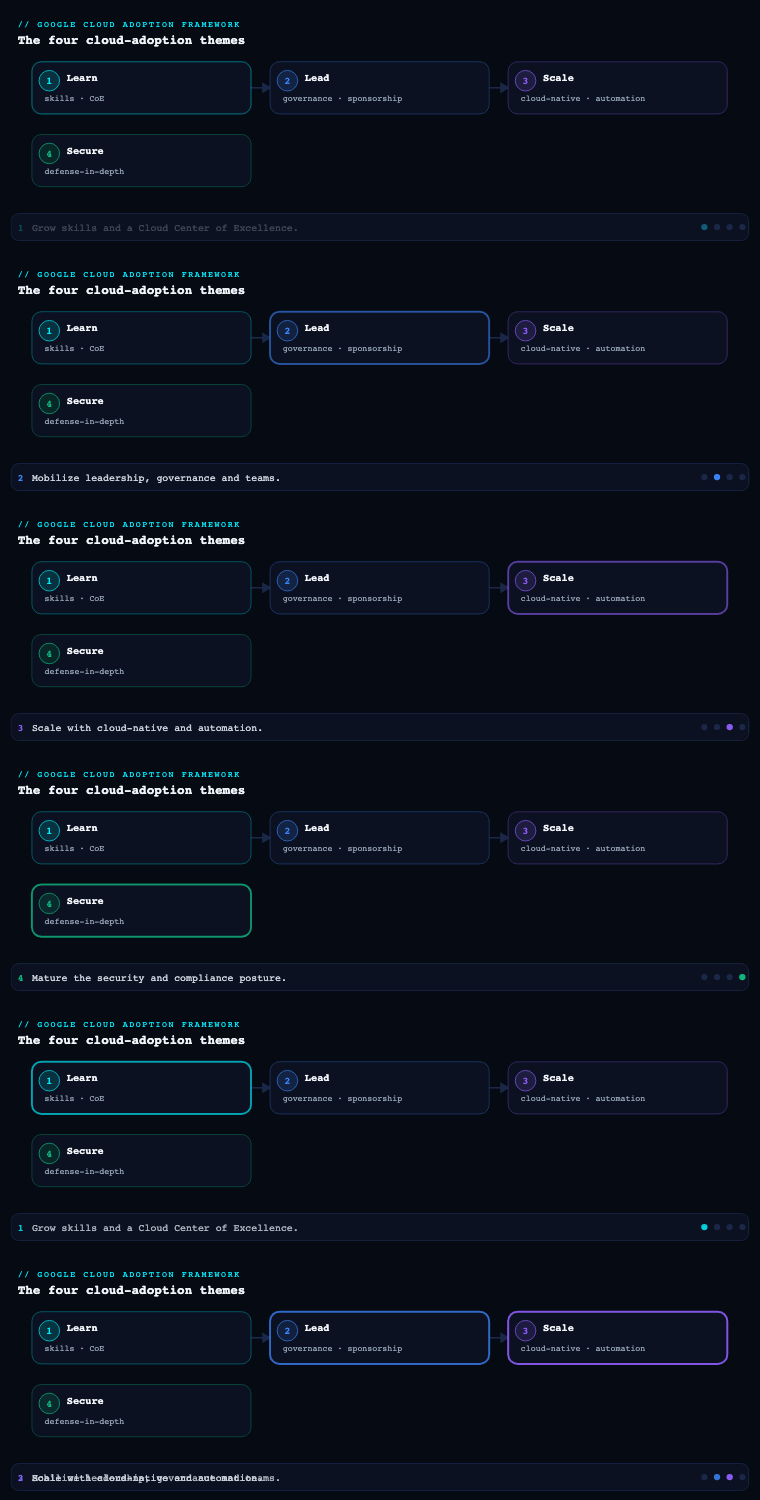
Google’s Cloud Adoption Framework (CAF) rates your organization across four themes — Learn, Lead, Scale, and Secure — at one of three maturity phases: Tactical, Strategic, or Transformational. The Scale theme is Google’s own words “the extent to which you use cloud-native services that reduce operational overhead and automate manual processes and policies.” It is the theme that measures whether you are running the cloud or merely renting servers in it. Where Learn built the skills and Lead built the organizational momentum, Scale is where that capability cashes out as throughput: it asks how far you have abstracted infrastructure behind managed and serverless services, how good your CI/CD chain and Infrastructure-as-Code are, and how much of your operations are self-service and consumption-based rather than ticket-driven. This is part 4 of the series and goes deep on the five levers that move you from Tactical (where, per Google, “change is slow and risky with operations still heavy”) to Transformational (where “all change is constant, low risk, and quickly fixed”) — cloud-native adoption, automation, CI/CD, scaling workloads and teams, and consumption-based self-service operations. Google groups the underlying work into three epics — Architecture, CI/CD, and Infrastructure as Code — and these map almost one-to-one onto the levers below.
Sub-component 1: Cloud-native adoption
What it is. Cloud-native adoption is the deliberate move up the abstraction stack — from VMs you patch, to containers an orchestrator schedules, to managed runtimes and serverless functions where you own only code and configuration. The CAF is explicit that “your ability to scale in the cloud is determined by the extent to which you abstract away your infrastructure with managed and serverless cloud services.” A Tactical organization lift-and-shifts onto Compute Engine and keeps doing data-center operations in a more expensive location. A Transformational one consumes managed services so that elasticity, patching, and high availability are properties of the platform, not projects on a backlog.
Why it matters. Every layer of infrastructure you own is operational overhead that does not scale linearly — it scales with headcount. Managed services break that coupling: Cloud Run scales to thousands of container instances and back to zero with no node pool to size; BigQuery scales query slots without a DBA provisioning storage; Spanner reshards transparently across regions. Google’s own maturity model treats this abstraction as the precondition for the constant, low-risk change that defines Transformational — you cannot deploy fearlessly fifty times a day onto infrastructure you are hand-nursing.
How to do it well. Adopt a default-to-managed principle and make teams justify choosing a lower abstraction, not the reverse. Use a clear compute-selection ladder so the decision is mechanical, not religious:
| Workload shape | Preferred GCP runtime | Why |
|---|---|---|
| Stateless HTTP / event-driven services, bursty or scale-to-zero | Cloud Run | Fully managed containers, request-based autoscaling, zero idle cost |
| Glue / event handlers / lightweight automation | Cloud Run functions (formerly Cloud Functions) | Event-sourced, per-invocation billing |
| Complex microservices needing fine control, service mesh, GPUs | GKE Autopilot | Managed Kubernetes where Google runs and bills per-pod; no node ops |
| Kubernetes where you need node-level control | GKE Standard | You own node pools — use only when Autopilot constraints bite |
| Legacy / licensed / stateful that cannot containerize yet | Compute Engine + MIGs | Lift-and-shift landing spot; treat as a modernization queue, not a destination |
| Relational OLTP, regional | Cloud SQL / AlloyDB | Managed Postgres/MySQL; AlloyDB for HTAP and performance |
| Global, strongly-consistent relational | Spanner | Horizontal scale with external consistency |
| Analytics / data warehouse | BigQuery | Serverless, separates storage from compute |
| Async messaging / streaming | Pub/Sub, Dataflow | Serverless ingestion and stream processing |
Concrete artifacts, decisions, and tools. Produce a compute-and-data decision tree that codifies the table above, a modernization backlog that ranks lift-and-shifted VMs by the business value of modernizing them, and a set of reference architectures (golden patterns) the CCoE publishes. The decisive decision to write down is your abstraction floor: e.g. “new workloads target Cloud Run or GKE Autopilot by default; Compute Engine requires an architecture-review exception.” Supporting tools: Migration Center and Migrate to Containers to assess and replatform; Artifact Registry for container images; Anthos / GKE Enterprise if you must span on-prem and multiple clouds; Cloud Run jobs for batch. Track the lagging indicator that proves adoption is real — the percentage of production compute spend on managed/serverless versus raw VMs.
Sub-component 2: Automation
What it is. Automation in the Scale theme means encoding everything repeatable — environment provisioning, policy enforcement, scaling, remediation — as code that runs without a human in the loop. This is the substance of Google’s Infrastructure-as-Code epic. The maturity arc is unambiguous: Tactical means manual change (“operations still heavy”); Strategic means “templates are allowing for reliable governance without manual review”; Transformational means change is “constant, low risk, and quickly fixed” because the system, not a person, makes and verifies most changes.
Why it matters. Manual operations are the throughput ceiling and the largest source of risk. Every click in a console is unaudited, unreviewable, and unreproducible; every snowflake environment drifts. Automation converts operations from a cost that grows with the estate into a fixed asset you build once and reuse. It is also what makes governance scale without slowing teams down — policy-as-code lets you enforce hundreds of rules at provisioning time instead of in a change-advisory-board meeting.
How to do it well. Pursue three reinforcing tracks: declarative infrastructure, policy-as-code, and closed-loop operations.
- Declarative infrastructure (IaC). Standardize on Terraform with the Cloud Foundation Toolkit and the official Terraform Google modules; for teams that want native GCP tooling, Infrastructure Manager runs Terraform as a managed service. Adopt a project factory so every new project is born with IAM, networking, logging, and billing labels already wired. State lives in a versioned GCS backend; modules live in a private registry. Frameworks like Fabric FAST give you an opinionated, end-to-end landing zone in Terraform.
- Policy-as-code (guardrails). Enforce Organization Policy Service constraints (e.g. restrict resource locations, block external IPs, require OS Login) at the org/folder level so the secure path is the only path. Layer Policy Controller (Anthos Config Management / Config Sync, built on Open Policy Agent / Gatekeeper) for Kubernetes admission control, and terraform-validator /
gcloud beta terraform vetto catch violations in CI before apply. - Closed-loop operations. Replace pager-driven toil with autoscaling (managed instance groups, GKE HPA/VPA, Cloud Run concurrency) and event-driven remediation (Eventarc + Cloud Run functions reacting to Cloud Logging / Security Command Center findings — e.g. auto-revoke a public bucket). Schedule recurring work with Cloud Scheduler and Workflows.
| Automation discipline | Primary GCP tool(s) | What it eliminates |
|---|---|---|
| Environment provisioning | Terraform + Cloud Foundation Toolkit / Infrastructure Manager | Manual console clicks; snowflakes |
| Org-wide guardrails | Organization Policy Service | CAB review for routine config |
| Kubernetes policy | Policy Controller (Config Sync / OPA Gatekeeper) | Hand-checked manifests |
| Pre-apply policy gate | gcloud terraform vet / terraform-validator |
Post-hoc compliance findings |
| Scaling | MIGs, GKE Autopilot/HPA/VPA, Cloud Run | Capacity planning tickets |
| Event-driven remediation | Eventarc + Cloud Run functions | On-call manual fixes |
| Scheduled orchestration | Cloud Scheduler + Workflows | Cron-on-a-VM, runbook steps |
Artifacts and decisions. A module registry of versioned, reviewed Terraform; the project factory; an Org Policy baseline checked into Git; a remediation runbook → automation conversion log (every manual fix done twice becomes code); and a written decision that production changes are made through pipelines, not consoles (with break-glass the audited exception).
Sub-component 3: CI/CD
What it is. CI/CD is Google’s named Continuous Integration and Delivery epic — the automated chain that takes a commit and safely produces a running, verified change in production. The CAF states plainly that your ability to scale depends on “the quality of your CI/CD process chain and the programmable infrastructure code that runs through it.” Critically, Google does not measure CI/CD by tool ownership but by outcomes: the DORA (DevOps Research and Assessment) metrics that the framework folds in as its yardstick for software-delivery performance.
Why it matters. Deployment is the moment risk is realized. Organizations that deploy rarely, in large batches, through manual gates, suffer slow lead times and high failure rates — the worst of both. The DORA research, which Google publishes annually in the State of DevOps report, shows that elite performers achieve high throughput and high stability simultaneously, because automation and small batches make change safe. The CAF’s Transformational endpoint — change that is “constant, low risk, and quickly fixed” — is literally a description of DORA-elite delivery.
How to do it well. Build a paved-road pipeline and measure it against the four DORA keys:
| DORA metric | What it measures | Elite-class target | Levers on GCP |
|---|---|---|---|
| Deployment frequency | How often you ship to prod | On-demand, many/day | Trunk-based dev, small batches, automated deploys |
| Lead time for changes | Commit → running in prod | < 1 day (elite: < 1 hr) | Fast CI, automated tests, no manual gates |
| Change failure rate | % of deploys causing degradation | 0–15% | Progressive delivery, automated tests, IaC |
| Failed-deployment recovery time | Time to restore after a bad change | < 1 hour | Automated rollback, canary, good observability |
Pipeline mechanics that matter:
- Source and build. Trunk-based development in Cloud Source Repositories or GitHub/GitLab; build with Cloud Build (or skaffold for GKE). Produce immutable, signed artifacts in Artifact Registry.
- Supply-chain integrity. Generate SLSA-aligned provenance with Cloud Build, store it via Artifact Analysis, and enforce it at deploy time with Binary Authorization so only attested images run. This is what separates a Strategic pipeline from a Transformational one — provenance is verified by policy, not trust.
- Progressive delivery. Use Cloud Deploy for managed, promotion-based delivery across dev → staging → prod with built-in approvals and one-click rollback; do canary and blue-green on GKE/Cloud Run (traffic-split revisions). This is the mechanism that drives change-failure-rate down and recovery-time toward minutes.
- Test and verify in-pipeline. Unit, integration, and policy tests (
gcloud terraform vet), plus post-deploy verification gates. Shift security left with vulnerability scanning in Artifact Registry.
Artifacts and decisions. A reusable golden pipeline template (the CCoE’s product); a deployment strategy standard (which workloads get canary vs. blue-green vs. rolling); a Binary Authorization policy; and a DORA dashboard that every team can see. The cultural decision to write down: no production change bypasses the pipeline, and the team that builds it runs it (you-build-it-you-run-it), which is what makes fast recovery real.
Sub-component 4: Scaling workloads and teams
What it is. Scale has two axes that must move together: workloads must scale technically (handle 10× load without redesign) and the organization must scale operationally (handle 10× teams and services without the platform team becoming a bottleneck). The CAF’s Architecture epic covers the first; the operating-model discipline — paved roads, platform engineering, autonomous teams — covers the second. Getting one without the other is the classic failure: an infinitely elastic platform that only three people are allowed to touch.
Why it matters. Technical scale is necessary but insufficient. If every new service requires the central team to provision its project, wire its network, and write its pipeline, your throughput is capped by that team’s calendar regardless of how elastic BigQuery is. Conversely, fully autonomous teams with no paved road re-implement (and mis-secure) the same primitives forever. The Transformational state requires architecting for scale and a platform that lets teams self-serve safely.
How to scale workloads. Design stateless, horizontally-scalable services; push state into managed, elastic stores; decouple with async messaging; and design for failure across zones and regions.
| Scaling concern | GCP mechanism |
|---|---|
| Horizontal compute scale | Cloud Run (request-based), GKE HPA/VPA + Cluster Autoscaler, MIGs |
| Global load distribution | Cloud Load Balancing (global anycast), Cloud CDN |
| Elastic data | BigQuery (slots/autoscaling), Spanner (shards), Bigtable, AlloyDB read pools |
| Decoupling for burst | Pub/Sub, Dataflow, Cloud Tasks |
| Resilience | Multi-zone by default; multi-region for tier-1; Spanner / multi-region GCS |
| Caching | Memorystore (Redis/Valkey), Cloud CDN |
How to scale teams. Adopt platform engineering: the platform team builds and runs an Internal Developer Platform so product teams self-serve. On GCP the building blocks are Service Catalog (curated, governed Terraform solutions teams deploy themselves), the project factory, golden pipelines, and a developer portal (often Backstage on GKE). Use the resource hierarchy (Org → Folders → Projects) and Shared VPC so teams get isolated, pre-governed blast radii without bespoke setup. Structure teams along Team-Topologies lines — stream-aligned product teams pulling from an enabling platform team — and use the CCoE as the standards body, not the order desk.
Artifacts and decisions. Scalability reference architectures with documented load assumptions; a resilience/SLO standard (which tier gets multi-region); a Service Catalog of self-service products; the team-interaction model (who self-serves what, where the platform team’s responsibility ends). Decide your per-team autonomy boundary explicitly: what teams can do without asking (deploy, scale, create resources in their project) versus what stays centralized (org policy, network peering, billing).
Sub-component 5: Consumption-based, self-service operations
What it is. The economic and operational endpoint of Scale: teams consume cloud capacity on demand and pay for what they use, while operations are self-service rather than ticket-mediated. This is where Scale meets FinOps. Tactical organizations provision big and idle (data-center habits, “buy for peak”); Transformational ones run elastic, scale-to-zero, and right-sized workloads with cost visibility pushed to the teams that incur it — so the people who can change consumption are the people who see its price.
Why it matters. Consumption-based operating is the entire financial argument for the cloud, and it is only realized if you actually scale down, right-size, and let teams move without gatekeepers. Without self-service, the platform team becomes the bottleneck the whole theme is trying to remove; without consumption discipline, you recreate a data center’s capital waste on an operating-expense bill. Self-service plus consumption-based cost accountability is what lets an organization grow its cloud estate and its cost-efficiency at the same time.
How to do it well.
- Make cost visible and attributed. Enforce a labeling standard (team, environment, cost-center, application) and stream billing data to BigQuery via Cloud Billing export; build Looker Studio showback/chargeback dashboards. Set Budgets & alerts per project/team and wire alerts to Pub/Sub for automated action.
- Right-size continuously. Act on Active Assist Recommender signals (idle VM, idle disk, rightsizing, idle Cloud SQL, committed-use-discount recommendations); enforce scale-to-zero (Cloud Run) and autoscaling everywhere.
- Buy commitment for the steady-state base. Use Committed Use Discounts (CUDs) and Spot VMs for fault-tolerant batch; reserve only the predictable baseline, burst on-demand above it.
- Self-service the operations. Service Catalog + project factory + golden pipelines mean a team can provision a compliant environment, deploy, scale, and see its bill without filing a ticket. The CCoE owns the catalog; teams own the consumption.
| Mechanism | Tool | Outcome |
|---|---|---|
| Cost attribution | Labels + BigQuery billing export + Looker Studio | Per-team showback/chargeback |
| Budget control | Budgets & alerts → Pub/Sub | Proactive, automated cost guardrails |
| Right-sizing | Active Assist Recommender | Idle/over-provisioned resources reclaimed |
| Commitment savings | CUDs, Spot VMs | 20–70% off the predictable base |
| Self-service provisioning | Service Catalog, project factory | No ticket to get a compliant environment |
| FinOps operating model | FinOps hub, monthly cost reviews | Engineering owns its spend |
Artifacts and decisions. A labeling/tagging standard enforced by Org Policy; billing export + cost dashboards; a FinOps operating model (who reviews spend, on what cadence, with what authority); a CUD/Spot purchasing policy; and a self-service catalog with the unit-cost of each pattern surfaced. Decide and write down your showback vs. chargeback model and the unit-economics metric that matters to the business (cost per transaction, per customer, per claim) — the KPI that proves consumption is under control.
Real-world enterprise scenario
Company: Helios Logistics, a 9,000-employee freight and supply-chain firm headquartered in Bengaluru, with a ~450-person engineering org running a parcel-tracking platform, a route-optimization service, and a data warehouse. A CAF self-assessment rated them Tactical on Scale: 80% of compute was lift-and-shifted onto Compute Engine VMs, environments were provisioned by hand through a 3-week ticket queue, deployments were fortnightly Saturday-night events with frequent rollbacks, there was no cost attribution, and the central platform team of 11 was the bottleneck for all 30+ product squads. The CTO funds a 12-month program to reach Strategic on Scale ahead of peak holiday freight season.
Decisions per sub-component:
-
Cloud-native adoption. Helios sets an abstraction floor: new services target Cloud Run or GKE Autopilot by default; Compute Engine now requires an architecture-review exception. They publish a compute-and-data decision tree and a modernization backlog ranking 140 VMs by business value. The parcel-tracking API is replatformed onto Cloud Run, the route-optimization microservices onto GKE Autopilot, the legacy reporting DB onto AlloyDB, and analytics consolidated into BigQuery with Pub/Sub + Dataflow for event ingestion. Managed/serverless compute spend rises from 20% to 64% of the production bill.
-
Automation. The platform team standardizes on Terraform with the Cloud Foundation Toolkit, ships a project factory, and moves state to a GCS backend with a private module registry. An Organization Policy baseline (restrict locations to
asia-south1/asia-south2, block external IPs, require OS Login) is checked into Git, andgcloud terraform vetgates every plan. Public-bucket and over-permissive-IAM findings from Security Command Center trigger Eventarc + Cloud Run functions auto-remediation. Console write access to production is revoked; changes flow through pipelines with audited break-glass. -
CI/CD. A golden pipeline is built on Cloud Build → Artifact Registry → Cloud Deploy, with Binary Authorization enforcing SLSA provenance so only attested images run. Teams move to trunk-based development with canary releases (traffic-split Cloud Run revisions) and one-click rollback. A shared DORA dashboard goes live. Over the program: deployment frequency moves from fortnightly to a median of 6/day, lead time from ~9 days to under 4 hours, change-failure-rate from ~28% to 11%, and recovery time from hours to under 15 minutes.
-
Scaling workloads and teams. Tier-1 tracking runs multi-region (Spanner-backed) behind a global Cloud Load Balancer with Cloud CDN; everything else is multi-zone with HPA/Autopilot autoscaling. The platform team pivots to platform engineering: a Service Catalog of self-service Terraform solutions, the project factory, and a Backstage portal on GKE let squads provision compliant projects and pipelines themselves. The 11-person team stops being the order desk and becomes the enabling team; squads get a defined autonomy boundary (full control inside their own project; org policy/network/billing stay central).
-
Consumption-based, self-service operations. A mandatory labeling standard (team/env/cost-center/app) is enforced by Org Policy; Cloud Billing export to BigQuery feeds Looker Studio showback dashboards per squad. Active Assist Recommender drives a right-sizing sprint that reclaims idle VMs and disks; CUDs cover the steady-state base and Spot VMs run the nightly route-optimization batch. Self-service provisioning collapses the 3-week environment ticket to under 30 minutes.
Measurable outcome (month 12). Managed/serverless share of compute spend rises from 20% to 64%; environment provisioning drops from 3 weeks to <30 minutes (self-service); deployment frequency goes from fortnightly to 6/day with change-failure-rate down to 11% and recovery under 15 minutes (DORA-elite on two of four keys, high on the rest); the right-sizing and CUD/Spot program cuts the monthly bill 31% despite a 40% traffic increase over peak season; and the next CAF assessment rates Helios Strategic on Scale, citing the project factory, the Binary-Authorization-gated golden pipeline, and per-squad cost accountability as the decisive evidence.
Deliverables & checklist
Common pitfalls
- Calling a lift-and-shift “cloud.” Re-hosting VMs onto Compute Engine and keeping data-center operations scores Tactical and often costs more. Fix: set an explicit abstraction floor, keep a funded modernization backlog, and measure the managed/serverless share of compute spend — make moving up the stack the default, not a someday project.
- Automation that stops at provisioning. Teams write Terraform for day-1 but still hand-fix incidents and hand-approve every change on day-2. Fix: convert every manual fix done twice into code (Eventarc + Cloud Run functions), enforce policy-as-code so governance is automatic, and route all production change through pipelines.
- CI/CD measured by tooling, not outcomes. Buying Cloud Build and declaring victory while deployments are still fortnightly batch events. Fix: instrument the four DORA metrics, drive toward small batches and progressive delivery, and treat change-failure-rate and recovery-time as first-class targets — not just deployment frequency.
- A platform team that is the order desk. If every project, network, and pipeline must be hand-built by the central team, your throughput is capped by their calendar no matter how elastic the services are. Fix: ship a Service Catalog and project factory so teams self-serve inside a governed blast radius; make the platform team an enabling team, not a gate.
- Cloud cost with no attribution or scale-down. Provisioning for peak, never right-sizing, and a single un-attributed bill recreates data-center capital waste on an OpEx invoice. Fix: enforce labels, export billing to BigQuery, push per-team showback, act on Active Assist recommendations, and buy CUDs/Spot only for the predictable base.
- Self-service without guardrails (the other extreme). Handing teams unrestricted projects to “move fast” produces mis-secured, mis-sized snowflakes and a compliance fire drill. Fix: self-service must run through paved-road assets — Org Policy, the project factory, and the golden pipeline — so the fast path is also the compliant path.
What’s next
Part 5 of “Google Cloud Adoption Framework” closes the series with the Secure theme — how identity-centric, defense-in-depth controls (IAM, VPC Service Controls, Security Command Center) let everything you scaled here run safely at speed.