Where this fits
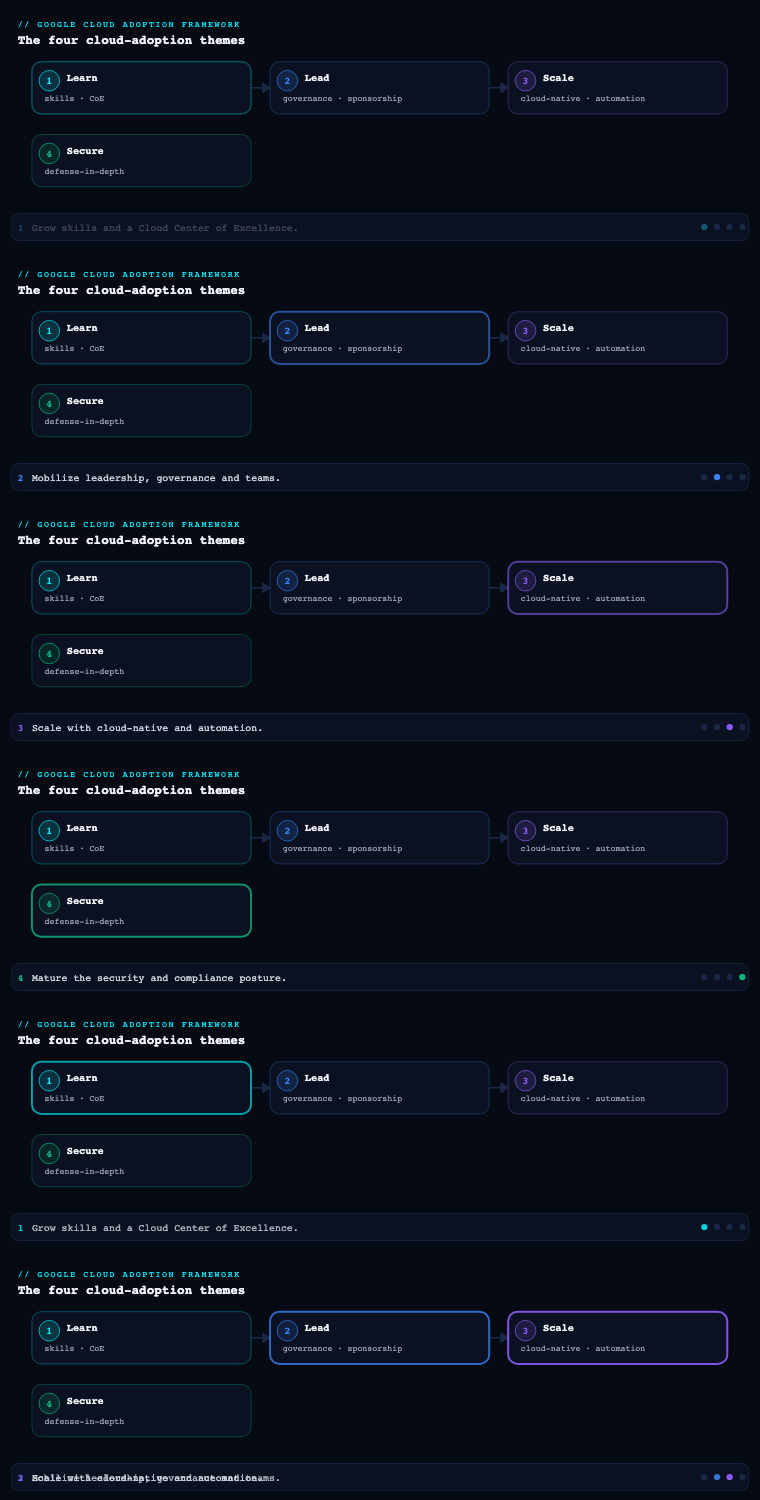
Google’s Cloud Adoption Framework (Google’s CAF) measures organizational cloud readiness across four themes — Learn, Lead, Scale, and Secure — and rates each across the Tactical → Strategic → Transformational phase ladder. Secure is the theme that measures the maturity of your capability to protect your services from unauthorized and inappropriate access with a multi-layered, identity-centric, defense-in-depth approach that deepens as the rest of your cloud estate matures; its natural owner is the CISO. This article is part 5 of the series — the last of the four themes — and goes deep on the four levers that move Secure from “products bolted on after an incident” to “security designed into the operating model”: advanced security posture, identity, network and data security, compliance, and proactive threat management and defense-in-depth. The framing that matters throughout: in Google’s model, Tactical security is reactive and per-project, Strategic security is standardized and centrally governed, and Transformational security is automated, continuously assessed, and shifted left into the platform itself — security as code that ships with every landing-zone change rather than a gate that work queues behind.
Sub-component 1: Advanced security posture
What it is. Your security posture is the aggregate, measurable state of how exposed your Google Cloud estate is right now — the sum of your misconfigurations, your vulnerabilities, your over-broad grants, your toxic combinations, and your drift from a known-good baseline — together with the organization-wide guardrails that hold that state in place. An advanced posture is one that is (a) centrally visible across the whole resource hierarchy rather than per-project, (b) expressed as policy-as-code so the secure configuration is the default and deviations are prevented or flagged automatically, and © continuously scored so you can prove the posture is improving over time, not just asserted to be “fine.” Posture is the theme’s centre of gravity: identity, network, data, compliance, and threat management are all just facets of posture, and Security Command Center is the lens through which Google’s CAF expects you to see all of them.
Why it matters. The dominant way enterprises get breached in cloud is not a zero-day — it is a misconfiguration: a bucket made public, a firewall rule opened to 0.0.0.0/0, a service-account key leaked into a repo, a default network left in place, an over-privileged role binding nobody remembers granting. These are posture failures, and they are invisible until something points a continuous evaluator at the estate. A Tactical organization discovers them during a pen-test or, worse, in an incident; a Strategic organization sees them on a dashboard the day they appear; a Transformational organization prevents most of them from ever being created because the guardrail rejects the change. Posture is also the thing auditors and boards actually ask about — “show me your security score and its trend” is a posture question, and you cannot answer it without a posture management capability.
How to do it well. Build posture from three reinforcing layers — prevent, detect, score — and wire all three to the resource hierarchy so they apply by inheritance, not per-project effort.
- Prevent with policy-as-code (the guardrails). The Organization Policy Service is the foundational preventive control: org-level constraints that are inherited down the Organization → Folders → Projects hierarchy. Enforce the high-value baseline early —
iam.disableServiceAccountKeyCreation,compute.requireOsLogin,compute.vmExternalIpAccess(deny by default),storage.publicAccessPrevention,sql.restrictPublicIp,gcp.resourceLocations(residency),iam.allowedPolicyMemberDomains(domain-restricted sharing, your single strongest defence against external data exfiltration via IAM), and custom org-policy constraints for anything Google does not ship a managed constraint for. Pair these with Security Command Center’s posture management (security posture definitions and Posture as a service) so a named, versioned posture can be deployed to a folder and its drift continuously detected. - Detect with continuous evaluation. Security Command Center (SCC) is GCP’s native CSPM/CNAPP and the single most important service in the entire Secure theme. Its Security Health Analytics detector library continuously flags misconfigurations (public buckets, open firewalls, disabled logging, weak SSL policy) against benchmarks (CIS GCP, PCI-DSS, NIST 800-53, ISO 27001) mapped to findings. Web Security Scanner finds app-layer vulns (XSS, outdated libraries) in your App Engine, Compute Engine and GKE web apps. The Attack Path Simulation and Toxic Combination features (SCC Enterprise) are the genuinely advanced part — they correlate a public-facing VM + an over-privileged service account + an open firewall into a single ranked attack path to a high-value resource, so you fix the chain, not 200 unranked findings.
- Score and trend. Use the SCC Security Posture score / attack exposure score as the executive metric. Export findings to BigQuery and build a Looker dashboard of posture-score-over-time, mean-time-to-remediate (MTTR) per finding class, and the count of high/critical open findings by folder. A score that is trending up and to the right is the artifact the board wants; a one-time snapshot is not.
SCC tiers — choose deliberately.
| Tier | What you get | When it fits |
|---|---|---|
| SCC Standard | Security Health Analytics (core detectors), Web Security Scanner (custom scans), basic vuln findings — free at org level | Cost-sensitive start; baseline misconfiguration visibility |
| SCC Premium | Full Health Analytics, Event Threat Detection, Container/VM Threat Detection, Rapid Vulnerability Detection, compliance reports, Continuous Exports | The standard enterprise floor for a Strategic posture |
| SCC Enterprise | Premium + multi-cloud (AWS/Azure) CNAPP, Attack Path Simulation, toxic-combination detection, integrated SIEM/SOAR (Google SecOps / Chronicle), case management, posture-as-a-service | Transformational posture; multi-cloud estates; in-house SOC |
Posture KPIs.
| KPI | Tactical | Strategic | Transformational |
|---|---|---|---|
| Estate covered by SCC | none/partial | all production projects | entire org incl. sandbox, by inheritance |
| Guardrails (Org Policy) enforced org-wide | ad hoc | baseline set enforced | full set + custom constraints, as code |
| MTTR for critical misconfig findings | days–weeks | < 72 h | automated/auto-remediated where safe |
| Posture score tracked over time | no | dashboard exists | trended, SLO’d, in the board pack |
| Attack-path / toxic-combination analysis | no | manual | continuous (SCC Enterprise) |
Artifacts & decisions: the Organization Policy baseline (as Terraform), the deployed SCC security posture definitions per folder, the SCC tier decision (Standard/Premium/Enterprise) and its budget justification, a findings-to-BigQuery export + Looker posture dashboard, and a remediation runbook mapping each finding class to an owner and an SLA.
Sub-component 2: Identity, network and data security
This is the technical heart of defense-in-depth — the three planes you protect. Google’s CAF treats Secure as identity-centric first, then network, then data; that ordering is deliberate, because in a zero-trust cloud, identity is the new perimeter.
Identity security
What it is. Everything that controls who (human or machine) can do what to which resource: authentication, authorization, the privilege model, and the lifecycle of credentials. On GCP this means Cloud Identity / Google Workspace as the identity source (ideally federated from your existing IdP via SAML/OIDC), Cloud IAM for authorization, groups as the unit of grant, and a disciplined approach to service accounts for workload identity.
Why it matters. Compromised or over-privileged identity is the highest-leverage attack vector in cloud — one leaked service-account key or one Owner grant on the org node can be game-over. The CAF rewards moving from individual, long-lived, over-broad grants toward group-based, least-privilege, short-lived, federated identity.
How to do it well.
- Federate, don’t fork. Use Cloud Identity federated from your enterprise IdP (Entra ID, Okta, Ping) so joiners/movers/leavers are governed by one HR-driven lifecycle. Enforce 2-Step Verification, preferably phishing-resistant Titan / FIDO2 security keys, and context-aware access.
- Grant to groups, at the right node, with least privilege. Never bind roles to individual users; bind Google Groups to roles at the folder that matches the blast radius. Prefer predefined roles over
Owner/Editor, and build custom roles for the long tail. Use IAM Conditions (time-bound, resource-tagged) and Privileged Access Manager (PAM) for just-in-time elevation so standing privilege approaches zero. - Eliminate service-account keys. Disable key creation org-wide (
iam.disableServiceAccountKeyCreation) and replace keys with Workload Identity Federation (for external/CI workloads, e.g. GitHub Actions, AWS, on-prem) and Workload Identity (for GKE), so workloads authenticate with short-lived tokens and no exportable secret exists. - Right-size continuously. Use the IAM Recommender (Active Assist) to strip unused permissions, and Policy Analyzer / Policy Troubleshooter to answer “who can access this?” and “why can this principal do that?”
- Reach for zero-trust app access. BeyondCorp Enterprise / Identity-Aware Proxy (IAP) put identity-and-context in front of apps and VMs so you can retire the VPN and stop trusting the network location at all.
Network security
What it is. The controls that constrain reachability and traffic — segmentation, perimeters, ingress/egress filtering, DDoS and WAF protection, and private connectivity — so that even an authenticated principal cannot reach what it should not.
Why it matters. Network controls are the layer that contains an identity compromise and prevents data exfiltration. The single most distinctive GCP network-security control — VPC Service Controls — exists specifically to stop a credential-theft attack from turning into a data breach.
How to do it well.
- Architect with Shared VPC + hub-and-spoke so networking is centrally governed by the platform team, not improvised per project. Disable the default network and default-allow rules via Org Policy.
- Build a service perimeter with VPC Service Controls (VPC-SC). This is the control that earns the Secure theme its keep: it draws an identity-and-resource perimeter around your sensitive managed services (BigQuery, Cloud Storage, etc.) so that even valid credentials cannot read or copy data out of the perimeter to an unauthorized project or the public internet. Pair with Private Google Access and Private Service Connect so traffic to Google APIs never traverses the public internet.
- Filter and segment. Use hierarchical firewall policies (inherited from folders), firewall policy rules and network tags / service accounts for micro-segmentation, and Cloud NGFW (Cloud Firewall Plus) for L7 inspection, IDS/IPS and TLS interception where required.
- Protect the edge. Front internet-facing apps with Cloud Armor (managed WAF + OWASP rules + Adaptive Protection ML-based L7 DDoS defence) behind the global Cloud Load Balancer, with Google Cloud Armor managed rules and rate-limiting.
Data security
What it is. Protecting the data itself — at rest, in transit, and increasingly in use — through encryption, key management, classification, de-identification, and exfiltration prevention.
Why it matters. Data is what you are ultimately protecting; everything else is a means. Regulated data (PII, PHI, PCI) carries legal obligations around encryption, key control, residency and de-identification that the CAF’s compliance lens depends on.
How to do it well.
- Own your keys deliberately. Data is encrypted at rest by default with Google-managed keys; move to Customer-Managed Encryption Keys (CMEK) in Cloud KMS for sensitive workloads, Cloud HSM (FIPS 140-2 Level 3) for high-assurance, and Cloud External Key Manager (EKM) when policy demands keys live outside Google. Consider Key Access Justifications (KAJ) so you can deny Google operational access to your keys.
- Classify and de-identify. Use Sensitive Data Protection (Cloud DLP) to discover and classify PII/PHI across BigQuery, Cloud Storage and Datastore, and to de-identify (tokenize, mask, format-preserving-encrypt, redact) data before it lands in analytics. Apply BigQuery column-level security, dynamic data masking, and row-level security with policy tags from Dataplex/Data Catalog.
- Prevent exfiltration end-to-end. Combine VPC-SC (network egress of data) + DLP (content inspection) +
iam.allowedPolicyMemberDomains(no sharing to external identities) + CMEK (revoke the key, revoke the data). - Protect data in use with Confidential Computing (Confidential VMs / Confidential GKE Nodes, memory encrypted while processing) for the most sensitive analytics.
The three planes at a glance.
| Plane | Primary GCP controls | The failure it prevents | Key artifact |
|---|---|---|---|
| Identity | Cloud Identity federation, IAM groups + custom roles, IAM Conditions, PAM, Workload Identity (Fed), IAP/BeyondCorp, IAM Recommender | Over-privileged / leaked credentials, standing admin | IAM model + group-to-role mapping; key-elimination plan |
| Network | Shared VPC, VPC Service Controls, hierarchical firewall, Cloud NGFW/IDS, Cloud Armor + Adaptive Protection, Private Service Connect | Lateral movement, data exfiltration, DDoS/L7 attack | Perimeter design; firewall-as-code; edge protection config |
| Data | Cloud KMS / HSM / EKM (CMEK), Sensitive Data Protection (DLP), BigQuery column/row security, Confidential Computing | Plaintext exposure, residency breach, PII leakage | Key-management standard; DLP classification + de-id pipeline |
Sub-component 3: Compliance
What it is. The discipline of demonstrating, with evidence, that your Google Cloud estate meets the regulatory, contractual and internal-policy obligations you are bound by (PCI-DSS, HIPAA, ISO 27001, SOC 2, GDPR, DPDP, FedRAMP, RBI/IRDAI/sovereign mandates, etc.) — and doing so continuously rather than as a once-a-year scramble. Compliance in the CAF is the bridge between technical posture and the business’s licence to operate; it turns “we have controls” into “we can prove the control to an auditor on demand.”
Why it matters. In regulated industries, compliance is not optional and not cheap to fake. The CAF distinguishes a Tactical organization — which assembles audit evidence manually, screenshot by screenshot, in a panic before each audit — from a Transformational one that produces continuous, automated compliance evidence as a by-product of its posture tooling. The difference is the cost of every audit, the ability to enter regulated markets at all, and whether a control gap is found by you (cheap) or by a regulator (expensive). Crucially, the CAF expects you to internalize the shared responsibility model: Google certifies the platform; you are responsible for configuring your workloads compliantly and evidencing it.
How to do it well.
- Map controls to a framework, then automate the evidence. Pick your control frameworks, then use Security Command Center compliance reports (which map live findings to PCI-DSS, NIST 800-53, ISO 27001, CIS GCP Benchmark, HIPAA, SOC 2) and Assured Workloads to enforce the control set rather than merely check it.
- Use Assured Workloads for hard regulatory/sovereignty boundaries. Assured Workloads creates a compliance-controlled environment that enforces data residency, personnel access controls (e.g. EU/US-only support personnel), provider access transparency, and an approved product set for regimes like FedRAMP High/Moderate, CJIS, IL4/IL5, ITAR, HIPAA, and regional sovereign packages (EU, and Sovereign Controls offerings). This is how you bind residency and operational-sovereignty controls technically, not just on paper.
- Evidence the platform’s certifications. Pull Google’s own audit reports, certifications and CAIQ from Compliance Reports Manager to satisfy the platform half of shared responsibility, and use Access Transparency / Access Approval so you can prove (and gate) any Google operational access to your data.
- Make evidence continuous and immutable. Centralize Cloud Audit Logs (Admin Activity, Data Access, System Event, Policy Denied) into a log sink to a locked, retention-policy’d BigQuery dataset / Cloud Storage bucket so the audit trail is tamper-evident and queryable. Treat policy-as-code itself (Org Policy, IAM, firewall in Terraform) as compliance evidence — the Git history is your change-control record.
- Govern data residency with
gcp.resourceLocationsOrg Policy constraints and region-locked resources, mapped to your DPDP/GDPR/sovereign obligations.
Compliance toolchain.
| Need | GCP mechanism | Notes |
|---|---|---|
| Continuous control mapping & reports | SCC compliance reports | Live findings mapped to PCI/NIST/ISO/CIS/HIPAA/SOC 2 |
| Enforced regulatory/sovereign boundary | Assured Workloads | Residency + personnel + provider-access controls per regime |
| Platform certifications & CAIQ | Compliance Reports Manager | Google’s SOC/ISO/PCI/FedRAMP attestations for shared-responsibility |
| Provable control of Google access | Access Transparency + Access Approval | Logs and gates Google operational access |
| Tamper-evident audit trail | Cloud Audit Logs → locked sink (BigQuery/GCS) | Retention-lock; enable Data Access logs on sensitive services |
| Residency enforcement | Org Policy gcp.resourceLocations |
Technical residency, not policy-document residency |
| Policy-as-code as evidence | Terraform + Git + Config Validator/Policy Library | Change-control history = audit evidence |
Artifacts & decisions: a control-to-framework mapping (control → framework → GCP enforcing service → evidence source), the Assured Workloads folder design for regulated workloads, the audit-log architecture (sinks, destinations, retention locks, who can read), a data-residency policy enforced via Org Policy, and a shared-responsibility matrix the auditor can read.
Sub-component 4: Proactive threat management and defense-in-depth
What it is. The operational arm of Secure: the people, process and tooling that detect, investigate, and respond to active threats in near-real-time, layered so that no single control failure is fatal (defense-in-depth), and increasingly proactive — hunting for threats and automating response rather than waiting for an alert to be triaged by a human. Posture is about reducing exposure (the static state); threat management is about handling the adversary (the dynamic event). A mature Secure theme needs both: you minimize the attack surface and you assume breach and instrument for it.
Why it matters. No posture is perfect; a determined adversary will eventually find a gap, an insider will misuse access, or a supply-chain dependency will be compromised. The CAF’s top maturity rung is reserved for organizations that have moved from reactive security operations (a ticket gets filed, someone looks at it days later) to proactive operations (threats are detected in seconds, enriched with context, and frequently remediated by automation), and that have layered controls so that defeating one (say, a stolen credential) still runs into the next (VPC-SC blocks the exfil, DLP flags the content, the anomaly trips Event Threat Detection). Defense-in-depth is the architectural principle; proactive threat management is its operational expression.
How to do it well.
- Detect across every layer (the depth). Layer GCP’s native detection: Event Threat Detection (SCC Premium) mines Cloud Audit/VPC Flow/DNS logs for IAM anomalies, brute force, crypto-mining, data exfiltration and malware C2; Container Threat Detection and VM Threat Detection watch runtime behaviour and memory for kernel rootkits and miners; Cloud IDS does deep packet inspection on network traffic; Sensitive Actions Service flags high-risk operations (e.g. disabling logging). These produce SCC findings — one pane of glass.
- Aggregate into a SIEM and hunt. Feed everything into Google Security Operations (Google SecOps, formerly Chronicle) — a cloud-native SIEM with sub-second search over petabytes, built-in Applied Threat Intelligence from Mandiant and VirusTotal, UEBA, and detection-as-code via the YARA-L rule language. This is where proactive threat hunting happens: you write detections, run retro-hunts against a year of telemetry, and enrich alerts with Mandiant’s frontline intel.
- Automate the response (SOAR). Use Google SecOps SOAR (formerly Siemplify) for case management and playbooks that auto-enrich, auto-contain (quarantine a VM, revoke a session, disable a key, isolate a network), and route to the right responder — collapsing mean-time-to-respond from hours to seconds for known patterns.
- Shift detection left and harden the supply chain. Adopt Software Delivery Shielding / Software Supply Chain Security: Binary Authorization (only signed, attested images deploy), Artifact Analysis / Artifact Registry vulnerability scanning, Assured Open Source Software, and SLSA-aligned provenance, so threats are caught in CI before they ever run in production. Use Shielded VMs and Confidential Computing to harden the runtime itself.
- Instrument the human loop. Stand up (or buy) a SOC function, define incident-response runbooks and severities, run purple-team / tabletop exercises, and engage Mandiant for incident-response retainers and threat assessments. Detection without a tested response process is theatre.
The defense-in-depth layers and what holds each.
| Layer | Proactive control(s) on GCP | Assumed breach it catches |
|---|---|---|
| Perimeter / edge | Cloud Armor + Adaptive Protection, Cloud NGFW/IDS | Volumetric & L7 DDoS, exploit attempts |
| Network | VPC-SC, hierarchical firewall, Cloud IDS | Lateral movement, data exfiltration |
| Identity | Event Threat Detection (IAM anomaly), context-aware access, PAM | Stolen credentials, privilege abuse |
| Workload / runtime | VM & Container Threat Detection, Shielded VM, Confidential Computing | Rootkits, crypto-mining, memory attacks |
| Supply chain / build | Binary Authorization, Artifact Analysis, Assured OSS, SLSA | Poisoned images, vulnerable dependencies |
| Data | DLP, CMEK + Key Access Justifications, BigQuery row/column security | Bulk PII read, plaintext exposure |
| Detect & respond (cross-cutting) | Google SecOps (Chronicle) SIEM + SOAR, Mandiant intel, SCC aggregation | Anything that slips a layer — central correlation & response |
Threat-management KPIs.
| KPI | Tactical | Strategic | Transformational |
|---|---|---|---|
| Mean time to detect (MTTD) | unknown/days | hours | minutes (SecOps + ETD) |
| Mean time to respond (MTTR) | manual, hours–days | hours | seconds–minutes (SOAR playbooks) |
| Detection coverage (layers instrumented) | edge only | edge + identity + workload | full depth incl. supply chain |
| Threat hunting | none | occasional manual | continuous, detection-as-code (YARA-L) |
| Supply-chain assurance | none | scanning only | Binary Authorization enforced |
Artifacts & decisions: the detection architecture (which detectors → SCC → SecOps), YARA-L detection content under version control, SOAR playbooks for the top incident types, an incident-response plan with severities and runbooks, the Binary Authorization policy and CI integration, and a Mandiant / IR-retainer decision.
Real-world enterprise scenario
Company: Cygnet Bancorp, a mid-tier digital bank with ~9,000 employees, headquartered in Bengaluru, regulated by the RBI and expanding into the EU. Their Google Cloud estate has grown organically to ~140 projects across retail-banking, payments, data-analytics and a new Vertex AI fraud-scoring platform. A CAF assessment, grounded with Security Command Center evidence, rates them Tactical on Secure: IAM is a sprawl of individual Editor grants, 60+ exportable service-account keys exist, there are no Organization Policies, audit logs are scattered and unretained, public-bucket findings sit open for weeks, and “threat detection” means someone occasionally reads Cloud Logging. The CISO sponsors a 10-month program to reach Strategic on Secure (with the fraud platform and EU launch as the forcing functions), and the Cloud Center of Excellence owns delivery.
Decisions per sub-component.
-
Advanced security posture. Cygnet enables SCC Enterprise at the org node (justified by the multi-cloud roadmap and the need for attack-path analysis). The CCoE ships an Organization Policy baseline as Terraform — disabling SA-key creation, external IPs, public bucket access, default networks, and restricting
iam.allowedPolicyMemberDomainsto Cygnet’s Cloud Identity domain plus an allowlist. A security posture is deployed per folder (stricter forprod-paymentsthan forsandbox). Findings export to BigQuery; a Looker dashboard trends the posture score and critical-finding MTTR. Within eight weeks, open critical misconfigurations drop from 214 to 11, and the attack-path simulation surfaces (and the team closes) three toxic combinations leading to the cardholder-data store. -
Identity, network and data security. Cloud Identity is federated from Cygnet’s existing Okta with FIDO2 keys enforced for all engineers. IAM is rebuilt group-based and least-privilege at the folder level; the 60+ service-account keys are eliminated via Workload Identity Federation (for GitHub Actions CI) and GKE Workload Identity, and standing admin is replaced with Privileged Access Manager JIT elevation. On the network, the CCoE lands a Shared VPC hub-and-spoke and — the keystone control — wraps VPC Service Controls around BigQuery and Cloud Storage in
prod-paymentsandprod-analytics, with Cloud Armor + Adaptive Protection fronting the customer apps. For data, all regulated datasets move to CMEK in Cloud HSM, Sensitive Data Protection (DLP) classifies and de-identifies PII before it reaches the fraud-analytics layer, and BigQuery column-level security with policy tags restricts who sees PAN and Aadhaar fields. -
Compliance. Cygnet maps controls to PCI-DSS (payments) and ISO 27001 / SOC 2 (org-wide), and stands up an Assured Workloads environment with EU sovereign controls and data residency for the EU launch, enforced alongside
gcp.resourceLocationsOrg Policy. SCC compliance reports generate continuous PCI/ISO evidence; Cloud Audit Logs (including Data Access logs on payments services) flow to a retention-locked BigQuery sink as the tamper-evident trail; Access Transparency + Access Approval gate Google operational access. The PCI QSA’s evidence-gathering, previously a six-week manual scramble, becomes a set of saved SCC reports and BigQuery queries. -
Proactive threat management and defense-in-depth. All detectors — Event Threat Detection, Container & VM Threat Detection, Cloud IDS — feed SCC and then Google SecOps (Chronicle), where the SOC writes YARA-L detections enriched with Mandiant intel and runs weekly retro-hunts. SOAR playbooks auto-contain on high-confidence signals (quarantine VM, disable key, revoke session). The CI pipeline enforces Binary Authorization so only signed, scanned images reach GKE, and Confidential VMs run the fraud-scoring inference. A Mandiant IR retainer is signed and the first tabletop exercise is run against a simulated credential-theft-to-exfil scenario — which the layered controls (ETD alert → SOAR session-revoke → VPC-SC exfil-block) defeat in the drill.
Measurable outcome (month 10). Open critical SCC findings fall from 214 to under 15 and stay there; exportable service-account keys go from 60+ to 0; MTTD drops from days to ~4 minutes and MTTR for known patterns to under 5 minutes via SOAR; the PCI-DSS audit passes with continuous SCC evidence and no major findings; the EU launch ships on Assured Workloads with enforced residency; and the next CAF assessment rates Cygnet Strategic on Secure, with the enforced Org-Policy guardrails, VPC-SC perimeter, Assured Workloads boundary, and the SecOps SIEM/SOAR pipeline cited as the decisive evidence — and the fraud platform’s posture pushing toward Transformational.
Deliverables & checklist
Common pitfalls
- Treating Secure as a product checklist instead of an operating-model maturity. Turning on Security Command Center and declaring victory ignores that the theme is about how systematically and early security is built in. Avoid it by enforcing guardrails as code in the landing zone (Org Policy in Terraform) so the secure path is the default, and by trending a posture score over time, not a one-off snapshot.
- Leaving exportable service-account keys (and standing privilege) in place. Long-lived keys and permanent
Owner/Editorgrants are the most common real-world breach vector and the easiest thing an auditor flags. Avoid it by disabling key creation org-wide, migrating to Workload Identity Federation, and using PAM so standing privilege trends to zero. - Posture without prevention — detecting misconfigurations you never stopped. A dashboard full of “public bucket” findings you remediate by hand forever is Tactical, not Strategic. Avoid it by pairing SCC detection with Organization Policy prevention (
storage.publicAccessPrevention, etc.) so the bad state cannot be created in the first place. - Compliance as a once-a-year manual scramble. Assembling screenshots before each audit is expensive and fragile. Avoid it by generating continuous evidence from SCC compliance reports, enforcing hard boundaries with Assured Workloads, and centralizing Cloud Audit Logs to a retention-locked sink so the trail is always audit-ready.
- Detection without response — alerts nobody actions. Wiring up Event Threat Detection but having no SOC, runbook, or automation means findings pile up unworked. Avoid it by aggregating into Google SecOps with SOAR playbooks for the top incident types and a tested incident-response plan (run the tabletop).
- Skipping the network and data exfiltration controls because identity “feels” sufficient. Identity is the first layer, not the only one; a stolen-but-valid credential walks straight past IAM. Avoid it by adding VPC Service Controls (perimeter), DLP (content), domain-restricted sharing, and CMEK so defeating identity still hits three more layers — the essence of defense-in-depth.
What’s next
You have now completed all four themes of the series — Learn, Lead, Scale, and Secure; return to part 1, the Overview & Maturity Model, to assemble the four-theme scorecard, plot your radar chart, and sequence the prioritized epic backlog that turns these per-theme assessments into a funded cloud-adoption roadmap.