Quick take: LLMs know the internet, not your documents. A retrieval-augmented generation pipeline grounds answers in your private knowledge, while an LLM gateway enforces guardrails, cost controls, and auditability.
HelpDesk AI wanted to let support agents ask an LLM why a customer order failed. The base model kept inventing refund policies and quoting non-existent SLAs. By building a RAG pipeline over their knowledge base and adding an LLM gateway, the company could answer accurately, cite sources, and block sensitive data leakage.
The problem it solves
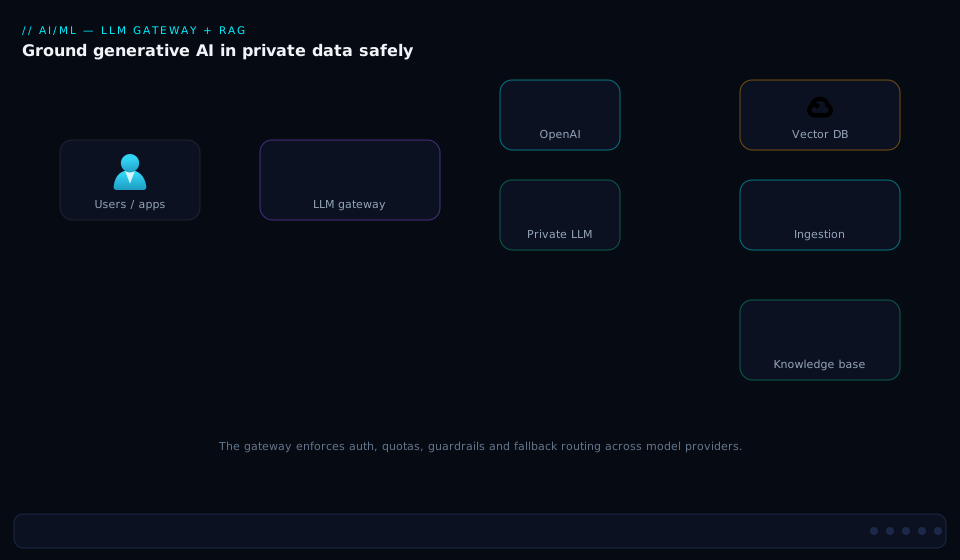
Raw LLMs hallucinate, leak prompts, and rack up costs. Enterprise GenAI needs three things: grounding in private data, governance over model access, and observability of prompts and responses. RAG solves grounding. The LLM gateway solves governance and cost control.
Core concepts
| Concept | What it means in practice |
|---|---|
| LLM gateway | Central proxy for model routing, auth, rate limits, caching, logging, guardrails. |
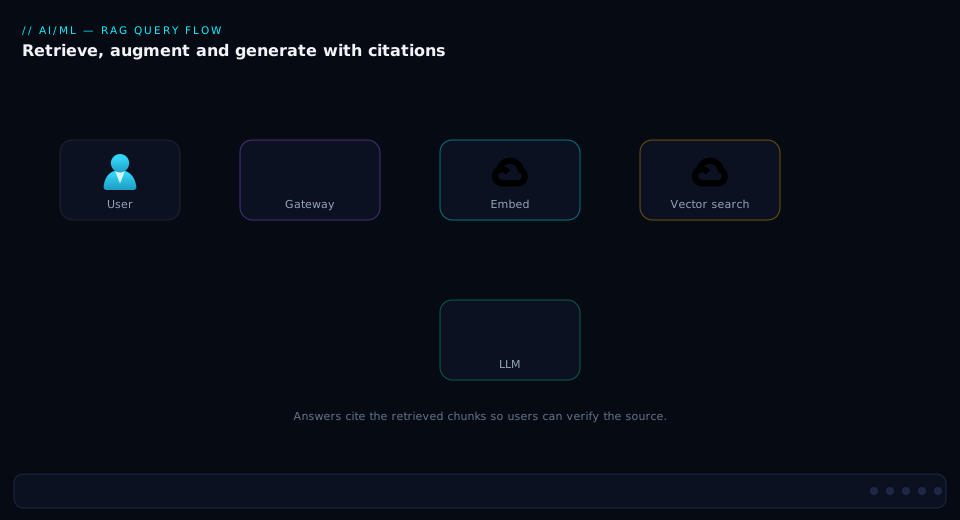
| RAG | Retrieve relevant context from a knowledge base and add it to the prompt. |
| Embeddings | Dense vector representations of text used for semantic search. |
| Vector database | Stores embeddings and supports similarity search. |
| Chunking | Splitting documents into small pieces for retrieval. |
| Guardrails | Rules that block unsafe prompts or sanitize outputs. |
Architecture
How it works
Retrieval quality is everything
A RAG system is only as good as its chunks and embeddings. Poor chunking sends irrelevant context, and the model amplifies the noise. Invest in cleaning, chunking strategy, and metadata filters before optimizing the LLM itself.
Real-world scenario
HelpDesk AI indexed support tickets, policy PDFs, and runbook wikis into a vector database. When an agent asked about a failed order, the pipeline retrieved the order status, the relevant refund policy paragraph, and the escalation runbook. The LLM answered using only retrieved content and cited each source. A prompt trying to extract customer PII was blocked by the gateway’s guardrails.
Advantages
- Grounded answers: reduces hallucination with real citations.
- No retraining: private data enters through retrieval, not model weights.
- Centralized governance: one place for quotas, logging, and fallback routing.
- Cost control: caching and rate limiting prevent runaway spend.
Disadvantages
- Retrieval failures: bad chunks or embeddings produce wrong answers.
- Latency: embedding + search + generation adds round trips.
- Data freshness: stale documents lead to stale answers.
- Prompt injection risk: attackers can manipulate retrieval context.
When to use it (and when not to)
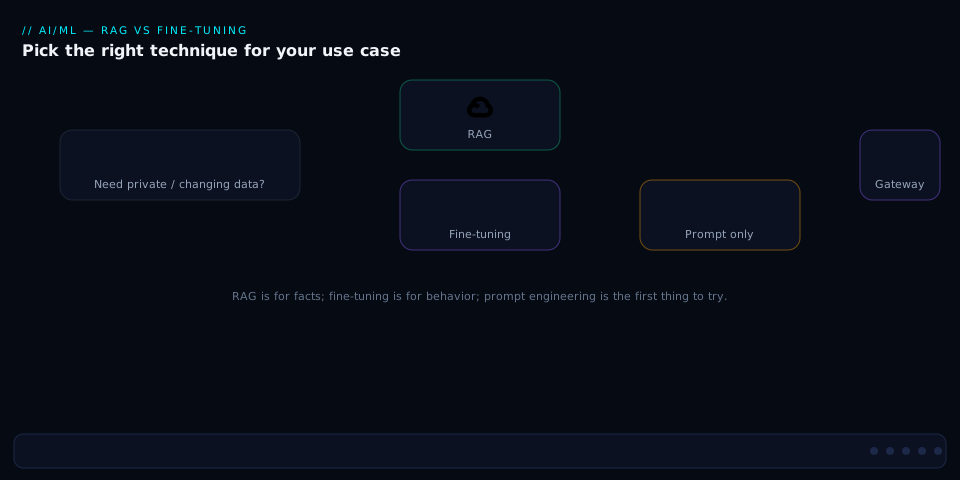
Use RAG when you need answers grounded in private, changing documents and cannot retrain a model.
Skip RAG if your use case requires deep reasoning beyond retrieved context, or if a simple prompt with a small fixed context suffices. Fine-tuning may be better for style or task-specific behavior.
Best practices
- Chunk documents by semantic unit, not arbitrary character count.
- Add metadata filters so retrieval respects tenant, version, and access control.
- Log every prompt, retrieved chunk, and response for audit and debugging.
- Implement guardrails for PII, toxicity, prompt injection, and off-topic requests.
- Use the gateway to switch models or regions during provider outages.
- Refresh embeddings as source documents change.
RAG makes the LLM a reader, not a knower. The gateway makes that reader safe and economical.