A competitive online gaming publisher is about to launch the third season of a 5v5 tactical shooter, and the launch trailer has already done its damage: the marketing team is forecasting a peak of 250,000 concurrent players within the first 48 hours, concentrated across North America, Western Europe, and Southeast Asia, with a sharp evening spike in each region that rolls around the globe like a wave. The studio’s last title died in the reviews not because the game was bad but because the netcode experience was bad — players in Mumbai and São Paulo were routinely matched to servers 180 ms away, the rubber-banding made the gunplay feel broken, and a launch-night capacity shortfall put 40,000 players in a queue staring at a spinner. The mandate from the executive producer this time is unambiguous: a fair match, on a nearby server, in under fifteen seconds, that never runs out of capacity and never bankrupts us at 3 a.m. when nobody is playing. This article is the reference architecture for delivering that on AWS GameLift — a globally distributed, latency-aware, autoscaling dedicated-server fleet that a studio’s live-ops team and finance team will both sign.
The pressures in real-time multiplayer are unlike a web app’s, and naming them sets up every decision that follows. Latency is the product: a 30 ms round trip feels crisp and a 120 ms round trip feels broken, so where a session runs matters more than almost anything else. Fairness is the retention lever: a lopsided match where a bronze player is stomped by a diamond smurf churns both of them, so matchmaking quality is a first-class concern, not a nicety. Demand is violently spiky and diurnal: the same fleet that needs 4,000 game servers at 9 p.m. local needs 200 at 5 a.m., and paying for the peak around the clock across three continents is how a studio burns its entire infrastructure budget before the season ends. GameLift exists to solve exactly this triad — it places, scales, and matches dedicated game-server processes close to players — and the architecture below is how you wire it for a real launch rather than a tech demo.
Why not the obvious shortcuts
The naive approaches each fail in a way someone on the project will propose, so it is worth dismissing them by name.
A fixed fleet of EC2 instances behind an Auto Scaling Group treats game servers like stateless web workers, which they are not. A live match is a long-lived, stateful session with players bound to a specific server process for 30-plus minutes; a generic ASG will happily terminate an instance hosting four active matches during a scale-in, and it has no concept of “drain this server only once its sessions end.” You would end up rebuilding session placement, draining, and matchmaking from scratch.
Peer-to-peer or player-hosted servers dodge the hosting bill but hand the competitive integrity of the game to whoever has the host advantage and the best cheat tooling, and they collapse the moment the host rage-quits mid-match. For a ranked, monetized title this is a non-starter.
Spinning servers up per-match on raw Kubernetes is buildable — Agones exists — but you are then operating a global, multi-region, latency-routed, autoscaling game-server platform yourself, including the buffer math, the spot-interruption handling, and the matchmaker, which is precisely the undifferentiated heavy lifting GameLift packages. For a studio whose competitive advantage is the game, not the orchestration plane, that is the wrong place to spend headcount.
GameLift threads the needle: it understands that a game server hosts game sessions, it keeps a warm buffer of available server processes so a match never waits on a cold boot, it places each match in the region that minimizes the whole lobby’s latency, and it autoscales the fleet on a metric that actually reflects demand — available session slots — rather than CPU.
Architecture overview
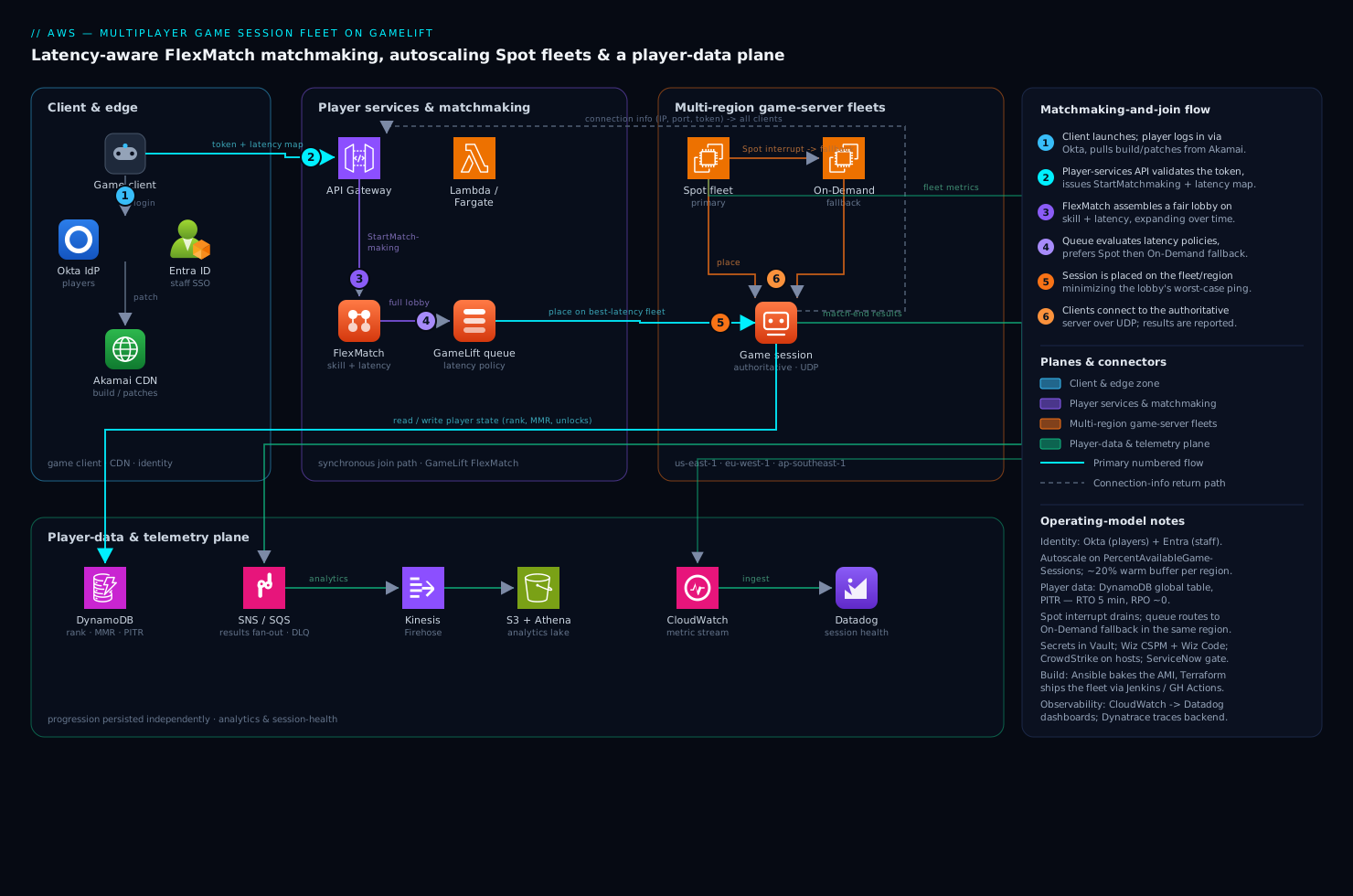
The platform runs three distinct flows that share infrastructure but live on different clocks, and keeping them separate in your head is the first step to operating it well: a synchronous client-and-matchmaking path that gets a player into a match, an asynchronous session-placement and fleet-scaling control plane that GameLift drives, and a player-data and telemetry plane that persists progression and feeds the dashboards.
The defining property of the whole topology is the one the executive producer cares about most: a match is placed in the region that minimizes the entire lobby’s latency, and the fleet in each region scales itself to demand independently. There is no single “game backend region” — the game server fleet is replicated across us-east-1, eu-west-1, and ap-southeast-1, and the GameLift queue with latency-based placement is what decides, per match, where the session actually spins up.
Matchmaking-and-join path, following the control flow:
- A player launches the game client. Account login federates through the studio’s identity layer — Okta as the consumer-facing IdP for the player accounts, with the internal live-ops console federating Microsoft Entra ID for staff SSO — issuing a signed token the backend services trust. The client also pulls the game build and patches from Akamai at the edge, which fronts the large binary downloads with global CDN caching so a 60 GB launch-day patch does not melt the origin.
- The client calls a thin player-services API on API Gateway + AWS Lambda (or a small ECS Fargate service) that validates the player’s token, then issues a StartMatchmaking request to GameLift FlexMatch, attaching the player’s skill rating and — critically — a latency map: the player’s measured ping to each GameLift region, sampled by the client at startup.
- FlexMatch evaluates the player against a configurable rule set — team sizes, skill-delta limits, latency ceilings — and assembles a fair, full lobby of ten players, expanding its skill tolerance as the player waits so that nobody sits in queue forever. The match’s combined latency profile is part of the rule set, so FlexMatch will not form a lobby that has no acceptable region to play in.
- Once a match forms, FlexMatch hands it to a GameLift queue. The queue evaluates latency policies across its destination fleets and places the session on the fleet/region that minimizes the lobby’s worst-case ping, preferring a Spot fleet for cost and falling back to an On-Demand fleet in the same region if Spot capacity is interrupted or unavailable.
- GameLift creates the game session on an available server process inside the chosen fleet, injects the matchmaker data (teams, player IDs, skills), and returns connection info — the server’s IP, port, and a per-player session token — back through the player-services API to all ten clients.
- Each client connects directly to the authoritative dedicated game-server process over UDP. The server runs the simulation, validates inputs server-side (the anti-cheat boundary), and on match end reports results back so progression can be written.
Player-data and telemetry plane, persisted independently: the dedicated server reads and writes player state — rank, MMR, unlocks, match history — to DynamoDB, the natural store for this access pattern (single-digit-millisecond key-value reads keyed on player ID, predictable at any scale, no connection pool to exhaust from thousands of game servers). Match results flow to a results topic on SNS/SQS that fans out to a progression Lambda (updates MMR and unlocks), an analytics sink on Kinesis → S3 for the data team, and the live-ops dashboards. Every server process and the GameLift control plane emit metrics to CloudWatch, which Datadog ingests alongside the game-server logs to drive the real-time session-health dashboards live-ops watches on launch night.
Component breakdown
| Component | Service / tool | Role in the platform | Key configuration choices |
|---|---|---|---|
| Edge / patch delivery | Akamai | CDN for game builds and large patches; perimeter protection | Tiered distribution for 60 GB patch; origin shield to S3 build bucket |
| Player identity | Okta (players) + Entra ID (staff) | Consumer SSO for accounts; staff SSO for the live-ops console | OIDC; token validated at player-services API; MFA on live-ops |
| Player-services API | API Gateway + Lambda / ECS Fargate | Token validation, StartMatchmaking, returns connection info |
Throttling per player; idempotent matchmaking ticket lookup |
| Matchmaking | GameLift FlexMatch | Fair lobby assembly on skill + latency, expanding tolerance over time | Rule set: team sizes, skill delta, latency ceiling, expansions |
| Placement | GameLift queue | Latency-based, multi-region session placement with Spot→On-Demand fallback | Latency policy; Spot fleet primary, On-Demand backup destination |
| Compute fleets | GameLift fleets (Spot + On-Demand) | Run authoritative dedicated game-server processes per region | RuntimeConfiguration (procs/instance); per-region replication |
| Player data | DynamoDB | Rank, MMR, unlocks, match history; hot key-value store | Partition by player ID; on-demand or autoscaled capacity; PITR on |
| Results fan-out | SNS / SQS | Decouple match-end events from progression, analytics, dashboards | Topic per event type; DLQ on the progression consumer |
| Analytics | Kinesis → S3 (+ Athena) | Durable match telemetry for the data team | Firehose to partitioned S3; Athena/Glue catalog |
| Secrets | HashiCorp Vault | Third-party tokens (Okta introspection, payment, anti-cheat), signing keys | AWS auth method; dynamic leases; agent injection on Fargate/EC2 |
| CSPM / posture | Wiz + Wiz Code | Cloud posture, public-exposure drift, IaC scanning pre-merge | Agentless scan of fleets/DynamoDB/S3; Wiz Code on the Terraform PR |
| Runtime security | CrowdStrike Falcon | Runtime threat detection on the game-server hosts | Sensor in the build AMI; detections to the studio SOC |
| Observability | Datadog + Dynatrace | Session-health dashboards; deep traces of the backend services | CloudWatch metric stream to Datadog; Dynatrace on player-services |
| ITSM / change | ServiceNow | Launch change gate, incident records, capacity-change approvals | Change gate before a season fleet goes live; auto-ticket on SLO breach |
| CI / IaC | Jenkins / GitHub Actions + Terraform + Ansible | Build the server, bake the AMI, ship the fleet, manage config | OIDC to AWS; Ansible bakes the server image; eval/smoke gate |
A few of these choices deserve the why, because they are the ones teams get wrong.
Why DynamoDB and not a relational database for player data. The access pattern at match time is “given this player ID, fetch their rank and unlocks, and after the match write the new MMR” — a high-volume, latency-sensitive, key-value lookup issued by thousands of game-server processes at once. A relational database becomes a connection-pool and lock bottleneck under that fan-in, and its rich query power buys you nothing for a primary-key read. DynamoDB gives single-digit-millisecond reads at any throughput, scales horizontally with zero operational ceremony, and never makes a game server wait on a connection. The trade you accept is that analytical queries (“show me MMR distribution by region this week”) do not belong here — those run on the Kinesis → S3 → Athena path, which is why both planes exist.
Why latency-based placement belongs in the queue, not the client. It is tempting to let the client pick “the closest region” and matchmake within it. Do not — that fragments your player pool into per-region silos, which lengthens queue times in smaller regions and produces worse matches because there are fewer players to choose from. Instead, FlexMatch forms the best possible lobby from a broad pool using each player’s latency map, and the GameLift queue then places that specific lobby on the region that minimizes its collective worst-case ping. Matchmaking quality and latency are optimized together, by the platform, with the whole lobby’s data — not guessed by one client.
Why a Spot-primary fleet with On-Demand fallback. Game-server instances are the dominant cost, and GameLift Spot fleets run them at a steep discount. The risk is a Spot interruption mid-match; GameLift mitigates this by draining (it stops placing new sessions on an interrupted instance and gives active sessions notice), and the queue’s destination order means a new match that cannot land on Spot falls through to an On-Demand fleet in the same region automatically. You get most of the Spot savings with a correctness backstop, instead of betting a ranked match on spare capacity.
Implementation guidance
Build the server image with Ansible and ship the fleet with Terraform, treating capacity buffers as a first-class deliverable. The deployment order matters because GameLift’s scaling behaviour is only as good as the buffer you configure.
- Bake the dedicated-server image. A Jenkins (or GitHub Actions) pipeline compiles the game server, and Ansible provisions the host image — OS hardening, the GameLift Agent, the CrowdStrike Falcon sensor, log shippers, and the server binary — producing a versioned, immutable build uploaded to GameLift. Baking the security sensor and observability agents into the image is what makes every server in a 4,000-instance fleet identically governed.
- Define the fleet runtime configuration, declaring how many server processes run per instance and the launch path. This is the dial that sets your density — pack too few processes and you waste instances, too many and you starve them of CPU under a full match load.
- Configure the FlexMatch rule set — team composition, the skill-delta limit, the latency ceiling, and the expansion rules that loosen those constraints the longer a player waits, so the matchmaker prefers a great match early and a playable match rather than an infinite queue.
- Build the queue with latency policies and the Spot-primary / On-Demand-fallback destination order across all three regions.
- Set target-tracking autoscaling on
PercentAvailableGameSessions. This is the single most important number in the system.
The FlexMatch rule set is where match quality lives; a trimmed shape communicates the intent — a fair lobby that tolerates more skill spread the longer someone waits:
{
  "name": "ranked_5v5",
  "ruleLanguageVersion": "1.0",
  "teams": [
    { "name": "red",  "minPlayers": 5, "maxPlayers": 5 },
    { "name": "blue", "minPlayers": 5, "maxPlayers": 5 }
  ],
  "rules": [
    { "name": "SkillDelta", "type": "distance",
      "measurements": ["avg(teams[*].players.attributes[skill])"],
      "referenceValue": "avg(flatten(teams[*].players.attributes[skill]))",
      "maxDistance": 200 },
    { "name": "LatencyCeiling", "type": "latency",
      "maxLatency": 80 }
  ],
  "expansions": [
    { "target": "rules[SkillDelta].maxDistance",
      "steps": [ { "waitTimeSeconds": 15, "value": 400 },
                 { "waitTimeSeconds": 30, "value": 800 } ] }
  ]
}
And the autoscaling policy that keeps a warm buffer so a match never waits on a cold instance — expressed as Terraform intent:
resource "aws_gamelift_fleet" "shooter_spot_use1" {
  name              = "shooter-s3-spot-use1"
  build_id          = aws_gamelift_build.shooter.id
  fleet_type        = "SPOT"
  ec2_instance_type = "c6i.large"

  runtime_configuration {
    game_session_activation_timeout_seconds = 60
    max_concurrent_game_session_activations = 10
    server_process {
      launch_path        = "/local/game/shooter-server"
      concurrent_executions = 4          # density per instance
    }
  }
}

# Keep ~20% of session slots available as warm buffer.
resource "aws_appautoscaling_policy" "buffer" {
  policy_type = "TargetTrackingScaling"
  target_tracking_scaling_policy_configuration {
    target_value = 80                    # 80% utilised => 20% headroom
    predefined_metric_specification {
      predefined_metric_type = "GameLiftPercentAvailableGameSessions"
    }
  }
}
Identity and secrets. Players authenticate through Okta; the player-services API validates the Okta-issued token before it ever calls StartMatchmaking, so an unauthenticated client cannot consume matchmaking capacity. Staff who operate the live-ops console and the fleet sign in through Microsoft Entra ID with MFA, and their console actions map to least-privilege IAM roles. The backend services and the bake pipeline get their AWS access from IAM roles, never long-lived keys; the residual third-party secrets — the Okta introspection secret, the payment-provider token, the anti-cheat service key — live in HashiCorp Vault, leased dynamically and injected at runtime, so nothing sensitive is baked into an AMI or a task definition. (The studio has a standing rule, learned the hard way, that a credential never lands in source control or a machine image.)
Enterprise considerations
Security and anti-cheat. The architecture is authoritative-server by design, which is the foundation of competitive integrity: the dedicated server, not the client, is the source of truth for the simulation, so a tampered client cannot teleport, shoot through walls, or fabricate a result. Layer on top: (a) the third-party anti-cheat kernel/service running on the server with its key held in Vault; (b) Wiz running continuous CSPM across the fleets, DynamoDB tables, and the S3 build bucket, alerting the instant any resource drifts to public exposure or an IAM policy widens too far, with Wiz Code scanning the Terraform on the pull request so a misconfiguration is caught before it is ever applied; © CrowdStrike Falcon sensors baked into the server image for runtime threat detection on the hosts, feeding the studio’s SOC; (d) DDoS protection at the edge via Akamai for the patch/web tier and AWS Shield for the GameLift front, because a launch-day title is a guaranteed DDoS target; (e) an SLO breach or a detected mass-cheat event auto-raises a ServiceNow incident so live-ops and security get a ticket, not just a Datadog alert. Player data in DynamoDB is encrypted at rest with KMS, and access is scoped so the game-server role can read/write player records but not enumerate the whole table.
Cost optimization. Game-server compute dominates and the demand is brutally diurnal, so engineer for it from the start.
| Lever | Mechanism | Typical effect |
|---|---|---|
| Spot fleets | Run servers on GameLift Spot with On-Demand fallback in the queue | ~50–70% off the server bill on the Spot share |
| Buffer tuning | Set PercentAvailableGameSessions headroom to demand volatility |
Smaller buffer = fewer idle instances; too small = queue waits |
| Diurnal scale-in | Target-tracking follows the daily curve down to a floor per region | Avoids paying peak capacity at 5 a.m. local |
| Right-size density | Tune concurrent_executions per instance to match CPU at full load |
Fewer instances for the same player count |
| Regional fit | Replicate only where players are; let the queue cover the long tail | No idle fleet in a region with 200 players |
The single most expensive mistake here is an oversized warm buffer multiplied across three regions and held around the clock — a 20% buffer is prudent on launch night and wasteful at 4 a.m., so the buffer target itself should follow the diurnal curve. Pipe the per-region instance count and cost to Datadog for the dashboard finance watches, and put a ServiceNow change gate in front of any permanent capacity increase so a “temporary” launch fleet does not quietly become the steady-state bill.
Scalability. Each region’s fleet scales independently on PercentAvailableGameSessions, so the evening wave that hits ap-southeast-1 first does not perturb a quiet us-east-1. FlexMatch scales with the player pool and actually produces better matches as concurrency rises, since there are more players to assemble a fair lobby from. DynamoDB scales horizontally with on-demand capacity (or autoscaled provisioned capacity tracking the same diurnal curve), and because access is by player-ID key there is no hot-partition risk from a popular query. The natural ceilings to plan around are the EC2 instance-type service quota per region (raise it before launch, not during) and matchmaking ticket throughput — both are launch-readiness checklist items, not surprises.
Failure modes, and what each one looks like. Name them before they page you.
- Capacity exhaustion at launch — demand outruns the fleet,
PercentAvailableGameSessionshits zero, and players queue. Mitigation: a pre-warmed buffer sized to the marketing forecast, raised instance quotas, and the autoscaling target set conservatively for the first 72 hours. - Spot interruption mid-match — the host instance is reclaimed. Mitigation: GameLift drains the instance (no new sessions placed on it) and the queue’s On-Demand fallback absorbs the displaced demand; design the server to tolerate a short reconnection window.
- A “matchmaking black hole” — an overly strict rule set (tight skill delta and tight latency ceiling) means lobbies never form for off-peak or fringe-region players, who sit in queue forever. Mitigation: expansion rules that loosen constraints over time, and a Datadog alert on matchmaking ticket age.
- A region failure — an AZ or regional impairment. Mitigation: the queue simply stops placing there and routes lobbies to the next-best-latency region; players see slightly higher ping, not an outage. Multi-AZ fleets within each region cover the smaller failures.
- DynamoDB write throttling at a match-end surge — thousands of matches ending in the same minute. Mitigation: on-demand capacity (or headroom on provisioned), and the SQS-buffered progression consumer with a DLQ so a write spike queues rather than drops a player’s hard-won rank.
Reliability and DR (RTO/RPO). Decide the numbers per plane. The session plane is inherently ephemeral — a match that dies is a 30-minute loss, painful but recoverable, and the queue’s multi-region placement means a region loss degrades latency rather than causing a global outage. The plane that demands real DR is player data: enable DynamoDB Point-in-Time Recovery and a global table replicated across the same regions as the fleets, giving near-zero RPO and seconds-level RTO for progression — losing a player’s rank is the unforgivable failure. The S3 build bucket (the durable source of truth for the server binary) is versioned and cross-region replicated so a fleet can be rebuilt anywhere. A pragmatic target for this platform: RTO 5 minutes, RPO ~0 for player data, with active matches treated as best-effort and the matchmaking front able to fail over to a healthy region within minutes.
Observability. Instrument the session lifecycle end to end in Datadog, fed by a CloudWatch metric stream, and trace the backend services (player-services API, matchmaking-orchestration Lambdas) in Dynatrace with OpenTelemetry. Emit the metrics live-ops actually cares about — players in queue, matchmaking ticket age (p50/p95), time-to-match, session placement success rate, active sessions and PercentAvailableGameSessions per region, Spot-interruption rate, and server-tick health / frame time on the game-server processes (the metric that tells you the simulation itself is healthy). The launch-night dashboard puts queue depth, match quality, and per-region capacity headroom on one screen so the live-ops lead can see a capacity shortfall forming and raise the buffer before players feel it. A sustained SLO breach (queue age past target, placement failures) auto-opens a ServiceNow incident.
Governance. Pin the server build version explicitly and promote new builds through a smoke-test gate in Jenkins / GitHub Actions — a bad server build shipped to a live fleet is a season-defining incident, so a new build goes to a canary fleet taking a slice of real traffic before a full rollout. Keep the FlexMatch rule set and the fleet/queue definitions in Terraform under version control, reviewable and instantly revertable, with Wiz Code gating the PR. New season fleets pass through a ServiceNow change approval before going live, giving the studio a documented record of the launch posture. Player data is personal data — log access for audit, encrypt at rest, and keep a deletion path for account closures.
Explicit tradeoffs
Accept these or do not build it. GameLift trades raw control for a packaged platform: you operate inside its placement, scaling, and matchmaking model rather than building your own, and when you need behaviour it does not natively offer (an exotic placement heuristic, a bespoke session-draining rule) you bend the platform rather than the platform bending to you. The warm-buffer economics are a genuine tension — the headroom that guarantees a fast match on launch night is wasted spend at 4 a.m., and tuning that buffer against a volatile, diurnal, multi-region demand curve is ongoing live-ops work, not a set-and-forget. Spot fleets save the most money and introduce the interruption risk you must design the server to tolerate. And the multi-region replication that delivers low latency multiplies your operational surface: three fleets, three sets of quotas, a global DynamoDB table, and a queue whose placement logic you must understand cold when a region wobbles at 9 p.m.
The alternatives, and when they win. If your game is session-based but tiny — a few thousand concurrent players in one region — a single On-Demand fleet (or even a managed container service with your own thin matchmaker) is simpler and cheaper than the full multi-region apparatus. If you need deep, idiosyncratic control of the orchestration plane and have the platform team to run it, Agones on Kubernetes gives you that control at the cost of owning the buffer math, the spot handling, and the matchmaker yourself. If your title is asynchronous or turn-based (no real-time UDP simulation), you do not need dedicated game servers at all — a stateless API on Lambda/Fargate with DynamoDB is the right, far cheaper shape. GameLift earns its place specifically when you have real-time, latency-critical, session-based multiplayer at a scale and spikiness that makes hand-rolling placement and autoscaling a liability — which is exactly the launch this studio is staring down.
The shape of the win
For the studio’s launch, the payoff is not “servers in the cloud.” It is that a player in Mumbai clicks Play Ranked, gets a fair 5v5 lobby in eleven seconds, lands on a Singapore server at 28 ms, and plays a match that feels crisp — while 250,000 players do the same thing simultaneously across three continents, the fleet scales itself down to a skeleton at 5 a.m. so finance is not paying peak around the clock, and a Spot interruption that would have killed a match on the last title is silently absorbed by an On-Demand fallback nobody noticed. That experience — fair, fast, nearby, always-available, and economically sane — is what the season was reviewed on. Everything upstream (the FlexMatch rule set, the latency-aware queue, the per-region autoscaling on available session slots, the DynamoDB global table for progression, the Wiz posture scanning, the Datadog session-health wall) exists to make a player, a live-ops lead, and a CFO each say yes on the same launch night. The architecture here is the destination; start with one region if you must, but this is where a real-time, at-scale multiplayer launch has to land.