A mid-sized online retailer — call it the kind of e-commerce business that does three quarters of its annual revenue in the six weeks around the holidays — opens its monthly cloud invoice and finds it has grown 38% year over year, to a number that now rivals the cost of the warehouse. The CFO asks the only question a CFO ever asks: which products, which teams, and which features are driving that? The platform lead pulls up the billing console and discovers, to everyone’s quiet horror, that there is no answer. The bill is one undifferentiated pile of Virtual Machines, Storage and Load Balancers. There are 1,900 resources and no way to tell the checkout team’s spend from the recommendations team’s, the production fleet from a forgotten load-test environment someone spun up in March and never deleted. Nobody is doing anything wrong, exactly — but nobody can be held accountable either, because the data to assign accountability does not exist.
This is the problem that tagging solves, and it is the single most under-appreciated piece of cloud architecture there is. Tagging is not glamorous. It produces no feature, ships no product, and shows up in no demo. But every FinOps practice, every chargeback model, every “shut down what we are not using” initiative, and every accurate answer to the CFO’s question rests entirely on whether your resources carry good metadata. Get tagging right at the foundation and cost visibility is a query away. Get it wrong — or skip it, as most teams do until the bill forces the issue — and you are reconstructing ownership from server names and Slack archaeology, which is exactly where our retailer now finds itself. This article is the reference architecture for doing it properly: a tag taxonomy worth enforcing, the policy machinery that enforces it, and the showback reporting that turns tags into the accountability the business actually wanted.
Why the obvious shortcuts fail
Three “solutions” get proposed in the first meeting, and naming why each one fails saves you from building it.
“We’ll tag everything later, in a cleanup sprint.” Retroactive tagging is the most expensive way to do it. By the time you have thousands of untagged resources, nobody remembers who created the orphaned database in us-east-1, the original engineer has left, and you are guessing at ownership from naming conventions that three different teams interpreted three different ways. Tags are cheap at creation and ruinous to backfill.
“We’ll organize by account/subscription instead of tags.” Account boundaries are real and useful — they give you hard cost separation and a blast radius. But they are coarse. One subscription holds the whole checkout team’s resources across production, staging, and dev; account structure alone cannot tell you that a single over-provisioned staging cluster inside it is the line item bleeding money. You need both: accounts for the big partitions, tags for the fine grain inside them.
“The bill is close enough; we’ll eyeball it.” At a few dozen resources, maybe. At 1,900, across a holiday spike, eyeballing is how you miss the forgotten load-test environment that quietly cost ₹4 lakh over a quarter. Visibility that depends on a human remembering is not visibility.
The thing all three avoid is the actual work: deciding on a small set of mandatory tags, enforcing them at creation, and wiring them into reporting. That is the whole architecture, and it is genuinely not large — but it has to be deliberate.
Architecture overview
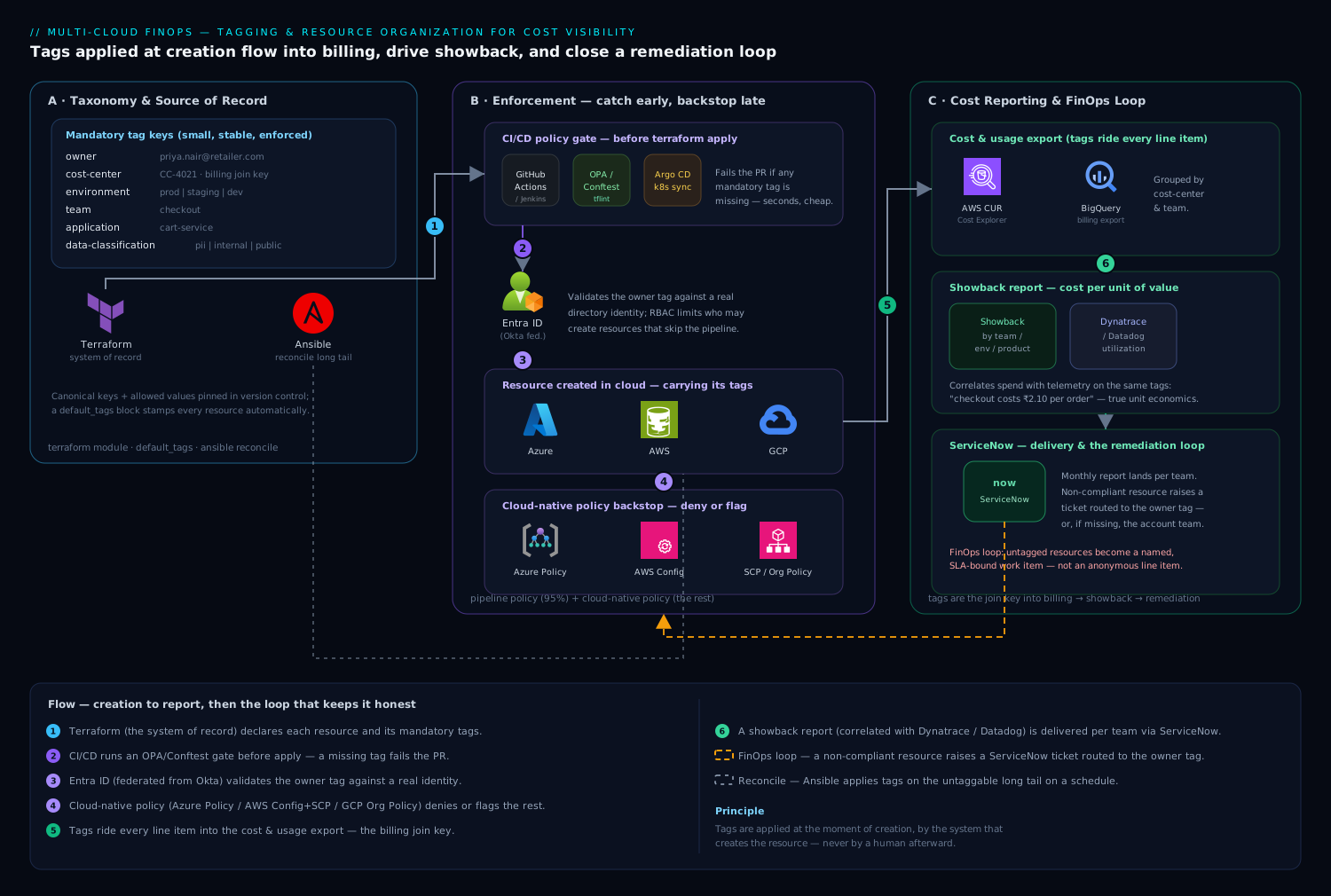
The system has three layers that map to three questions: what metadata do we require (the taxonomy), how do we guarantee it is present (enforcement), and how do we turn it into money the business understands (reporting). Data flows one way — a resource is created with tags, the tags ride along into the cloud provider’s billing export, and the export is sliced into a per-team cost report. The control flow is the loop that keeps it honest: policy blocks or flags untagged resources, and a remediation queue cleans up what slips through.
The defining principle of the whole design is this: tags must be applied at the moment of creation, by the system that creates the resource, not by a human afterward. Everything else follows from that. If the infrastructure-as-code pipeline is the only way resources come into existence, and that pipeline stamps the tags, then good tagging is automatic and untagged resources are the rare exception you hunt down, rather than the default state you despair of fixing.
Following the flow, creation to report:
- An engineer requests infrastructure the only sanctioned way — a change in the Terraform codebase, reviewed and merged. Terraform is the system of record for what exists; the same definition that creates a resource also declares its tags, so the two can never drift apart. For the handful of resources that exist outside Terraform (legacy servers, manually-built appliances), Ansible plays applies and reconciles tags on a schedule so nothing stays unmanaged for long.
- The merge triggers a CI/CD pipeline — GitHub Actions or Jenkins depending on the team, with Argo CD syncing the Kubernetes-side resources. The pipeline runs a policy check before
terraform apply: a tag-validation step (tflint, OPA/Conftest, or the provider’s native policy) that fails the build if any resource is missing a mandatory tag. This is the cheapest enforcement point — a missing tag is caught in seconds, in a pull request, before the resource ever exists. - The resource is created in the cloud — AWS, Azure, or GCP — carrying its tags. Identity for who may create what flows from Entra ID (federated from Okta for the workforce), so the
Ownertag can be validated against a real directory identity rather than a free-text guess, and RBAC ensures only the platform team can create resources that skip the pipeline. - The cloud provider’s native policy engine — Azure Policy, AWS Service Control Policies plus Tag Policies, or GCP Organization Policy — acts as the backstop for anything that bypasses CI/CD (a console click, an emergency fix). It either denies creation of an untagged resource outright, or flags it as non-compliant for remediation. Belt and suspenders: the pipeline catches the 95% that goes through it; the cloud policy catches the rest.
- Every resource’s tags flow automatically into the provider’s cost and usage export — the AWS Cost and Usage Report, Azure Cost Management exports, or GCP’s BigQuery billing export. This is the join key. Because the
cost-centerandteamtags are on every line item, the billing data can finally be grouped by something the business recognizes. - The export feeds a showback report — built natively (Azure Cost Management views, AWS Cost Explorer) or in a BI tool — that slices spend by team, by environment, by product. Dynatrace or Datadog correlates that cost data with utilization and application performance, so a report does not just say “checkout costs ₹X” but “checkout costs ₹X to serve Y requests” — cost per unit of business value, which is the metric FinOps actually wants. The report lands in front of each team monthly via ServiceNow, which also owns the workflow for tag-policy exceptions and remediation tickets.
The loop closes when a non-compliant resource raises a ServiceNow ticket routed to the Owner on the tag — and if there is no owner tag, to the team that owns the account. Untagged resources become someone’s named problem, on a clock, instead of an anonymous line in a report nobody reads.
The tag taxonomy: small, mandatory, and stable
The single biggest mistake teams make is inventing too many tags. A taxonomy of forty optional tags is a taxonomy nobody fills in consistently, which means it is useless for grouping. Start with a tiny set of mandatory tags that answer the questions the business will actually ask, and make them non-negotiable.
| Tag key | Example value | Question it answers | Why mandatory |
|---|---|---|---|
owner |
priya.nair@retailer.com |
Who do I call about this resource? | Routes remediation and accountability; validated against Entra ID |
cost-center |
CC-4021 |
Which budget does this charge to? | The join key for chargeback/showback to finance |
environment |
prod | staging | dev |
Is this production or disposable? | Drives the single biggest cleanup win — non-prod waste |
team |
checkout |
Which engineering team owns it? | Slices the bill the way the org chart reads |
application |
cart-service |
Which app/service is this part of? | Per-product and per-feature cost attribution |
data-classification |
pii | internal | public |
How sensitive is what is stored here? | Drives security posture and compliance scoping |
Six keys. That is enough to answer “what does the checkout team spend on production,” “which non-prod resources can we kill,” and “who owns this.” Resist the urge to add created-by-tool, cost-optimization-candidate, review-date, and the dozen other tags that sound useful and will be empty within a month. A few enforced tags beat many ignored ones — this is the rule that governs the whole design.
Two discipline points make or break consistency:
Standardize the values, not just the keys. A team tag is worthless if it contains checkout, Checkout, checkout-team, and chkt across different resources, because each is a separate bucket in the report. Pin the allowed values in policy: an environment tag may only be prod, staging, or dev. Use the same casing convention everywhere — lowercase with hyphens is a sane default.
Pin keys in version control as the source of truth. Keep the canonical list of tag keys and allowed values in the Terraform repo, in one shared module, so every team inherits the same definitions and a change to the taxonomy is a reviewed pull request, not tribal knowledge. A Terraform default_tags block makes this nearly free — declare the standard tags once at the provider level and every resource inherits them:
provider "aws" {
  region = "ap-south-1"

  default_tags {
    tags = {
      cost-center         = var.cost_center      # CC-4021
      team                = var.team             # checkout
      environment         = var.environment      # prod
      managed-by          = "terraform"
      data-classification = var.data_class
    }
  }
}

# owner and application are resource-specific, set per-resource:
resource "aws_db_instance" "cart" {
  # ...
  tags = {
    owner       = "priya.nair@retailer.com"
    application = "cart-service"
  }
}
Every resource this provider creates now carries five tags automatically, with no per-resource effort and no way to forget. That single block is the highest-leverage line of code in this entire architecture.
Enforcement: catch it early, backstop it late
Enforcement lives at two points, and you want both because each covers the other’s gap.
At the pipeline (preventive, cheap). A policy step in CI runs before any infrastructure is created and fails the pull request if a mandatory tag is missing or an environment value is not in the allowed set. Open Policy Agent with Conftest is the common tool; a Rego rule expresses “every resource of a taggable type must have cost-center, owner, and environment.” Because this runs in the PR, the engineer fixes it in the editor in seconds — the cheapest possible place to catch the problem, long before it touches a bill.
At the cloud provider (detective + corrective, the backstop). Not everything goes through the pipeline. Someone clicks “create” in the console during an incident; a SaaS integration provisions a resource directly. The cloud’s native policy engine catches these:
| Cloud | Preventive control | Detective / reporting control |
|---|---|---|
| Azure | Azure Policy deny effect on missing required tag; modify to auto-inherit from resource group |
Policy compliance dashboard; Cost Management tag views |
| AWS | Tag Policies (org-level) + SCPs to deny untagged creation for key services | AWS Config rule required-tags; Cost Explorer + CUR |
| GCP | Organization Policy + labels constraints | BigQuery billing export grouped by label |
A pragmatic stance: use deny for the resources where an untagged one is genuinely costly or risky (databases, large compute, storage), and use flag-and-remediate for the long tail, because a hard deny on every resource type creates enough friction that people route around your whole governance model. The goal is high compliance with low friction, not a fortress nobody can deploy through.
Whatever slips past both layers gets swept up by a scheduled reconciliation: an Ansible play or a small scheduled function lists untagged resources daily, and for each one opens a ServiceNow remediation ticket assigned to the owner tag — or, when even that is missing, to the team that owns the account. The ticket has an SLA. Untagged resources stop being a vague aspiration to “clean up someday” and become a tracked work item with a name on it.
From tags to money: showback and chargeback
Tags are a means; the end is the report that lets the business reason about spend. Two models, and the difference matters:
- Showback — each team sees its costs but is not internally billed. This is where almost everyone should start. It creates awareness and accountability without the political weight of moving money between budgets, and it is enough to drive most of the easy wins.
- Chargeback — costs are formally allocated to each team’s budget, so the spend hits their P&L. More powerful for accountability, but it demands near-perfect tag coverage (an untagged resource means money that cannot be charged to anyone) and the organizational maturity to handle the budget fights it triggers. Earn your way here after showback has the data clean.
The mechanics are the same either way: the billing export, already carrying cost-center and team on every line, is grouped by those tags. Suddenly the CFO’s question has an answer — checkout’s production spend, the recommendations team’s GPU bill, and, crucially, the ₹4 lakh of environment=staging resources that are running 24/7 when they only need to exist during business hours. That last finding is the one that pays for the entire tagging effort in its first month, and it is invisible without the environment tag.
Correlating cost with Dynatrace or Datadog utilization data elevates this from a bill to an insight. A resource tagged team=recommendations, environment=prod that costs a fortune but sits at 8% CPU is a right-sizing opportunity the cost report alone would never surface — you need the performance telemetry joined to the cost data, on the same tags, to see it. This is unit economics: cost per order, cost per active user, cost per thousand requests. It is the metric that turns “the cloud is expensive” into “checkout costs ₹2.10 per order and rec-engine costs ₹0.40, and here is why.”
Enterprise considerations
Security and compliance, not just cost. The data-classification and owner tags pull double duty. Wiz (with Wiz Code scanning the Terraform in the pull request, before deploy) uses data-classification=pii to prioritize its posture findings — a public-facing storage bucket tagged pii is a far louder alarm than one tagged public. CrowdStrike Falcon uses the owner and team tags to route a runtime detection straight to the team that owns the affected workload, instead of a generic SOC queue, cutting response time. Tags are security infrastructure as much as cost infrastructure; the same six keys serve both, which is part of why keeping the set small and universal is worth the discipline.
The organizational reality. Tagging fails as a technical project and succeeds as an organizational one. The taxonomy is the easy 20%; getting every team to adopt it is the hard 80%. Two things make adoption stick: making the right way the easy way (the Terraform default_tags block means a compliant resource takes zero extra effort), and making non-compliance visible and owned (the ServiceNow ticket with a name on it). A monthly showback report that lands in each team’s inbox — here is what you spent, here is what your idle staging cost — does more for tagging hygiene than any policy, because now the team has a reason to care.
Multi-cloud consistency. Tag keys differ in spelling and rules across providers — AWS and Azure call them “tags,” GCP calls them “labels,” and GCP labels forbid uppercase and most punctuation. Normalize to one canonical taxonomy in the Terraform module and let provider-specific code translate (lowercase everything for GCP, map cost-center to whatever each provider’s billing export expects). One taxonomy, many providers; the report stitches them into a single view of total spend.
Cost of the system itself. Refreshingly, near zero. Tags are free on every major cloud. The cost export is free or pennies. The policy engines are included. The only real cost is the engineering time to set up the taxonomy and pipeline checks once — a few days — and the discipline to maintain them. The return is a recurring, often double-digit-percentage reduction in the bill as waste becomes visible. There is no cheaper architecture in this entire blog with a better return.
Failure modes and tradeoffs
Name the failure modes before they cost you a quarter:
- Tag sprawl — too many optional tags, inconsistently filled, so no grouping is reliable. Mitigation: a small mandatory set, enforced; everything else is genuinely optional and never depended on for reporting.
- Value drift —
prod,Prod,productionfragment one environment into three report buckets. Mitigation: allowed-value constraints in policy, not just key presence. - The untaggable long tail — some resource types or some clouds will not enforce tags on creation. Mitigation: scheduled reconciliation plus a default-tag inheritance rule (Azure’s
modifyeffect inheriting from the resource group) so a missing tag is filled, not just flagged. - Backfill debt — you start tagging today but 1,900 resources predate the policy. Mitigation: a one-time bulk-tagging script keyed off the best available signal (account, naming convention, creation logs), accepting that some old resources will get an
owner=unknownyou chase down manually — and treating that pain as the argument for never letting it happen again. - Enforcement friction backlash — a blanket
denyon every resource so annoys engineers that they build shadow infrastructure outside your governance. Mitigation:denyonly the high-value resource types; flag-and-remediate the rest.
The honest tradeoffs. Strict enforcement creates deployment friction, and there is a real line between “governed” and “obstructive” that you have to find for your org — too loose and tags are inconsistent, too tight and people route around you. A small mandatory taxonomy means you cannot answer every conceivable slicing question, only the ones your six tags cover — and that is the correct trade, because a taxonomy that answers everything is one nobody fills in. Showback is lower-friction than chargeback but also lower-accountability; start with showback and graduate only when the data is clean and the org is ready for budget fights. And tagging gives you visibility, not savings on its own — it tells you the idle staging fleet exists, but someone still has to act on the report. The architecture’s job is to make the waste impossible to ignore; closing the loop is a human decision.
The shape of the win
Three months after the retailer adopts this, the CFO’s question has a one-screen answer: checkout, recommendations, search, and fulfilment each with their production and non-prod spend broken out, trending, and — via Dynatrace — expressed per order served. The forgotten load-test environment that bled ₹4 lakh is gone, killed the week the first showback report made it visible. The next time someone spins up a cluster, it carries its owner, cost-center, and environment automatically because the Terraform module stamps them, and if somehow it does not, a ServiceNow ticket finds the person who created it by Friday. None of this required a new platform or a big budget — just a six-key taxonomy, a policy check in the pipeline, a default_tags block, and the organizational will to make the report land in front of the people who can act on it.
That is the entire point of foundational governance: it is unglamorous, nearly free, and it is the prerequisite for every cost-optimization, FinOps, and accountability initiative that comes after. You cannot manage what you cannot measure, you cannot measure what you cannot attribute, and you cannot attribute without tags. Start here — with a small set of mandatory tags, enforced at creation, wired into a report someone reads — and every cost conversation that follows becomes a data conversation instead of an argument. Skip it, and you are our retailer in March, doing Slack archaeology on an orphaned database while the bill climbs another 38%.