A payments company runs 42 AWS accounts under one Organization, and the cloud security team has exactly the problem every multi-account shop hits eventually: they have agent coverage on EC2 from the CrowdStrike Falcon sensor, but no continuous picture of the configuration of the accounts themselves — the public S3 bucket someone spun up for a one-day test, the security group that quietly opened 0.0.0.0/0 to RDS, the IAM role with *:* that a contractor created and never removed. They also ship roughly 200 container images a week to Amazon ECR, and “is this image safe to deploy” is currently answered by a vibe. The mandate from the CISO is concrete: onboard every account into CrowdStrike Falcon Cloud Security for agentless posture management (CSPM), turn on behavioural Indicator of Attack (IOA) detection so a live attacker action — not just a static misconfiguration — pages the SOC, and make ECR registry scanning a gate in the build pipeline.
This guide is the step-by-step to do exactly that, repeatably, with CloudFormation and Terraform. It is an implementation guide, so the hands-on lab — a full Organization registration, a StackSet fan-out, an IOA smoke test, an ECR scan gate, and a wave-based rollout runbook — is the centerpiece. Around it sits everything you need to run the platform after day one: how the cross-account IAM reader role and external ID actually work, what the onboarding CloudFormation stack really creates in your accounts, how the policy framework layers CIS benchmarks and CrowdStrike’s own rules into IOM (Indicator of Misconfiguration) findings, how 1-click and guided remediation differ and when each is safe, how the attack path graph turns 4,000 findings into 12 that matter, and how agentless CSPM composes with the sensor-based Cloud Workload Protection (CWP) you already run.
The thing to internalise before you start: Falcon Cloud Security gives you three complementary lenses. Agentless CSPM reads your AWS control plane through a cross-account IAM role on a scan schedule and tells you what is misconfigured and what an attack path looks like. IOA detection consumes a CloudTrail-derived event stream over EventBridge in near-real-time and tells you what an attacker is doing right now — a root login from a new geography, a disabled GuardDuty detector, a sudden PutBucketPolicy that makes data public. Registry and snapshot assessment is the third lens, on your supply chain and unsensored hosts. You will wire all three, prove each one works with a deliberate test finding, and leave with a teardown path that removes every artefact cleanly.
What problem this solves
Multi-account AWS estates drift. Every account is a blast radius with its own IAM surface, its own network edges, and its own S3 buckets, and past about five accounts nobody can hold the posture in their head. AWS-native tooling covers pieces — Config rules for drift, GuardDuty for threat findings, Security Hub for aggregation — but teams that already standardised on Falcon for endpoint want one console, one severity language, one ticket pipeline for both “the sensor saw a reverse shell on EC2” and “this bucket went public an hour ago”. That single-pane requirement, not a gap in AWS tooling, is usually why Falcon Cloud Security lands on the roadmap.
What breaks without a CSPM layer is predictable, and it is worth being concrete because these are the findings the platform will surface in week one:
| Failure mode you have today | How it happens | What it costs when it bites | Which Falcon lens catches it |
|---|---|---|---|
| Public S3 bucket with customer data | One-off test bucket, policy pasted from Stack Overflow | Breach disclosure, regulator fines | IOM (CSPM scan) + IOA (PutBucketPolicy event) |
Security group open to 0.0.0.0/0 on 5432/3306 |
“Temporary” debug rule never removed | Database credential stuffing, crypto-mining | IOM (CSPM scan) |
IAM role with AdministratorAccess + no boundary |
Contractor onboarding shortcut | Full-account takeover from one leaked key | IOM + attack path graph |
| CloudTrail stopped in one account | Attacker’s first move post-compromise | Blind forensics, undetected lateral movement | IOA (behavioural, near-real-time) |
| Root user console login | Break-glass creds reused casually | Untraceable privileged change | IOA |
| Vulnerable base image promoted to prod | No scan gate between build and deploy | Exploitable CVE in a payment path | Registry assessment (ECR) |
| Unsensored EC2 with 2-year-old kernel | Team that “doesn’t do agents” | Unpatched remote-code-execution exposure | Snapshot (agentless host) assessment |
| GuardDuty/Config disabled to “save cost” | Well-meaning cost cleanup | Native detection silently dark | IOM + IOA (DeleteDetector event) |
The second problem this guide solves is operational, not detective: onboarding 42 accounts by clicking through a console wizard 42 times is how you get 38 registered accounts, three half-registered ones, and one nobody remembers. Everything here is expressed as CloudFormation and Terraform so that account 43 — created next quarter by Control Tower — onboards itself with zero human action, and so that teardown is a terraform destroy, not an archaeology project.
The three lenses differ in mechanism, latency, and what they can see. Keep this table in your head for the whole article — every later design decision derives from it:
| Lens | Mechanism | Latency | What it sees | What it cannot see |
|---|---|---|---|---|
| CSPM / IOM | Falcon assumes a read-only IAM role, enumerates config via AWS APIs on a scan schedule | Scan interval (hours) | Misconfigurations, IAM relationships, exposure, compliance state | Live process activity, events between scans |
| IOA (behavioural) | Per-account, per-region EventBridge rules forward CloudTrail management events to a CrowdStrike event bus; a behavioural engine scores sequences | Near-real-time (minutes) | Attacker actions: logging tampering, privilege grants, exfil setup, anomalous logins | Anything CloudTrail doesn’t log (data events unless enabled, in-instance activity) |
| Registry / snapshot assessment | Falcon pulls ECR image layers (or CI pushes them to a scanner), and scans EBS snapshots of running hosts | On push / scheduled | OS + language-package CVEs, embedded secrets, malware in images and unsensored hosts | Runtime behaviour, memory-only threats (that is the sensor’s job) |
Learning objectives
By the end of this article you can:
- Register a single AWS account and a whole AWS Organization into Falcon Cloud Security using the console CloudFormation quick-create flow, the raw API, and the
crowdstrike/crowdstrikeTerraform provider — and explain what each method creates in AWS. - Explain the cross-account trust chain end to end: CrowdStrike’s AWS account → intermediate role → your per-account reader role, and why the external ID defeats the confused-deputy attack.
- Deploy the reader role and the IOA EventBridge forwarding rules to every member account with a
SERVICE_MANAGEDCloudFormation StackSet that auto-enrols future accounts. - Distinguish IOMs from IOAs, tune the policy framework (CIS + CrowdStrike policies, severity overrides, exclusions), and predict which lens catches which class of incident.
- Choose between 1-click remediation, guided remediation, Fusion workflow auto-remediation, and IaC pull-request fixes — and articulate why 1-click on a Terraform-managed resource creates drift.
- Read the attack path graph and use it to cut a 4,000-finding backlog to the dozen combinations that actually terminate at data.
- Wire ECR registry assessment both as a scheduled registry connection and as an inline CI gate that fails builds on policy, and scan unsensored hosts via snapshot assessment.
- Route findings to ServiceNow with severity-mapped SLAs, prove each lens works with a deliberate test finding, and tear the whole integration down cleanly.
Prerequisites & where this fits
You should be comfortable with AWS Organizations concepts (management account, OUs, trusted access, delegated administration), IAM cross-account trust policies, CloudFormation StackSets, and intermediate Terraform. On the CrowdStrike side you need console access and the right subscription; this article assumes the Falcon sensor story (endpoint/EKS) is already handled — if it is not, read Deploy CrowdStrike Falcon Sensor to Linux Fleets and Kubernetes via Helm DaemonSet first, because the CWP integration section below builds on it.
Concretely, have these in hand before the lab:
| Prerequisite | Specifics | Why it blocks you without it |
|---|---|---|
| Falcon Cloud Security subscription | The CSPM/cloud module licensed for your CID (Customer ID) | Registration endpoints return 403 without the entitlement |
| Falcon console role | Falcon Administrator or Cloud Security manager role on your user | Needed to create API clients and view registration pages |
| Falcon API client | Client ID + secret with CSPM registration: Read & Write and Falcon Container Image: Read & Write scopes | Every API/Terraform step authenticates with it |
| Your Falcon cloud region | us-1, us-2, eu-1, or us-gov-1 — check your console URL |
Tokens minted against the wrong regional API base fail |
| AWS Organizations management account access | Ability to create StackSets with Org trusted access, or a delegated admin account | Org-wide registration deploys from here |
| Org-wide CloudTrail | An organization trail logging management events, IsLogging = true |
IOA detection has nothing to score without it |
| Terraform ≥ 1.6, AWS provider ≥ 5.40 | Run from CI with sts:AssumeRole into the management account |
The lab is Terraform-first |
| Secrets store | HashiCorp Vault (or AWS Secrets Manager) path for the API secret | The client secret is shown once; it must never live in tfvars or git |
| SSO to the Falcon console | Okta or Entra ID SAML federation with MFA | Analyst access should be corporate identity, not local passwords |
The Falcon cloud region deserves its own lookup because it is the number-one cause of “nothing works” on day one. Your tenant lives in exactly one, and every API call, scanner image path, and provider block must agree with it:
| Falcon cloud | API base URL | Console URL | Who is on it |
|---|---|---|---|
us-1 |
api.crowdstrike.com |
falcon.crowdstrike.com |
Most US commercial tenants |
us-2 |
api.us-2.crowdstrike.com |
falcon.us-2.crowdstrike.com |
Newer US commercial tenants |
eu-1 |
api.eu-1.crowdstrike.com |
falcon.eu-1.crowdstrike.com |
EU tenants (data residency) |
us-gov-1 |
api.laggar.gcw.crowdstrike.com |
falcon.laggar.gcw.crowdstrike.com |
US GovCloud tenants |
Where this fits in the corpus: it is the AWS-side CSPM implementation in the multi-cloud security track. The org-plumbing it rides on is covered in Enforcing Org-Wide Guardrails with AWS Organizations, SCPs, and Delegated Administration and AWS Control Tower Guardrails: Building a Secure Multi-Account Foundation. The CloudTrail foundation IOA depends on is AWS CloudTrail and Config: Audit and Compliance at Scale. If your shop evaluates Wiz for the same job, Roll Out Wiz CSPM Across a Multi-Account AWS Organization with the AWS Connector is the direct parallel — the reader-role/external-ID pattern is nearly identical, which tells you it is the industry-standard shape for agentless CSPM.
Core concepts
Five mental models make every later step obvious.
Registration is an API object; the IAM role is its AWS-side half. When you “onboard an account”, you create a registration record in CrowdStrike’s backend (via console, API, or Terraform) keyed by your AWS account ID or Organization ID. That record generates two values: the IAM role name Falcon expects to find in your account and the external ID it will present when assuming it. Nothing works until both halves exist — a registration without the role shows the account as pending/inactive; a role without a registration is an orphan grant nobody uses. Every onboarding method (console wizard, API, Terraform) is just a different way of creating the record and then materialising the role.
The trust chain is: CrowdStrike’s AWS account → intermediate role → your reader role, locked by external ID. Falcon’s scanners run in CrowdStrike-owned AWS accounts. They first assume an intermediate role in CrowdStrike’s own environment, and that role is the principal your reader role trusts. Your role’s trust policy adds an sts:ExternalId condition carrying the per-registration external ID. This is the classic confused-deputy defence: even if an attacker convinces CrowdStrike’s infrastructure to assume roles on their behalf, they cannot name your role and your external ID together without your registration record. The external ID is not a secret in the cryptographic sense, but treat it like one — it is the only thing distinguishing your grant from anyone else’s.
IOM and IOA are different engines answering different questions. An Indicator of Misconfiguration is the output of the assessment engine: on each scan cycle, Falcon enumerates resources through the reader role, evaluates them against configuration policies (CIS controls plus CrowdStrike’s own rules), and emits findings with a severity and a remediation. An Indicator of Attack is the output of the behavioural engine: CloudTrail management events stream in through EventBridge, and the engine scores event sequences against attacker tradecraft — not “this bucket is public” but “this principal just disabled logging, created an access key, and attached an admin policy inside ten minutes”. IOMs tell you where the doors are unlocked; IOAs tell you the handle is turning. Teams that treat the platform as IOM-only buy half the product and none of the urgency.
Agentless and agent are complements, not substitutes. The reader role sees the control plane: what exists, how it is configured, who can reach what. The Falcon sensor (CWP) sees the data plane inside the host: processes, memory, network syscalls, container runtime behaviour. Snapshot scanning bridges the gap for hosts that cannot take a sensor — it reads EBS snapshots for vulnerable packages, but still cannot see live behaviour. The console unifies all of it per cloud asset, which is precisely the argument for running CSPM where your EDR already lives.
Everything you create in AWS is read-only and inert. The reader role carries AWS-managed SecurityAudit plus a small CrowdStrike supplement of Describe*/Get*/List* permissions; the EventBridge rules only forward events; the ECR grant only pulls layers. Falcon cannot mutate your environment through anything this guide deploys — remediation, when you enable it, is a separately-permissioned, deliberately-scoped add-on. You will verify the read-only claim empirically in the lab rather than trusting the vendor or this article.
Pin the vocabulary before the deep sections:
| Term | One-line definition | Where it lives |
|---|---|---|
| CID | Your CrowdStrike customer/tenant ID | Falcon backend |
| Registration | The record binding an AWS account/Org to your CID | Falcon backend (API object) |
| Reader role | Read-only IAM role Falcon assumes for assessment | Every AWS account |
| Intermediate role | CrowdStrike-side role that is the trusted principal | CrowdStrike’s AWS account |
| External ID | Per-registration sts:ExternalId condition value |
Trust policy + Falcon backend |
| IOM | Indicator of Misconfiguration — a static posture finding | Assessment engine |
| IOA | Indicator of Attack — a behavioural detection from event streams | Behavioural engine |
| Realtime visibility | The IOA feature flag on a registration | Registration record |
| Event bus (CrowdStrike) | The EventBridge bus in CrowdStrike’s account your rules target | CrowdStrike’s AWS account |
| CWP | Cloud Workload Protection — the sensor-based runtime lens | Your hosts/clusters |
| Image assessment | CVE/secret/malware analysis of container images | Falcon registry/CI scanning |
| Snapshot assessment | Agentless vulnerability scan of EBS snapshots | Your account + Falcon |
| Attack path | Graph chaining findings from exposure to crown-jewel data | Falcon console |
| Fusion workflow | Falcon’s SOAR automation (triggers → conditions → actions) | Falcon console |
And keep the account-level data flows straight — three distinct pipes, three distinct AWS primitives:
| Pipe | AWS primitive on your side | Direction | Frequency | Payload |
|---|---|---|---|---|
| Assessment (IOM) | IAM reader role (sts:AssumeRole inbound) |
Falcon pulls | Scan schedule (configurable, hours) | AWS API read responses |
| Behavioural (IOA) | EventBridge rule + IAM role for events:PutEvents |
You push | Continuous (event-driven) | CloudTrail management events |
| Registry assessment | ECR pull permissions on the reader role (or CI push) | Falcon pulls / CI pushes | On schedule / on build | Image manifests + layers |
Account registration: the trust chain, the stack, and the StackSet
Registration is where most rollouts stall, so this section goes mechanism-by-mechanism. There are three ways to onboard, and they all converge on the same two artefacts — the registration record in Falcon and the reader role in AWS:
| Method | How it works | Best for | Repeatability | Gotcha |
|---|---|---|---|---|
| Console quick-create (CloudFormation) | Falcon console generates a pre-parameterised CloudFormation quick-create URL; you launch it in the management account; the stack creates roles + StackSets + EventBridge rules | First account, proof-of-value, teams without IaC discipline | Low — parameters live in a browser session | The stack name and role names are CrowdStrike defaults; changing them later means re-registering |
API (cloud-connect-cspm-aws) |
POST /cloud-connect-cspm-aws/entities/account/v1 creates the registration and returns the role name + external ID; you deploy the role yourself |
Scripted onboarding from existing automation (Lambda, Step Functions, account-vending pipelines) | High | You own the drift between record and role; deletion must be two-sided |
Terraform (crowdstrike/crowdstrike provider) |
crowdstrike_cloud_aws_account resource creates the record; outputs feed an aws_cloudformation_stack_set in the same plan |
Production, multi-account, anything you intend to keep | Highest — one plan shows both sides |
Provider needs FALCON_CLIENT_ID/FALCON_CLIENT_SECRET/FALCON_CLOUD env vars; state now contains the external ID (encrypt your backend) |
Use the console flow once in a sandbox to see what it creates, then do production in Terraform. Never mix methods for the same account — a Terraform-managed registration that someone “fixes” in the console is drift you will chase for a week.
What the onboarding stack actually creates
Whichever method you choose, the AWS-side footprint is the same shape. Inventory it before you deploy it, because your security review will ask, and because knowing what should exist is how you spot a broken rollout later:
| Artefact | Scope | Created by | Purpose | Mutating power |
|---|---|---|---|---|
Reader IAM role (e.g. CrowdStrikeCSPMReader) |
Every account | Stack / StackSet | Assessment engine assumes it to enumerate config | None — read-only |
| Reader role inline/supplement policy | Every account | Stack / StackSet | Describe*/Get*/List* for services SecurityAudit misses (ECR pulls, Lambda config, EKS describe) |
None — read-only |
| EventBridge rules (per region in scope) | Every account, each active region | Stack / StackSet | Match CloudTrail management events, forward to CrowdStrike’s bus | Forward-only |
| EventBridge target IAM role | Every account | Stack / StackSet | Grants events:PutEvents on the CrowdStrike event bus ARN only |
Forward-only |
| StackSet(s) + Org trusted access | Management account | Root stack | Fan the above out to members; auto-enrol new accounts | Deploys the above |
| (Optional) snapshot-scanning role/infra | Accounts you enable it in | Separate template | Lets the scanner read EBS snapshots | Read snapshots only |
Two things are deliberately absent from that list: nothing writes to your resources, and nothing runs compute in your accounts for core CSPM/IOA (snapshot scanning is the exception you opt into). That absence is the security-review headline.
Anatomy of the reader role
The role is two policy attachments and one trust policy. The permissions half:
| Attachment | What it grants | Why it is there |
|---|---|---|
AWS managed arn:aws:iam::aws:policy/SecurityAudit |
Broad read-only across ~100 services: Describe*, List*, Get* on config metadata (not data) |
The baseline every CSPM vendor uses; AWS maintains it as services evolve |
| CrowdStrike supplement policy | The deltas: ecr:GetDownloadUrlForLayer, ecr:BatchGetImage, eks:Describe*/ListClusters, lambda:GetFunction, backup:List*, and similar |
SecurityAudit deliberately excludes anything that could read content; Falcon needs a handful of these (notably ECR layer pulls for registry assessment) |
Note the asymmetry: SecurityAudit cannot read your S3 objects, your secrets, or your snapshots — it reads configuration about resources. The supplement’s ecr:GetDownloadUrlForLayer/BatchGetImage is the one place the role touches content (image layers), and only because you want image scanning. If you do not license registry assessment, strip those statements.
The trust policy is where the security actually lives:
{
  "Version": "2012-10-17",
  "Statement": [
    {
      "Effect": "Allow",
      "Principal": {
        "AWS": "arn:aws:iam::<CROWDSTRIKE_ACCOUNT_ID>:role/<INTERMEDIATE_ROLE_NAME>"
      },
      "Action": "sts:AssumeRole",
      "Condition": {
        "StringEquals": { "sts:ExternalId": "<YOUR_REGISTRATION_EXTERNAL_ID>" }
      }
    }
  ]
}
Read it like an auditor:
| Field | Value | What it defends against |
|---|---|---|
Principal.AWS |
CrowdStrike’s intermediate role ARN (returned by your registration, not hand-typed) | Any principal outside CrowdStrike’s scanner infrastructure |
Action |
sts:AssumeRole only |
The role cannot be passed, federated, or used with web identity |
Condition sts:ExternalId |
Your per-registration external ID | Confused deputy: another CrowdStrike customer (or a hijacked internal path) naming your role ARN still fails the condition |
(What’s absent) no aws:SourceIp, no MFA |
— | Deliberate: scanner fleet IPs churn; the external ID + principal pin is the contract |
If your org standard demands more, you can add an aws:PrincipalOrgID-style condition only if CrowdStrike publishes one for their org — they do not, so resist inventing conditions that will silently break scanning after their infra rotates. The correct hardening dial is elsewhere: alert on AssumeRole calls against this role from unexpected principals via your own CloudTrail analytics.
Organization-wide registration with Terraform
Here is the production pattern end to end: register the Organization, then fan the role out via a SERVICE_MANAGED StackSet. The provider handles the Falcon side; the StackSet handles all member accounts and — critically — every future account.
terraform {
  required_providers {
    crowdstrike = { source = "crowdstrike/crowdstrike", version = "~> 0.4" }
    aws         = { source = "hashicorp/aws", version = "~> 5.40" }
  }
}

# Reads FALCON_CLIENT_ID / FALCON_CLIENT_SECRET / FALCON_CLOUD from env — never tfvars
provider "crowdstrike" {}
provider "aws" { region = "us-east-1" }   # management account credentials

# 1) The registration record: whole Org, assessment + behavioural IOA on
resource "crowdstrike_cloud_aws_account" "org" {
  account_id           = "111111111111"        # Organization MANAGEMENT account
  organization_id      = "o-abcd1234ef"
  is_organization_mgmt = true

  asset_inventory = { enabled = true }          # agentless CSPM (IOM) scanning
  realtime_visibility = {                       # behavioural IOA feed
    enabled           = true
    cloudtrail_region = "us-east-1"             # region your org trail's home is in
  }
  sensor_management = { enabled = false }       # sensors handled by our own pipeline
}

# 2) Falcon hands back the AWS-side contract as attributes
locals {
  role_name    = crowdstrike_cloud_aws_account.org.iam_role_name
  external_id  = crowdstrike_cloud_aws_account.org.external_id
  cs_role_arn  = crowdstrike_cloud_aws_account.org.intermediate_role_arn
  cs_bus_arn   = crowdstrike_cloud_aws_account.org.eventbus_arn
}

# 3) StackSet that lands the reader role + IOA forwarding in every member account
resource "aws_cloudformation_stack_set" "falcon" {
  name             = "crowdstrike-falcon-cloud-security"
  description      = "CrowdStrike FCS reader role + IOA EventBridge forwarding"
  permission_model = "SERVICE_MANAGED"          # Org trusted access, no per-account exec roles
  capabilities     = ["CAPABILITY_NAMED_IAM"]
  call_as          = "SELF"                     # or DELEGATED_ADMIN from a delegated account

  auto_deployment {
    enabled                          = true     # account 43 onboards itself
    retain_stacks_on_account_removal = false
  }

  operation_preferences {
    max_concurrent_percentage    = 25           # wave through the Org, don't carpet-bomb it
    failure_tolerance_percentage = 10
    region_concurrency_type      = "PARALLEL"
  }

  parameters = {
    ReaderRoleName    = local.role_name
    ExternalID        = local.external_id
    CSIntermediateArn = local.cs_role_arn
    CSEventBusArn     = local.cs_bus_arn
  }

  template_body = file("${path.module}/templates/falcon-member.yaml")
}

resource "aws_cloudformation_stack_set_instance" "members" {
  stack_set_name = aws_cloudformation_stack_set.falcon.name
  region         = "us-east-1"                  # IAM is global; one home region for the stacks
  deployment_targets {
    organizational_unit_ids = [
      "ou-abcd-workloads1",                      # prod + non-prod workload OUs
      "ou-abcd-platform22",
    ]
  }
}

# The management account is NOT covered by a service-managed StackSet — stack it directly
resource "aws_cloudformation_stack" "mgmt" {
  name         = "crowdstrike-falcon-cloud-security-mgmt"
  capabilities = ["CAPABILITY_NAMED_IAM"]
  parameters = {
    ReaderRoleName    = local.role_name
    ExternalID        = local.external_id
    CSIntermediateArn = local.cs_role_arn
    CSEventBusArn     = local.cs_bus_arn
  }
  template_body = file("${path.module}/templates/falcon-member.yaml")
}
The StackSet decisions that matter, since each is a fork you cannot cheaply reverse:
| Decision | Options | Pick | Why |
|---|---|---|---|
| Permission model | SERVICE_MANAGED vs SELF_MANAGED |
SERVICE_MANAGED |
Uses Organizations trusted access; no AWSCloudFormationStackSetExecutionRole to pre-stage in 42 accounts; enables auto-deployment |
call_as |
SELF (management) vs DELEGATED_ADMIN |
DELEGATED_ADMIN if you have a security-tooling account registered as delegated admin for CloudFormation |
Keeps humans and pipelines out of the management account |
| Auto-deployment | on/off | On, retain_stacks_on_account_removal = false |
New accounts get the role at creation; departing accounts get scrubbed |
| Targets | Root vs specific OUs | Specific OUs | Excludes suspended/sandbox OUs you don’t license; targeting root also hits accounts mid-decommission |
| Concurrency | max_concurrent_percentage, failure_tolerance_percentage |
25% / 10% | A bad template parameter fails fast on the first wave instead of wedging 42 accounts |
| Management account | StackSet vs direct stack | Direct aws_cloudformation_stack |
Service-managed StackSets skip the management account by design — forgetting this is the #1 “one account missing” cause |
API onboarding (when Terraform is not in the loop)
Account-vending pipelines sometimes need to register an account the moment it is created, before any Terraform runs. The raw API is two calls — create the registration, read back the contract:
# OAuth2 token (client-credentials)
TOKEN=$(curl -s -X POST "https://api.${FALCON_CLOUD}.crowdstrike.com/oauth2/token" \
  -H "Content-Type: application/x-www-form-urlencoded" \
  -d "client_id=${FALCON_CLIENT_ID}&client_secret=${FALCON_CLIENT_SECRET}" \
  | jq -r .access_token)

# Register one member account under the existing Org registration
curl -s -X POST "https://api.${FALCON_CLOUD}.crowdstrike.com/cloud-connect-cspm-aws/entities/account/v1" \
  -H "Authorization: Bearer ${TOKEN}" -H "Content-Type: application/json" \
  -d '{"resources":[{"account_id":"222222222222","organization_id":"o-abcd1234ef","account_type":"commercial"}]}'

# Read the registration back — role name, external ID, provisioning status
curl -s "https://api.${FALCON_CLOUD}.crowdstrike.com/cloud-connect-cspm-aws/entities/account/v1?ids=222222222222" \
  -H "Authorization: Bearer ${TOKEN}" | jq '.resources[] | {account_id, iam_role_arn, external_id, status}'
The same via FalconPy (the official Python SDK), which is what you embed in a Lambda hooked to your account-creation event:
from falconpy import CSPMRegistration

falcon = CSPMRegistration(client_id=CID, client_secret=SECRET, base_url="us-1")

resp = falcon.create_aws_account(
    account_id="222222222222",
    organization_id="o-abcd1234ef",
    behavior_assessment_enabled=True,   # IOA
    sensor_management_enabled=False,
)
assert resp["status_code"] in (200, 201), resp["body"]["errors"]
Whichever path creates the record, the account shows Inactive/Pending in Cloud security → Settings → Account registration until the role exists and the first assessment succeeds — the StackSet’s auto-deployment usually closes that gap within minutes of account creation.
The policy framework: how findings get made
An IOM finding is the intersection of three things: a resource (enumerated through the reader role), a policy (a rule with a severity, mapped to one or more compliance frameworks), and an assessment run (the scan cycle that evaluated it). Understanding the policy layer is what separates teams that operate CSPM from teams that stare at a 4,000-finding wall.
Falcon ships policies in families. The ones that matter on AWS:
| Policy family | Source | Coverage character | Typical count/scope | How you use it |
|---|---|---|---|---|
| CIS AWS Foundations Benchmark | Center for Internet Security (v1.4/v2.0/v3.0 mappings) | The auditable baseline: ~60 prescriptive controls on IAM, logging, monitoring, networking | Identity, CloudTrail, Config, S3, VPC | Compliance reporting; the floor every auditor recognises |
| CrowdStrike configuration policies | CrowdStrike research | Broader and more opinionated than CIS: per-service misconfiguration rules across S3, EC2, RDS, EKS, Lambda, KMS, ELB, and more | Hundreds of rules across services | Day-to-day IOM findings; the operational queue |
| Behavioural policies (IOA) | CrowdStrike threat research | Attacker tradecraft over CloudTrail event sequences | Dozens of behaviour patterns | SOC detections, not posture backlog |
| Framework mappings | PCI DSS, NIST 800-53, SOC 2, HIPAA, ISO 27001, MITRE ATT&CK cloud matrix | Same underlying rules, re-grouped per framework | Reporting views | Evidence packs; scoping which accounts need which framework |
| Custom policies | You | Org-specific rules (naming, mandated tags, banned regions) where supported | As needed | Encode house rules the vendors cannot know |
Severity is the language everything downstream speaks — ticket priority, SLA, paging. Falcon grades IOMs and IOAs on the same scale, which is exactly why a unified queue works:
| Severity | What it means in practice | Example IOM | Example IOA | Sane SLA |
|---|---|---|---|---|
| Critical | Internet-reachable path to data or control plane, or active-attack indicator | S3 bucket public + contains data classifiers | CloudTrail logging disabled in prod | Fix/contain same day |
| High | Exploitable weakness needing one more step | SG open to world on 22/3389; IAM user without MFA with console access | Root user API activity | 7 days |
| Medium | Defence-in-depth gap | EBS volumes unencrypted; RDS not multi-AZ backup-verified | Unusual region activity for a principal | 30 days |
| Informational | Hygiene and context | Untagged resources; idle credentials | First-seen-service events | Backlog / trend only |
Reading and tuning IOM policies
A representative slice of what turns up in week one on a real estate — learn to read the policy → finding → fix chain:
| Policy (IOM) | Service | Default severity | What triggers it | The fix it prescribes |
|---|---|---|---|---|
| S3 bucket is publicly accessible | S3 | Critical | Bucket policy/ACL grants * read, and account/bucket Public Access Block off |
Enable Public Access Block; rewrite policy |
| Security group allows unrestricted ingress to admin port | EC2/VPC | High | 0.0.0.0/0 or ::/0 on 22/3389 |
Restrict CIDR; prefer SSM Session Manager |
| IAM policy allows full administrative privileges | IAM | High | Customer policy with "Action":"*","Resource":"*" attached |
Split to least privilege; add permission boundary |
| CloudTrail not enabled in all regions | CloudTrail | High | No multi-region/org trail | Create org trail (see the CloudTrail article) |
| RDS instance is publicly accessible | RDS | Critical | PubliclyAccessible=true + subnet route to IGW |
Disable flag; move to private subnets |
| EBS volume not encrypted | EC2 | Medium | Volume without KMS encryption | Enable default EBS encryption per region |
| Access key not rotated in 90 days | IAM | Medium | Active key age > 90d | Rotate; move workload to roles |
| EKS cluster endpoint publicly accessible | EKS | High | Public API endpoint without CIDR allowlist | Private endpoint or tighten publicAccessCidrs |
Tuning is where you keep the queue honest. Every knob, and the cost of misusing it:
| Tuning action | Where | When it is right | When it is a mistake |
|---|---|---|---|
| Disable a policy tenant-wide | Cloud security → policies | The rule genuinely doesn’t apply (e.g. a service you ban via SCP anyway) | Disabling “noisy” rules that are noisy because the estate is actually bad |
| Override severity | Per policy | Your threat model genuinely differs (e.g. all data is public by design on a CDN bucket set) | Downgrading Critical to make a dashboard green |
| Exclude resources (exemptions) | Per finding/resource, with expiry | Sanctioned exceptions with an owner and a review date | Permanent exclusions with no owner — that is shadow risk acceptance |
| Scope policies per account group | Registration/account groups | Sandbox OUs held to a lighter bar than prod | Scoping prod out of CIS to pass an audit |
| Custom policy | Policy builder (where supported) | House rules: mandatory data-classification tag, banned regions |
Re-implementing CIS badly |
The discipline that makes this work: every exemption carries an owner tag and an expiry, reviewed monthly. Falcon lets you suppress; only your process makes suppression safe.
Behavioural IOAs: the near-real-time pipeline
IOA detection is a streaming pipeline, and you own the first half of it. When it is silent, you debug it hop by hop, so learn the hops now:
| # | Hop | Owner | What happens | Failure mode to check |
|---|---|---|---|---|
| 1 | CloudTrail records a management event | You | API call in any member account lands in the org trail | Trail not logging; management events excluded |
| 2 | Event surfaces on the account’s default EventBridge bus | AWS | CloudTrail management events are visible to EventBridge rules in the same region | Region not covered by a rule |
| 3 | Falcon forwarding rule matches | You (StackSet) | Rule pattern detail-type: AWS API Call via CloudTrail (plus console sign-in events) matches |
Rule deleted/disabled by account owner |
| 4 | events:PutEvents to CrowdStrike’s bus |
You → CrowdStrike | Target role posts the event cross-account to the bus ARN from your registration | Target role trust/permission broken; wrong bus ARN |
| 5 | Behavioural engine scores sequences | CrowdStrike | Single events and multi-event sequences evaluated against IOA patterns | Registration’s realtime visibility disabled |
| 6 | Detection raised, severity assigned | CrowdStrike | Appears in Cloud security detections; Fusion workflows fire | Nobody subscribed — detection lands in an unwatched queue |
Two design consequences fall out of that table. First, coverage is per region: the forwarding rule must exist in every region where API activity can occur, which is why the member template stamps rules into each enabled region rather than only your home region — an attacker who notices you only watch us-east-1 will happily create their access keys in ap-northeast-3. Second, IOA is downstream of CloudTrail health: aws cloudtrail get-trail-status belongs in the same monitoring tier as the detections themselves, because stopping the trail blinds hop 1 — which is precisely why “CloudTrail logging disabled” is itself a high-severity IOA. The event-bus mechanics (buses, rules, cross-account targets) are standard EventBridge — Designing Event-Driven Architectures with Amazon EventBridge: Buses, Rules, Schemas, and Archive/Replay covers the primitive itself in depth.
What the engine actually catches — representative behavioural IOAs and why each is high-signal:
| Behavioural IOA (representative) | Underlying events | Why it is attacker-shaped |
|---|---|---|
| CloudTrail logging disabled or trail deleted | StopLogging, DeleteTrail, PutEventSelectors (scoping down) |
Defence evasion is step one of competent intrusions |
| GuardDuty detector disabled | DeleteDetector, UpdateDetector |
Same evasion class, native-tooling flavour |
| Root account activity | Console sign-in / API calls as root | Root has no business in daily ops; break-glass only |
| Console login without MFA / from anonymising infrastructure | Sign-in events + context | Credential-stuffing and token-theft tradecraft |
| IAM privilege escalation sequence | CreateUser → CreateAccessKey → AttachUserPolicy(AdministratorAccess) in a tight window |
The canonical persistence chain; single events look innocent, the sequence does not |
| Security group opened to the world on a sensitive port | AuthorizeSecurityGroupIngress with 0.0.0.0/0 |
Exposure created now, not found at next scan |
| S3 bucket made public | PutBucketPolicy / PutBucketAcl with public grants |
The IOA twin of the classic IOM — minutes, not hours |
| Unusual compute spin-up pattern | Burst RunInstances in odd regions/instance types |
Cryptomining monetisation after credential theft |
The IOM/IOA pairing is the operational punchline: the same public-bucket problem surfaces as an IOA within minutes (someone just did it) and as an IOM at the next scan (it is still true). Route the IOA to the SOC pager and the IOM to the backlog — same policy family, different consumers, and you configure that split in the triage section below.
Remediation: 1-click, guided, or automated — and when each is safe
Finding things is the easy half. Falcon offers a spectrum of remediation mechanics, and picking the wrong one for a resource class creates a different incident — usually IaC drift or a broken workload. The spectrum:
| Mode | Mechanism | Speed | Blast-radius control | Where it is safe |
|---|---|---|---|---|
| Guided remediation | The finding panel shows the exact fix: console path, aws CLI command, and the reasoning |
Human-paced | Full — a person executes with change control | Default for everything; the only mode for Terraform-managed resources (fix the module, not the resource) |
| 1-click remediation | A remediation action attached to the finding executes the fix through a scoped role/workflow you provisioned | Seconds | Per-action approval | Click-ops estates; true emergencies (public bucket with regulated data) where drift is the lesser evil |
| Fusion workflow auto-remediation | Trigger (detection/finding) → conditions → action (Lambda, webhook, native action) with no human in the loop | Seconds, 24/7 | Conditions + scoping only | Narrow, rehearsed playbooks: quarantine-tag an instance, block a public-ACL bucket in a sandbox OU |
| IaC pull request | Finding routed to the owning repo; fix lands as a Terraform/CloudFormation PR through CI | Hours–days | Full review + plan | The correct steady-state for everything IaC-managed; pairs with pipeline scanning |
The decision rule that keeps you out of trouble:
| If the resource is… | And the finding is… | Then remediate via… | Because… |
|---|---|---|---|
| Terraform/CloudFormation-managed | Any severity | IaC PR (guided remediation as the PR’s content) | 1-click fixes get reverted by the next apply — or worse, half-reverted |
| Click-ops / unmanaged | Critical, internet-exposed | 1-click now, then import to IaC | Minutes matter; drift is moot on unmanaged resources |
| Sandbox/dev OU | Repeat offender classes (public buckets, open SGs) | Fusion auto-remediation | Low blast radius, high toil savings |
| Production data stores | Anything touching policies/encryption | Guided + change window | An automated PutBucketPolicy “fix” that breaks a legitimate cross-account grant is a P1 |
| Anything with an SCP already denying it | The same control | Fix the finding source (delete the resource) and rely on the SCP | Two enforcement layers disagreeing is confusion, not defence |
Note what 1-click requires that plain CSPM does not: a write-capable path into your account. That is a deliberate, separately-provisioned role or workflow target with a tightly scoped policy (e.g. only s3:PutBucketPublicAccessBlock, only in tagged accounts) — never a broadening of the reader role. If a security review finds write verbs on the reader role, someone wired remediation lazily; fail the review.
Attack paths: from 4,000 findings to the 12 that matter
A fresh 42-account onboarding will produce thousands of IOMs. Triaging them severity-first is better than nothing, but severity is a local property — it scores one resource in isolation. The attack path view (CrowdStrike’s graph analysis; the capability family the industry files under exposure management, and post the Bionic acquisition extended toward ASPM, application security posture management) scores combinations: it chains an internet-exposed entry point through IAM and network edges to a crown-jewel target, and only complete chains rank.
The graph’s building blocks:
| Element | Examples | Contribution to a path |
|---|---|---|
| Entry node (exposure) | Public ALB/EC2/API endpoint, public bucket, leaked-key-shaped IAM user | Where the adversary starts |
| Pivot edge (identity) | Instance profile → role, role trust → role, over-broad iam:PassRole, sts:AssumeRole grants |
How they become someone else |
| Pivot edge (network) | SG/NACL reachability, peering, TGW routes, VPC endpoints | Where they can move |
| Amplifier finding | Missing MFA, unrotated key, unpatched CVE from snapshot/registry assessment | What makes each hop cheap |
| Target node (crown jewel) | RDS/DynamoDB with data classifiers, S3 with sensitive data, KMS keys, the management account | What ends up in the ransom note |
The operational play: sort by paths terminating at data, fix the choke-point edge (the one edge appearing in the most paths — often a single over-permissive role trust or one iam:PassRole wildcard), and watch dozens of paths collapse at once. In practice, week-one estates repeatedly show the same choke points: a CI/CD role assumable from too many places, an SSM automation role with PassRole *, and a legacy peering connection nobody remembered. Fixing three edges did more for the payments company in the scenario below than closing three hundred medium IOMs — that is the entire argument for graph-first triage, and it is also the honest counter to “we already have Config rules”: native tooling evaluates resources; the graph evaluates reachability.
Composing agentless CSPM with the sensor (CWP)
You already run the Falcon sensor on EC2 and EKS — that is Cloud Workload Protection: runtime process telemetry, exploit blocking, container drift detection. The composition question is what each layer contributes per asset class, because coverage gaps hide in the seams:
| Asset class | Agentless CSPM sees | Sensor (CWP) sees | Snapshot/registry assessment adds | Residual gap |
|---|---|---|---|---|
| EC2 with sensor | Its config: SGs, IAM profile, exposure, encryption | Processes, memory, network behaviour, malware | (Snapshot redundant) | — |
| EC2 without sensor | Config only | — | OS/package CVEs via EBS snapshot scan | Live behaviour invisible — close it or accept it in writing |
| EKS nodes/pods | Cluster config: endpoint exposure, RBAC-adjacent config, node IAM | Container runtime behaviour via DaemonSet sensor | Image CVEs via ECR assessment | Admission control (separate policy layer) |
| Fargate tasks | Task/service config | Sensor as sidecar/patched runtime (see the EKS/Fargate article) | Image CVEs | Kernel-level visibility (by design on Fargate) |
| Lambda | Function config: role, env, triggers, public URLs | — (no sensor) | Layer/package CVEs where licensed | Runtime tracing |
| RDS/S3/managed data | Full config posture | n/a | n/a | Data-plane access patterns (CloudTrail data events, if enabled) |
The console stitches these into one asset view: open an EC2 instance and you see its IOMs, its sensor detections, its CVEs, and the attack paths through it — one severity model, one timeline. Two integration behaviours worth configuring deliberately:
- Sensor coverage as a posture policy. The unified inventory knows which instances lack a sensor (agentless sees the instance; no sensor heartbeat matches it). Treat “EC2 instance not protected by a sensor” as an IOM-class finding with an owner, and burn the list down — this is the highest-leverage report the combination produces, and it is how the two lenses audit each other.
- Registration
sensor_management. The registration object can enable 1-click sensor deployment (via SSM) for hosts the agentless side discovered. If your sensor rollout is already pipeline-managed (golden AMIs, the Helm DaemonSet flow), leave itfalse— two deployment authorities for the same agent is how version skew happens. Runtime policy for EKS and Fargate specifically is its own discipline: CrowdStrike Falcon Runtime Protection for EKS and Fargate Workloads.
The anti-pattern to ban in design review: treating a green CSPM dashboard as runtime safety, or sensor coverage as posture. The lenses answer different questions; the value is the join.
Registry and snapshot assessment: the supply-chain lens
ECR: registry connection vs CI gate
There are two integration styles for image assessment, and mature pipelines run both, because they answer different questions — “what is in my registry” versus “should this build promote”:
| Dimension | Style A — registry connection | Style B — inline CI scan |
|---|---|---|
| Mechanism | Falcon inventories the ECR registry via IAM role (external-ID trust, ecr:GetAuthorizationToken/BatchGetImage/GetDownloadUrlForLayer) and assesses images on a schedule |
Your pipeline runs the falcon-image-analyzer container against the just-built image and uploads results |
| Latency | Scheduled (catches images however they arrived) | At build time (before promotion) |
| Can block a deploy | No — detective | Yes — exit code gates the job |
| Catches | Everything in the registry: old images, hotfix pushes that bypassed CI, third-party images teams pulled in | Only what flows through the pipeline |
| New-CVE re-evaluation | Yes — tomorrow’s CVE against today’s inventory | No — a build is scanned once |
| Cost profile | Falcon-side licensing; negligible AWS (ECR egress within region) | CI minutes + scanner image pull (cache it) |
| Failure mode | Stale credentials/role → silent inventory gap | Scanner outage blocks all builds — decide fail-open vs fail-closed in writing |
Register the registry connection through Cloud security → Registry connections or the container-security API; the role it assumes can be the reader role (which already carries the ECR read statements) or a dedicated CrowdStrike-ECR-Read role if you want separately revocable supply-chain access — take the dedicated role in regulated estates. The CI style drops into any runner:
# GitHub Actions — scan-and-gate after build, before push/promote
- name: CrowdStrike image assessment gate
  env:
    FALCON_CLIENT_ID:     ${{ secrets.FALCON_CLIENT_ID }}
    FALCON_CLIENT_SECRET: ${{ secrets.FALCON_CLIENT_SECRET }}
  run: |
    docker run --rm \
      -v /var/run/docker.sock:/var/run/docker.sock \
      registry.crowdstrike.com/falcon-imageanalyzer/us-1/release/falcon-image-analyzer:latest \
      --client-id "$FALCON_CLIENT_ID" --client-secret "$FALCON_CLIENT_SECRET" \
      --cloud us-1 \
      --image "111111111111.dkr.ecr.us-east-1.amazonaws.com/payments-api:${GITHUB_SHA}"
What the gate actually evaluates is an image assessment policy you define in the console — the pipeline only enforces the verdict:
| Policy criterion | Typical production setting | Rationale |
|---|---|---|
| CVE severity threshold | Fail on Critical; fail on High with fix available | “High with no vendor fix” blocks forever; track it, don’t block on it |
| Exploit status | Fail on known-exploited regardless of severity score | CVSS is not exploitability |
| Embedded secrets | Fail, always | A key baked into a layer is already leaked |
| Malware / packers | Fail, always | Non-negotiable |
| Base-image age / OS EOL | Warn → fail after grace period | Forces base-image hygiene without breaking Friday |
| Registry scope | Per-repository or per-tag-pattern | Hold prod-* repos to the strict policy, sandbox-* to warn-only |
Pair the Falcon gate with ECR’s own hygiene — immutable tags, scan-on-push, lifecycle policies — which is a five-minute add via Terraform Module: AWS ECR Repository. And if your platform team also runs Wiz on the pipeline side, the gate-design trade-offs are the same shape: Integrate Wiz Code into GitHub Actions for IaC and Container Scanning Gates.
Snapshot assessment: the no-agent hosts
Some fleet will never take a sensor — appliance AMIs, vendor-managed instances, teams with change freezes. Snapshot assessment closes the vulnerability-visibility gap agentlessly:
| Aspect | How it works | The catch |
|---|---|---|
| Acquisition | EBS snapshots of in-scope instances are read and their filesystems analysed for installed-package inventories | Needs snapshot-read/creation permissions beyond the base reader role — a separate opt-in template |
| Scope | OS packages, language packages, some config files | Point-in-time: it sees the disk, never memory or processes |
| Cadence | Scheduled re-scans; new snapshots as instances change | Snapshot churn has an AWS storage cost (see Cost & sizing) |
| Output | CVEs per host, merged into the same asset view and attack paths as sensor-derived vulns | Same CVE may appear from sensor and snapshot — the console de-duplicates per asset |
| When to use | Unsensorable hosts, M&A due diligence on an unfamiliar estate, pre-sensor triage of a new Org | It is a bridge, not a substitute — no runtime protection, only knowledge |
Compliance dashboards and reporting
Compliance is the same findings re-projected: each framework view groups policy results into control families, scores them, and exports evidence. The operating model that works: pick one framework per audience — CIS for engineering (“is the floor solid”), PCI DSS scoped to the cardholder-data OUs for the auditor, MITRE mapping for the SOC (“which tactics are we blind to”) — and schedule exports rather than screenshotting dashboards:
| Reporting need | Mechanism | Cadence |
|---|---|---|
| Auditor evidence pack | Framework view → scheduled export (CSV/PDF) filtered to in-scope account group | Quarterly, and frozen at audit kickoff |
| Engineering burn-down | Findings API pull → your BI (severity × service × account trend) | Weekly |
| Executive posture score | Framework compliance % per BU account group | Monthly |
| SOC coverage review | MITRE-mapped detections vs tactics matrix | Quarterly |
Two habits keep the numbers honest. Scope frameworks to account groups — running PCI against your marketing sandbox produces noise that erodes trust in the real number. And track trend, not point-in-time: a 71% CIS score means nothing; 71% up from 44% in eight weeks is a programme working. If you also aggregate into AWS-native tooling for a second opinion, Security Hub’s standards engine covers similar ground — Terraform Module: AWS Security Hub stands it up in one block.
Findings triage → ticketing: making someone own every red row
A finding nobody owns is a dashboard decoration. The routing model that survives contact with production splits by lens and severity, not by tool:
| Signal | Route | Consumer | SLA clock |
|---|---|---|---|
| IOA, Critical/High | Fusion workflow → ServiceNow security incident + SOC channel page | SOC (24/7) | Minutes — treat as live attack until triaged |
| IOA, Medium/Info | ServiceNow queue, no page | SOC next business day | 1–3 days |
| IOM, Critical | ServiceNow incident to the owning team (account tag → assignment group) | Resource owner | Same day |
| IOM, High | ServiceNow change/task, batched daily | Resource owner | 7 days |
| IOM, Medium/Info | Weekly digest + backlog import (Jira/ADO) | Team backlog | 30 days / grooming |
| Image gate failure | The failed build itself + repo notification | The committing developer | Immediate — it is their red build |
| Attack path (new, terminating at data) | Security architecture review, one ticket per choke-point edge | Cloud security team | 7 days |
The ServiceNow mapping is configured once in the Falcon ServiceNow integration (or a Fusion workflow calling the ServiceNow API) and then argued about forever, so write it down:
| Falcon field | ServiceNow field | Mapping rule |
|---|---|---|
| Severity | Impact/Urgency → Priority | Critical→P1, High→P2, Medium→P3, Info→P4 |
| AWS account ID | Assignment group | Via your account-metadata table (account → team) — this lookup is the whole game |
| Resource ARN + region | CI / affected item | Direct |
| Policy ID + finding description | Short description + work notes | Include the guided-remediation text so the assignee never opens the console cold |
| Finding ID | Correlation ID | Dedupe: re-detections update, never re-create |
The one non-negotiable: close the loop in Falcon. When ServiceNow resolves, the fix must show as the finding disappearing at next scan (IOM) or the detection being closed with a disposition (IOA). Tickets closed while findings persist means your assignment-group lookup is wrong or teams are closing without fixing — both are audit findings in the making. The broader governance pattern (CMDB-driven ownership, ServiceNow as the system of record across scanners) is the subject of Multi-Account AWS Governance: Tying Wiz, ServiceNow, and Control Tower Together — the same skeleton applies with Falcon as the emitter.
Architecture at a glance
Walk the diagram left to right as three flows converging on one Falcon tenant. The CSPM flow starts in CrowdStrike’s own AWS environment: the assessment engine assumes the intermediate role, then hops cross-account into the read-only reader role stamped into every one of your accounts by the StackSet, presenting your registration’s external ID; it enumerates configuration and feeds the IOM/assessment and attack-path views. The IOA flow runs the opposite direction: CloudTrail management events in each account and region hit the Falcon-deployed EventBridge forwarding rules, which PutEvents onto CrowdStrike’s event bus, where the behavioural engine turns event sequences into detections within minutes. The registry flow has Falcon pulling image layers from ECR through the same trust pattern on a schedule, while your CI pushes just-built images through the inline analyzer as a promotion gate. Around the edges sit the operating integrations: Okta/Entra ID gate console access over SAML, Vault holds the API client credentials, detections fan out to ServiceNow and the SOC, Wiz runs as an independent posture cross-check, and Datadog/Dynatrace ingest the detection stream for dashboards.
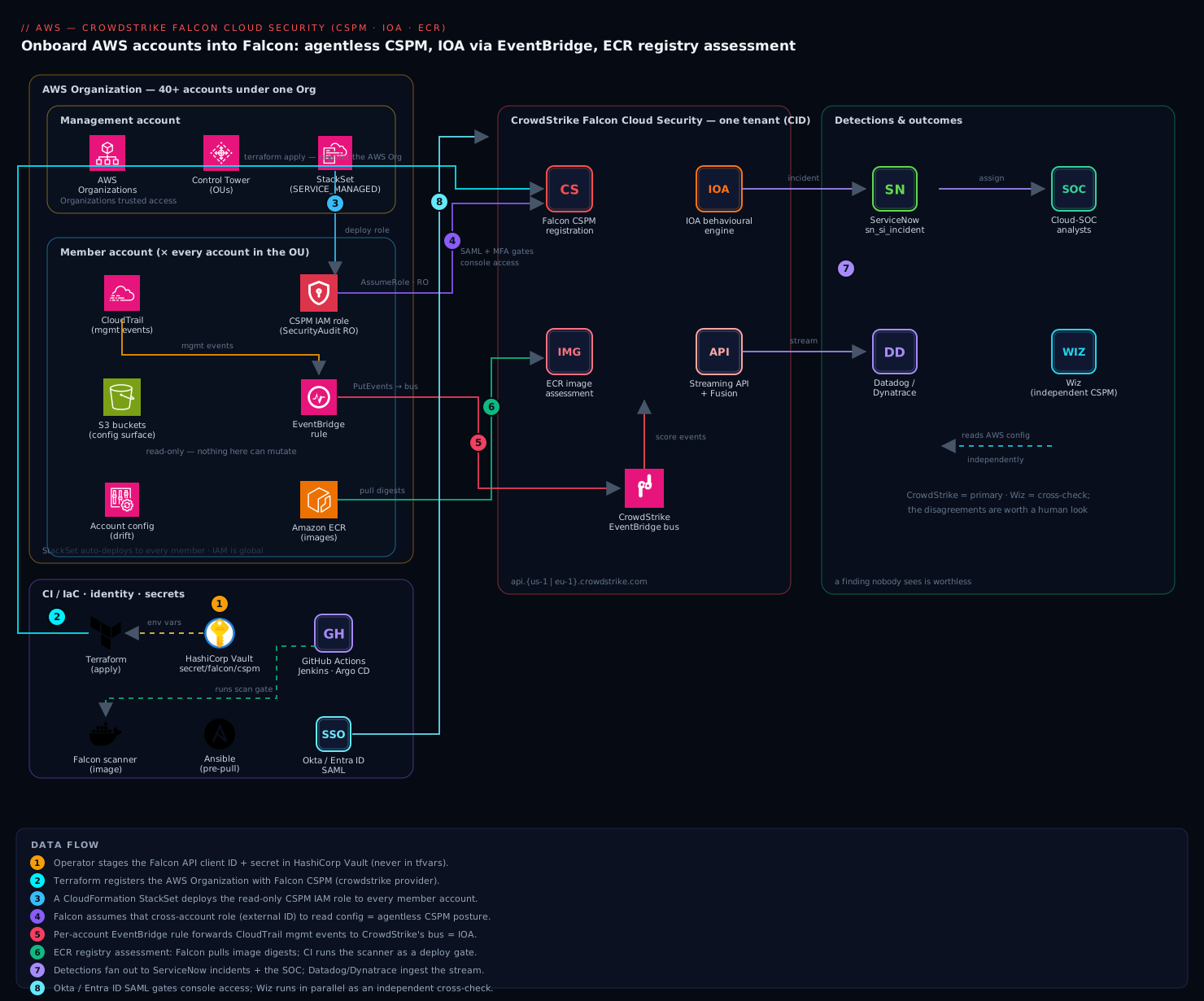
The property to notice: every arrow into your accounts is either read (role assumption for enumeration, ECR layer pulls) or outbound push you control (EventBridge forwarding). Nothing in the core deployment gives CrowdStrike write access to your environment, which is why the whole architecture can ship through a security review in one pass — and why remediation, which does need write, is deliberately a separate, opt-in path.
Real-world scenario: 42 accounts, 6 weeks, one choke point
SwiftRail Payments (fictional, realistic) runs 42 accounts: 8 prod, 22 non-prod, 12 sandbox, Control Tower-vended, with the Falcon sensor already on ~600 EC2 instances and 14 EKS clusters. Two staff engineers got the CSPM mandate with a hard constraint: no console click-ops, everything reviewable in git.
Week 1 they registered the Organization via the Terraform provider and stacked the reader role into the 8 prod accounts only (max_concurrent_percentage = 25), deliberately excluding sandboxes from licensing scope. First full scan: 3,847 IOMs — 41 Critical, 312 High. The team did not file 3,847 tickets. They filed 41, from which two patterns emerged: 29 of the Criticals were the same public-snapshot misconfiguration stamped by one legacy AMI-bakery module, and the attack-path view showed one choke point — a CI role in a shared-services account assumable by arn:aws:iam::* principals within the org and holding iam:PassRole on *. One Terraform PR to the bakery module and one to the CI role’s trust policy closed 29 Criticals and collapsed 14 of the 17 data-terminating attack paths. Total effort: four days.
Week 3, IOA went live org-wide. Day two produced a page: StopLogging on a member-account trail — not an attacker, but a cost-cleanup script an SRE had written months earlier that disabled “unused” trails, which had been silently running ever since. The behavioural lens caught in 6 minutes what the posture lens would have reported at next scan as one more High among hundreds; the SRE’s script got an allowlist and a code review. The same week, ServiceNow routing went in with the account→assignment-group lookup, and the first weekly digest went to team backlogs.
Week 5, the ECR gate turned on in warn mode across 61 repositories: 34% of builds carried a fixable Critical, almost all from two stale base images. Platform published refreshed bases, gave teams a two-week grace window, then flipped prod-* repos to fail-closed. Break-glass procedure (deploy despite a finding, VP sign-off, 72-hour expiry) was used twice in the first month — both times for CVEs with no vendor fix, both tracked to closure.
Week 6 numbers: Criticals 41 → 3 (all exempted with expiry and owner), data-terminating attack paths 17 → 2, image-gate pass rate 66% → 94%, mean SOC triage time for cloud IOAs 11 minutes. The retrospective’s one-liner: “The graph told us which three edges to cut; everything else was backlog.”
Advantages and disadvantages
| Advantages | Disadvantages |
|---|---|
| One console and one severity language across endpoint (sensor), posture (IOM), behaviour (IOA), and images — the join is the product | Licensing is per-asset/account and commercially significant; sandbox scoping decisions become budget decisions |
| Read-only, externally-auditable AWS footprint; security review is straightforward | Scan-cycle latency on IOMs — between scans, only IOA sees change, and only for CloudTrail-visible actions |
Org-level registration + SERVICE_MANAGED StackSet auto-enrols future accounts — governance that scales past human memory |
Trust chain depends on CrowdStrike-side infrastructure (intermediate role, event bus); an upstream change can silently degrade coverage until you alert on it |
| Behavioural IOAs catch attacker sequences natively (multi-event patterns GuardDuty scores differently or not at all) | IOA coverage is bounded by CloudTrail management events — data-plane exfiltration needs data events or the sensor |
| Attack-path graph turns finding floods into a short choke-point worklist | Graph quality depends on complete registration — a few unregistered accounts create false “no path” confidence |
| Terraform provider + API make the entire lifecycle IaC-native, including teardown | Provider ecosystem is younger than the platform; some console features (policy tuning, Fusion workflows) still lack full IaC coverage — document the click-configured remainder |
| Registry + snapshot assessment extend one CVE model to images and unsensored hosts | Overlap with AWS-native (Config, GuardDuty, Inspector, Security Hub) means paying twice unless you consciously assign each tool a job |
The honest competitive note: if you have no CrowdStrike footprint at all, evaluate this against Wiz and against an all-native stack on joins, not features — every vendor’s checklist looks identical. Falcon’s differentiated join is sensor-runtime + posture in one asset record; if that join is worthless to you, the calculus changes.
Hands-on lab: register the Org, prove all three lenses, roll out in waves
This is the centerpiece. It assumes the prerequisites table is satisfied, runs from a workstation or CI runner with management-account credentials, and finishes with a verified, torn-downable deployment. Run steps 1–8 in a sandbox Organization first if you have one; the runbook in step 9 is how you take it to production.
Lab variables — set once, reference everywhere:
export FALCON_CLOUD="us-1"                    # your tenant's cloud from the region table
export MGMT_ACCOUNT="111111111111"
export ORG_ID="o-abcd1234ef"
export SANDBOX_ACCOUNT="333333333333"         # a member account you can safely break
export HOME_REGION="us-east-1"
Step 1 — API client, secret into Vault, token smoke test
In the console: Support and resources → API clients and keys → Create API client. Name aws-cspm-onboarding, scopes CSPM registration: Read & Write and Falcon Container Image: Read & Write. The secret displays exactly once — put it straight into Vault:
vault kv put secret/falcon/cspm client_id="$CID" client_secret="$CSECRET" cloud="$FALCON_CLOUD"
export FALCON_CLIENT_ID=$(vault kv get -field=client_id  secret/falcon/cspm)
export FALCON_CLIENT_SECRET=$(vault kv get -field=client_secret secret/falcon/cspm)

# Smoke test — expect: token-ok
curl -s -X POST "https://api.${FALCON_CLOUD}.crowdstrike.com/oauth2/token" \
  -d "client_id=${FALCON_CLIENT_ID}&client_secret=${FALCON_CLIENT_SECRET}" \
  | python3 -c "import sys,json;print('token-ok' if json.load(sys.stdin).get('access_token') else 'FAILED')"
FAILED here is a wrong FALCON_CLOUD or mistyped secret — fix before proceeding; nothing downstream works without it. (Vault-side patterns for exactly this shape of credential are in HashiCorp Vault as Central Secrets Broker for Multi-Cloud Workloads.)
Step 2 — Confirm the CloudTrail foundation
aws cloudtrail describe-trails \
  --query 'trailList[].[Name,IsOrganizationTrail,IsMultiRegionTrail]' --output table
aws cloudtrail get-trail-status --name org-management-trail --query 'IsLogging'
# Expect: an org trail, multi-region, IsLogging: true
No org trail, or IsLogging: false → stop and fix that first (the CloudTrail article has the module). IOA without a logging trail is a pipeline to nowhere.
Step 3 — Register the Organization (Terraform)
Apply the registration + StackSet configuration from the registration section above (crowdstrike_cloud_aws_account.org, aws_cloudformation_stack_set.falcon, instances, and the direct management-account stack):
terraform init && terraform plan -out=tf.plan     # review: 1 Falcon registration, 1 StackSet, instances, 1 stack
terraform apply tf.plan
terraform output external_id                       # note it; validation uses it
Step 4 — Watch the StackSet fan out, then confirm registration health
aws cloudformation list-stack-instances \
  --stack-set-name crowdstrike-falcon-cloud-security \
  --query 'Summaries[].[Account,Region,Status,StatusReason]' --output table
# Expect: every targeted account CURRENT; investigate any OUTDATED/FAILED row before proceeding

TOKEN=$(curl -s -X POST "https://api.${FALCON_CLOUD}.crowdstrike.com/oauth2/token" \
  -d "client_id=${FALCON_CLIENT_ID}&client_secret=${FALCON_CLIENT_SECRET}" | jq -r .access_token)
curl -s "https://api.${FALCON_CLOUD}.crowdstrike.com/cloud-connect-cspm-aws/entities/account/v1?organization-ids=${ORG_ID}" \
  -H "Authorization: Bearer ${TOKEN}" \
  | jq '[.resources[] | {account_id, status}] | group_by(.status) | map({status: .[0].status, n: length})'
# Expect: all accounts "provisioned"/"Active" once the role exists and the first scan touched them
Console check: Cloud security → Settings → Account registration — every account green. Accounts stuck Pending past an hour: wrong role name, wrong external ID, or the StackSet skipped them (management account? excluded OU?).
Step 5 — Prove the IOM lens with a deliberate finding (sandbox account)
aws s3api create-bucket --bucket "cs-iom-canary-${SANDBOX_ACCOUNT}" --region "$HOME_REGION"
aws s3api put-public-access-block --bucket "cs-iom-canary-${SANDBOX_ACCOUNT}" \
  --public-access-block-configuration BlockPublicAcls=false,IgnorePublicAcls=false,BlockPublicPolicy=false,RestrictPublicBuckets=false
aws s3api put-bucket-policy --bucket "cs-iom-canary-${SANDBOX_ACCOUNT}" --policy '{
  "Version":"2012-10-17",
  "Statement":[{"Effect":"Allow","Principal":"*","Action":"s3:GetObject",
                "Resource":"arn:aws:s3:::cs-iom-canary-'"${SANDBOX_ACCOUNT}"'/*"}]}'
Within one scan cycle, Cloud security → Misconfigurations, filter the sandbox account → expect the public-bucket Critical against your canary. Open it and read the guided remediation panel — this is the panel your ServiceNow tickets will embed. Do not fix it yet; step 7 uses it.
Step 6 — Prove the IOA lens (sandbox only, and re-enable immediately)
# Classic defence-evasion IOA: stop a sandbox trail (NEVER the org trail)
aws cloudtrail stop-logging --name sandbox-local-trail
sleep 300
aws cloudtrail start-logging --name sandbox-local-trail
Expect a behavioural detection (“CloudTrail logging disabled”-class) in Cloud security → Detections within minutes, severity High+, carrying the principal, source IP, and event narrative. If nothing after ~15 minutes, debug the six-hop pipeline table from the IOA section — in practice: hop 3 (rule missing in that region) or hop 4 (target role broken).
Step 7 — Prove read-only, then close the loop
# The reader role must be able to READ...
aws sts assume-role --role-arn "arn:aws:iam::${SANDBOX_ACCOUNT}:role/$(terraform output -raw iam_role_name)" \
  --role-session-name verify --external-id "$(terraform output -raw external_id)" > /tmp/cs.json
export AWS_ACCESS_KEY_ID=$(jq -r .Credentials.AccessKeyId /tmp/cs.json) \
       AWS_SECRET_ACCESS_KEY=$(jq -r .Credentials.SecretAccessKey /tmp/cs.json) \
       AWS_SESSION_TOKEN=$(jq -r .Credentials.SessionToken /tmp/cs.json)
aws s3api list-buckets --query 'Buckets | length(@)'          # succeeds: read works
aws s3api put-object --bucket "cs-iom-canary-${SANDBOX_ACCOUNT}" --key x --body /etc/hostname 2>&1 \
  | grep -q AccessDenied && echo "read-only confirmed"        # writes: denied
unset AWS_ACCESS_KEY_ID AWS_SECRET_ACCESS_KEY AWS_SESSION_TOKEN
Now remediate the canary the way production will: apply the guided-remediation fix (re-enable Public Access Block, delete the policy), and confirm the finding clears at the next scan — that disappearance is your triage loop’s “done” signal.
Step 8 — Wire and gate ECR
Register the registry connection (console Registry connections, or the container-security API) against a dedicated CrowdStrike-ECR-Read role, then prove the CI gate fails closed:
docker pull vulnerables/web-dvwa:latest    # a knowingly-vulnerable image
docker tag vulnerables/web-dvwa:latest "${MGMT_ACCOUNT}.dkr.ecr.${HOME_REGION}.amazonaws.com/lab-canary:dvwa"
# Run the falcon-image-analyzer step from the registry section against it — expect a non-zero exit
echo "exit=$?"                              # a 0 here means your policy is warn-only: fix the policy, not the pipeline
Console: Cloud security → Images shows the digest with its CVE counts; the assessment policy verdict matches the exit code.
Step 9 — The production rollout runbook
With the mechanics proven, production is sequencing. This is the wave plan that avoids both big-bang risk and eternal pilots:
| Wave | Scope | Actions | Gate to next wave |
|---|---|---|---|
| 0 (day 0) | Sandbox Org / 1 sandbox account | Steps 1–8 end to end, including teardown rehearsal | All three lenses proven + teardown clean |
| 1 (week 1) | Security/tooling + 2 low-risk prod accounts | Register, stack, first scan; baseline finding counts; no ticketing yet | Registration green; scan completes; no unexplained findings class |
| 2 (week 2) | All prod OUs | StackSet targets widen; IOA on; SOC dry-run on detections | SOC triage runbook exercised on ≥1 real IOA |
| 3 (week 3–4) | Non-prod OUs; ServiceNow routing live | Account→assignment-group lookup verified per account; Critical/High SLAs start | <5% ticket misroutes in the first week |
| 4 (week 4–5) | ECR gate warn-mode on all repos | Publish base-image fixes; grace window announced | Pass rate > 90% on prod-* repos |
| 5 (week 6) | Gate fail-closed on prod-*; auto-deployment on for new accounts |
Flip policy; enable StackSet auto-deployment against the full OU set; exemption register reviewed | Steady state — hand to operations |
Step 10 — Validation matrix (run at every wave boundary)
| Check | Command / place | Pass condition |
|---|---|---|
| Registration health | API query from step 4 | 100% of wave accounts provisioned |
| StackSet drift | aws cloudformation detect-stack-set-drift + instance list |
All CURRENT, no drift |
| IOM pipeline | Canary bucket (sandbox) | Finding within one scan cycle, clears after fix |
| IOA pipeline | Sandbox trail stop/start | Detection < 15 min, correct principal |
| Read-only invariant | Step 7 assume-role probe | Write denied, read allowed |
| ECR gate | Vulnerable-image scan | Non-zero exit on policy breach |
| Ticket routing | Latest 20 ServiceNow incidents | Correct assignment group ≥ 95% |
| New-account auto-enrol | Vend a test account | Registered + stacked with zero human action |
Step 11 — Teardown (sandbox, or full decommission)
Order matters — forwarders first, then roles, then the registration, then credentials:
aws s3 rb "s3://cs-iom-canary-${SANDBOX_ACCOUNT}" --force        # lab canaries out first
terraform destroy -target=aws_cloudformation_stack_set_instance.members   # EventBridge rules + roles leave members
terraform destroy -target=aws_cloudformation_stack.mgmt
terraform destroy -target=aws_cloudformation_stack_set.falcon
terraform destroy -target=crowdstrike_cloud_aws_account.org      # deregister from Falcon
# API fallback if state is lost:
curl -s -X DELETE "https://api.${FALCON_CLOUD}.crowdstrike.com/cloud-connect-cspm-aws/entities/account/v1?ids=${MGMT_ACCOUNT}" \
  -H "Authorization: Bearer ${TOKEN}"
vault kv delete secret/falcon/cspm                               # then revoke the API client in the console
Verify: registration page empty, list-stack-instances empty, no cs-/CrowdStrike-named roles or EventBridge rules left in a spot-checked member account.
Common mistakes & troubleshooting
The playbook, symptom-first — these twelve cover essentially every stuck rollout I have seen:
| # | Symptom | Root cause | Confirm | Fix |
|---|---|---|---|---|
| 1 | OAuth token call fails with 403/opaque error | Wrong Falcon cloud (us-1 vs us-2 vs eu-1) |
Compare console URL to the region table | Pin FALCON_CLOUD in Vault; retest step 1 |
| 2 | Account stuck Pending/Inactive after stacking |
Role name or external ID mismatch vs registration | aws iam get-role on the member; diff trust policy vs terraform output |
Redeploy StackSet with outputs sourced from the registration, never hand-copied |
| 3 | One account missing from an otherwise green Org | Management account skipped (service-managed StackSets exclude it by design) | list-stack-instances has no row for it |
Direct aws_cloudformation_stack in the management account |
| 4 | Whole OU missing | OU not in deployment_targets, or account suspended |
StackSet targets vs aws organizations list-organizational-units-for-parent |
Add the OU; re-run instance deployment |
| 5 | StackSet instance FAILED: Role name already exists |
Prior manual/console onboarding left an old role | StatusReason on the instance; get-role shows unmanaged role |
Delete the orphan role, or import it; never run two onboarding methods per account |
| 6 | CSPM green but zero IOA detections ever | CloudTrail not logging, or forwarding rules dead | get-trail-status; aws events list-rules in the member; sandbox trail-stop test |
Fix trail; redeploy rules; re-run step 6 |
| 7 | IOA works in us-east-1 only |
Forwarding rules stamped in one region | list-rules per enabled region |
Extend the member template to all enabled regions |
| 8 | AccessDenied errors in your CloudTrail from the reader role |
Normal: Falcon probing services SecurityAudit doesn’t cover, or SCP-denied regions |
Event source/action pattern is all reads | Expected noise — allowlist the role in your CloudTrail analytics rather than “fixing” it |
| 9 | Registry connection shows no images | ECR role lacks GetDownloadUrlForLayer/BatchGetImage, or wrong registry URL |
Test aws ecr get-download-url-for-layer with the role’s creds |
Correct the role policy / registry URL (account+region specific) |
| 10 | CI gate passes visibly vulnerable images | Assessment policy is warn-only, or scoped to the wrong repos | Policy scope vs repo name pattern | Fix the policy criteria/scope; re-run the DVWA canary |
| 11 | Finding counts explode after adding sandbox OUs | Licensing/scope decision made implicitly by a StackSet target change | Finding trend by account group | Scope registration + policies by account group deliberately; exclude or lighten sandboxes |
| 12 | Tickets closed but findings persist | Assignment-group lookup wrong, or teams closing without fixing | Sample 10 closed tickets vs live findings | Fix account→team mapping; make “finding cleared at rescan” the ServiceNow close condition |
Two systemic mistakes sit above the table. Mixing onboarding methods (console for account A, Terraform for the Org, an API script from a hackathon) produces exactly the drift zoo rows 2 and 5 describe — pick Terraform and delete the rest. And turning on ticketing before baselining (wave 3 before wave 1) floods teams with thousands of legacy findings, burning the political capital the programme needs; baseline, fix the choke points, then open the tap.
Best practices
- Register at the Organization level with StackSet auto-deployment on — per-account onboarding past five accounts is technical debt on day one.
- Keep the reader role’s read-only invariant enforced by review: any PR adding a write verb to it fails; remediation gets its own scoped role.
- Source role name and external ID only from provider outputs; hand-copied values are the top cause of dead registrations.
- Stamp IOA forwarding rules into every enabled region, and monitor CloudTrail health with the same urgency as the detections it feeds.
- Run the canary tests (public bucket, trail stop, vulnerable image) at every wave boundary and quarterly thereafter — detection pipelines rot silently.
- Triage attack paths before finding counts; fix choke-point edges, not leaderboards.
- Give every exemption an owner and an expiry; review monthly. Permanent suppressions are unbooked risk.
- Route by lens and severity (IOA→SOC, IOM→owning team) with the account→team lookup as managed data, not tribal knowledge.
- Keep image gates fail-closed on prod repos with a written, expiring break-glass — a warning gate trains people to ignore it.
- Rotate the Falcon API client secret on a schedule; it is a tenant-admin-shaped credential living in Vault, not a set-and-forget.
- Track trend metrics (Criticals, path count, gate pass rate, triage time) — they are the programme’s existence proof at budget time.
Security notes
Least privilege runs in both directions. Toward AWS: the reader role is SecurityAudit plus enumerated read statements, no write verbs, external-ID-pinned trust to one CrowdStrike principal — and you verified it empirically in the lab rather than trusting the template. Toward Falcon: the API client carries exactly two scopes; console humans authenticate through Okta/Entra SAML with MFA and IdP-group-mapped roles, so analyst/manager/admin separation lives in the identity layer where joiner-leaver processes already work. The external ID and API secret live in Vault with access audit; Terraform state contains the external ID, so the state backend is encrypted and access-controlled like the secret store it now effectively is. The IOA pipe is one-way outbound (events:PutEvents to one bus ARN) and carries management-event metadata, not data-plane content — put that sentence in your DPIA. Finally, monitor the monitors: alert on AssumeRole against the reader role from unexpected principals, on DeleteRule/RemoveTargets against the forwarding rules, and on the registration count dropping — an attacker who knows you run Falcon will try to unplug it before working.
Cost & sizing
Falcon Cloud Security is commercially licensed (typically per cloud asset/workload under CrowdStrike’s Falcon Flex or module bundles — get real numbers from your rep; list prices in public marketplaces run low-hundreds of USD per workload per year, and Org size changes everything). What you engineer, though, is the scoping and the AWS-side bill:
| Cost line | Driver | Order of magnitude | Your lever |
|---|---|---|---|
| Falcon licensing | Assets/accounts in scope | The dominant line | Scope OUs deliberately; sandbox accounts on a lighter (or no) tier |
| CloudTrail | Management events, first copy free; S3 storage for the trail | ₹2,000–8,000/mo for a mid-size Org’s trail storage | Lifecycle old logs to Glacier tiers |
| EventBridge forwarding | Cross-account PutEvents to the CrowdStrike bus (custom-event pricing, ~$1/million events) |
A 42-account Org doing 50M management events/mo ≈ $50 (~₹4,200)/mo | Nothing worth doing — this is the whole IOA pipe |
| Snapshot assessment | Snapshot storage + scan churn in enabled accounts | GB-month pricing on changed blocks | Enable per-OU, only where sensors are impossible |
| CI scan minutes | Scanner image pull + scan time per build | Minutes per build | Cache the analyzer image on runners |
| SIEM/observability ingest | Detection stream into Datadog/Splunk | Per-GB ingest | Forward High/Critical only; the console keeps the rest |
Sizing rules of thumb: the AWS-side infrastructure is effectively free relative to licensing — roles and rules have no hourly cost, and the EventBridge line above is lunch money. The real sizing decision is which OUs are in scope, and the honest way to make it is the failure-mode table from the top of this article: any OU whose compromise you would page a human for belongs in scope; any OU you would shrug at can wait.
Interview & exam questions
Q1. Why does the reader role’s trust policy carry an external ID, and what attack does it stop?
It pins role assumption to CrowdStrike’s intermediate principal and a per-registration secret-ish value, defeating the confused deputy: another CrowdStrike tenant (or abused internal path) naming your role ARN still fails the sts:ExternalId condition. Without it, any principal CrowdStrike’s infra serves could potentially enumerate your account.
Q2. IOM vs IOA — mechanism and latency. IOM: assessment engine assumes the reader role on a scan schedule, evaluates config against policies — latency is the scan interval, hours. IOA: CloudTrail management events forwarded via EventBridge to CrowdStrike’s bus, behavioural engine scores event sequences — latency is minutes. IOM says the door is unlocked; IOA says the handle is turning.
Q3. Why does a service-managed StackSet miss the management account, and what do you do?
By design, SERVICE_MANAGED StackSets deploy only to member accounts via Organizations trusted access. You deploy a direct CloudFormation stack (same template) in the management account — forgetting this is the classic “one account never registered”.
Q4. A team asks for 1-click remediation on a Terraform-managed prod bucket. Answer?
No — the next terraform apply reverts the fix (or half-reverts it), recreating the finding plus drift. Route it as an IaC PR using the guided-remediation content; reserve 1-click for unmanaged resources or genuine emergencies, followed by import.
Q5. IOA has never fired in eu-west-2. Name the two most likely hops broken.
Forwarding rules were only stamped into the home region (hop 3), or the region’s events aren’t in scope because the trail isn’t multi-region (hop 1). Confirm with aws events list-rules in that region and describe-trails.
Q6. Registry connection vs inline CI scan — why run both? The connection answers “what is in my registry”, re-evaluates on new CVEs, and catches images that bypassed CI; the inline scan answers “should this build promote” and can block. One is detective and retroactive, the other preventive and point-in-time.
Q7. What can snapshot assessment never tell you? Runtime behaviour: processes, memory, live network activity. It reads a disk image — it finds vulnerable packages on unsensored hosts but detects no active attacker. It is a bridge to sensor coverage, not a substitute.
Q8. Where does SecurityAudit stop and the CrowdStrike supplement start?
SecurityAudit is config-metadata reads across ~100 services but deliberately excludes content reads. The supplement adds specific extras Falcon needs — notably ecr:GetDownloadUrlForLayer/BatchGetImage (image layers are content) and a few Describe/Get calls on newer services.
Q9. Your CISO asks why buy this when GuardDuty + Config + Security Hub exist. The join: one asset record carrying sensor runtime detections, posture findings, image CVEs, and attack paths, with one severity language and one ticket pipe — valuable precisely proportional to your existing Falcon footprint. Feature-by-feature, natives cover much of it; the argument is operational consolidation, and it is honest to say so.
Q10. How do you prove the integration is read-only to an auditor?
Empirically: assume the reader role with the external ID, demonstrate a read succeeding and a write returning AccessDenied (lab step 7), and show the trust policy plus the absence of write verbs in both attachments. Evidence beats template review.
Q11. What breaks if someone rotates/deletes the org CloudTrail without telling security? Hop 1 of the IOA pipeline goes dark: CSPM stays green, EventBridge rules sit idle, and the SOC sees silence indistinguishable from safety. This is why trail health is monitored alongside detections and why “CloudTrail disabled” is itself a high-severity IOA.
Q12. Design the exemption process that keeps suppressions from becoming shadow risk. Every exemption carries an owner, a justification, and an expiry; monthly review re-approves or lapses them; the exemption count is a tracked metric. Suppression without expiry is unbooked risk acceptance by whoever clicked fastest.
Quick check
- Which two values does a registration hand back that the AWS-side deployment must consume exactly?
- An account shows
Pendingin the registration page an hour after the StackSet succeeded. First two things to diff? - Which lens catches
AuthorizeSecurityGroupIngressto0.0.0.0/0within minutes, and which reports it hours later if still true? - Why fail-closed on the image gate only for
prod-*repositories initially? - In teardown, why do EventBridge rules leave before the registration is deleted?
Answers
- The IAM role name and the external ID (plus the intermediate role ARN and event bus ARN as trust/target inputs).
- The deployed role’s name vs the registration’s expected name, and the trust policy’s external ID vs
terraform output— mismatches there are the dominant cause. - IOA (behavioural, event-driven) in minutes; IOM at the next assessment scan.
- Fail-closed needs a rehearsed break-glass and a >90% pass rate first; flipping everything at once turns the security gate into an outage generator and burns goodwill.
- So no forwarding rule ever targets a bus ARN whose registration (and thus permission grant) no longer exists — orphaned rules fail forever and pollute logs.
Glossary
- CSPM — Cloud Security Posture Management; agentless, control-plane configuration assessment.
- CID — CrowdStrike Customer ID; your tenant identifier.
- IOM — Indicator of Misconfiguration; a static posture finding from the assessment engine.
- IOA — Indicator of Attack; a behavioural detection scored from event sequences.
- Reader role — the read-only cross-account IAM role Falcon assumes in each AWS account.
- Intermediate role — the CrowdStrike-side role your reader role trusts as principal.
- External ID — per-registration
sts:ExternalIdvalue; the confused-deputy defence. - Realtime visibility — the registration flag enabling the IOA EventBridge feed.
- CWP — Cloud Workload Protection; sensor-based runtime security on hosts/containers.
- Image assessment — CVE/secret/malware analysis of container images (registry or CI).
- Snapshot assessment — agentless vulnerability scanning of EBS snapshots for unsensored hosts.
- Attack path — a graph chain from an exposed entry node through identity/network edges to a data target.
- Fusion workflow — Falcon’s SOAR automation: trigger → conditions → actions.
- StackSet (
SERVICE_MANAGED) — CloudFormation fan-out using Organizations trusted access with auto-deployment to new accounts. - Guided remediation — the per-finding fix instructions (console path + CLI) Falcon attaches to IOMs.
Next steps
- Put runtime protection under the posture layer: CrowdStrike Falcon Runtime Protection for EKS and Fargate Workloads.
- Close the sensor-coverage findings this article’s unified inventory will surface: Deploy CrowdStrike Falcon Sensor to Linux Fleets and Kubernetes via Helm DaemonSet.
- Harden the CloudTrail foundation IOA depends on: AWS CloudTrail and Config: Audit and Compliance at Scale.
- Compare the same rollout shape on the other major CSPM: Roll Out Wiz CSPM Across a Multi-Account AWS Organization with the AWS Connector.
- Make the org-plumbing itself enforce guardrails beneath the scanner: Enforcing Org-Wide Guardrails with AWS Organizations, SCPs, and Delegated Administration.