Quick take: A single central data team cannot stay ahead of every domain’s questions forever. Data mesh keeps it out of the critical path by pushing ownership of analytical data to the domains that produce it — while a self-serve platform and federated computational governance stop that decentralization from collapsing into a swamp of incompatible, untrusted datasets.
MegaRetail’s central data platform team was drowning. Every new dashboard meant weeks of ETL because domain experts threw requirements over the wall and the central team — twelve engineers serving forty squads — reverse-engineered meaning from raw tables they did not own. Lineage was folklore; data quality was whatever the last pipeline produced; nobody trusted the numbers, so every executive deck carried three competing “revenue” figures. The bottleneck was not technology; it was an organizational design in which the people who knew the data were structurally separated from those responsible for it. Data mesh is the response to that failure: a socio-technical architecture, introduced by Zhamak Dehghani in 2019, that treats analytical data as a product owned by the domain that generates it, served on a self-serve data platform, and held together by federated computational governance — global rules enforced as code rather than committee meetings.
This is the architect’s version, not the conference keynote. Data mesh is mostly an operating model and only partly a stack, and the most common way it fails is to be bought as a technology (“we have a catalog, we have a mesh”) while the org chart, incentives and ownership stay exactly as broken as before. So we treat the four principles as engineering constraints — what each obliges you to build and staff — then the anatomy of a data product and the data contract that makes it trustworthy, a clear-eyed comparison against the warehouse, lake and lakehouse you already run (the mesh replaces none of them — it organizes them), the Conway’s-Law reasoning behind it, an honest section on when to not adopt it, the real building blocks, and a decision matrix you can put in front of a steering committee.
Most valuably, by the end you can recognize the common case where a centralized lakehouse run by one capable team is the cheaper, faster, correct answer — and the mesh would be a self-inflicted wound.
What problem this solves
Centralized analytical architectures concentrate ownership: a single platform/data team owns every pipeline, schema, transformation and SLA, for every domain. That works beautifully at small scale. It stops working when two things grow at once — the number of sources and the number of consumers — because the central team becomes a serialized queue every question must pass through. Its throughput is fixed; the demand on it is not.
The pain is recognizable. Analytics requests sit in a backlog measured in months. Central engineers who didn’t build the operational systems encode guesses about business meaning into transformations — subtly wrong in ways only the domain would catch — so trust erodes and shadow pipelines sprout. When an upstream team changes a column, the pipeline breaks silently days later, far from the change, and nobody who made it feels the pain (accountability is decoupled from the change). Data quality has no owner with both the knowledge and the incentive to fix it. The result is the classic data swamp: huge, expensive, barely trusted.
Who hits this: mid-to-large organizations — typically beyond a few hundred engineers, spanning many domains (payments, logistics, catalog, growth, risk) — where every team wants self-serve access to every other team’s data and a central bottleneck now limits the whole company’s decision velocity. Critically, it is not a problem most organizations have. A 40-person startup with three sources and one analyst has no bottleneck; it has a lakehouse and a dbt project, and a mesh would add coordination cost with no upside.
The failure, framed as the four structural decouplings the mesh reverses:
| Structural problem in centralized data | Why it happens | What it costs | How the mesh reverses it |
|---|---|---|---|
| Knowledge separated from responsibility | Central team owns data it didn’t produce | Wrong semantics, low trust, rework | Domain that produces the data owns it |
| Change decoupled from consequence | Upstream changes a schema; downstream breaks days later | Silent breakage, firefighting | Data contracts make the producer accountable at the interface |
| Demand serialized through one team | Every request queues behind one backlog | Months of lead time, shadow IT | Domains self-serve on a platform; no central queue |
| Quality has no incentivized owner | Nobody both knows the data and is paid to fix it | Permanent “data swamp” | Data-as-a-product: a named owner, an SLO, a consumer |
Learning objectives
By the end of this article you can:
- Explain the four principles of data mesh (domain ownership, data-as-a-product, self-serve data platform, federated computational governance) as concrete engineering and organizational obligations, not slogans — and say what each one forces you to build and staff.
- Design a data product with its full anatomy — input/output ports, a versioned data contract, an SLO, lineage, observability and discoverable metadata — and tell source-aligned from consumer-aligned and aggregate products apart.
- Distinguish a data mesh from a data warehouse, data lake and lakehouse, and explain why the mesh is an organizational pattern that can sit on top of any of those storage architectures rather than replacing them.
- Apply Conway’s Law and domain-driven design to predict whether your org structure can support a mesh, and what the inverse Conway maneuver would need to change.
- Identify the situations where data mesh is the wrong choice — small scale, immature platform culture, a single dominant domain, no governance muscle — and articulate the cheaper centralized alternative.
- Map the four principles onto real platform building blocks (a self-serve plane on Databricks Unity Catalog, Snowflake, BigQuery; contracts via the Open Data Contract Standard / data contract tooling; catalogs and computational policy) without buying “a data mesh product,” because none exists.
- Use a decision matrix to recommend mesh, lakehouse, or a hybrid, and defend the recommendation in an architecture review with the trade-offs, costs and prerequisites named explicitly.
Prerequisites & where this fits
You should be comfortable with analytical data fundamentals: OLTP vs OLAP workloads; what ETL/ELT pipelines do; what a data warehouse, data lake and lakehouse are; and the basics of domain-driven design (bounded contexts, ubiquitous language). Familiarity with one analytical platform — Databricks/Spark, Snowflake, or BigQuery — and a transform tool like dbt makes the platform sections concrete. You need no specific tool: the mesh is stack-agnostic.
This sits at the top of the data-architecture stack, in the organization-and-architecture layer rather than storage. It assumes the storage fundamentals from the lakehouse with medallion architecture and the medallion bronze/silver/gold layout on Data Lake Gen2, because the inside of a data product is often a medallion lakehouse. It pairs tightly with data contracts and a schema registry for reliable pipelines (the connective tissue) and enterprise data catalog, lineage and governance (how products become discoverable). The next read is the implementation-grade companion, implementing data mesh with domain data products and federated computational governance.
A quick map of where each concern lives, so you know which layer you’re reasoning about:
| Layer | What lives here | Owned by | Mesh principle that governs it |
|---|---|---|---|
| Operational plane | Source systems, microservices, OLTP DBs | Product/app teams | (upstream of the mesh) |
| Domain analytical plane | Data products, their transforms and ports | Domain data teams | Domain ownership + data-as-a-product |
| Self-serve platform plane | Storage, compute, catalog, CI/CD, observability | Platform team | Self-serve data platform |
| Governance plane | Global standards, policies-as-code, interop rules | Federated governance guild | Federated computational governance |
| Mesh experience plane | Discovery portal, marketplace, lineage graph | Platform + governance | Cross-cuts all four |
Core concepts
Six mental models make every later section obvious; internalize these and the rest is detail.
Data mesh is a socio-technical architecture, not a technology. “Socio-technical” is load-bearing: roughly 60–70% of a mesh is organizational design — team topology, ownership, incentives, a governance operating model — and only 30–40% is platform. You can buy every tool on the market and still not have a mesh if the central team is still in everyone’s critical path. The biggest predictor of success is whether leadership will actually change reporting lines and headcount to put data engineers inside domains. If that’s off the table, stop and run a good lakehouse.
A domain is a bounded context, and it owns its analytical data end to end. Straight from domain-driven design, a domain is a slice of the business with its own ubiquitous language — “Payments,” “Logistics,” “Catalog,” “Risk.” The domain that produces data is also responsible for serving it analytically: quality, schema, SLA, documentation. The team that knows what order_status = 'B' means is the team that publishes the orders product. Knowledge and responsibility are re-coupled.
Analytical data is a product, with an owner and consumers. The inversion that makes the mesh work. Instead of data being byproduct exhaust someone else has to clean, each dataset is a product: a named owner, defined consumers, a published interface (contract + SLO), documentation, and product-quality standards — because failing your consumers is a visible failure with an owner’s name on it. The litmus test: a data product is discoverable, addressable, understandable, trustworthy, natively accessible, interoperable, valuable on its own, and secure (Dehghani’s eight characteristics).
The platform removes the central team from the critical path — by automating it, not doing the work. A self-serve data platform lets a domain team — including non-specialists — provision storage, register a product, attach a contract, ship a pipeline, and expose an output port without filing a ticket. The platform team’s job shifts from “build pipelines for everyone” to “build the paved road everyone drives on.” Its success metric is domain autonomy: how much a domain can do without talking to it.
Governance is federated and computational — global rules, local implementation, enforced as code. Decentralizing without standards produces chaos: incompatible identifiers, undiscoverable products, inconsistent PII handling. Federated computational governance resolves the tension. Federated: a guild of domain reps plus platform/security decides the global rules (customer ID format, mandatory PII tagging, contract schema, interoperability standards) by negotiation; everything else is local. Computational: those rules become policy-as-code — a product violating the contract schema fails CI; untagged PII is blocked at publish; access is granted by attribute-based policy, not email. Governance is a property of the platform, not a three-week meeting.
The mesh is an organizational pattern; warehouse/lake/lakehouse are storage patterns — they compose, they don’t compete. The most common confusion. A mesh doesn’t tell you how to store bytes. Inside one domain’s product you’ll often find an ordinary medallion lakehouse (Delta/Iceberg, bronze→silver→gold); another might serve from Snowflake or BigQuery. The mesh is the decentralized ownership-and-interoperability layer across all of them. “Mesh vs lakehouse” is a category error, like “microservices vs PostgreSQL.”
The vocabulary in one table
Pin down every moving part before the deep sections — the glossary repeats these for lookup; this is the mental model side by side.
| Term | One-line definition | Lives where | Why it matters |
|---|---|---|---|
| Domain | A bounded context of the business that owns its data | Org structure | Unit of ownership and accountability |
| Data product | A trustworthy, discoverable, self-describing unit of analytical data | In a domain | The atomic deliverable of a mesh |
| Data product owner | The named person accountable for a product’s value and quality | In a domain | Re-couples knowledge to responsibility |
| Output port | The published, contracted interface consumers read from | On a data product | How products are consumed without coupling internals |
| Input port | Where a product ingests its upstream sources | On a data product | Decouples a product from source-system internals |
| Data contract | A versioned, machine-readable agreement on schema, semantics, SLO, quality | Between producer and consumers | Makes the interface enforceable and changes accountable |
| SLO | The committed freshness/availability/quality target for a product | In the contract | Turns “best effort” into a measurable promise |
| Self-serve platform | The paved road that lets domains build products without central tickets | Platform plane | Removes the central bottleneck |
| Federated computational governance | Global rules set by a guild, enforced as code | Governance plane | Keeps decentralization from becoming chaos |
| Policy-as-code | Governance rules encoded as automated, enforced checks | In the platform/CI | Makes governance instant and consistent |
| Source-aligned product | A product modeled on a source domain’s facts | In the producing domain | Raw, reusable building blocks |
| Consumer-aligned product | A product modeled for a specific consumption use case | In a consuming domain | Fit-for-purpose, often aggregate |
| Aggregate product | A product composed from several other products | Often a consumer domain | Cross-domain analytics without a central monolith |
| Mesh experience plane | Discovery, marketplace, lineage across all products | Platform/governance | Makes the whole mesh navigable |
| Inverse Conway maneuver | Restructuring teams to produce the architecture you want | Org change | The prerequisite most adopters skip |
Principle 1 — Domain-oriented decentralized data ownership
The first principle says the data is owned by the domain that knows it best, where “owned” means responsible for its full analytical lifecycle — ingestion, modeling, quality, serving — not just dropping raw bytes into a shared lake for someone else to decode. This attacks the knowledge-vs-responsibility decoupling: Payments owns the payments product because Payments engineers are the only people who know what every status code means, why refunds are negative authorizations, and which fields are nullable.
Decentralize along which axis? The mesh aligns data ownership with the same bounded contexts that organize the operational systems and teams — where the ubiquitous language is consistent, and the boundary Conway’s Law produces anyway. When data boundaries match team boundaries, whoever changes a system also owns its data product, so a schema change and its consequence land on one desk.
There are three useful kinds of domain, and most organizations have all three; which kind a domain is tells you what it should publish:
| Domain type | What it is | Products it tends to publish | Example |
|---|---|---|---|
| Source-aligned | Owns an operational system / source of facts | Raw, reusable, source-shaped products | Payments → transactions; Catalog → products |
| Consumer-aligned | Exists to serve a specific analytical use | Fit-for-purpose, modeled products | Growth → marketing_attribution; Finance → revenue_recognition |
| Aggregate | Composes data across several domains | Cross-domain aggregate products | Exec analytics → company_kpis (joins many) |
The hardest decision is boundary placement — the most expensive mistake in the architecture, because a wrong boundary forces constant cross-domain coordination, the thing the mesh exists to eliminate. A few hard-won heuristics:
| Boundary heuristic | Why it matters | Failure if you get it wrong |
|---|---|---|
| Align to operational bounded contexts | Reuses the existing ubiquitous language and team lines | Data team and app team disagree on meaning; constant translation |
| Boundaries follow the business, not the org chart’s accidents | Org charts churn; business capabilities are stable | Re-orgs constantly shuffle data ownership |
| A domain should own end-to-end, not a slice of a pipeline | Slicing recreates the over-the-wall handoff | Two teams co-own one product; nobody is accountable |
| Prefer fewer, coherent domains over many tiny ones | Too-fine domains multiply coordination | Mesh degenerates into chatty point-to-point integration |
| Cross-domain concepts become explicit aggregate products | Avoids a hidden central monolith creeping back | One “god domain” quietly becomes the new bottleneck |
A blunt readiness test: can the domain acquire an embedded data-capable engineer; does it have a product owner who will accept accountability; does it have consumers who will actually depend on its products? A domain with no consumers should publish nothing until someone needs it — premature data products are inventory, and inventory is waste.
What domain ownership obliges you to staff
This is where adopters underestimate the cost. Each domain needs analytical data capability inside it — headcount, upskilling, or an embedded engineer, the line item that kills naive proposals. The roles a domain needs (one person may wear several hats in a small domain):
| Role | Responsibility in the domain | Can be shared/embedded? |
|---|---|---|
| Data product owner | Accountable for value, roadmap, SLO of the products | Usually the existing product owner, extended |
| Domain data engineer | Builds and runs the product’s pipelines and ports | Embedded; the new headcount the mesh requires |
| Domain analyst / SME | Encodes the semantics, validates correctness | Existing domain expert |
| (Platform engineer) | Paves the road; not domain-specific | Central platform team, not per-domain |
Principle 2 — Data as a product
If domain ownership says who is responsible, data-as-a-product says what they deliver: not a table, but a product a consumer can find, trust, understand and use without talking to the producer — turning a folder of Parquet files into something an analyst three domains away can build a board metric on. Apply product thinking — user research, a roadmap, SLOs, versioning, support — to internal data.
Dehghani defines eight characteristics every data product must have — an acceptance checklist; missing any, it’s not yet a product:
| Characteristic | What it means concretely | How you implement it |
|---|---|---|
| Discoverable | A consumer can find it without knowing it exists | Registered in the mesh catalog with rich metadata |
| Addressable | It has a permanent, unique address | A stable URI / fully-qualified name that doesn’t move |
| Understandable | A consumer grasps its schema and semantics unaided | Schema docs, column descriptions, sample data, semantics |
| Trustworthy | The consumer can rely on its correctness and freshness | Published SLOs + quality metrics + lineage, all visible |
| Natively accessible | Usable from the consumer’s tool of choice | SQL, files, API — multiple output ports |
| Interoperable | Joins cleanly with products from other domains | Global standards: shared IDs, formats, field conventions |
| Valuable on its own | Useful without needing five other products glued on | Cohesive, fit-for-a-purpose modeling |
| Secure | Access controlled, PII handled, audited | Policy-as-code access, masking, classification |
Anatomy of a data product
A data product is more than its data — an architectural quantum (the smallest independently deployable unit) bundling code, data, metadata and infrastructure behind a contracted interface:
| Component | What it is | Why it’s part of the product |
|---|---|---|
| Input ports | Connections to upstream sources/products | Decouple the product from source-system internals |
| Transformation code | The pipelines that build the product | Versioned, tested, owned with the product |
| Output ports | The contracted interfaces consumers read | The only thing consumers are allowed to depend on |
| Data contract | Versioned schema + semantics + SLO + quality rules | Makes the output port enforceable |
| Metadata | Description, ownership, classification, tags | Powers discovery and governance |
| Lineage | Where inputs came from, who consumes outputs | Trust, impact analysis, debugging |
| Observability | Freshness, volume, quality, distribution metrics | Detects breakage before consumers do |
| Policies | Access, masking, retention encoded with the product | Governance travels with the data |
Output ports are the mesh’s coupling-control mechanism. A consumer reads from a port — a contracted view, API, or published table — and is forbidden from reaching into the product’s internal silver/bronze tables. This is the encapsulation microservices get from a service API: the producer can refactor behind the port as long as the contract holds. A product exposes several ports to satisfy “natively accessible”:
| Output port type | Consumer accesses via | Good for | Trade-off |
|---|---|---|---|
| SQL table/view | A query engine (Snowflake, BigQuery, Spark SQL, Trino) | Analysts, BI, ad-hoc SQL | Couples to one engine unless table-format-portable |
| Files (Parquet/Delta/Iceberg) | Object storage + open table format | ML, batch processing, engine-agnostic reads | Consumers must handle schema/format themselves |
| Streaming topic | Kafka / Event Hubs / Pub/Sub | Low-latency, event-driven consumers | More operational complexity than batch |
| REST/GraphQL API | HTTP | App integration, small lookups | Not for large analytical scans |
A realistic mistake: teams ship a “data product” that is really a curated gold table with a README. It passes “understandable” but fails “trustworthy” (no SLO, no observability) and “discoverable” (a catalog nobody searches). The eight characteristics prevent that regression.
Principle 3 — The self-serve data platform
The third principle determines whether the first two are affordable. If every domain built storage, catalogs, CI/CD, observability and access control from scratch, decentralization would multiply cost into forty incompatible mini-platforms. The self-serve data platform extracts the domain-agnostic complexity into a shared, automated platform-as-a-product — the domain provides data expertise, the platform provides everything else.
Its defining goal is to lower the cognitive load of building a data product so far that a generalist engineer embedded in a domain can do it. The metric is lead time to a new data product: from “we want to publish X” to “X is live, discoverable, contracted and observable.” Three days and the platform thrives; three months and it has re-created the central bottleneck in a different building.
A useful model splits the platform into planes:
| Platform plane | What it provides | Primary user | Example capabilities |
|---|---|---|---|
| Infrastructure (utility) plane | Raw provisioning | Platform engineers | Storage, compute, networking, identity |
| Data product experience plane | The “build a product” workflow | Domain data engineers | Scaffold product, attach contract, deploy pipeline, expose port |
| Mesh experience (supergraph) plane | Discover and connect products | Analysts, consumers, governance | Catalog, search, lineage graph, marketplace |
Capabilities a credible platform must cover, that domains should not each reinvent:
| Capability | What it does | Why it must be central |
|---|---|---|
| Storage & compute provisioning | Spin up the product’s storage/engine | Cost, consistency, quotas |
| Product scaffolding (templates) | One command creates a compliant product skeleton | Enforces structure; cuts lead time |
| Catalog registration | Auto-register product + metadata on deploy | Discovery only works if it’s automatic |
| Contract tooling | Author, validate, version, enforce contracts | Interop depends on a shared mechanism |
| CI/CD for data | Test, build, deploy pipelines and ports | Repeatability; “deploy a product like code” |
| Observability | Freshness/volume/quality/SLO monitoring | Trust depends on it; can’t be per-domain ad hoc |
| Access control / policy enforcement | ABAC, masking, classification at the port | Security can’t be optional or inconsistent |
| Lineage capture | Auto-capture input→output lineage | Impact analysis; cross-domain debugging |
| Cost attribution | Charge product cost back to its domain | Aligns incentives; prevents tragedy-of-commons |
The governing rule is the line between domain-agnostic and domain-specific complexity. Anything every domain needs the same way (storage, catalog, CI/CD, contract enforcement, observability scaffolding) belongs in the platform; anything specific to a domain’s data (its schema, logic, SLO targets) stays in the domain. Getting that line wrong is fatal either way: too little in and you get forty bespoke platforms; too much and the platform team is the bottleneck again, now forced to understand every domain’s logic.
| Concern | Belongs in the platform (domain-agnostic) | Belongs in the domain (domain-specific) |
|---|---|---|
| Storage | Provisioning, encryption, lifecycle defaults | Which datasets, partitioning of this product |
| Pipelines | CI/CD, runners, orchestration scaffolding | The transformation logic itself |
| Contracts | The contract format, validation, registry | The specific schema and SLO values |
| Access | ABAC engine, masking primitives, audit | Who specifically may read this product |
| Observability | Metric collection, alerting framework | Which quality rules matter for this data |
| Catalog | The catalog, search, lineage capture | The product’s description and tags |
Principle 4 — Federated computational governance
The fourth principle prevents the mesh from becoming the very swamp it was meant to escape. Decentralize with no shared rules and you get forty customer-ID formats, forty notions of “active user,” PII scattered untagged, products that cannot be joined. Federated computational governance holds it together by separating what must be global from what can be local, deciding the global rules through a federation of domain representatives, and enforcing them computationally rather than through review boards.
Both adjectives do real work.
Federated. Governance is neither a central authority dictating to domains nor forty domains doing whatever they want. It is a guild — a representative per domain plus platform, security and legal — deciding a small set of global policies by consensus. Everything else is local autonomy: schemas, modeling, internal tools, roadmap. The art is keeping the global set small: every globalized rule is a permanent coordination tax, so you globalize only what genuinely requires interoperability or compliance.
Computational. A global rule that lives in a Confluence page and is “enforced” by a review meeting is not governance; it is a suggestion. In a mesh every global rule is policy-as-code that runs automatically: a contract violating the global schema fails CI; a PII column lacking masking is blocked at publish; access is resolved by an attribute-based policy engine, not an email thread. Governance becomes instant, consistent, auditable and unblockable by bureaucracy — a property of the platform.
Deciding global versus local is the central judgment call. A workable split:
| Decision | Global (federated standard) | Local (domain autonomy) |
|---|---|---|
| Identifiers for shared entities (customer, product, order) | Yes — one canonical format, mesh-wide | — |
| PII classification & masking rules | Yes — mandatory tagging + masking | How the domain stores raw data internally |
| Data contract schema & versioning rules | Yes — one contract format and SemVer policy | The specific schema of each product |
| Interoperability formats (open table formats, time/units conventions) | Yes — agreed standards | — |
| Access model (ABAC attributes, audit requirements) | Yes — the model and audit baseline | Who specifically may read a given product |
| Quality dimensions that must be reported | Yes — the dimensions (freshness, completeness…) | The thresholds for each product |
| Internal modeling, tooling, transformation logic | — | Yes — entirely the domain’s choice |
| SLO targets | The requirement to publish an SLO | The actual numbers |
The governance dimensions you operationalize, and how each becomes computational:
| Governance dimension | The global rule | Computational enforcement |
|---|---|---|
| Interoperability | Shared IDs, open formats, naming conventions | Contract validation in CI rejects non-conforming products |
| Security/privacy | PII must be classified and masked; least privilege | Publish-time scan blocks untagged PII; ABAC at the port |
| Quality | Every product reports the agreed quality dimensions | Observability framework requires the metrics to deploy |
| Discoverability | Every product registers with mandatory metadata | Catalog registration is part of the deploy; missing metadata fails |
| Lifecycle | Versioning, deprecation and breaking-change policy | Contract registry enforces SemVer; breaking change requires a new major version |
| Lineage | End-to-end lineage must be captured | Platform auto-captures lineage on every run |
The guild’s cadence matters as much as its rules. It should behave like a standards body: propose a change as an RFC, review with affected domains, ratify, then implement it as code. The anti-pattern is a body issuing policies humans must remember to follow — exactly the slow, inconsistent governance the mesh promised to escape.
Data products and data contracts in depth
The data contract is the keystone: a versioned, machine-readable agreement at the output port saying precisely what a consumer can rely on — schema, semantics, quality, SLO, and how it may change. Contracts make decentralization safe by converting the fragile implicit coupling of “I read your table and hope you don’t change it” into an explicit, enforced, versioned interface, exactly as an API contract does for services. For the full mechanics see data contracts and a schema registry for reliable pipelines; what a contract must contain in a mesh:
| Contract element | What it specifies | Why a consumer needs it |
|---|---|---|
| Schema | Field names, types, nullability, structure | To bind code/queries safely |
| Semantics | What each field means, enumerations, units | To avoid the status='B' mystery |
| SLO | Freshness, availability, completeness targets | To know if they can build on it |
| Quality rules | Validity, uniqueness, range, referential constraints | To trust the values, not just the shape |
| Versioning policy | SemVer; what’s breaking vs additive | To plan for change without surprise breakage |
| Ownership & support | Owner, contact, on-call, SLA for issues | To get help when it breaks |
| Access & classification | Who may read; PII/sensitivity tags | To enforce policy at the port |
| Lineage references | Upstream products this depends on | For impact analysis |
The most operationally important rule a contract encodes is the breaking-change policy, governed by semantic versioning. Get this wrong and the interoperability promise collapses the first time a producer renames a column:
| Change to a data product | SemVer bump | Consumer impact | Required process |
|---|---|---|---|
| Add an optional field | Minor (1.2.0→1.3.0) |
None (additive) | Announce; no migration needed |
| Add documentation / relax a constraint | Patch (1.2.0→1.2.1) |
None | Just publish |
| Rename/remove a field; change a type | Major (1.x→2.0.0) |
Breaking | New major version; run both in parallel; deprecation window |
| Tighten an SLO or quality rule | Minor or Major (case-by-case) | Possibly breaking if consumers relied on slack | Negotiate; announce |
| Change a field’s meaning (same name) | Major | Silently breaking — the worst kind | Forbidden without a major bump; ideally a new field |
The last row is the subtle killer: changing what a field means while keeping its name and type passes every schema check and silently corrupts every downstream metric. Contracts must capture semantics, not just shape, to make that detectable.
A worked Open Data Contract Standard (ODCS)-style contract (a real, open, YAML standard under the Bitol project in the Linux Foundation), showing schema + semantics + SLO + quality in one artifact a domain ships with its product:
# contract for the Payments domain's "transactions" data product (ODCS-style)
apiVersion: 3.0.0
kind: DataContract
id: payments.transactions
version: 2.1.0
status: active
domain: payments
owner: payments-data-team
description: "Authorized, captured and refunded card transactions, one row per transaction event."
schema:
  - name: transactions
    physicalType: table
    properties:
      - name: transaction_id
        logicalType: string
        required: true
        unique: true
        description: "Globally unique transaction id (mesh-standard UUID v4)."
      - name: customer_id
        logicalType: string
        required: true
        description: "Canonical mesh customer id; joins to catalog.customers."
        classification: PII
      - name: status
        logicalType: string
        required: true
        description: "AUTHORIZED | CAPTURED | REFUNDED | VOIDED."
        allowedValues: [AUTHORIZED, CAPTURED, REFUNDED, VOIDED]
      - name: amount_minor_units
        logicalType: integer
        required: true
        description: "Amount in the currency's minor units (e.g. paise/cents)."
      - name: currency
        logicalType: string
        required: true
        description: "ISO 4217 currency code."
slaProperties:
  - property: freshness
    value: 15
    unit: minutes        # gold table no older than 15 min behind source
  - property: availability
    value: 99.9
    unit: percent
quality:
  - rule: row_count_anomaly
    description: "Daily volume within 3 sigma of trailing 30-day mean."
  - rule: not_null
    columns: [transaction_id, customer_id, status, amount_minor_units, currency]
  - rule: referential_integrity
    description: "customer_id exists in catalog.customers output port."
That single file is simultaneously documentation (humans read it), an enforcement artifact (CI validates schema and quality rules against the actual output), a discovery record (the catalog ingests it), and a governance hook (the classification: PII tag triggers masking). One artifact, four jobs — that economy is why contracts are the keystone.
Source-aligned, consumer-aligned and aggregate products
The three archetypes keep the mesh composable. Rule of thumb: source-aligned products few, stable and broadly reused; consumer-aligned many, fit-for-purpose and allowed to churn; aggregate products explicit, for cross-domain questions.
| Aspect | Source-aligned | Consumer-aligned | Aggregate |
|---|---|---|---|
| Models | Source facts as-is (cleaned) | A specific consumption use case | A cross-domain composite |
| Lifetime | Long-lived, stable | Shorter, evolves with the use case | Varies |
| Reuse | High — many consumers | Low — purpose-built | Medium |
| Owned by | The source domain | The consuming domain | Usually a consumer/analytics domain |
| Change cadence | Slow (stability prized) | Faster | Depends on its inputs |
| Example | payments.transactions |
finance.daily_revenue |
exec.company_kpis |
Data mesh vs warehouse, lake and lakehouse
This is where most architecture-review confusion lives, so be precise: a data warehouse, data lake and lakehouse are storage-and-processing architectures; a data mesh is an organizational/ownership architecture. The first three answer “how do we store and process analytical data?”; the mesh answers “who owns it and how do we coordinate across owners?” You don’t pick “mesh or lakehouse” — you run a mesh of lakehouses (and warehouses, and BigQuery datasets), because each product needs some storage architecture inside it, and the lakehouse is great for that.
First, the storage architectures:
| Architecture | What it is | Storage | Schema | Strengths | Weaknesses |
|---|---|---|---|---|---|
| Data warehouse | Structured, modeled analytical store | Proprietary columnar (Snowflake, BigQuery, Redshift, Synapse) | Schema-on-write | Fast SQL, governance, BI maturity | Costly for raw/unstructured; ELT before load |
| Data lake | Cheap store for raw data in any format | Object storage (S3/ADLS/GCS) + files | Schema-on-read | Cheap, flexible, all data types | Becomes a swamp without governance; weak ACID/BI |
| Lakehouse | Lake storage + warehouse semantics | Object storage + open table format (Delta/Iceberg/Hudi) | Schema-on-read with enforcement | One platform for BI+ML; ACID on cheap storage | Younger tooling; still one architecture, not org model |
| Data mesh | Decentralized ownership across stores | Any of the above, per product | Per product | Scales ownership, re-couples knowledge | Org change is hard; overkill at small scale |
The load-bearing point — the mesh sits on a different axis:
| Axis | Warehouse / Lake / Lakehouse | Data mesh |
|---|---|---|
| What it decides | How bytes are stored & processed | Who owns the data & how owners coordinate |
| Centralization | Typically one central store, one team | Decentralized: many domain-owned products |
| Unit of design | Tables / zones / layers | Data products |
| Primary failure mode | Swamp / bottleneck at scale | Chaos without governance; cost of org change |
| Can contain the other? | A product’s insides are often a lakehouse | A mesh is composed of warehouses/lakes/lakehouses |
| It is a… | Technical architecture | Socio-technical/organizational architecture |
To see the composition: a single data product, opened up, is frequently a medallion lakehouse. Payments’ transactions ingests at bronze, cleans to silver, exposes a gold output port governed by its contract — the pattern from the medallion lakehouse design. The mesh adds nothing inside that lakehouse; it adds the ownership boundary around it, the contract on its port, and the interoperability standards that let Finance’s product join transactions cleanly.
| Question you’re actually asking | The right architecture to reach for |
|---|---|
| “How do we get cheap storage + ACID + BI + ML on one platform?” | Lakehouse (a storage architecture) |
| “How do we store raw data of every type cheaply?” | Data lake |
| “How do we serve fast, governed SQL to BI?” | Data warehouse |
| “How do we stop one central team being the bottleneck for 40 domains?” | Data mesh (an org architecture) — over the above |
One sibling pattern is worth naming so you don’t confuse it: the data fabric. A fabric is technology-centric — metadata, a unified access layer and (often) AI-driven integration to make distributed data appear unified, largely a central automated integration layer. The mesh is organization-centric: it changes who owns data. They aren’t exclusive (fabric tooling can power a mesh’s experience plane), but they answer different questions — and “data fabric” is frequently sold as “data mesh” by vendors who mean the former.
| Dimension | Data mesh | Data fabric |
|---|---|---|
| Center of gravity | Organizational (ownership) | Technological (integration) |
| Ownership | Decentralized to domains | Often still central |
| Core mechanism | Domains + products + governance | Metadata + virtualization + automation |
| Primary deliverable | Domain-owned data products | A unified access/metadata layer |
| Buy or build | Mostly an operating model you build | More of a product category you buy |
| They relate by… | Fabric tech can power a mesh’s experience plane | — |
Architecture at a glance
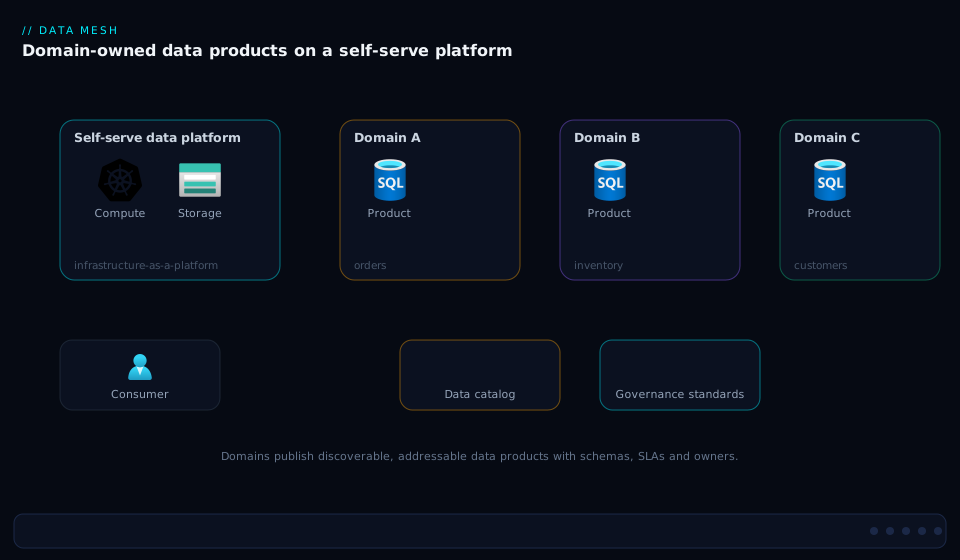
Read the architecture as four planes interacting. At the bottom sit the domains — Payments, Catalog, Logistics, Finance — each an autonomous zone containing one or more data products. Open a product and you see its anatomy: input ports pulling from operational sources, internal transformation (often a bronze→silver→gold lakehouse), a data contract, and one or more output ports (a SQL view, Delta/Iceberg table, or stream). A consumer in Finance reading Payments’ transactions product touches only its output port and contract — never its internals. That encapsulation is what the whole picture turns on.
Underneath every domain runs the shared self-serve platform plane: storage, compute, catalog, CI/CD, observability and policy machinery consumed identically by all. Wrapping it is the federated governance plane, which doesn’t sit between producer and consumer at runtime — it pushes policy-as-code into the platform (PII masking, contract validation, ABAC, lineage), enforced at build and access time. Spanning everything is the mesh experience plane — catalog, search and lineage for cross-domain discovery. Follow one question: a Finance analyst searches the catalog, finds payments.transactions, reads its contract and SLO, requests access (granted by ABAC automatically), and queries its gold output port directly — no ticket to any central team at any step. That last clause is the entire value proposition.
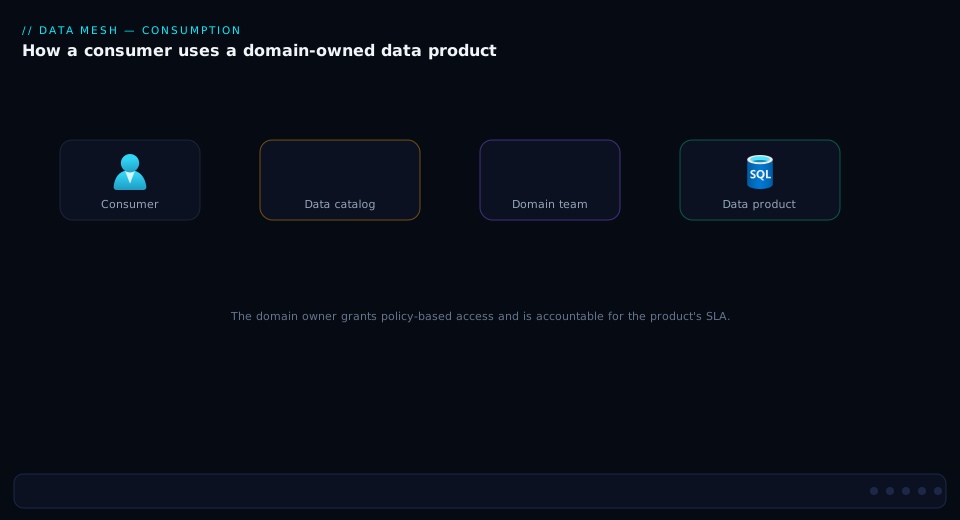
The consumption flow — the second diagram — makes the runtime interaction explicit. A consumer does not ask a central team for data; it self-serves: search the catalog and discover a domain-owned product; read its contract, schema, SLO and sample data to decide fit; request access, which policy-as-code grants or denies by attribute with no human in the loop; then query the output port directly, producer-to-consumer, with the platform recording lineage. The producer is not in the request path — they are in the contract path. They guarantee the port; they don’t broker every read.
Real-world scenario
MegaRetail is a mid-size omnichannel retailer: ~600 engineers across ~45 squads, an e-commerce site, stores, a supply chain, and a growing analytics appetite. Their central data team of 12 had a 14-week median lead time on new datasets and a trust problem so severe that three teams maintained three different “revenue” numbers. The board asked why a data-driven retailer couldn’t answer basic questions in under a quarter. The honest answer was architectural: the central team was a serialized queue, and it was overflowing.
They adopted the mesh slowly — the speed is part of the lesson. Phase 0 (one quarter) was pure platform and governance investment with zero domain products: a self-serve plane on Databricks with Unity Catalog (one metastore as the governance backbone, catalogs per domain), a product-scaffolding template, contract validation in CI, automatic catalog registration and lineage, and an ABAC access model. In parallel they stood up the federated governance guild — one rep per pilot domain plus security and platform — ratifying exactly four global standards: a canonical customer_id format, mandatory PII classification with masking, the contract schema and SemVer policy, and Delta as the interoperable format. Deliberately small.
Phase 1 onboarded two pilot domains, not forty. Supply Chain — which owns the operational systems and knows the data — published a purchase-order-events source-aligned product: inside, an ordinary medallion lakehouse; outside, a gold Delta output port governed by a contract (event schema with documented semantics, a 15-minute freshness SLO, a daily-volume anomaly check, mesh-standard IDs), auto-registered in Unity Catalog with lineage. Finance — a consumer domain — discovered it in the catalog, read its contract, got access by policy in minutes (no ticket), and built a cash-flow product joining purchase-order events to payment events, exposing its own contracted port for the FP&A dashboards.
The payoff showed up where it mattered. A cash-flow dashboard that previously took the central team 9 weeks took Finance 6 days, because the builders understood the data and never left the paved road. When Supply Chain later renamed a field, the SemVer policy forced a major version: v2 ran in parallel with v1 through a 30-day deprecation window announced via the catalog, and Finance migrated on its own schedule — zero silent breakage, the failure that used to cost a week of firefighting a quarter. The mistakes were instructive too: a third domain tried to publish a product with no consumers and the guild killed it as inventory; and the platform under-invested in cost attribution, so one runaway pipeline spiked the shared bill before chargeback was wired in. Two years on, MegaRetail runs ~30 products across 9 domains, the central “platform” team is smaller (8, doing platform not pipelines), and median lead time for a new dataset is under one week. The bottleneck didn’t move; it dissolved.
Advantages and disadvantages
The trade-off is real and should be stated without either evangelism or cynicism. The mesh buys you scalable ownership and re-coupled accountability at the price of significant organizational change and upfront platform/governance investment. Whether that trade is worth it is almost entirely a function of your scale and your culture, which is what the “when not to” and decision-matrix sections quantify.
| Advantages | Disadvantages |
|---|---|
| Scales with the number of domains/sources — no central queue | Requires real organizational change (the hard part) |
| Re-couples knowledge to responsibility → higher quality & trust | Heavy upfront platform + governance investment before payoff |
| Faster time-to-insight: consumers self-serve, no ETL backlog | Risk of inconsistency/chaos if governance is weak |
| Products are reusable → fewer duplicate pipelines | Each domain needs data capability (headcount/upskilling) |
| Producer accountability via contracts → fewer silent breakages | Coordination/governance overhead is ongoing, not one-time |
| Domain autonomy → faster local iteration | Initial duplication and learning curve; tooling immaturity |
| Resilience: one product’s failure is contained, not company-wide | Easy to do badly: “lake + wiki” cosplaying as a mesh |
The advantages compound at scale and domain diversity; the disadvantages dominate at small scale and low maturity. That asymmetry is the whole decision: a 600-engineer, 45-domain retailer with a real bottleneck gets enormous value; a 40-engineer startup gets pure overhead. The mesh is a scaling pattern, and like all scaling patterns it is a liability before you need it.
Hands-on lab
You cannot “install a data mesh” — it’s an operating model. But you can build the technical core of one data product with free tooling, the unit you’d replicate across domains. This lab builds a source-aligned product locally with DuckDB (a free embedded analytical engine standing in for a domain’s warehouse/lakehouse), a data contract, and a contract test, then validates the product against its contract — exactly the CI gate a mesh platform automates. Everything runs on a laptop; no cloud account needed.
1. Set up the workspace and a free analytical engine.
mkdir -p ~/mesh-lab/payments-transactions && cd ~/mesh-lab/payments-transactions
python3 -m venv .venv && source .venv/bin/activate
pip install duckdb pyyaml
# DuckDB is our stand-in for a domain's analytical store (Snowflake/BigQuery/Delta in real life)
python3 -c "import duckdb; print('duckdb', duckdb.__version__)"
Expected output:
duckdb 1.1.3
2. Build the product’s gold output table (the transformation code). In a real mesh this is a dbt/Spark pipeline; here it’s a single SQL build for clarity.
python3 - <<'PY'
import duckdb
con = duckdb.connect("transactions.duckdb")
con.execute("""
CREATE OR REPLACE TABLE transactions_gold AS
SELECT * FROM (VALUES
  ('11111111-1111-4111-8111-111111111111','c-001','CAPTURED',  4999,'INR'),
  ('22222222-2222-4222-8222-222222222222','c-002','AUTHORIZED',12000,'INR'),
  ('33333333-3333-4333-8333-333333333333','c-003','REFUNDED',  -999,'INR')
) AS t(transaction_id, customer_id, status, amount_minor_units, currency);
""")
n = con.execute("SELECT count(*) FROM transactions_gold").fetchone()[0]
print(f"built transactions_gold with {n} rows")
PY
Expected output:
built transactions_gold with 3 rows
3. Write the data contract (the output port’s promise). This is the product’s interface — schema, semantics, allowed values, SLO, quality rules.
cat > contract.yaml <<'YAML'
id: payments.transactions
version: 1.0.0
owner: payments-data-team
output_port: transactions_gold
schema:
  transaction_id:   {type: VARCHAR, required: true, unique: true}
  customer_id:      {type: VARCHAR, required: true, classification: PII}
  status:           {type: VARCHAR, required: true, allowed: [AUTHORIZED, CAPTURED, REFUNDED, VOIDED]}
  amount_minor_units: {type: BIGINT, required: true}
  currency:         {type: VARCHAR, required: true}
slo:
  freshness_minutes: 15
quality:
  - not_null: [transaction_id, customer_id, status, amount_minor_units, currency]
  - unique: [transaction_id]
YAML
echo "contract written"
4. Write a contract test (the CI gate the platform automates). It checks the live table against the contract: column names/types, required-not-null, uniqueness, and allowed-values.
cat > validate_contract.py <<'PY'
import duckdb, yaml, sys

contract = yaml.safe_load(open("contract.yaml"))
con = duckdb.connect("transactions.duckdb")
port = contract["output_port"]
errors = []

# 1. schema: every contracted column exists with the declared type
actual = {r[0]: r[1] for r in con.execute(f"DESCRIBE {port}").fetchall()}
for col, spec in contract["schema"].items():
    if col not in actual:
        errors.append(f"missing column: {col}")
    elif spec["type"] not in actual[col]:
        errors.append(f"type mismatch {col}: contract={spec['type']} actual={actual[col]}")

# 2. required → not null
for rule in contract["quality"]:
    for col in rule.get("not_null", []):
        nulls = con.execute(f"SELECT count(*) FROM {port} WHERE {col} IS NULL").fetchone()[0]
        if nulls: errors.append(f"not_null violated: {col} has {nulls} nulls")
    for col in rule.get("unique", []):
        dupes = con.execute(
            f"SELECT count(*)-count(DISTINCT {col}) FROM {port}").fetchone()[0]
        if dupes: errors.append(f"unique violated: {col} has {dupes} duplicates")

# 3. allowed-values enumerations
for col, spec in contract["schema"].items():
    if "allowed" in spec:
        bad = con.execute(
            f"SELECT count(*) FROM {port} WHERE {col} NOT IN {tuple(spec['allowed'])}"
        ).fetchone()[0]
        if bad: errors.append(f"allowed-values violated: {col} has {bad} bad rows")

if errors:
    print("CONTRACT FAILED:"); [print("  -", e) for e in errors]; sys.exit(1)
print(f"CONTRACT PASSED: {contract['id']} v{contract['version']} conforms")
PY
python3 validate_contract.py
Expected output:
CONTRACT PASSED: payments.transactions v1.0.0 conforms
5. Prove the gate works — introduce a violation. Insert a row with a status outside the allowed set, then re-run validation. This simulates a producer change that would break consumers; the gate must catch it before publish.
python3 -c "import duckdb; duckdb.connect('transactions.duckdb').execute(
  \"INSERT INTO transactions_gold VALUES ('44444444-4444-4444-8444-444444444444','c-004','PENDING',500,'INR')\")"
python3 validate_contract.py || echo "EXIT CODE: $? (gate correctly blocked the bad data)"
Expected output:
CONTRACT FAILED:
  - allowed-values violated: status has 1 bad rows
EXIT CODE: 1 (gate correctly blocked the bad data)
6. Validate discovery metadata (a stand-in for catalog registration). Confirm the product carries the metadata a mesh catalog would index.
python3 -c "import yaml; c=yaml.safe_load(open('contract.yaml'));
print('discoverable:', all(k in c for k in ['id','owner','version','schema']));
print('has SLO:', 'freshness_minutes' in c.get('slo',{}));
print('PII classified:', any(v.get('classification')=='PII' for v in c['schema'].values()))"
Expected output:
discoverable: True
has SLO: True
PII classified: True
7. Teardown.
deactivate 2>/dev/null
rm -rf ~/mesh-lab
echo "lab removed"
What you built is a data product in miniature: a transformation producing an output port, a versioned contract describing that port, and an automated gate enforcing it — the exact loop a mesh platform runs in CI for every domain so governance is computational, not a meeting. Scale this across domains, add catalog registration, lineage and ABAC, and you have the technical substrate of a mesh.
Common mistakes & troubleshooting
Data mesh failures are rarely technical bugs; they are organizational and design failures that show up as symptoms. Treat this as the playbook: match the symptom, find the root cause, confirm it, and apply the real fix (not the band-aid).
| # | Symptom | Root cause | How to confirm | Fix |
|---|---|---|---|---|
| 1 | “We adopted a mesh but the central team is still the bottleneck” | Bought tools; didn’t change org/ownership | Are data engineers reporting into domains? Is there a central queue? | Actually embed ownership in domains; this is the prerequisite, not optional |
| 2 | Products exist but nobody can find or trust them | Catalog not central to the workflow; no SLOs/quality published | Is registration automatic on deploy? Do products show SLO + quality? | Make catalog registration part of CI; mandate SLO + observability to publish |
| 3 | Domains build incompatible products that won’t join | Governance too weak/late; no shared IDs or formats | Do two products use different customer_id formats? |
Federated guild ratifies a small set of global standards; enforce in CI |
| 4 | Governance is a 3-week review meeting; teams route around it | Governance is human/manual, not computational | Are policies in Confluence or in code? | Encode global rules as policy-as-code enforced at build/access time |
| 5 | A producer renamed a field and broke five dashboards silently | No contracts, or contracts not enforced; no SemVer | Is there a contract on the port? Did CI catch it? | Mandatory versioned contracts + SemVer; breaking change = new major + parallel run |
| 6 | Every domain reinvents pipelines/catalogs differently | Self-serve platform too thin; too much left to domains | Lead time to a new product measured in months? | Invest in the platform; pull domain-agnostic complexity central; ship scaffolding |
| 7 | A “god domain” quietly became the new central bottleneck | Boundaries wrong; one domain owns too much cross-domain data | Does one team own products everyone depends on for everything? | Re-draw boundaries; turn cross-domain concepts into explicit aggregate products |
| 8 | Shared bill exploded; no one knows whose product caused it | No cost attribution/chargeback to domains | Can you attribute spend per product/domain? | Wire cost attribution into the platform; chargeback aligns incentives |
| 9 | Domains publish products with zero consumers | “Build it and they will come”; product = inventory | Do products have named consumers and read traffic? | Don’t publish without a consumer; guild rejects speculative products |
| 10 | Two teams co-own one product; quality is nobody’s job | Sliced a pipeline instead of owning end-to-end | Is there one accountable product owner? | One product = one owning domain, end-to-end |
| 11 | PII leaked into a widely-shared product | Classification optional; masking not enforced at the port | Is PII tagging mandatory and masking automatic? | Publish-time PII scan blocks untagged; ABAC + masking at the port |
| 12 | Mesh “works” in a pilot but stalls company-wide | Tried to mandate company-wide from day one | Did you skip the platform/governance phase-0? | Phase it: platform + governance first, then 2 pilot domains, then expand |
The meta-pattern across all twelve: when a mesh fails, look first at org and incentives, second at governance enforcement, third at platform maturity, and only last at any specific tool. The reverse order is how most post-mortems waste their time.
Best practices
- Treat it as an operating-model change first, a platform second. Secure leadership commitment to actually move ownership and headcount into domains before you write any platform code. Without that, everything below is theater.
- Invest in the self-serve platform and governance before pushing ownership to domains. A phase-0 with zero domain products but a working paved road and a ratified (small) set of global standards is the highest-leverage thing you can do. Skipping it is the most common cause of failure.
- Start with two or three pilot domains, never a company-wide mandate. Pick domains with real consumer demand, an existing product owner, and at least one data-capable engineer. Prove the model, learn, then expand.
- Keep the global governance set deliberately small. Every global standard is a permanent coordination tax. Globalize only identifiers for shared entities, PII/classification, the contract format + SemVer, interoperability formats, and the access model. Everything else stays local.
- Make every global rule computational. If a policy isn’t enforced by code at build or access time, it isn’t governance — it’s a wish. Contract validation in CI; PII blocking at publish; ABAC at the port; automatic lineage.
- Mandate versioned data contracts on every output port. Schema and semantics, an SLO, quality rules, and a SemVer breaking-change policy with a deprecation window and parallel-running of major versions.
- Never publish a product without a consumer. Speculative products are inventory and waste. A product earns its existence from a named consumer who depends on it.
- Own products end-to-end within one domain. No co-owned products, no sliced pipelines. One product, one accountable owner, ingestion through serving.
- Make discovery automatic. Catalog registration, metadata, lineage and quality metrics must be emitted by the platform on deploy — not a manual wiki step nobody does.
- Wire cost attribution from the start. Charge each product’s spend back to its domain. Shared, unattributed cost is a tragedy of the commons that will blow your budget and your governance credibility.
- Run governance like a standards body, not a gatekeeper. RFCs, representation from every domain, ratify, then implement in code. The guild sets the rules; the platform enforces them; domains stay autonomous within them.
- Measure domain autonomy and lead time, not lines of pipeline. The platform team’s success metric is how little domains need it. Track median lead time to a new data product as the health metric for the whole mesh.
Security notes
Decentralizing ownership does not mean decentralizing security policy — that breeds inconsistent, leaky controls. In a well-built mesh, security is something the federated governance plane standardizes globally and enforces computationally, so every domain gets the same strong controls without reinventing them. The principles:
- Classification is mandatory and global. Every field is classified (public, internal, confidential, PII/PHI) as a contract requirement; a product with untagged PII fails to publish — enforced at the port, not trusted to domain goodwill.
- Access is attribute-based, granted by policy not email. ABAC resolves “may this principal read this product?” from attributes (team, purpose, sensitivity, region) automatically and auditably. The self-serve access request runs through policy-as-code; a human approving a ticket is the anti-pattern.
- Least privilege at the output port. Consumers access the port, never a product’s internal bronze/silver tables. Masking and row/column-level security apply at the port per the consumer’s attributes — the same field can be clear to the owning domain and masked to a distant consumer.
- Encryption and isolation are platform defaults. Encryption at rest and in transit, network isolation (private endpoints for PaaS targets), and key management are domain-agnostic and belong in the platform so every product inherits them.
- Audit is global and automatic. Every access and policy decision is logged centrally — decentralizing ownership must not fragment the audit trail.
| Security concern | How the mesh handles it | Where it’s enforced |
|---|---|---|
| PII/sensitive data discovery | Mandatory classification in the contract | CI / publish-time scan |
| Access control | ABAC by attributes, self-serve + policy-decided | The output port (platform) |
| Over-broad access | Port-only access; masking/RLS by consumer attributes | The output port |
| Inconsistent controls across domains | Global standards enforced as code | Governance plane → platform |
| Audit & compliance | Central, automatic logging of access + decisions | Platform |
| Encryption / isolation | Platform defaults inherited by every product | Infrastructure plane |
For the access mechanics underneath — attribute-based policy, fine-grained masking, column/row-level controls in Unity Catalog and BigQuery — pair this with lakehouse governance with Databricks Unity Catalog and enterprise data catalog, lineage and governance.
Cost & sizing
The cost conversation is unusual because the dominant cost is organizational, not infrastructural. The platform and storage bill is often smaller than a comparable monolith (domains pay only for their products, cost attributed), but the people and coordination cost — embedded data engineers, a platform team, the governance guild’s standing time — is the real spend, and why the mesh is uneconomic below a certain scale.
What drives the bill:
| Cost driver | What it is | How to control it |
|---|---|---|
| Platform team | The engineers building/running the self-serve plane | Keep it small and product-focused; it should shrink as automation matures |
| Embedded domain data engineers | The new per-domain headcount the mesh requires | The unavoidable cost; only worth it when the central bottleneck is real |
| Governance guild time | Standing coordination across domains | Keep the global rule set small; automate enforcement to cut meeting time |
| Storage & compute per product | Each product’s lakehouse/warehouse spend | Cost attribution + chargeback; right-size per product; lifecycle policies |
| Duplication during transition | Parallel old + new systems while migrating | Phase carefully; deprecate the monolith deliberately, not indefinitely |
| Tooling | Catalog, contract tooling, observability | Favor open standards (ODCS, open table formats) over lock-in |
A blunt people-side heuristic: a mesh needs 1 small central platform team (≈4–8 engineers) plus ≈1 data-capable engineer per active domain (often upskilled, not net-new). Below roughly 5–8 genuinely distinct domains with real cross-domain consumption, the headcount math doesn’t close and a centralized lakehouse team is cheaper. The economics improve with scale and are negative at small scale. Infrastructure is not the deciding factor: a per-product lakehouse on cheap object storage (ADLS/S3/GCS at ~₹1.5–2/GB-month / ~US$0.02/GB-month) plus on-demand compute is a few thousand rupees per product per month at modest scale. Don’t let an infrastructure cost model drive a mesh decision; let org-scale and people cost drive it.
Real platform building blocks
There is no product called “a data mesh.” Vendors selling one are selling a catalog, fabric, or governance tool with “mesh” in the marketing. You assemble a mesh from building blocks that implement the four principles — pick per your stack:
| Building block (real) | Implements which principle | What it provides | Notes |
|---|---|---|---|
| Databricks Unity Catalog | Governance + self-serve + discovery | One metastore, catalogs-per-domain, lineage, ABAC, masking, marketplace | A very common mesh governance backbone; pairs with Delta Sharing for cross-domain ports |
| Snowflake (+ Horizon, data sharing) | Self-serve + discovery + governance | Per-domain databases, secure data sharing, masking, classification, marketplace | Strong for SQL-first domains; sharing avoids data copies |
| Google BigQuery (+ Dataplex) | Self-serve + governance + discovery | Serverless per-domain datasets; Dataplex/Analytics Hub for governance, catalog, sharing | Dataplex is Google’s data-mesh-oriented governance layer |
| Delta Sharing / Iceberg + REST catalog | Interoperability (output ports) | Open, engine-agnostic cross-domain data sharing | Lets products expose ports consumers read without copying or lock-in |
| Open Data Contract Standard (ODCS / Bitol) | Data-as-a-product (contracts) | An open YAML standard for data contracts | Vendor-neutral contract format; the keystone artifact |
| dbt | Data-as-a-product (transforms + tests + docs) | Versioned transformations, tests, docs, lineage per product | The de-facto transform layer inside many products |
| DataHub / OpenMetadata / Collibra | Discovery + governance | Catalog, lineage, glossary, classification across products | The mesh experience plane / supergraph |
| Open Policy Agent / native ABAC | Governance (computational) | Policy-as-code for access and contract enforcement | Turns global rules into enforced code |
| Great Expectations / Soda / dbt tests | Data-as-a-product (quality/observability) | Automated quality checks the contract references | Powers the “trustworthy” characteristic |
| Backstage / internal developer portal | Self-serve (product experience plane) | Scaffolding templates, the “build a product” workflow | Often the data-product experience plane front door |
The pattern most teams land on: one governance-capable platform as the backbone (Unity Catalog, Snowflake, or BigQuery+Dataplex), contracts in an open standard (ODCS), transforms in dbt with tests, open output ports (Delta Sharing / Iceberg) so cross-domain reads aren’t engine-locked, everything in a catalog, and global rules enforced with policy-as-code. These are the same tools you’d use for a centralized lakehouse — what makes it a mesh is the decentralized ownership and federated governance operating model, not any tool on this list.
When NOT to use data mesh
This section is the one most worth your time: adopting a mesh when you shouldn’t is more damaging than not adopting one when you should — it adds permanent coordination cost and org upheaval to a problem you didn’t have. The mesh is a scaling pattern; before the scale and diversity that create a bottleneck, it’s pure overhead. Do not adopt a data mesh when:
| Don’t use a mesh when… | Why the mesh hurts here | What to do instead |
|---|---|---|
| You’re small (≤ a few hundred engineers, few sources) | No bottleneck exists; you’d add coordination cost for nothing | A centralized lakehouse + dbt run by one capable team |
| There’s one dominant domain / homogeneous data | Nothing to decentralize to; “domains” would be artificial | A single well-run warehouse/lakehouse |
| The org has no platform-engineering culture | The self-serve platform won’t exist; domains will flounder | Centralize until the platform muscle is built |
| Leadership won’t change org/ownership | The mesh is socio-technical; without org change it’s theater | Don’t pretend; run a great central team |
| You have no governance maturity or appetite | Decentralization without governance → swamp, fast | Centralize governance until you can federate it |
| Domains lack any data capability and can’t hire/upskill | Products will be unowned and low quality | Build capability first, or stay central |
| You need a quick win this quarter | The mesh’s payoff is 2–4+ quarters out (phase-0 first) | Solve the urgent thing centrally; revisit the mesh later |
| Strict end-to-end consistency/transactionality is the goal | The mesh optimizes autonomy, not global ACID consistency | Centralized modeling where consistency is paramount |
The honest summary: most organizations that think they need a mesh actually need a better-run centralized lakehouse — clearer ownership, contracts on key tables, a real catalog, and a platform team that automates instead of bottlenecks. You can adopt the mesh’s ideas (data-as-a-product, contracts, a catalog, self-serve) incrementally on a centralized architecture and capture most of the value with none of the org upheaval. Reserve the full mesh for when scale genuinely breaks the centralized model — deploying it early solves a problem you don’t yet have at the cost of one you will create.
Decision matrix
Use this to make and defend a recommendation in an architecture review. Score each row; a strong lean across most rows points to your answer. The mesh is justified only when multiple high-scale/high-maturity signals are present together — one alone is never sufficient.
| Decision factor | Lean centralized lakehouse | Lean hybrid (mesh ideas, central core) | Lean full data mesh |
|---|---|---|---|
| Number of distinct business domains | 1–4 | 4–8 | 8+ with real cross-domain demand |
| Engineering org size | < ~150 | ~150–500 | 500+ |
| Central data team status | Coping fine | Strained, growing backlog | Hard, persistent bottleneck |
| Platform-engineering maturity | Low | Medium | High (can build a self-serve plane) |
| Governance maturity/appetite | Low–medium | Medium | High (can run a federated guild) |
| Leadership willingness to change org | None | Some | Strong (will move ownership + headcount) |
| Per-domain data capability | None | Some, can upskill | Present or hireable |
| Consistency vs autonomy priority | Strict global consistency | Mixed | Autonomy + interoperability |
| Time-to-value pressure | Need it this quarter | Can invest a quarter | Can invest several quarters |
| Data diversity (sources/types) | Homogeneous | Mixed | Highly diverse |
How to read it:
| If most rows land in… | Recommend | Why |
|---|---|---|
| The left column | Centralized lakehouse | No bottleneck; mesh is overhead and risk |
| The middle column | Hybrid — adopt mesh ideas (contracts, data-as-product, catalog, self-serve) on a central core | Captures most value, defers org upheaval |
| The right column | Full data mesh — phased: platform + governance first, then pilots, then expand | Scale genuinely breaks the centralized model |
The defensible recommendation is almost never “mesh because it’s modern.” It is: “We have N domains, a central team with an M-week backlog that’s a structural bottleneck, leadership has committed to embedding ownership, and we can stand up a self-serve platform and federated governance. So we’ll phase into a mesh — one-quarter platform-and-governance investment, then two pilot domains.” If you can’t say all of those clauses truthfully, the matrix is telling you to pick hybrid or centralized — a better outcome, not a lesser one.
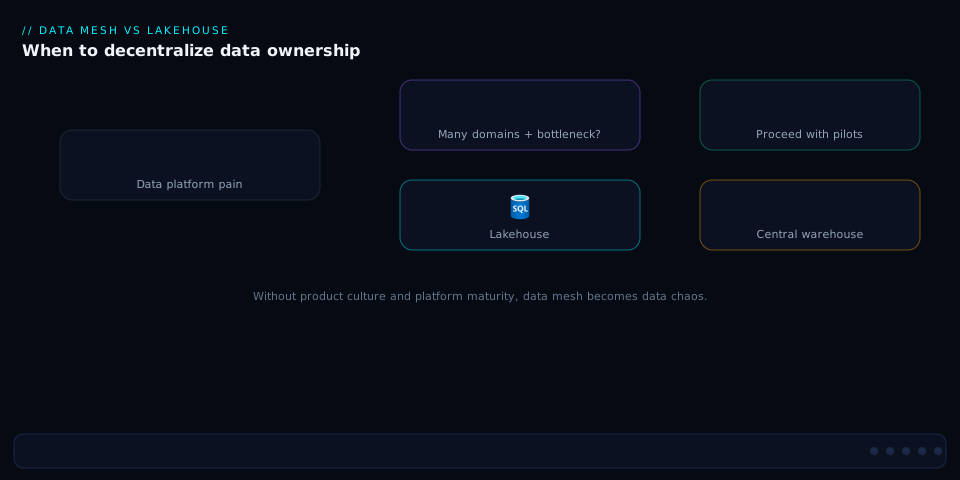
The same logic reads as a decision flow: start from scale and domain diversity, gate on whether a central team is genuinely the bottleneck, then on platform/governance maturity and leadership’s willingness to change ownership — only when all gates pass does the path reach a full mesh; otherwise it lands on a centralized lakehouse or a hybrid that borrows the mesh’s ideas without its org upheaval.
Interview & exam questions
Q1. In one sentence, what is a data mesh, and what category of architecture is it? A decentralized, socio-technical (organizational + technical) architecture that treats analytical data as a product owned by the domain that produces it, served on a self-serve platform, and held together by federated computational governance. The key category point: it is an organizational/ownership architecture, not a storage technology.
Q2. Name the four principles and the problem each solves. Domain-oriented ownership (re-couples knowledge to responsibility); data-as-a-product (makes data trustworthy, discoverable, usable); self-serve platform (removes the central team from the critical path); federated computational governance (keeps decentralization from becoming chaos). Together they trade a central bottleneck for distributed ownership with enforced interoperability.
Q3. “Should we use a data mesh or a lakehouse?” — critique the question. It’s a category error. A lakehouse is a storage-and-processing architecture; a mesh is an ownership architecture. They compose: a product’s internals are often a lakehouse, and a mesh is composed of lakehouses/warehouses. The real question is “centralized vs decentralized ownership,” which depends on scale and org maturity, not storage tech.
Q4. What is a data contract and why is it the keystone of a mesh? A versioned, machine-readable agreement at a product’s output port specifying schema, semantics, SLO, quality rules and a breaking-change (SemVer) policy. It converts fragile implicit coupling (“I read your table and hope”) into an explicit, enforced interface, making the producer accountable and changes non-silent — what makes decentralization safe rather than chaotic.
Q5. What does “federated computational governance” mean, precisely? Federated: a guild of domain representatives (plus platform/security) decides a small set of global rules by consensus; everything else is local domain autonomy. Computational: those global rules are encoded as policy-as-code and enforced automatically (contract validation in CI, PII blocking at publish, ABAC at the port) rather than via review meetings — making governance instant, consistent and unblockable by bureaucracy.
Q6. Why is data mesh described as “socio-technical,” and what’s the practical implication? Because most of it is organizational design (team topology, ownership, incentives, a governance operating model) and only a minority is platform. Practically: the biggest predictor of success is whether leadership will actually change reporting lines and headcount to embed data ownership in domains. Buying tools without the org change produces a relabeled lake, not a mesh.
Q7. When should you NOT adopt a data mesh? At small scale (no bottleneck), with one dominant/homogeneous domain (nothing to decentralize), with no platform or governance maturity, when leadership won’t change ownership, when domains have no data capability, or when you need a quick win (the payoff is several quarters out). In those cases a well-run centralized lakehouse is faster, cheaper and lower-risk.
Q8. What are the eight characteristics of a data product? Discoverable, addressable, understandable, trustworthy, natively accessible, interoperable, valuable on its own, and secure. They’re an acceptance checklist: a dataset missing any (no SLO → not trustworthy; not in a searched catalog → not discoverable) is not yet a product.
Q9. Distinguish source-aligned, consumer-aligned and aggregate data products. Source-aligned products model a source domain’s facts (raw, stable, broadly reused); consumer-aligned products model a specific use case (fit-for-purpose, allowed to churn); aggregate products compose several products for cross-domain questions. Rule of thumb: few stable source-aligned, many fit-for-purpose consumer-aligned, explicit aggregate products.
Q10. How does Conway’s Law motivate the mesh, and what’s the “inverse Conway maneuver”? Conway’s Law says systems mirror the communication structures of the organizations that build them; a centralized data team therefore produces a centralized, bottlenecked architecture. The mesh structures teams around domains so the architecture that emerges is domain-aligned and decentralized — restructuring the org to produce the desired architecture is the “inverse Conway maneuver,” and skipping it is why most mesh adoptions fail.
Q11. How is a data mesh different from a data fabric? A fabric is technology-centric: metadata, virtualization and automation to make distributed data appear unified, usually with ownership still central. A mesh is organization-centric: it decentralizes ownership to domains. They aren’t exclusive (fabric tech can power a mesh’s experience plane), but vendors often sell a fabric as a “mesh.” The differentiator is who owns the data, not the integration tech.
Q12. What is the role and success metric of the platform team in a mesh? Its role shifts from building pipelines for everyone to building the self-serve “paved road” that lets domains build products themselves — pulling domain-agnostic complexity central, leaving domain-specific logic in domains. Its success metric is domain autonomy / lead time to a new data product: the less domains need it and the faster they ship, the better. A platform that becomes a new bottleneck has failed.
Quick check
- True or false: choosing a data mesh means you no longer use a data warehouse, lake or lakehouse.
- Which principle is most responsible for keeping a decentralized mesh from becoming a chaotic swamp of incompatible datasets?
- A producer wants to rename a column in a published data product. What does a correct contract/SemVer policy require?
- Name two situations in which a centralized lakehouse is the better choice than a data mesh.
- What is the success metric of the self-serve platform team, and why is “lines of pipeline built” the wrong one?
Answers
- False. The mesh is an ownership/organizational architecture; each data product still uses some storage architecture inside it (very often a lakehouse). You run a mesh of warehouses/lakes/lakehouses — they compose, they don’t compete.
- Federated computational governance. It defines a small set of global standards (shared IDs, PII rules, contract format, interoperability formats) and enforces them as code, so decentralization keeps interoperability instead of fragmenting.
- A rename is a breaking change → a major version bump. The producer publishes the new major version, runs the old and new versions in parallel through an announced deprecation window, and lets consumers migrate on their own schedule — no silent breakage.
- Any two of: small org with few sources (no bottleneck); a single dominant/homogeneous domain; no platform-engineering or governance maturity; leadership unwilling to change ownership; domains with no data capability; needing a quick win this quarter.
- Domain autonomy / lead time to a new data product — how little domains need the platform team and how fast they ship. “Lines of pipeline built” measures the central team doing the work, which is exactly the bottleneck the mesh removes; the goal is to automate the work, not perform it.
Glossary
| Term | Definition |
|---|---|
| Data mesh | A decentralized socio-technical architecture treating analytical data as domain-owned products on a self-serve platform under federated computational governance. |
| Domain | A bounded context of the business (Payments, Logistics, Catalog) that owns its analytical data end to end. |
| Data product | A discoverable, addressable, trustworthy, self-describing unit of analytical data with an owner, contract and SLO. |
| Data product owner | The person accountable for a data product’s value, roadmap, quality and SLO. |
| Output port | The published, contracted interface (table/view/stream/API) consumers read from; the only thing they may depend on. |
| Input port | Where a data product ingests its upstream sources, decoupling it from source-system internals. |
| Data contract | A versioned, machine-readable agreement specifying a product’s schema, semantics, SLO, quality rules and change policy. |
| SLO (Service Level Objective) | A committed, measurable target for a product’s freshness, availability or quality. |
| Self-serve data platform | The shared, automated “paved road” letting domains build products without central tickets. |
| Federated computational governance | Global rules set by a guild of domain representatives and enforced automatically as policy-as-code (rules encoded as build/access-time checks, not review meetings). |
| Source-aligned product | A product modeling a source domain’s facts; raw, stable, broadly reused. |
| Consumer-aligned product | A product modeled for a specific consumption use case; fit-for-purpose, allowed to churn. |
| Aggregate product | A product composed from multiple other products for cross-domain analytics. |
| Conway’s Law | The principle that system architecture mirrors the communication structure of the organization that builds it. |
| Inverse Conway maneuver | Deliberately restructuring teams to produce a desired architecture (here, domain-aligned ownership). |
| Data fabric | A technology-centric approach using metadata/virtualization/automation to unify distributed data, typically with central ownership — distinct from the mesh’s decentralized ownership. |
| ABAC | Attribute-based access control: access decided automatically from attributes (team, purpose, sensitivity) rather than manual grants. |
Next steps
- Read the implementation-grade companion: implementing data mesh with domain data products and federated computational governance for the hands-on build of the patterns described here.
- Go deep on the keystone artifact in data contracts and a schema registry for reliable pipelines — the connective tissue of any mesh.
- Understand what usually lives inside a data product with designing a lakehouse with medallion architecture and unified streaming-batch ingestion and the medallion bronze/silver/gold layout on Data Lake Gen2.
- Build the governance and discovery backbone with lakehouse governance with Databricks Unity Catalog and enterprise data catalog, lineage and governance.
- Compare the centralized alternatives the mesh is weighed against: a modern data warehouse with Snowflake, dbt and BI and building a self-service data platform with Snowflake and dbt on Azure.