A lakehouse starts as a liberation and becomes a liability on exactly the day it succeeds. The first quarter, three data engineers land a few hundred tables in object storage, query them with Spark, and the business is thrilled. Eighteen months later there are forty thousand tables across six business units, nobody can say with certainty which ones contain customer PII, two teams have built conflicting “gold” revenue tables, an auditor wants to know every downstream consumer of a column the company just learned was mislabeled, and the access model is a sediment of S3/ADLS bucket policies, IAM roles, table ACLs, and one shared service principal whose token has been pasted into nineteen notebooks. The data is not the problem. The governance of the data is the problem, and on Databricks the answer to that problem is Unity Catalog — a single governance layer that sits above every workspace and makes identity, permissions, lineage, and audit a property of the data itself rather than of whichever compute happened to touch it. This article is a reference architecture for running a governed lakehouse on Unity Catalog at enterprise scale: not a tutorial that creates one catalog, but the multi-account, multi-cloud, cataloged, attested platform a regulated enterprise actually has to defend.
The business scenario
The forcing function is almost always regulation meeting scale at the same moment. Consider Helvson Capital, a fictional pan-European asset manager (~6,000 employees, offices in Frankfurt, Dublin, and Singapore) running quantitative strategies across equities, fixed income, and private credit. Their lakehouse holds market data, client holdings, trade blotters, KYC/AML records, and the feature tables their ML models score against. Three pressures collide.
First, MiFID II, GDPR, and the bank’s own model-risk policy demand that the firm prove, for any given report or model output, exactly which source data produced it and who was allowed to see that data along the way. “Trust us” is not an answer an auditor accepts; they want the lineage graph and the access log.
Second, scale has outrun tribal knowledge. Twelve quant teams, three regions, two cloud accounts (the firm runs Databricks on AWS for analytics and on Azure for the Entra-integrated reporting estate after an acquisition), and a data volume crossing two petabytes. No human knows what is in all of it. A column called acct_ref might be a harmless internal key or a regulated client identifier, and the difference determines who may query it.
Third, a single PII leak is existential. A junior analyst in Singapore must never be able to SELECT an EU client’s name, but should freely query the same trade table’s anonymized analytics. The blunt instrument — give the analyst the whole table or nothing — is both a compliance failure and a productivity tax.
The naive fixes fail predictably. Per-workspace table ACLs do not compose: a permission granted in the equities workspace means nothing in the reporting workspace, so the same data gets re-secured (inconsistently) in every place it is used. Cloud-native bucket policies (S3, ADLS) secure files, not tables, columns, or rows — and they are invisible to the analysts and auditors who think in tables. Copying “safe” subsets into curated marts multiplies storage, multiplies the things that can drift, and multiplies the surfaces an auditor must inspect. What the firm needs is one governance authority that spans clouds and workspaces, expresses permission at the grain of catalog/schema/table/column/row, records lineage automatically, and feeds the enterprise data catalog and security tooling the business already runs.
Architecture overview
Unity Catalog inverts the old Databricks model. Instead of each workspace owning its own Hive metastore and its own ACLs, a single Unity Catalog metastore is created once per region per account and attached to many workspaces. Governance lives in that metastore; workspaces are merely compute that asks the metastore “may this identity do this thing to this object, and where does the underlying data live?” The three-level namespace — catalog.schema.table — replaces the flat two-level Hive world and becomes the unit of organization, ownership, and isolation.
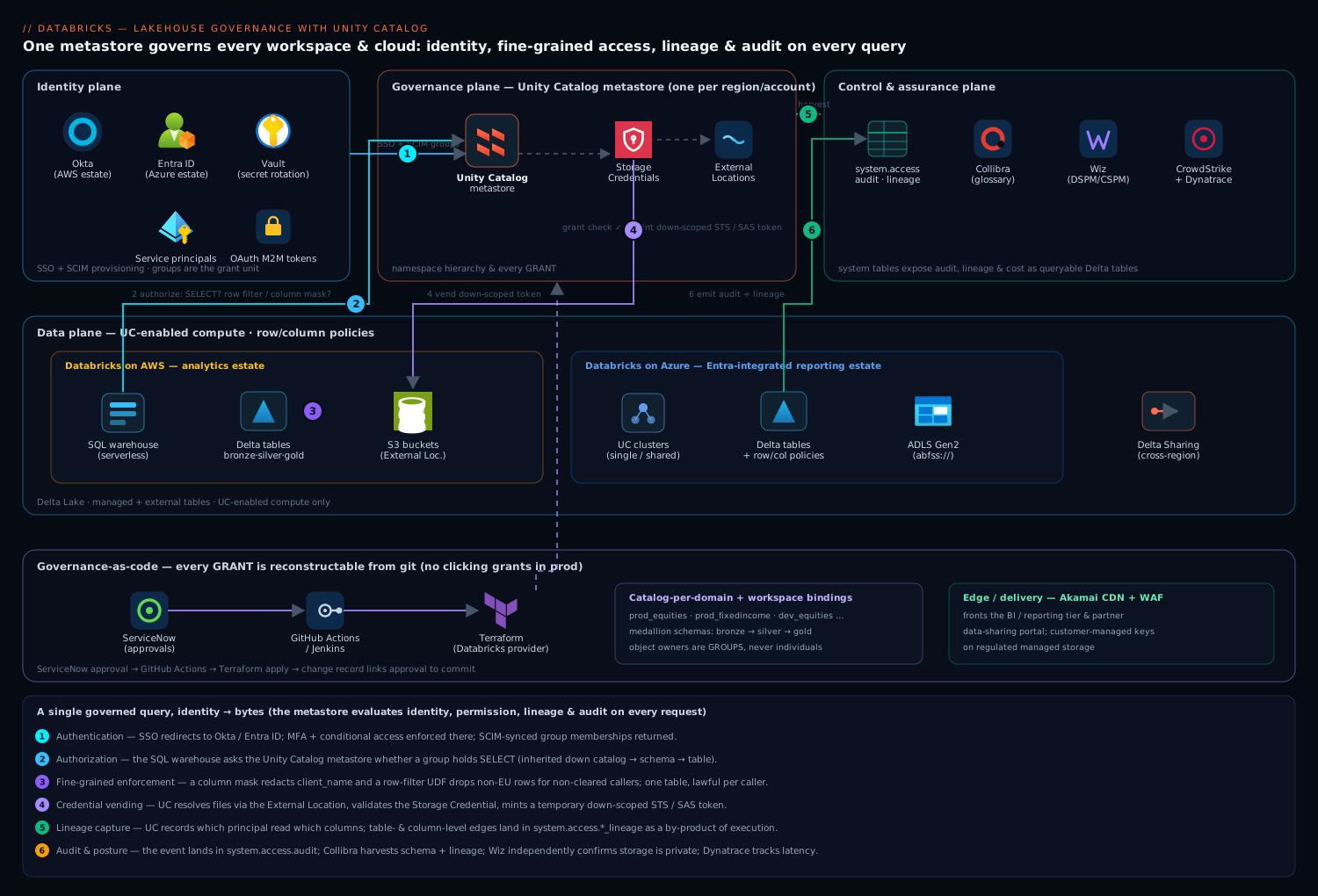
Identity plane. Humans and groups originate in Okta as the identity provider. Okta federates SSO into the Databricks account console (SAML/OIDC), and — critically — Okta provisions users and groups into Databricks via SCIM to the account-level SCIM endpoint, so a leaver deprovisioned in Okta loses lakehouse access automatically and group membership is never hand-maintained. On the Azure estate the same role is played by Microsoft Entra ID with its own SCIM connector. Groups, not individuals, are the unit Unity Catalog grants against. Service identities use service principals with OAuth machine-to-machine tokens; no personal access token is ever pasted into a notebook, and HashiCorp Vault issues and rotates the few residual external secrets (a Kafka SASL password, a partner API key) that jobs need, fetched at runtime rather than stored in cluster config.
Governance plane. The metastore holds the object hierarchy and every GRANT. Storage Credentials (an IAM role on AWS, an Access Connector / managed identity on Azure) and External Locations (a credential bound to a specific s3:// or abfss:// path) are the only things permitted to touch object storage; clusters never carry storage keys. When a query runs, Unity Catalog checks the grant, then mints short-lived, down-scoped storage tokens so compute reads exactly the files for exactly the tables the caller is entitled to — and nothing else.
Data plane. Tables are Delta Lake by default (managed tables live in Unity Catalog’s storage; external tables point at registered External Locations). Delta is what makes the governance real and performant: ACID transactions, schema enforcement, time travel, and the transaction log that powers MERGE, OPTIMIZE, VACUUM, and — increasingly — open interop via the catalog’s Iceberg-compatible read endpoint. Compute is Unity-Catalog-enabled clusters and SQL warehouses running in single-user or shared access mode; only UC-enabled compute can resolve the three-level namespace and enforce row/column policies.
Control & assurance plane. Everything Unity Catalog does is observable. System tables (system.access.audit, system.access.table_lineage, system.access.column_lineage, system.billing.usage) expose audit, lineage, and cost as queryable Delta tables. Collibra ingests the catalog and the lineage to become the enterprise’s business-facing data dictionary and policy system of record. Wiz scans the cloud accounts and the lakehouse for data-security posture — finding exposed storage, over-permissive roles, and sensitive data outside its sanctioned location. CrowdStrike Falcon covers runtime on the compute hosts and Dynatrace ingests Databricks and warehouse telemetry for performance and reliability SLOs.
The control flow, component by component
Walk a single governed query from identity to bytes, because the ordering is the whole point.
-
Authentication. A quant in Frankfurt opens a Databricks SQL editor. SSO redirects to Okta; MFA and conditional access (device posture, geo) are enforced there, not in Databricks. Okta returns a signed assertion; Databricks maps it to the account identity that Okta’s SCIM sync already created, along with the user’s group memberships (
fra-equities-analysts,eu-pii-restricted). -
Authorization. The user issues
SELECT * FROM prod_equities.trading.blotter. The SQL warehouse asks the Unity Catalog metastore: does any group this principal belongs to holdSELECTon this table (inherited from schema or catalog), and is there a row filter or column mask attached? Permissions inherit down the hierarchy, so a grant on theprod_equitiescatalog flows to every schema and table beneath unless overridden. -
Fine-grained enforcement. The
blottertable carries a column mask onclient_nameand a row filter keyed to region. Because the caller is ineu-pii-restrictedbut notpii-cleared, the mask returns'***'forclient_name, and the row filter — a SQL UDF the table references — drops rows wherejurisdiction <> 'EU'for non-cleared callers. The analyst sees real analytics on EU rows with the name redacted; the same query from apii-clearedcompliance officer returns the cleartext. One table, one query, two lawful results. -
Credential vending. With access resolved, Unity Catalog locates the table’s files via its External Location, validates that the bound Storage Credential may read that path, and vends a temporary, down-scoped token (an STS session on AWS, a SAS/managed-identity token on Azure) good for just those file prefixes. The cluster reads Delta files directly from object storage with that ephemeral credential. No standing storage key ever existed on the compute.
-
Lineage capture. As the query executes, Unity Catalog records that this warehouse, run by this principal, read these columns of this table — and if the query had written a downstream table, the table- and column-level edges would be captured automatically into
system.access.table_lineage/column_lineage. Lineage is a by-product of execution, not a manual annotation, which is why it is trustworthy. -
Audit and posture. The access event lands in
system.access.auditwithin minutes. Collibra has already harvested the table’s schema, owner, and lineage so a steward can see it in the business glossary; Wiz has independently confirmed the table’s storage is private and that no IAM principal outside the sanctioned role can reach the path. Dynatrace sees the query’s latency against the warehouse’s SLO.
Every arrow in the diagram is one of those steps. The defining property: identity, permission, lineage, and audit are evaluated by the metastore on every request, uniformly, regardless of which workspace or cloud the compute lives in.
Designing the catalog topology
The single most consequential design decision is how you carve the three-level namespace, because catalogs are the natural unit of isolation, ownership, and environment separation. Two patterns dominate.
| Dimension | Catalog-per-environment | Catalog-per-domain (with env prefix/binding) |
|---|---|---|
| Layout | dev, staging, prod catalogs; domains as schemas |
prod_equities, prod_fixedincome, dev_equities… |
| Ownership | Platform team owns catalogs; domains own schemas | Each data domain owns its catalog end to end |
| Isolation | Environment isolation strong; domain blast radius = schema | Domain isolation strong; bind catalogs to specific workspaces |
| Best when | Few domains, central platform team | Data-mesh org, many autonomous teams, strict workspace binding |
| Watch-outs | One huge prod catalog becomes a grant bottleneck |
Cross-domain joins need explicit grants; more catalogs to manage |
Helvson chose catalog-per-domain with workspace bindings — prod_equities is bound to the equities production workspaces only, so even a misconfigured job in another workspace cannot resolve it. Within each catalog they enforce the medallion convention as schemas: bronze (raw, ingest-owned), silver (cleaned, conformed), gold (curated, business-facing). Grants concentrate at gold: analysts get broad SELECT on gold schemas, narrow or no access to bronze. Crucially, set object owners to groups, never individuals — an owner who leaves the firm must not orphan a schema.
A representative slice of the grant model, expressed in SQL because that is exactly how it is applied and reviewed in a pull request:
-- Domain catalog, bound to the equities prod workspaces only
CREATE CATALOG IF NOT EXISTS prod_equities
  MANAGED LOCATION 'abfss://uc-prod@helvsoneu.dfs.core.windows.net/equities';
ALTER CATALOG prod_equities OWNER TO `grp-equities-data-eng`;

-- Analysts read gold; only the ingestion SP writes bronze
GRANT USE CATALOG ON CATALOG prod_equities TO `grp-equities-analysts`;
GRANT USE SCHEMA, SELECT ON SCHEMA prod_equities.gold TO `grp-equities-analysts`;
GRANT MODIFY ON SCHEMA prod_equities.bronze TO `sp-equities-ingest`;

-- Column mask + row filter for PII on the blotter
CREATE FUNCTION prod_equities.gov.mask_name(name STRING)
  RETURN CASE WHEN is_account_group_member('pii-cleared') THEN name ELSE '***' END;
ALTER TABLE prod_equities.trading.blotter
  ALTER COLUMN client_name SET MASK prod_equities.gov.mask_name;

CREATE FUNCTION prod_equities.gov.eu_row_filter(jur STRING)
  RETURN is_account_group_member('pii-cleared') OR jur = 'EU';
ALTER TABLE prod_equities.trading.blotter
  SET ROW FILTER prod_equities.gov.eu_row_filter ON (jurisdiction);
Note that is_account_group_member resolves the Okta-provisioned group, so the policy is governed by HR/identity lifecycle, not by a Databricks admin remembering to revoke. That single fact is what makes attribute-based access control auditable.
Weaving in the enterprise toolchain
Unity Catalog is the system of enforcement; the surrounding tools are the systems of record, discovery, and assurance. Naming them is not name-dropping — each does a specific job the lakehouse cannot do alone.
| Concern | Tool | What it does here |
|---|---|---|
| Identity & lifecycle | Okta (AWS estate) / Entra ID (Azure estate) | SSO + SCIM provisioning of users/groups; leaver deprovisioning; MFA/conditional access upstream of Databricks |
| Secrets | HashiCorp Vault | Issues and rotates external secrets (Kafka SASL, partner APIs) fetched at job runtime; storage creds stay native via UC credentials |
| Enterprise catalog | Collibra | Business glossary, policy system of record, data-owner workflow; ingests UC schemas + lineage so stewards govern in business terms |
| Data-security posture | Wiz | DSPM/CSPM across the cloud accounts and lakehouse — finds exposed storage, over-broad IAM, sensitive data outside sanctioned locations |
| Runtime security | CrowdStrike Falcon | EDR on the compute plane hosts; threat detection on the clusters/warehouses |
| Observability | Dynatrace | Ingests Databricks + warehouse metrics/logs; SLOs on query latency, job success, warehouse saturation |
| ITSM & approvals | ServiceNow | Access requests and break-glass elevations as tickets; approved grants applied via pipeline, change records for audit |
| IaC | Terraform (Databricks provider) | Metastore, catalogs, external locations, grants, warehouses as code; the only sanctioned way to mutate governance |
| CI/CD | GitHub Actions / Jenkins | Plan/apply Terraform with policy checks; promote table changes dev→prod through gated pipelines |
| Edge / delivery | Akamai | CDN + WAF in front of the BI/reporting tier and the partner data-sharing portal |
The integration that pays off most is Collibra plus lineage. Unity Catalog produces technical lineage automatically; Collibra overlays business meaning — owners, sensitivity classifications, retention policy, certified-vs-draft status — and pushes classifications back so a column tagged “PII/High” in Collibra drives the masking policy in UC. When the auditor asks “show me everything that consumed the mislabeled acct_ref column,” the answer is a lineage query in system.access.column_lineage joined to Collibra’s business context, produced in minutes, not a two-week manual trace.
The Wiz integration is the independent check on the operator. Unity Catalog enforces access inside Databricks, but the underlying buckets still exist in AWS/Azure; Wiz continuously verifies that those buckets are private, that no rogue IAM role can bypass UC and read the files directly, and that no copy of regulated data has escaped into an unsanctioned location — the exact gap that brought the firm to a single governance layer in the first place.
Access changes flow through ServiceNow → GitHub Actions → Terraform: a steward approves a request in ServiceNow, the pipeline applies the corresponding GRANT via the Databricks Terraform provider, and the change record links the approval to the commit. Nobody clicks “grant” in a UI in production; every permission in the lakehouse is reconstructable from git.
Failure modes, scaling, and operations
Metastore as a dependency. The Unity Catalog metastore is in the path of every query — if a workspace cannot reach it, governed compute cannot resolve names or vend credentials. Databricks runs it as a managed, highly-available regional service, but the architectural consequence is real: one metastore per region, and a multi-region firm (Helvson’s EU and APAC) runs separate metastores, sharing data across them via Delta Sharing rather than stretching one metastore across regions. Treat the metastore region as a blast-radius boundary.
Stale identity is the quiet failure. If SCIM from Okta lags or breaks, a leaver might retain group membership and thus access. Monitor the SCIM connector, alert on sync errors, and run a periodic reconciliation that diffs Okta groups against system.access membership. Identity drift is the failure auditors find, not the one dashboards show.
Credential and location misconfiguration. The commonest operational error is an External Location whose Storage Credential is over-broad (points at a whole account rather than a prefix), which Wiz will flag — fix by binding credentials to the narrowest path and using read-only external locations for source data.
Scaling the data plane is independent of governance. SQL warehouses scale with serverless (instant, auto-suspending, the default for BI concurrency) or classic clusters with autoscaling; Delta performance scales with liquid clustering / OPTIMIZE and predictive optimization (Databricks auto-runs OPTIMIZE/VACUUM). Governance overhead does not grow with data volume — a grant check and a token vend are constant-time regardless of whether the table is 1 GB or 1 PB. What grows is the number of grants and objects; this is why group-based grants and inheritance matter, and why per-user, per-table grants become an unmanageable bottleneck at scale.
Concurrency and noisy neighbors. A runaway ad-hoc query can starve a shared warehouse. Isolate workloads with separate warehouses per tier (BI vs. data science vs. ETL), set query timeouts, and let Dynatrace alert on warehouse queue depth so capacity is added before users feel it.
Security, cost, and explicit tradeoffs
Security posture. The model is least-privilege by construction: no standing storage keys (credentials are vended just-in-time and down-scoped), identity-only access via Okta/Entra with MFA upstream, group-based grants under HR lifecycle, and column/row policies that make “all or nothing” obsolete. Defense in depth layers on Wiz (independent posture check that UC cannot be bypassed at the cloud layer), CrowdStrike Falcon (runtime EDR on compute), Vault (rotation of the residual external secrets), and customer-managed keys on the managed storage for the regulated catalogs. Audit completeness comes free from system.access.audit; ship it to the SIEM with a retention that satisfies MiFID II.
Cost optimization. Lakehouse spend is compute (DBUs) + cloud storage + the surrounding tools, and compute dominates. Five levers: (1) serverless SQL with aggressive auto-suspend so idle warehouses cost nothing — the biggest waste is a warehouse left running overnight; (2) right-size, do not over-provision — start small, let autoscale prove demand; (3) predictive optimization + liquid clustering to cut scan costs (well-clustered Delta reads a fraction of the files); (4) VACUUM and lifecycle policies so storage and time-travel history do not grow unbounded; (5) system.billing.usage for chargeback — tag jobs and warehouses by domain so each business unit sees its own DBU bill, which changes behavior faster than any policy. Helvson attributes DBUs per catalog and bills the quant desks directly; the equities desk’s spend fell ~22% the quarter after they could see it.
The tradeoffs you accept. Unity Catalog is not free of constraints. (1) Migration cost — moving off legacy Hive metastore and per-workspace ACLs is real project work (re-pointing tables, re-expressing grants, re-testing jobs on UC-enabled compute), and some older patterns (certain RDD/Scala access, init-script behaviors, non-UC-compatible libraries) need adjustment. (2) Compute coupling — fine-grained row/column enforcement requires UC-enabled clusters in supported access modes; a few legacy workloads may need rework before they can run governed. (3) Single-vendor governance — you are standardizing the lakehouse’s governance on Databricks; Collibra/Wiz/Okta keep the enterprise view portable, but the enforcement layer is Databricks-native, which is the price of having one consistent layer at all. (4) Lineage is execution-based — it captures what ran through Databricks; data that moves via paths Unity Catalog doesn’t see (a raw bucket-to-bucket copy a job did outside UC) won’t appear, which is exactly why Wiz’s independent scan and the discipline of routing all access through governed compute matter.
The honest framing: Unity Catalog trades the false freedom of ungoverned sprawl for the real freedom of a lakehouse you can attest. For a regulated enterprise that tradeoff is not close.
When to use it, and the alternatives
Use this architecture when you have multiple Databricks workspaces (especially across clouds or regions), regulated or sensitive data, a compliance obligation to prove access and lineage, and more than one team sharing data. That describes essentially every enterprise lakehouse past its first year. The payoff is one governance authority instead of N inconsistent ones, fine-grained access that lets analysts work safely instead of being walled off, and lineage/audit that turns a quarterly audit from a fire drill into a query.
Anti-patterns to avoid. (1) Per-workspace Hive ACLs at scale — they don’t compose; the same data gets re-secured inconsistently everywhere. (2) Standing storage keys on clusters — defeats the entire vended-credential model and is what Wiz will flag first. (3) Individuals as object owners — orphaned schemas the day someone leaves; own with groups. (4) Grant sprawl per user/table — becomes unmanageable; grant to groups, lean on inheritance. (5) Treating lineage as documentation — it’s execution-derived and must be paired with an independent posture scan for anything that bypasses governed compute. (6) Clicking grants in prod — every permission should be in git via Terraform.
Alternatives, and when they win. If you are not on Databricks, the equivalent conversation is Snowflake’s native RBAC + Horizon, or an open-table-format estate (Apache Iceberg on Trino/Spark) governed by Apache Polaris or AWS Lake Formation + Glue Data Catalog — viable, and the right call when your compute is heterogeneous and Databricks is just one engine among many. If your world is single-cloud and single-engine, a cloud-native catalog (Lake Formation, or BigQuery’s column/row policies) may be simpler than adopting Databricks for governance alone. And if you are a small team with one workspace, Unity Catalog is still worth enabling from day one — it costs little and saves the painful migration later — but you can defer Collibra, Wiz integration, and the full ServiceNow/Terraform pipeline until scale or audit demands them. The architecture here is what a regulated, multi-team, multi-cloud lakehouse converges on; you adopt the metastore early and grow the governance plane around it as the obligations arrive.