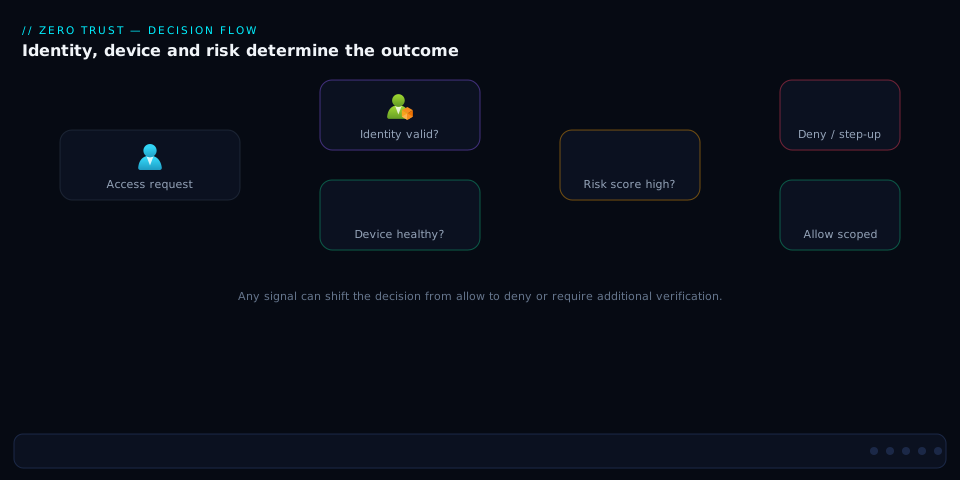
Quick take: Zero Trust is not a product you buy — it is an architectural stance that assumes breach and verifies every access request using real-time signals. If your security model still trusts anything inside the corporate network, it is already outdated.
MediSecure Health had a flat network, domain-joined laptops trusted by default, and a VPN that granted access to everything once connected. After a phishing incident, an attacker moved laterally for days. Zero Trust became their mandate: verify identity, verify device health, verify the request context, and enforce least privilege at every hop.
The problem it solves
Perimeter security trusts too much. Once inside, attackers roam freely. Zero Trust solves this by removing implicit trust and requiring continuous verification for every access decision. It shifts security from “where are you” to “who are you, what is your device health, what are you accessing, and what is the risk right now.”
Core concepts
| Concept | What it means in practice |
|---|---|
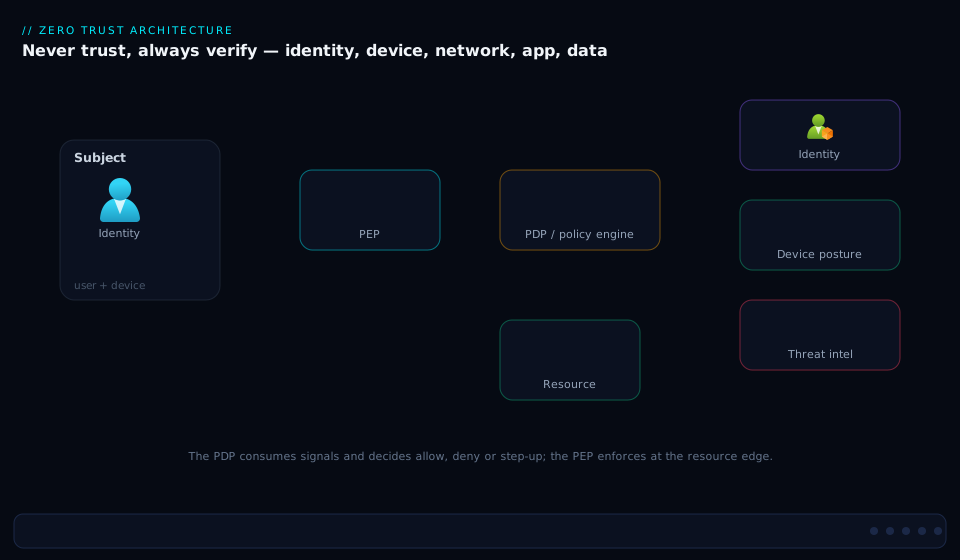
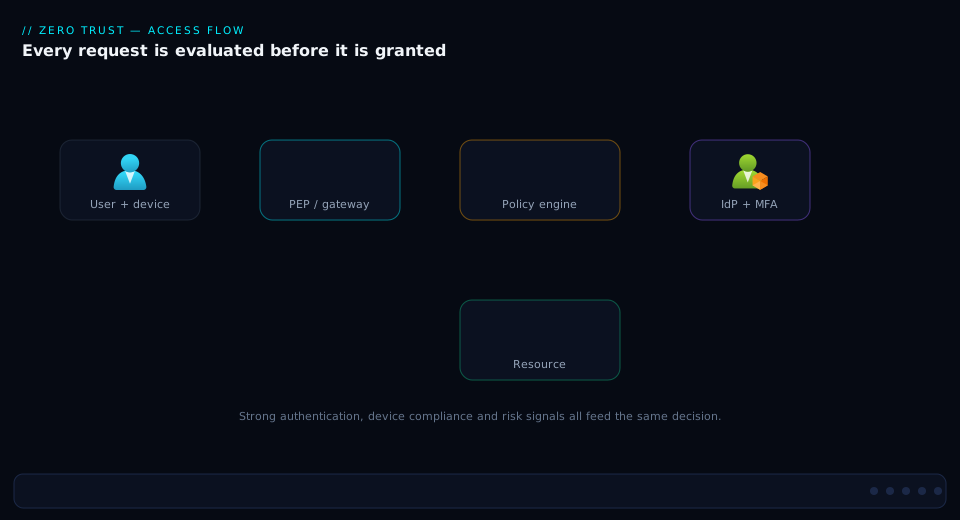
| Policy Decision Point (PDP) | Engine that evaluates signals and decides access. |
| Policy Enforcement Point (PEP) | Gateway, proxy, or agent that blocks or allows the request. |
| Signals | Identity, device posture, location, threat intel, data sensitivity. |
| Least privilege | Grant only the minimum access needed for the task. |
| Micro-segmentation | Small, isolated network zones rather than flat VLANs. |
| Assume breach | Design as if an attacker is already inside. |
Architecture
How it works
The five pillars
- Identity: strong authentication, least privilege, risk-based step-up.
- Device: managed, healthy endpoints with attestation.
- Network: micro-segmentation, encryption, no flat network.
- Application: per-application access, no broad VPN permissions.
- Data: classification, encryption, and rights-aware access.
Real-world scenario
MediSecure Health deployed Zero Trust for their electronic health record system. A clinician on a managed hospital workstation received seamless access. The same clinician connecting from a personal tablet in a coffee shop was blocked because the device was unmanaged and the location was unexpected. A researcher requesting bulk export triggered a step-up approval and DLP scan before the data left the environment.
Advantages
- Limits blast radius: attackers cannot move laterally easily.
- Context-aware access: decisions adapt to risk in real time.
- Supports hybrid work: security is not tied to the office network.
- Compliance alignment: maps cleanly to regulations that require least privilege and audit.
Disadvantages
- Complex to implement: many signals, products, and integrations.
- User friction: MFA and device checks can slow legitimate access.
- Identity as the new perimeter: compromise of the identity provider is catastrophic.
- Legacy systems: older apps may not support modern authentication or agents.
When to use it (and when not to)
Use Zero Trust when you have sensitive data, hybrid users, cloud workloads, and a realistic threat model.
Avoid trying to implement a full Zero Trust model in one big bang. Also, simple internal labs or non-sensitive tools may not justify the investment.
Best practices
- Start with identity: enforce MFA and phishing-resistant authentication first.
- Inventory every asset and classify data before writing policies.
- Use a trust algorithm, not binary allow/deny rules.
- Segment networks around application workloads, not just VLANs.
- Implement continuous access evaluation, not one-time login checks.
- Plan break-glass procedures so a PDP outage does not lock everyone out.
Zero Trust is a journey, not a checkbox. The destination is a system where every access request proves itself.