Change data capture off DynamoDB looks deceptively simple — turn on a stream, point a Lambda at it, ship the deltas somewhere. The trouble starts the first time a single poison record wedges a shard, an OpenSearch index drifts out of sync, or someone discovers that “exactly-once” was never a property the stream promised. DynamoDB Streams give you an ordered, at-least-once feed of item-level mutations. Everything downstream — ordering across reprocessing, deduplication, partial-batch recovery — is yours to engineer. This is how to build that pipeline so it survives throttles, redrives, and the occasional malformed item, using Lambda event source mappings where you need code and EventBridge Pipes where you do not.
The reason this is hard is that the failure modes are invisible until load. A pipeline that processes ten records a minute in dev never reveals that you have no idempotency, no bisect, no DLQ — and then a flash sale drives one partition key hot, the iterator age on that shard climbs past forty minutes, a malformed item silently blocks every update behind it, and your “real-time” search index is now lying about stock. The platform did exactly what you configured; you simply never configured it for the bad day. So this article treats DynamoDB CDC the way a senior engineer learns it the hard way: not “how do I move a change” but “how do I move a change such that it survives replay, isolates poison, preserves per-key order, and never silently drops data.”
By the end you will know which of the four delivery surfaces (native Stream + Lambda ESM, native Stream + EventBridge Pipes, Kinesis Data Streams for DynamoDB, or a glue Lambda fan-out) fits a given freshness/retention/ordering requirement; exactly which event-source-mapping knobs (BatchSize, ParallelizationFactor, MaximumRecordAgeInSeconds, BisectBatchOnFunctionError, ReportBatchItemFailures) prevent a stalled shard; and how to make every downstream write idempotent so at-least-once delivery is a non-event. Because this is a reference you will return to mid-incident, the knobs, the error/limit numbers, the view types, and the symptom→cause→confirm→fix playbook are all laid out as scannable tables — read the prose once, then keep the tables open when the iterator age starts climbing.
In a nutshell
Picture a receipt printer bolted to your database table. Every time an item is added, changed, or deleted, a slip prints — in order, one per change — and drops into a tray that holds the last 24 hours of slips. That tray is a DynamoDB Stream: an automatic, ordered feed of every change to your table. Change data capture (CDC) is just the discipline of having something read those slips and do things with them — update a search index, refresh a cache, append to an audit log, land the change in a data lake — so those copies stay in step with the table without your application code having to fan the change out itself.
Why a beginner should care: this is how one table quietly powers many things. The table stays the single source of truth; the stream lets a search index, an analytics pipeline, and a cache all react to changes instead of being written to directly. That decoupling is the backbone of event-driven architecture on AWS.
The catch — and the reason this lesson is long — is that the printer makes exactly three promises and no more: slips are in order per item (not across the whole table), each slip is delivered at least once (sometimes twice), and the tray empties after 24 hours. It never promises “exactly once,” never promises a full history, and by default a single slip your reader chokes on can jam the whole tray for hours. Everything here is about building a reader that survives that: reads each change once in effect (idempotency), isolates a bad slip instead of jamming (bisect + a dead-letter queue), and keeps up when one item goes hot (parallelism). Get those right and CDC is boring in the best way; skip them and it fails silently the first busy day.
Level: Advanced · Time: ~72 min · You’ll leave able to pick the right delivery surface, tune a Lambda event source mapping so one poison record can’t stall a shard, and make every downstream write idempotent so at-least-once delivery stops mattering.
What problem this solves
A relational database hands you a transaction log and a dozen mature CDC tools that tail it. DynamoDB hands you a Stream: an ordered, append-only feed of every INSERT, MODIFY, and REMOVE, retained for 24 hours, partitioned to match your table’s shards. That is a genuine gift — you get item-level deltas with per-partition-key ordering and no triggers to write — but it is a primitive, not a pipeline. The delivery contract is at-least-once, the retention is hard-capped at 24 hours, and the ordering guarantee is per partition key only, never table-wide. Everything that makes a production CDC pipeline trustworthy sits in the gap between that primitive and your sinks.
What breaks without this knowledge is depressingly consistent. A team points a single Lambda at the stream with default settings, fans out to OpenSearch + S3 + a warehouse from that one function, and ships it. Then: (1) a malformed item throws, the whole batch retries forever, and the shard stalls — every change behind the poison record is blocked for hours; (2) a redrive replays a batch and the search index double-applies a delete, or a stale replay overwrites a newer document; (3) one slow sink (OpenSearch under merge pressure) stalls the shared function, so the data lake and warehouse go stale too; (4) a record that needed reprocessing ages past the 24-hour window before anyone noticed, and it is gone for good. None of these are exotic. All of them are the default outcome of treating the stream as if it were exactly-once, infinitely retained, and globally ordered.
Who hits this: anyone projecting DynamoDB state into a search index, a cache, a data lake, an audit trail, or another service. It bites hardest on high-write, hot-key workloads (a single partition going hot starves the one-poller-per-shard model), multi-sink fan-out (coupling sinks behind one function), and first-time CDC builders who assume the stream gives them guarantees it explicitly does not. The fix is almost never “make the stream stronger” — the stream is what it is — it is “engineer idempotency, bisect, DLQ, and bus-level fan-out around it.” Here is the whole field at a glance: every guarantee the stream gives you, every one it withholds, and where you make up the difference.
| Property | What the native Stream guarantees | What it does NOT guarantee | Where you close the gap |
|---|---|---|---|
| Delivery | At-least-once to the consumer | Exactly-once | Idempotent downstream write (conditional-on-SequenceNumber) |
| Ordering | Per partition key, within a shard lineage | Global / table-wide ordering | Design so consumers only assume per-key order |
| Retention | 24 hours, rolling | Anything beyond 24h | S3 system-of-record via Firehose; one-time scan for backfill |
| Failure isolation | Records stay readable for 24h | Auto-skip of a poison record | BisectBatchOnFunctionError + on-failure destination |
| Partial success | — (whole-batch retry by default) | Per-record checkpointing | ReportBatchItemFailures |
| Fan-out | One stream, up to ~2 ESMs efficiently | Independent retry per sink from one Lambda | EventBridge bus/Pipe, one rule+DLQ per sink |
| Dedup across replay | — | Suppression of duplicates | Sink-native upsert + external version from SequenceNumber |
Learning objectives
By the end of this article you can:
- Choose between the four CDC delivery surfaces — native Stream + Lambda ESM, native Stream + EventBridge Pipes, Kinesis Data Streams for DynamoDB, and a glue-Lambda fan-out — by retention, ordering, freshness, and code-vs-config requirements.
- Enable a stream with the correct
StreamViewTypefor the consumer’s job, and explain what each of the four view types lets you compute (diffs, soft-delete capture, invalidation). - Tune a Lambda event source mapping deliberately:
BatchSize,MaximumBatchingWindowInSeconds,ParallelizationFactor,MaximumRetryAttempts,MaximumRecordAgeInSeconds, and the starting position — and name the trade-off each one makes. - Stop a stalled shard by combining
ReportBatchItemFailures(precise per-record checkpointing) withBisectBatchOnFunctionError(the safety net for unhandled exceptions), and read iterator age as the leading indicator. - Build filter-enrich-route pipelines with EventBridge Pipes — pushing selectivity into the filter stage and reshaping with a target transformer — and know when to keep a Lambda ESM instead.
- Engineer exactly-once downstream semantics as an idempotent write: conditional-on-
SequenceNumberin DynamoDB, external versioning in OpenSearch, deterministicpk#sk#seqkeys elsewhere. - Operate the pipeline: alarm on iterator age /
ApproximateAgeOfOldestRecord, evict poison records to a DLQ while they are still readable, and run a deliberate, reviewed redrive fromshardId+ sequence range.
Prerequisites & where this fits
You should already understand DynamoDB’s data model — partition keys, sort keys, items, and that a table’s throughput is sharded by partition key. Familiarity with the basics of Amazon DynamoDB, In Depth: Tables, Keys, Capacity Modes, Indexes & Streams is assumed — this article picks up where the “Streams” section there ends and goes deep on consuming them. You should be comfortable with AWS Lambda at the level of AWS Lambda, In Depth: Runtimes, Triggers, Layers, Concurrency & Every Setting, reading IAM-scoped CLI/Terraform, and JSON event shapes.
This sits in the event-driven / serverless integration track. It is downstream of table design — if your partition keys create hot shards, no consumer tuning saves you, so DynamoDB Single-Table Design: Modeling Access Patterns, GSIs, and Hot Partition Avoidance is upstream of everything here. It pairs tightly with Designing Event-Driven Architectures with Amazon EventBridge: Buses, Rules, Schemas, and Archive/Replay (the bus you fan out to) and Resilient Messaging with SQS and SNS: Fan-Out, FIFO Ordering, DLQs, and Poison-Message Handling (the DLQ and poison-handling patterns reused wholesale). The “land it in a lake” sink is the front half of A Structured Logging Pipeline on AWS: JSON Logs, CloudWatch Metric Filters, and Firehose to OpenSearch.
A quick map of who owns what during an incident, so you escalate to the right layer fast:
| Layer | What lives here | Typical owner | Failure classes it causes |
|---|---|---|---|
| Table + key design | Partition keys, write distribution | Data / app team | Hot shard, throttles → consumer falls behind |
| Stream | Shards, view type, 24h retention | Platform + app | Records age out; wrong view type starves consumers |
| Event source mapping / Pipe | The managed poller + its knobs | Platform / app | Stalled shard, whole-batch retry, no DLQ |
| Processor (Lambda) | Your code, idempotency, error handling | App team | Poison records, non-idempotent writes |
| Sinks (OpenSearch / S3 / DW) | Durability, freshness, versioning | App + data team | Index drift, duplicate apply, small-object tax |
| Observability | IteratorAge, DLQ depth, throttles | Platform / SRE | Silent stalls nobody alarmed on |
Core concepts
Six mental models make every later decision obvious.
A Stream is an ordered, append-only log, sharded like the table. Records for a given partition key always land in the same shard lineage and are delivered in commit order. That per-partition ordering is the single most important property to internalize — there is no global ordering across the table, only within a partition key. Shard topology mirrors the table’s partition structure and changes as the table splits/merges partitions, so your consumer must tolerate shards appearing and closing.
Delivery is at-least-once; “exactly-once” is something you build downstream. Redrives, bisect retries, and poller restarts all mean a sink can see the same change more than once. There is no setting that makes the stream exactly-once. The good news: every record hands you a stable item key and a monotonic SequenceNumber — exactly the tools an idempotent write needs.
Retention is 24 hours, hard. A record not consumed within 24 hours is gone. This drives two rules: set MaximumRecordAgeInSeconds below 24h so poison records are evicted to a DLQ while still readable, and treat S3 (fed via Firehose) as your replayable system of record once the window rolls off — the stream cannot backfill history.
The poller is managed; you tune it, you don’t write it. A Lambda event source mapping (ESM) is a poller AWS runs for you. You never write the GetShardIterator/GetRecords loop — you set BatchSize, ParallelizationFactor, batching window, retries, and failure handling, and the platform polls, batches, invokes, and checkpoints.
A stalled shard is the master failure mode. By default, if your function throws on a batch, the ESM retries the entire batch, and because the shard checkpoint has not advanced, it keeps retrying until success, age-out, or retry-exhaustion. One un-processable record blocks everything behind it. You see it as a climbing iterator age. Two mechanisms fix it: partial-batch responses and bisect-on-error.
Fan-out belongs at the bus, not in one function. If a single mega-Lambda writes to OpenSearch + S3 + a warehouse, one slow sink stalls the shard for all of them. Land changes on an EventBridge bus (often via a Pipe) and let independent rules deliver to each sink with its own retry budget and DLQ.
The vocabulary in one table
Pin down every moving part before the deep sections; the glossary repeats these for lookup.
| Term | One-line definition | Where it lives | Why it matters to CDC |
|---|---|---|---|
| Stream | Ordered, append-only log of item changes | On the table (enable per table) | The source of every change |
| Shard | An ordered partition of the stream | Within the stream | Unit of ordering and parallelism |
StreamViewType |
What each record carries (keys/new/old/both) | Stream spec | Dictates what consumers can compute |
SequenceNumber |
Monotonic per-shard record id | On every record | The idempotency / versioning anchor |
| Event source mapping (ESM) | Managed Lambda poller | On the Lambda | Where you tune batch/parallelism/failure |
ParallelizationFactor |
Concurrent invokes per shard (1–10) | ESM config | Drains a hot shard without resharding |
ReportBatchItemFailures |
Per-record checkpoint contract | ESM + function response | Stops one bad record blocking good ones |
| Bisect-on-error | Split-and-retry a failing batch | ESM config | Isolates a poison record |
| On-failure destination / DLQ | Where failure context lands | SQS/SNS (ESM), SQS (Pipe) | Points you at records to redrive |
| EventBridge Pipes | Managed source→filter→enrich→target | Standalone resource | No-code filter-enrich-route |
| Iterator age | How far behind the consumer is | CloudWatch metric | The leading indicator of a stall |
| Kinesis Data Streams for DynamoDB | Alternative change feed | Kinesis stream you own | Long retention, many fan-out consumers |
Delivery surfaces: native Streams, Pipes, Kinesis, or glue Lambda
Before any tuning, pick the right surface. Four options carry DynamoDB changes, and they differ on retention, ordering, dedup, freshness, and how much code you own. Choosing wrong here is the most expensive mistake in the article — you cannot tune your way out of a surface that doesn’t give you the retention or ordering you need.
| Surface | Retention | Ordering | Dedup | Freshness | Code you own | Best for |
|---|---|---|---|---|---|---|
| Native Stream + Lambda ESM | 24h | Per partition key (strict) | At-least-once (you dedupe) | Sub-second to seconds | The processor | Real compute, transactional multi-sink writes |
| Native Stream + EventBridge Pipes | 24h | Per partition key (strict) | At-least-once | Seconds | Only enrichment (optional) | Filter-enrich-route with no poller code |
| Kinesis Data Streams for DynamoDB | Up to 1 year | Best-effort (reorder on seq) | May duplicate (you dedupe) | Seconds | Consumer(s) | Long retention, many independent fan-out consumers |
| Glue Lambda fan-out (one ESM, code fans out) | 24h | Per partition key | At-least-once | Sub-second | The whole fan-out | Small scale, tight code control, few sinks |
The native Stream’s headline advantage is strict per-key ordering and no duplication at the source; its costs are the 24-hour cap and a practical limit on how many consumers can read it efficiently. Kinesis Data Streams for DynamoDB inverts that: configurable retention up to a year and clean multi-consumer fan-out, at the price of best-effort ordering and possible duplicates — so you must reorder and dedupe on a sequence number. The trade is real and worth stating plainly:
| Dimension | Native DynamoDB Stream | Kinesis Data Streams for DynamoDB |
|---|---|---|
| Max retention | 24 hours | Up to 365 days (configurable) |
| Ordering | Strict per partition key | Best-effort; reorder on ApproximateCreationDateTime/seq |
| Duplicates | At-least-once (rare in practice) | Possible; dedupe required |
| Consumers | ~2 efficient ESMs per stream | Many (enhanced fan-out, shared, Firehose, KCL) |
| Throughput model | Managed, tied to table | Provisioned/on-demand Kinesis shards |
| When to pick | Strict order, short window | Long replay, many sinks, analytics teams |
Enable the Kinesis surface when you need any of: retention beyond 24 hours, several independent teams consuming the same changes, or direct Firehose delivery to a lake without a Lambda in the path. Stay on the native Stream when strict per-key ordering matters most or your consumer count is small. A quick decision table:
| If you need… | It’s probably… | Choose |
|---|---|---|
| Strict per-key order, one or two consumers | A real-time projector | Native Stream + Lambda ESM |
| Filter + reshape + route, no poller code | A glue pipeline | Native Stream + EventBridge Pipes |
| Replay older than 24h / many fan-out consumers | An analytics backbone | Kinesis Data Streams for DynamoDB |
| A handful of sinks, tight code control, small scale | A bespoke processor | Glue Lambda fan-out |
| Both real-time projection AND long replay | A hybrid | Native Stream for projection + Kinesis for lake |
Stream internals: shards, records, and view types
A DynamoDB Stream is an ordered, append-only log of item-level changes, retained for 24 hours, composed of shards whose topology mirrors the table’s partition structure. Enable it and choose a StreamViewType, which controls what each record carries:
aws dynamodb update-table \
  --table-name orders \
  --stream-specification StreamEnabled=true,StreamViewType=NEW_AND_OLD_IMAGES
resource "aws_dynamodb_table" "orders" {
  name             = "orders"
  hash_key         = "pk"
  billing_mode     = "PAY_PER_REQUEST"
  stream_enabled   = true
  stream_view_type = "NEW_AND_OLD_IMAGES"
  attribute {
    name = "pk"
    type = "S"
  }
}
The four view types are not cosmetic — they dictate what your consumers can compute. For CDC you almost always want NEW_AND_OLD_IMAGES: the diff is what lets you route on transitions (“status went from PENDING to SHIPPED”) and reconstruct deletes — on a REMOVE event there is no new image, only the old one.
StreamViewType |
Record contains | Record size impact | Use when | Cannot do |
|---|---|---|---|---|
KEYS_ONLY |
Key attributes only | Smallest | You re-read the item yourself, or only need invalidation signals | Compute diffs; reconstruct deletes |
NEW_IMAGE |
Item after the write | Medium | Projecting current state to a search index or cache | See what changed from; capture old value on delete |
OLD_IMAGE |
Item before the write | Medium | Audit “what changed from”, soft-delete capture | Project current state on insert/modify |
NEW_AND_OLD_IMAGES |
Both images | Largest | Computing diffs, conditional routing on field transitions | (nothing — fullest fidelity) |
Each stream record carries an eventName of INSERT, MODIFY, or REMOVE, plus the keys, the requested image(s), the SequenceNumber, and (on TTL deletes) a userIdentity block. Know the record anatomy cold — it is what your filters and idempotency keys read:
| Record field | Meaning | Present when | CDC use |
|---|---|---|---|
eventName |
INSERT / MODIFY / REMOVE |
Always | Route by mutation type |
dynamodb.Keys |
The item’s key attributes (typed) | Always | The stable idempotency key |
dynamodb.NewImage |
Item after the write | Not on REMOVE (or KEYS_ONLY) |
Project current state |
dynamodb.OldImage |
Item before the write | Not on INSERT (or KEYS_ONLY) |
Diffs; reconstruct deletes |
dynamodb.SequenceNumber |
Monotonic per-shard id | Always | Idempotency + external version |
dynamodb.ApproximateCreationDateTime |
When the change happened | Always | Latency measurement; Kinesis reorder |
userIdentity |
Set to dynamodb.amazonaws.com for TTL |
TTL deletes only | Filter housekeeping deletes |
eventSourceARN |
The stream ARN | Always | Redrive target |
A subtle trap: a TTL deletion arrives as
REMOVEwithuserIdentity.principalId=dynamodb.amazonaws.comandtype=Service. If you mirror deletes downstream, filter TTL expiries explicitly or you replicate housekeeping you did not intend to.
The stream’s own limits are worth memorizing because several of them shape your tuning. These are the numbers that bite:
| Limit / quota | Value | Consequence if you hit it |
|---|---|---|
| Retention | 24 hours | Unconsumed records lost permanently |
| Max record size | ~400 KB (item size) | Large items still fit; very wide items inflate batches |
| Stream view type changes | Requires disable + re-enable stream | New stream ARN; consumers must re-point |
| Efficient simultaneous readers | ~2 processes per shard | More readers risk GetRecords throttling |
| Shard lineage | Splits/merges with table partitions | Consumer must handle new/closed shards |
GetRecords throughput |
5 calls/sec, up to 1,000 records or 1 MB | Over-reading throttles; ESM manages this for you |
Consuming with Lambda: batch size, window, and parallelization
The native stream is consumed through a Lambda event source mapping — a managed poller AWS runs on your behalf. You tune it; you do not write the polling loop. Three knobs dominate throughput and latency:
aws lambda create-event-source-mapping \
  --function-name orders-cdc-processor \
  --event-source-arn "$STREAM_ARN" \
  --starting-position LATEST \
  --batch-size 100 \
  --maximum-batching-window-in-seconds 5 \
  --parallelization-factor 4 \
  --maximum-retry-attempts 3 \
  --bisect-batch-on-function-error \
  --maximum-record-age-in-seconds 21600 \
  --function-response-types ReportBatchItemFailures \
  --destination-config '{"OnFailure":{"Destination":"'"$DLQ_ARN"'"}}'
Every tunable on the mapping, what it does, its default, its bounds, and the trade-off — this is the table you keep open when you create or adjust an ESM:
| Setting | What it controls | Default | Range / values | Trade-off / gotcha |
|---|---|---|---|---|
BatchSize |
Max records per invocation | 100 | 1–10,000 (streams) | Bigger amortizes overhead but widens failure blast radius and raises duration |
MaximumBatchingWindowInSeconds |
Wait before invoking | 0 | 0–300 | Higher = fewer/fuller invokes but more latency |
ParallelizationFactor |
Concurrent invokes per shard | 1 | 1–10 | Drains a hot shard; cross-key order within a shard relaxes (per-key holds) |
StartingPosition |
Where to begin | — | LATEST / TRIM_HORIZON |
LATEST ignores history; TRIM_HORIZON replays the 24h window |
MaximumRetryAttempts |
Retries before giving up on a record | -1 (infinite) | -1, or 0–10,000 | Infinite + no bisect = a poison record stalls forever |
MaximumRecordAgeInSeconds |
Evict records older than this | -1 (= 24h) | -1, or 60–604,800 (capped at 24h effective) | Set below 24h so poison hits DLQ while readable |
BisectBatchOnFunctionError |
Split a failing batch and retry halves | false | true/false | The safety net for unhandled throws |
FunctionResponseTypes |
Enables partial-batch responses | (none) | ReportBatchItemFailures |
Precise per-record checkpointing |
DestinationConfig.OnFailure |
Where failure context goes | (none) | SQS or SNS ARN | Without it, exhausted records vanish silently |
TumblingWindowInSeconds |
Stateful aggregation window | 0 | 0–900 | Enables windowed aggregation across invokes |
Enabled |
Poller on/off | true | true/false | Disable to pause without deleting the mapping |
FilterCriteria |
Pre-invoke event filtering | (none) | Up to 5 patterns | Drops non-matching records before you pay |
ParallelizationFactor deserves a warning. Ordering is preserved per partition key even with a factor above 1: the poller hashes each record’s partition key to one of the concurrent invocations, so all records for a key still go to the same invocation in order. What you lose is ordering across different keys within the same shard — almost always fine, because cross-key ordering was never guaranteed table-wide. Use it freely as long as your processing logic only assumes per-key order. How the parallelization factor interacts with order and throughput:
| Parallelization factor | Concurrency per shard | Per-key order | Cross-key order in a shard | When to use |
|---|---|---|---|---|
| 1 (default) | 1 | Preserved | Preserved | Strict in-shard order needed; low throughput |
| 2–4 | 2–4 | Preserved | Relaxed | Moderate hot-shard catch-up |
| 5–10 | 5–10 | Preserved | Relaxed | Drain a badly hot shard during a spike |
--starting-position LATEST begins at the tip and ignores history; TRIM_HORIZON replays everything still in the 24-hour window. For a brand-new pipeline that must backfill, TRIM_HORIZON plus a one-time scan-and-load for older data is the usual combination — the stream alone cannot reach beyond 24 hours. The starting-position choices side by side:
| Starting position | Begins at | Replays history? | Use for |
|---|---|---|---|
LATEST |
The tip (new changes only) | No | Steady-state pipelines; you backfill separately |
TRIM_HORIZON |
Oldest record still in the 24h window | Yes (≤24h) | New pipeline catching up recent changes |
(one-time Scan + load) |
The full table snapshot | N/A (not the stream) | Backfilling data older than 24h |
Rather than reason about each knob in isolation, start from the workload and read off a recipe. A decision table mapping the requirement to the ESM configuration:
| If your requirement is… | Set | Because |
|---|---|---|
| Lowest possible latency | MaximumBatchingWindowInSeconds=0, small BatchSize |
Invoke as soon as records arrive |
| Highest throughput / fewest invokes | BatchSize=100–1000, window 5 |
Full batches amortize overhead |
| Catch up a hot shard fast | ParallelizationFactor=8–10 |
Drain one shard across many invokes |
| Strict in-shard cross-key order | ParallelizationFactor=1 |
No concurrent invokes per shard |
| Survive a poison record | BisectBatchOnFunctionError + finite MaxRetryAttempts + DLQ |
Isolate and evict it |
| Never reprocess good records | FunctionResponseTypes=ReportBatchItemFailures |
Per-record checkpointing |
| Evict before the 24h cliff | MaximumRecordAgeInSeconds=21600 |
DLQ while still readable |
| Backfill a brand-new pipeline | StartingPosition=TRIM_HORIZON + one-time Scan |
Replay 24h + load older data |
The concurrency limits that bound how far you can push parallelism — real numbers, because they cap your catch-up:
| Limit | Value | What hits it |
|---|---|---|
ParallelizationFactor max |
10 per shard | Hot-shard catch-up ceiling |
BatchSize max (streams) |
10,000 records | Very large batches widen failure blast radius |
MaximumBatchingWindowInSeconds max |
300 | Latency vs invoke-count trade |
| Account concurrent executions (default) | 1,000 (raisable) | Total Lambda concurrency across functions |
| Effective concurrency per stream | shards × ParallelizationFactor |
The real parallel ceiling for one stream |
| Efficient readers per shard | ~2 | More risks GetRecords throttling |
GetRecords |
5/sec, ≤1,000 records or 1 MB | The poller manages this for you |
Ordering and partial-batch failures: bisect-on-error and checkpointing
Here is the failure mode that bites everyone. By default, if your function throws on a batch, the ESM retries the entire batch — and because the shard’s checkpoint has not advanced, it keeps retrying the same batch until it succeeds, expires past MaximumRecordAgeInSeconds, or exhausts MaximumRetryAttempts. A single un-processable record blocks every record behind it in that shard. That is a stalled shard, and you see it as a climbing iterator age.
Two mechanisms fix this; use both.
Partial batch responses let the function tell the poller exactly which records failed so the rest are checkpointed and never reprocessed. Set --function-response-types ReportBatchItemFailures and return the failed sequence numbers:
def handler(event, context):
    failures = []
    for record in event["Records"]:
        seq = record["dynamodb"]["SequenceNumber"]
        try:
            process(record)
        except Exception:
            failures.append({"itemIdentifier": seq})
    return {"batchItemFailures": failures}
The contract has a sharp edge worth memorizing: because ordering matters, the poller treats the earliest reported failure as the checkpoint. Everything at or after that sequence number is retried; everything before it is considered done. So return failures honestly — do not report a late record as failed while silently dropping an earlier one, or you will skip data. Returning an empty list ({"batchItemFailures": []}) means the whole batch succeeded. The exact response contract and how the poller interprets each shape:
| Function returns | Poller interprets as | Records reprocessed | Trap |
|---|---|---|---|
{"batchItemFailures": []} |
Whole batch succeeded | None | — |
{"batchItemFailures":[{"itemIdentifier": seq}]} |
Fail from earliest listed seq | That seq and everything after | List the earliest real failure |
| Throws an exception | Whole batch failed | Entire batch | One bad record burns the whole budget (without bisect) |
Returns null / nothing |
Whole batch succeeded | None | Swallowing an error here silently drops data |
| Reports a late seq, drops an earlier one | Checkpoints past the dropped one | Only from the late seq | Data loss — never do this |
Bisect-on-error (--bisect-batch-on-function-error) handles the case where the function throws instead of reporting failures. On error the poller splits the batch in two and retries each half, recursively narrowing down to the single offending record. That record then goes to the on-failure destination once retries are exhausted, and the rest of the batch proceeds. Without bisect, one bad record can burn your entire retry budget on a 100-record batch. The two mechanisms compared — ship both, but know which does what:
| Mechanism | Precision | Reprocesses good records? | Handles unhandled throw? | Role |
|---|---|---|---|---|
ReportBatchItemFailures |
Per record (exact seq) | No | Only if you catch and report | Primary — precise checkpointing |
BisectBatchOnFunctionError |
Narrows to one record via halving | Yes (re-runs halves) | Yes | Safety net for exceptions you didn’t anticipate |
MaximumRetryAttempts |
Batch/record budget | — | — | Bounds how long a failure retries |
MaximumRecordAgeInSeconds |
Time-based eviction | — | — | Evicts to DLQ before 24h age-out |
Rule of thumb:
ReportBatchItemFailuresis the primary mechanism — precise, avoids reprocessing good records.BisectBatchOnFunctionErroris the safety net for unexpected exceptions and serialization bugs you did not anticipate. Ship both.
EventBridge Pipes: filtering, enrichment, and routing without glue Lambdas
A large fraction of CDC “processors” are glue: filter the events you care about, reshape them, send them to a target. EventBridge Pipes does exactly that as a managed integration — source, optional filter, optional enrichment, target — with no poller code to own. The source can be a DynamoDB Stream directly. The four stages and what each is for:
| Pipe stage | Purpose | Optional? | Cost timing | Typical implementation |
|---|---|---|---|---|
| Source | Read the DynamoDB Stream (batch/window/retry like an ESM) | Required | — | Stream ARN + dynamodb_stream_parameters |
| Filter | Drop non-matching records before you pay | Optional | Runs first, cheapest | Up to 5 EventBridge patterns |
| Enrichment | Hydrate/transform the event | Optional | After filter | Lambda, Step Functions Express, API GW, API destination |
| Target | Where the final payload goes | Required | After enrichment | EventBridge bus, SQS, SNS, Step Functions, Lambda, … |
The filter stage runs before you pay for enrichment or invocation, so push as much selectivity into it as you can. Pipes filter patterns match the stream record shape, including the DynamoDB-typed attribute values:
{
  "eventName": ["MODIFY"],
  "dynamodb": {
    "NewImage": {
      "status": { "S": ["SHIPPED"] }
    }
  }
}
The Terraform wiring is compact, and the dynamodb_stream_parameters block carries the same batch/window/retry semantics as a Lambda ESM:
resource "aws_pipes_pipe" "orders_shipped" {
  name     = "orders-shipped-to-bus"
  role_arn = aws_iam_role.pipe.arn
  source   = aws_dynamodb_table.orders.stream_arn
  target   = aws_cloudwatch_event_bus.commerce.arn

  source_parameters {
    dynamodb_stream_parameters {
      starting_position                  = "LATEST"
      batch_size                         = 100
      maximum_batching_window_in_seconds = 5
      maximum_retry_attempts             = 4
      on_partial_batch_item_failure      = "AUTOMATIC_BISECT"
      dead_letter_config {
        arn = aws_sqs_queue.pipe_dlq.arn
      }
    }
    filter_criteria {
      filter {
        pattern = jsonencode({
          eventName = ["MODIFY"]
          dynamodb  = { NewImage = { status = { S = ["SHIPPED"] } } }
        })
      }
    }
  }
}
The enrichment stage can hydrate the event — look up a customer record, call a pricing service — and return a transformed payload, all without you running a poller. The target transformer then reshapes the final payload with an input template. The net effect: a filter-enrich-route pipeline that used to be 150 lines of Lambda becomes declarative infrastructure, and the only code you keep is genuine business logic in the enrichment. The decision between Pipes and a Lambda ESM, made explicit:
| If the work is… | Lean toward | Why |
|---|---|---|
| Filter + reshape + route | EventBridge Pipes | No poller code; filter runs before you pay |
| Non-trivial transformation needing libraries | Lambda ESM | Real code, real error handling |
| Transactional writes to multiple sinks | Lambda ESM | Coordinated, conditional writes |
| Enrich from one service, then route | Pipes (Lambda enrichment) | Keep only business logic as code |
| Fan-out to many independent consumers | Pipes → EventBridge bus | One rule + DLQ per consumer |
| Windowed aggregation across batches | Lambda ESM (tumbling window) | Pipes has no tumbling window |
Choose Pipes when the work is route and reshape. Keep a Lambda ESM when the work is compute — non-trivial transformation, transactional writes to multiple sinks, or anything needing libraries and real error handling.
The Pipes target options, end to end, with what each is good for as a CDC destination:
| Pipe target | Delivery shape | Good CDC use | Note |
|---|---|---|---|
| EventBridge bus | Event onto a bus | Fan-out to many independent rules/sinks | The canonical decoupling target |
| SQS queue | Message to a queue | Buffer + a single consumer with backpressure | Pair with a DLQ |
| SNS topic | Pub/sub fan-out | Push to multiple subscribers | No replay/buffer |
| Step Functions (Standard) | Start an execution | Long-running orchestration per change | Async; durable |
| Step Functions (Express) | Synchronous workflow | Short enrichment/route logic | Also valid as enrichment |
| Lambda | Invoke a function | Real compute on the routed event | When you do want code |
| Kinesis / Firehose | Record to a stream | Land in a lake / re-stream | Firehose → S3 for the system of record |
| API destination | HTTP call | Push to an external SaaS/webhook | Built-in retry + auth |
Idempotency and exactly-once semantics in downstream sinks
DynamoDB Streams are at-least-once. Redrives, bisect retries, and poller restarts all mean a downstream sink can see the same change more than once. “Exactly-once” downstream is therefore not a delivery setting you toggle — it is an idempotent write you design. The good news is every stream record hands you the tools: a stable item key and a monotonic SequenceNumber.
The cleanest pattern is a conditional write keyed on sequence. Store the last applied sequence number per item and reject anything not strictly newer. This collapses duplicates and protects against out-of-order application during reprocessing:
def apply_idempotent(key, new_image, sequence):
    try:
        table.put_item(
            Item={**new_image, "_seq": sequence},
            ConditionExpression="attribute_not_exists(#s) OR #s < :seq",
            ExpressionAttributeNames={"#s": "_seq"},
            ExpressionAttributeValues={":seq": sequence},
        )
    except ClientError as e:
        if e.response["Error"]["Code"] != "ConditionalCheckFailedException":
            raise
        # Duplicate or stale replay -> safe no-op
DynamoDB SequenceNumber values are strictly increasing within a shard for a given key, which is exactly the scope this guard needs. For sinks that lack conditional writes, fall back to a deterministic idempotency key — partitionKey#sortKey#sequenceNumber — and let the sink’s natural upsert (OpenSearch _id, an S3 object key, a primary-key MERGE) absorb the duplicate. The principle is invariant: make replay a no-op, never an additive side effect. The idempotency strategy per sink type:
| Sink | Idempotency mechanism | Dedup key | Out-of-order protection |
|---|---|---|---|
| DynamoDB (another table) | Conditional PutItem on _seq |
Item key | _seq < :seq rejects stale |
| OpenSearch | index with external version |
_id = item key |
_version_type=external rejects lower version |
| S3 (data lake) | Deterministic object key | pk#sk#seq.json |
Same key overwrites; immutable log |
| Relational warehouse | MERGE / upsert on PK |
Primary key | Compare a version/seq column |
| SQS → consumer | Idempotency table at consumer | MessageDeduplicationId / pk#sk#seq |
Consumer-side last-seq check |
| Cache (Redis/Memcached) | SET keyed by item key |
Item key | Conditional SET on stored seq |
The failure modes idempotency defends against, so you can reason about why each guard exists:
| Without idempotency you get… | Caused by | The guard that prevents it |
|---|---|---|
| Double-applied insert/modify | Redrive or bisect replay | Conditional-on-seq / upsert by id |
| Re-issued delete on an already-deleted item | Replay of a REMOVE |
Idempotent delete (no-op if absent) |
| Newer doc overwritten by older replay | Out-of-order reprocessing | External version / _seq < :seq |
| Duplicate rows in the warehouse | At-least-once + naive INSERT |
MERGE on PK |
| Inflated counters/aggregates | Additive side effect on replay | Make the write a set, not an increment |
Fan-out to OpenSearch, S3, and analytics targets
Real pipelines feed several sinks with different durability and freshness needs. Resist the urge to fan out from a single mega-Lambda — couple them and one slow target stalls the shard for all of them. Fan out at the bus instead: a Pipe lands changes on an EventBridge bus, and independent rules deliver to each consumer with its own retry budget and DLQ.
- OpenSearch — index the
NewImagewith_idset to the item key so writes are idempotent upserts; onREMOVE, issue a delete by that same_id. Honor per-key order by deriving a monotonicversionfrom the sequence number and using external versioning so a stale replay cannot overwrite a newer doc. - S3 (data lake) — buffer through Kinesis Data Firehose and write newline-delimited JSON partitioned by event date. Firehose batches and compresses, which keeps you off the small-object tax that kills Athena performance. This is your replayable system of record once the 24-hour stream window has rolled off.
- Analytics / warehouse — land in S3, then
COPY/MERGEinto Redshift or query in place with Athena. Keep the raw change log immutable and do transformation downstream; never let a warehouse load be the only place a change exists.
Each sink has a different freshness/durability/cost profile — match the sink to the requirement:
| Sink | Freshness | Durability role | Cost driver | Per-sink failure handling |
|---|---|---|---|---|
| OpenSearch | Sub-second to seconds | Queryable projection (rebuildable) | Cluster + indexing | Bus rule retry + DLQ; _version guard |
| Firehose → S3 | Buffered (≈60s / 5MB) | System of record (replayable) | Per-GB + PUTs | Firehose retry + S3 error bucket |
| Redshift / Athena | Minutes (after S3 land) | Analytical store | Compute + scan | Reload from immutable S3 |
| Another DynamoDB table | Sub-second | Materialized view | RU/s | Conditional-on-seq write |
| ElastiCache | Sub-second | Cache (rebuildable) | Node hours | Conditional SET; TTL |
A single Lambda target can also do the OpenSearch fan-out directly when you want code-level control — emit per-document failures via ReportBatchItemFailures so a 409 on one doc does not block the batch:
from opensearchpy import helpers

def to_action(record):
    key = record["dynamodb"]["Keys"]["pk"]["S"]
    if record["eventName"] == "REMOVE":
        return {"_op_type": "delete", "_index": "orders", "_id": key}
    img = deserialize(record["dynamodb"]["NewImage"])
    version = int(record["dynamodb"]["SequenceNumber"])
    return {
        "_op_type": "index", "_index": "orders", "_id": key,
        "_version": version, "_version_type": "external", "_source": img,
    }
Mapping each eventName to the right sink action — the table that keeps your projector correct:
eventName |
Image present | OpenSearch action | S3 action | Warehouse action |
|---|---|---|---|---|
INSERT |
NewImage | index (upsert by _id) |
Write pk#sk#seq.json |
MERGE insert |
MODIFY |
New + Old | index (upsert by _id) |
Write new version object | MERGE update |
REMOVE (user) |
OldImage only | delete by _id |
Write tombstone object | MERGE soft-delete flag |
REMOVE (TTL) |
OldImage + userIdentity |
Filter out (or delete) | Skip or tag as housekeeping | Skip |
Handling poison records with on-failure destinations and DLQs
A poison record is one that will never succeed no matter how many times you retry — a schema your code cannot parse, a downstream constraint it will always violate. The entire point of MaximumRetryAttempts, MaximumRecordAgeInSeconds, and an on-failure destination is to evict that record so the shard keeps moving.
For a Lambda ESM, the on-failure destination (SQS or SNS) receives metadata about the failed batch, not the record bodies themselves — shard ID, the failing sequence-number range, and an error summary. That is deliberate: the records still live in the stream for 24 hours, so the destination’s job is to point you at them. Your redrive tooling reads the DynamoDBStreamArn, shard, and sequence-number window from the failure message and re-reads the offending records with GetShardIterator at AT_SEQUENCE_NUMBER. An EventBridge Pipes DLQ behaves the same way — it captures failure context after retries are exhausted.
{
  "requestContext": { "functionArn": "arn:aws:lambda:...:orders-cdc-processor" },
  "responseContext": { "statusCode": 200, "functionError": "Unhandled" },
  "DDBStreamBatchInfo": {
    "shardId": "shardId-00000001700000000000-abcdef01",
    "startSequenceNumber": "700000000000000000001",
    "endSequenceNumber": "700000000000000000099",
    "approximateArrivalOfFirstRecord": "2026-06-08T14:00:00Z",
    "batchSize": 99,
    "streamArn": "arn:aws:dynamodb:...:table/orders/stream/2026-06-08T00:00:00.000"
  }
}
What the failure message contains, and what you do with each field during a redrive:
Field in DDBStreamBatchInfo |
Meaning | Redrive use |
|---|---|---|
shardId |
The shard that failed | GetShardIterator target |
startSequenceNumber |
First failing seq | Iterator at AT_SEQUENCE_NUMBER |
endSequenceNumber |
Last failing seq | Stop boundary for the re-read |
streamArn |
The stream | Which stream to read |
approximateArrivalOfFirstRecord |
When it arrived | How close to the 24h cliff you are |
batchSize |
How many records | Scope of the redrive |
Alarm on ApproximateAgeOfOldestRecord and on DLQ depth, and make the redrive a deliberate, reviewed action — not an automatic retry that re-poisons the pipeline. Set MaximumRecordAgeInSeconds comfortably below 24 hours (e.g. 6 hours) so records are evicted to the DLQ while they are still readable in the stream; if a record ages past the 24-hour retention before you redrive, it is gone for good. The on-failure surface differs slightly between ESM and Pipes:
| Aspect | Lambda ESM on-failure | EventBridge Pipes DLQ |
|---|---|---|
| Destination types | SQS or SNS | SQS (or SNS) |
| Payload | Batch metadata (shard + seq range) | Failure context after retries |
| Records included | No (still in stream 24h) | No (still in stream 24h) |
| Trigger | After MaximumRetryAttempts / age |
After maximum_retry_attempts |
| Redrive method | Re-read shard at AT_SEQUENCE_NUMBER |
Re-read shard at AT_SEQUENCE_NUMBER |
| Bisect setting | --bisect-batch-on-function-error |
on_partial_batch_item_failure = AUTOMATIC_BISECT |
The metrics you alarm on are the difference between catching a stall in minutes and discovering it from a customer complaint. The CloudWatch reference for a DynamoDB-Streams CDC pipeline — namespace, what it measures, and a starting alarm threshold:
| Metric | Namespace | What it tells you | Starting alarm threshold |
|---|---|---|---|
IteratorAge / GetRecords.IteratorAgeMilliseconds |
AWS/Lambda / AWS/DynamoDB |
How far behind the consumer is (the stall signal) | > 60,000 ms sustained 5 min |
ApproximateAgeOfOldestRecord |
AWS/Lambda (ESM) |
Oldest unprocessed record’s age | > 1/4 of MaximumRecordAgeInSeconds |
Errors |
AWS/Lambda |
Function invocation failures | > 0 sustained (with retries looping) |
Throttles |
AWS/Lambda |
Concurrency ceiling hit | > 0 sustained 5 min |
ConcurrentExecutions |
AWS/Lambda |
Headroom vs account/reserved limit | > 80% of reserved |
DeadLetterErrors / DLQ ApproximateNumberOfMessagesVisible |
AWS/Lambda / AWS/SQS |
Poison records captured | ≥ 1 (page on any) |
ReadThrottleEvents |
AWS/DynamoDB (stream) |
Too many readers per shard | > 0 sustained |
ProvisionedConcurrencySpilloverInvocations |
AWS/Lambda |
PC pool overflow (if using PC) | > 0 |
The error and exception strings you will actually see, what each means on this path, and the first move:
| Error / condition | Where it surfaces | Likely cause | How to confirm | First fix |
|---|---|---|---|---|
ConditionalCheckFailedException |
Idempotent PutItem |
Duplicate or stale replay (expected) | It’s a no-op by design | Swallow it; do NOT re-raise |
version_conflict_engine_exception (409) |
OpenSearch index | Older version rejected by external versioning | Stale replay arrived after newer | Treat as success; the guard worked |
ProvisionedThroughputExceededException |
GetRecords |
Too many readers per shard | ReadThrottleEvents > 0 |
≤2 readers; move to Kinesis fan-out |
TrimmedDataAccessException |
GetShardIterator/redrive |
Record aged past 24h before redrive | ApproximateAgeOfOldestRecord near 24h |
Lower MaxRecordAge; alarm earlier |
ExpiredIteratorException |
Long-running consumer | Shard iterator older than ~5 min unused | Iterator reused too late | Re-acquire the iterator |
ResourceNotFoundException (stream) |
ESM create / Pipe | Stream ARN stale after view-type change | View type changed → new ARN | Re-point the ESM/Pipe to the new ARN |
Unhandled (in DLQ functionError) |
On-failure destination | Function threw; batch exhausted retries | DLQ message present | Redrive from shard + seq range |
Lambda Task timed out |
CloudWatch logs | Per-record work exceeds function timeout | Duration ≈ configured timeout | Smaller batch; raise timeout; optimize |
Architecture at a glance
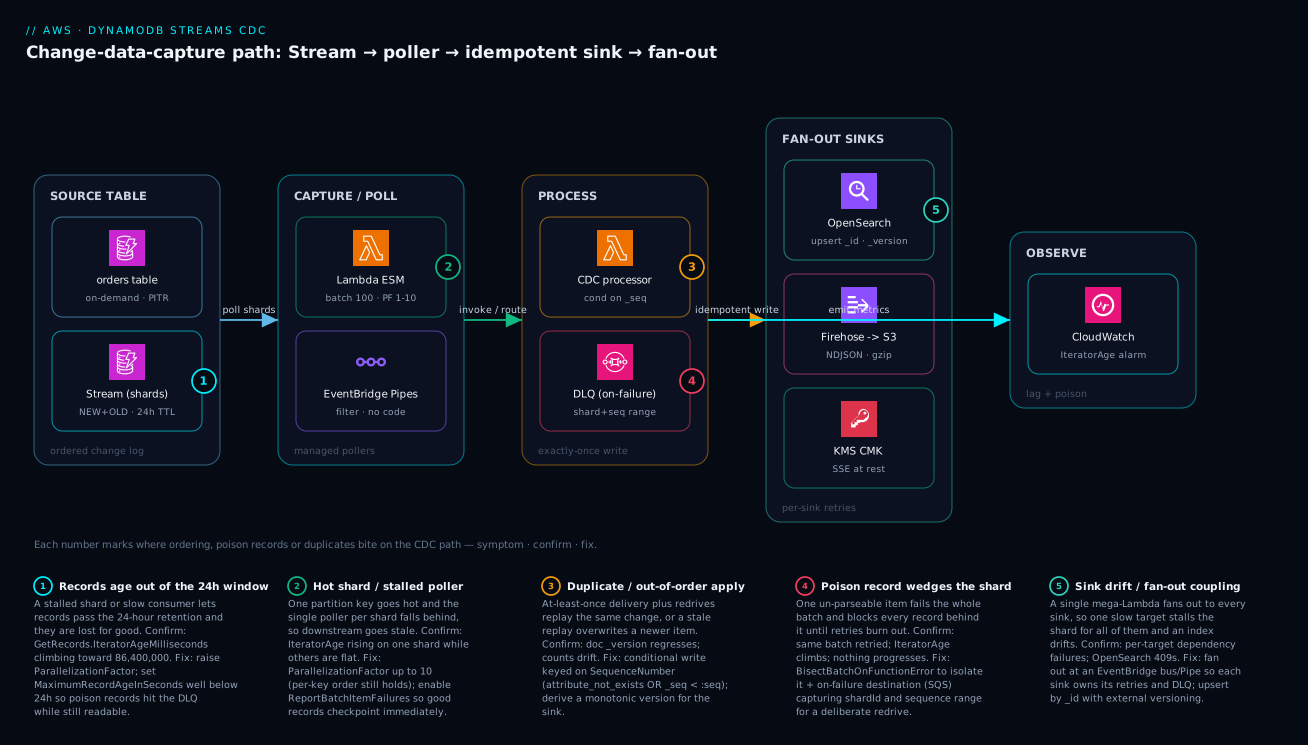
The diagram traces a change as it actually flows, then maps each failure class onto the exact hop where it bites. Read it left to right. A write commits to the orders table and lands on its Stream (NEW_AND_OLD_IMAGES, sharded, 24-hour retention) — badge 1 marks where records age out of the window if a stall lets them. The capture/poll zone holds the two managed pollers: the Lambda ESM (batch 100, parallelization 1–10) and EventBridge Pipes (filter, no code) — badge 2 sits on the ESM, where a hot shard stalls the single poller per shard. In process, the CDC processor writes idempotently (conditional on _seq) — badge 3 is the duplicate / out-of-order apply class — and the DLQ captures the shardId + sequence range when a poison record wedges the shard (badge 4). The fan-out sinks — OpenSearch (upsert by _id/_version), Firehose→S3 (NDJSON, gzip), encrypted with a KMS CMK — carry badge 5, the sink-drift / fan-out-coupling class. Finally CloudWatch watches IteratorAge, the leading indicator for every stall.
The whole method is in that left-to-right path: a change is captured once, processed exactly-once via an idempotent write, fanned out at the bus so each sink owns its retries, and observed so a climbing iterator age pages you before the 24-hour cliff. The five numbered badges are the five ways it goes wrong, and the legend narrates each as symptom · confirm · fix — so when the pager fires you localize the failure to a hop, read the cause, run the named confirm, and apply the fix.
Real-world scenario
A retail platform team — call them MeridianStock — ran inventory on a single DynamoDB table fronting 2,000 stores, with a Lambda ESM projecting every change into an OpenSearch index that powered the storefront’s “in stock near you” search. Average load was 600 writes/second; the team was five engineers; the monthly bill for the table + stream + Lambda + OpenSearch ran about ₹95,000. On a normal day it was fine.
During a flash sale, one SKU’s partition went hot. The ESM’s iterator age on that shard climbed past 40 minutes, and search results went stale right when traffic peaked — the exact failure that costs money. Worse, a malformed bundle item (a nested map their deserializer choked on) had been silently stuck in that shard for hours, blocking every inventory update behind it because the whole batch kept failing and retrying. Their original ESM had BatchSize=500, ParallelizationFactor=1, no partial-batch reporting, and no bisect — so a single bad record consumed the entire retry budget on a 500-record batch, over and over.
The constraint was twofold: they needed the hot shard to catch up without resharding a 2,000-store table mid-sale, and they could not let one un-parseable item hold the rest hostage. The breakthrough was reading the right metric. GetRecords.IteratorAgeMilliseconds was pinned near 2,400,000 (40 minutes) on exactly one shard while the others sat near zero — a textbook hot-shard-plus-poison signature, not a capacity problem. Scaling the table would have done nothing.
They made three changes, all configuration. They raised ParallelizationFactor to 8 so the hot shard drained across eight concurrent invocations (ordering held, because all records for a given SKU still hashed to one invocation). They switched the function to ReportBatchItemFailures and returned precise failed sequence numbers, so good records checkpointed immediately instead of being reprocessed behind the poison item. And they enabled BisectBatchOnFunctionError with MaximumRecordAgeInSeconds=21600, so the malformed bundle item was narrowed down and evicted to a DLQ within minutes instead of wedging the shard for hours.
aws lambda update-event-source-mapping \
  --uuid "$ESM_UUID" \
  --parallelization-factor 8 \
  --batch-size 100 \
  --maximum-record-age-in-seconds 21600 \
  --bisect-batch-on-function-error \
  --function-response-types ReportBatchItemFailures \
  --destination-config '{"OnFailure":{"Destination":"'"$DLQ_ARN"'"}}'
The outcome: iterator age on the hot shard fell back under 30 seconds within the next sale, the poison bundle item surfaced in the DLQ with its exact sequence range for an engineer to fix offline, and the storefront search stopped lying about stock during the one window where accuracy mattered most. The following sprint they also moved the data-lake sink off the projector Lambda and onto an EventBridge Pipe → bus, so a slow OpenSearch never again stalled the lake. No table redesign, no resharding — just the ESM knobs used the way they were designed. The incident as a timeline, because the order of moves is the lesson:
| Time | Symptom | Action taken | Effect | What it should have been |
|---|---|---|---|---|
| T+0 | Search stale during sale | (alert on stale results, not the pipeline) | — | Alarm on IteratorAge, not user reports |
| T+10m | One shard’s age at 40 min | Considered scaling the table | Would not help | Read per-shard IteratorAge first |
| T+20m | Confirmed hot shard + poison | ParallelizationFactor 1 → 8 |
Hot shard drains 8-way | Correct catch-up lever |
| T+25m | Poison still blocking | ReportBatchItemFailures on |
Good records checkpoint | Stop reprocessing good behind bad |
| T+30m | Poison record isolated | Bisect + MaxRecordAge=21600 |
bundle item to DLQ in minutes |
Evict while still readable |
| +1 sprint | Lake coupled to projector | Pipe → EventBridge bus | Sinks decoupled | Fan out at the bus from day one |
Advantages and disadvantages
DynamoDB Streams give you a genuinely powerful change feed, but the model’s strengths and its sharp edges are two sides of the same coin. Weigh them honestly:
| Advantages (why this model helps you) | Disadvantages (why it bites) |
|---|---|
| Ordered, item-level deltas with per-key ordering and no triggers to write | Ordering is per key only — never table-wide; consumers must not assume global order |
| Managed pollers (Lambda ESM / Pipes) — you tune, you don’t write the loop | At-least-once delivery means you must build idempotency; nothing is exactly-once |
ReportBatchItemFailures + bisect give precise poison isolation |
Defaults are unsafe: infinite retries, no bisect, no DLQ → a poison record stalls a shard for hours |
| 24-hour retention buffers consumers and enables redrive from the stream | The 24-hour cap is hard — miss the window and the record is gone; you need S3 as the system of record |
| EventBridge Pipes turns glue into declarative infrastructure | Pipes is route-and-reshape only — real compute still needs a Lambda |
ParallelizationFactor drains a hot shard without resharding |
A hot partition key still bottlenecks one shard; tuning helps, key design fixes |
| Native Stream never duplicates at the source (vs Kinesis) | Only ~2 efficient readers per shard; many consumers force the Kinesis surface |
| Tight integration with KMS, IAM, CloudWatch | Several failure modes are invisible until load (hot shard, SNAT-like coupling, ageing out) |
The model is right whenever you need item-level CDC with strict per-key ordering and a short replay window — search projection, cache invalidation, audit trails, materialized views. It bites hardest on hot-key workloads, multi-sink fan-out done in one function, and teams that ship the defaults. Every disadvantage is manageable — but only if you know it exists, which is the entire point of building idempotency, bisect, DLQ, and bus-level fan-out in from the start.
Hands-on lab
Build a minimal CDC pipeline end to end — a table with a stream, a Lambda ESM with the safety knobs on, an idempotent projection, and a deliberate poison record — then watch it recover. Free-tier-friendly; teardown at the end. Run in CloudShell.
Step 1 — Variables and a table with a stream.
export AWS_PAGER=""
TABLE=cdc-orders-lab
DLQ=cdc-orders-dlq
FN=cdc-orders-processor

aws dynamodb create-table \
  --table-name "$TABLE" \
  --attribute-definitions AttributeName=pk,AttributeType=S \
  --key-schema AttributeName=pk,KeyType=HASH \
  --billing-mode PAY_PER_REQUEST \
  --stream-specification StreamEnabled=true,StreamViewType=NEW_AND_OLD_IMAGES
aws dynamodb wait table-exists --table-name "$TABLE"
STREAM_ARN=$(aws dynamodb describe-table --table-name "$TABLE" \
  --query 'Table.LatestStreamArn' --output text)
echo "$STREAM_ARN"
Expected: a stream ARN ending in a timestamp. Note it — the ESM points at it.
Step 2 — Create the DLQ and capture its ARN.
DLQ_URL=$(aws sqs create-queue --queue-name "$DLQ" --query QueueUrl --output text)
DLQ_ARN=$(aws sqs get-queue-attributes --queue-url "$DLQ_URL" \
  --attribute-names QueueArn --query 'Attributes.QueueArn' --output text)
echo "$DLQ_ARN"
Step 3 — A processor that is idempotent and reports per-record failures. Save as app.py and zip it. It throws on a deliberately malformed item so you can watch bisect isolate it:
import json
def handler(event, context):
    failures = []
    for r in event["Records"]:
        seq = r["dynamodb"]["SequenceNumber"]
        try:
            img = r["dynamodb"].get("NewImage", {})
            if img.get("poison", {}).get("BOOL"):     # the malformed item
                raise ValueError("poison record")
            print("applied", r["dynamodb"]["Keys"]["pk"]["S"], seq)
        except Exception as e:
            print("FAILED", seq, str(e))
            failures.append({"itemIdentifier": seq})
    return {"batchItemFailures": failures}
Step 4 — Deploy the function (assumes an existing Lambda execution role with stream + SQS + logs permissions; see Security notes for the exact policy).
zip fn.zip app.py
aws lambda create-function --function-name "$FN" \
  --runtime python3.12 --handler app.handler \
  --role "$LAMBDA_ROLE_ARN" --zip-file fileb://fn.zip
Step 5 — Create the event source mapping with every safety knob on.
aws lambda create-event-source-mapping \
  --function-name "$FN" --event-source-arn "$STREAM_ARN" \
  --starting-position TRIM_HORIZON \
  --batch-size 10 --maximum-batching-window-in-seconds 5 \
  --parallelization-factor 2 \
  --maximum-retry-attempts 2 --maximum-record-age-in-seconds 3600 \
  --bisect-batch-on-function-error \
  --function-response-types ReportBatchItemFailures \
  --destination-config '{"OnFailure":{"Destination":"'"$DLQ_ARN"'"}}'
Expected: a mapping with State progressing to Enabled. Confirm: aws lambda list-event-source-mappings --function-name "$FN" --query 'EventSourceMappings[0].State'.
Step 6 — Write a few good items and one poison item, then watch.
aws dynamodb put-item --table-name "$TABLE" --item '{"pk":{"S":"ORDER#1"},"status":{"S":"PENDING"}}'
aws dynamodb put-item --table-name "$TABLE" --item '{"pk":{"S":"ORDER#2"},"poison":{"BOOL":true}}'
aws dynamodb put-item --table-name "$TABLE" --item '{"pk":{"S":"ORDER#3"},"status":{"S":"SHIPPED"}}'
sleep 30
aws logs tail "/aws/lambda/$FN" --since 5m
Expected in the logs: applied ORDER#1, a FAILED line for ORDER#2, and applied ORDER#3 — proof the good records checkpointed while the poison one was isolated and routed to the DLQ after its retries.
Step 7 — Confirm the poison landed in the DLQ.
aws sqs receive-message --queue-url "$DLQ_URL" --wait-time-seconds 5 \
  --query 'Messages[0].Body' --output text
Expected: a JSON body with DDBStreamBatchInfo carrying the shardId and the failing sequence range. The lab steps mapped to what each proves:
| Step | What you did | What it proves |
|---|---|---|
| 1 | Table + NEW_AND_OLD_IMAGES stream |
The source feed and its view type |
| 5 | ESM with bisect + partial-batch + DLQ | The safety knobs are real and composable |
| 6 | Good + poison items | Good records checkpoint; poison is isolated |
| 7 | Read the DLQ message | Failure context (shard + seq) is what you redrive from |
Cleanup.
ESM=$(aws lambda list-event-source-mappings --function-name "$FN" --query 'EventSourceMappings[0].UUID' --output text)
aws lambda delete-event-source-mapping --uuid "$ESM"
aws lambda delete-function --function-name "$FN"
aws sqs delete-queue --queue-url "$DLQ_URL"
aws dynamodb delete-table --table-name "$TABLE"
Cost note. On-demand DynamoDB, a tiny Lambda, and an SQS queue for an hour cost a few rupees; deleting the four resources stops everything. There is no charge for enabling a stream — you pay per GetRecords call the ESM makes, which is negligible at this scale.
Common mistakes & troubleshooting
This is the playbook — the part you bookmark. First as a scannable table you can read while the iterator age climbs, then the detail underneath for the entries that bite hardest.
| # | Symptom | Root cause | Confirm (exact metric / command) | Fix |
|---|---|---|---|---|
| 1 | One shard’s iterator age climbs to minutes; downstream stale | Hot partition key + one-poller-per-shard | GetRecords.IteratorAgeMilliseconds high on one shard, flat on others |
ParallelizationFactor up to 10; ReportBatchItemFailures on |
| 2 | Whole pipeline wedged; same batch retried forever | Poison record + no bisect + infinite retries | Invocation errors loop; iterator age climbs everywhere | BisectBatchOnFunctionError + on-failure DLQ + finite MaxRetryAttempts |
| 3 | Search index double-applies or shows stale doc | Non-idempotent write; out-of-order replay | OpenSearch _version regresses; counts drift |
Conditional-on-_seq; external versioning from SequenceNumber |
| 4 | Records vanished; never processed | Aged past 24h before redrive | ApproximateAgeOfOldestRecord was near 24h |
MaximumRecordAgeInSeconds well below 24h; alarm earlier |
| 5 | Housekeeping deletes replicated downstream | TTL REMOVE not filtered |
Record has userIdentity.principalId=dynamodb.amazonaws.com |
Filter TTL deletes in the function/filter |
| 6 | One slow sink stalls all sinks | Mega-Lambda fan-out couples sinks | Iterator age climbs when only OpenSearch is slow | Fan out at an EventBridge bus/Pipe; one rule+DLQ per sink |
| 7 | REMOVE events have no new data to project |
Expecting NewImage on delete |
eventName=REMOVE has only OldImage |
Use OldImage; reconstruct delete from keys |
| 8 | Consumers see no field-transition info | Wrong StreamViewType (KEYS_ONLY/NEW_IMAGE) |
Record lacks OldImage |
Re-enable stream as NEW_AND_OLD_IMAGES |
| 9 | DLQ message has no record body | Expecting records, got metadata | Body is DDBStreamBatchInfo, not items |
Re-read shard at AT_SEQUENCE_NUMBER |
| 10 | GetRecords throttling; lag despite low function load |
Too many readers per shard | ReadThrottleEvents / throttled GetRecords |
≤2 efficient readers; move to Kinesis fan-out |
| 11 | Reported failures but data still skipped | Reported a late seq, dropped an earlier one | Gap in processed sequence numbers | Always report the earliest real failure |
| 12 | Kinesis CDC shows duplicates / out of order | Kinesis is best-effort, not native Stream | Same record id twice; out-of-order seq | Dedupe + reorder on seq; or use native Stream |
The expanded form for the entries that cause the most lost hours:
1. One shard’s iterator age climbs to minutes; downstream goes stale.
Root cause: A hot partition key funnels writes into one shard, and the default one-poller-per-shard model falls behind.
Confirm: aws cloudwatch get-metric-statistics --namespace AWS/DynamoDB --metric-name ... — or simpler, the Lambda IteratorAge metric high on the one shard. The signature is one shard high while the rest are near zero.
Fix: Raise ParallelizationFactor (up to 10) so the shard drains across concurrent invocations; per-key order still holds because each key hashes to one invocation. Enable ReportBatchItemFailures so good records checkpoint immediately. The durable fix is key design — see single-table modeling — but tuning buys you the incident.
2. The whole pipeline is wedged; the same batch retries forever.
Root cause: A poison record with default settings (infinite retries, no bisect) — the batch fails, the checkpoint never advances, it retries indefinitely.
Confirm: Function invocation errors loop on the same batch; iterator age climbs across shards.
Fix: BisectBatchOnFunctionError to isolate the record by halving, a finite MaximumRetryAttempts, and an on-failure destination so the isolated record lands in a DLQ. Combine with ReportBatchItemFailures so you rarely reach bisect at all.
3. The search index double-applies a change or shows a stale document.
Root cause: A non-idempotent write, or an out-of-order replay overwriting a newer document during reprocessing.
Confirm: OpenSearch _version regresses; row counts in the warehouse drift from the table.
Fix: Conditional write keyed on SequenceNumber (attribute_not_exists(_seq) OR _seq < :seq); for OpenSearch use _version_type=external with the sequence-derived version so a lower version is rejected.
4. Records vanished and were never processed.
Root cause: They aged past the 24-hour retention before anyone redrove them.
Confirm: ApproximateAgeOfOldestRecord was approaching 86,400 seconds.
Fix: Set MaximumRecordAgeInSeconds well below 24h (e.g. 21,600) so poison records hit the DLQ while still readable; alarm on iterator age at minutes, not hours.
6. One slow sink stalls all sinks. Root cause: A single mega-Lambda fans out to every sink, so one slow target (OpenSearch under merge pressure) stalls the shard for all of them. Confirm: Iterator age climbs precisely when one sink is slow; the others are healthy but starved. Fix: Land changes on an EventBridge bus (via a Pipe) and give each sink its own rule, retry budget, and DLQ. The projector’s slowness no longer blocks the lake.
Iterator age is the master signal, but its shape tells you which failure you have. Read the pattern, not just the number:
| Iterator-age pattern | It’s probably… | Confirm | Do this |
|---|---|---|---|
| High on one shard, flat on the rest | Hot partition key (± poison) | Per-shard IteratorAge |
ParallelizationFactor up; fix key design |
| Climbing across all shards together | Poison + no bisect, or function too slow | Looping Errors; duration ≈ timeout |
Bisect + DLQ; smaller batch; optimize |
| Climbs only when one sink is slow | Mega-Lambda fan-out coupling | Sink dependency latency vs age | Fan out at the bus/Pipe |
| Sawtooth (climbs, drops, repeats) | Under-provisioned concurrency vs bursts | Throttles spiking on bursts |
Raise concurrency; ParallelizationFactor |
Flat-high near MaxRecordAge then drops |
Records being evicted to DLQ | DLQ depth rising | Expected — go fix the poison offline |
Common beginner mistakes
The troubleshooting table above is symptom-first — what to do when the pager fires. This section is misconception-first: the wrong mental models that cause those symptoms, and the right model to replace each with. Almost every incident in this article traces back to one of these.
-
“The stream delivers each change exactly once.” It does not — delivery is at-least-once, and there is no setting that changes that. Redrives, bisect retries, and poller restarts all replay records. Right model: treat every downstream write as something that will occasionally run twice, and make it idempotent (conditional-on-
_seq, upsert by id). Exactly-once is a property you build in the sink, never one you receive from the source. -
“Turning on the stream is the hard part; the defaults are fine.” The defaults are the trap: infinite retries, no bisect, no partial-batch reporting, no DLQ. A single un-parseable record then wedges the whole shard forever. Right model: enabling the stream is line one; the pipeline is
ReportBatchItemFailures+BisectBatchOnFunctionError+ a finite retry budget + an on-failure destination. Ship all four or you have not shipped a CDC pipeline. -
“Records are delivered in the order I wrote them.” Only per partition key. There is no global, table-wide ordering — two different keys can be processed in either order, and
ParallelizationFactor > 1makes that explicit. Right model: design consumers to assume order within a key and nothing across keys; if you think you need table-wide order, you have a modeling problem, not a tuning problem. -
“
ParallelizationFactorwill scramble my ordering, so I must leave it at 1.” It preserves per-key order at any value — every record for a key hashes to the same concurrent invocation. What relaxes is order across keys within a shard, which was never guaranteed anyway. Right model: reach forParallelizationFactorfreely to drain a hot shard; the only order it costs you is order you were never promised. -
“The DLQ holds my failed records, so I can just reprocess the queue.” For a stream ESM (and a Pipes DLQ), the destination receives batch metadata —
shardId, the failing sequence range, an error summary — not the record bodies. Right model: the records still live in the stream for 24 hours; the DLQ is a pointer, and recovery means re-reading the shard atAT_SEQUENCE_NUMBER. If you wait past 24 hours, the pointer dangles. -
“A
REMOVEevent carries the new state I need to project.” A delete has no new image — onlyOldImage(and only if the view type includes it). Beginners write a projector that readsNewImageon every event and it silently no-ops on deletes. Right model: branch oneventName; reconstruct the delete from the keys andOldImage, and remember a TTL delete is aREMOVEwith auserIdentityyou probably want to filter. -
“The stream is my history — I can always replay from it.” Retention is 24 hours, hard. A record not consumed in that window is gone, and the stream cannot backfill anything older. Right model: the stream is a short buffer, not an archive; land every change in S3 (via Firehose) as the immutable, replayable system of record, and use a one-time
Scanfor data older than the window. -
“Changing the
StreamViewTypeis a quick in-place edit.” It requires disabling and re-enabling the stream, which mints a new stream ARN — and every ESM and Pipe pointed at the old ARN stops receiving records. Right model: pickNEW_AND_OLD_IMAGESup front; if you must change it, plan a coordinated re-point of every consumer as part of the change.
Best practices
- Pick the delivery surface before tuning. Native Stream for strict per-key order and a short window; Kinesis Data Streams for DynamoDB for long retention or many fan-out consumers. You cannot tune your way out of the wrong surface.
- Enable
NEW_AND_OLD_IMAGESunless you have a concrete reason for a leaner view. The diff is what lets you route on transitions and reconstruct deletes. - Filter TTL-driven
REMOVEevents explicitly (or in the Pipe filter) so housekeeping is not replicated downstream. - Ship
ReportBatchItemFailuresandBisectBatchOnFunctionErrortogether on every ESM — the former for precise checkpointing, the latter as the safety net for unhandled exceptions. - Always report the earliest real failure in a partial-batch response. Reporting a late one while dropping an earlier one silently skips data.
- Set
MaximumRecordAgeInSecondsbelow 24 hours (e.g. 6h) so poison records are evicted to a DLQ while still readable in the stream. - Make every downstream write idempotent — conditional-on-
SequenceNumber, or a deterministicpk#sk#seqkey with the sink’s natural upsert. Treat replay as a non-event. - Derive a monotonic version from
SequenceNumberand use external versioning (OpenSearch_version) so a stale replay cannot overwrite a newer doc. - Fan out at an EventBridge bus/Pipe, never one mega-Lambda, so each sink owns its retries and DLQ and one slow target can’t stall the rest.
- Use
ParallelizationFactorto drain hot shards during a spike, but fix chronic hot keys in the data model. - Keep S3 (via Firehose) as the immutable system of record — the only thing that survives the 24-hour window and lets you rebuild any sink.
- Alarm on
IteratorAge/ApproximateAgeOfOldestRecord, function errors/throttles, and DLQ depth before go-live — a silent stall you didn’t alarm on is the worst case. - Make redrives deliberate and reviewed. Read
shardId+ sequence range from the DLQ and re-read atAT_SEQUENCE_NUMBER; never auto-retry a poison record back into the pipeline.
Security notes
DynamoDB Streams inherit the table’s encryption and are governed by their own IAM action set; the consumer needs least-privilege access to read the stream and write the DLQ, nothing more.
- Encrypt at rest with a customer-managed KMS key. A stream encrypts with the same key as its table; using a KMS CMK (rather than the AWS-owned key) gives you key policy control, rotation, and an auditable grant to the consumer’s role. See AWS KMS in Depth: Multi-Region Keys, Envelope Encryption, Key Policies, and Grants.
- Scope the consumer’s IAM to the four stream actions. The Lambda/Pipe role needs only
DescribeStream,GetRecords,GetShardIterator, andListStreamson the specific stream ARN — neverdynamodb:*. - Separate read-from-stream from write-to-sink. Grant
sqs:SendMessageto the DLQ, the specific OpenSearch/S3 write actions to the sinks, and nothing broader. Cross-account fan-out should use scoped assume-role — see Secure Cross-Account Access: Assume-Role Patterns, External ID, Confused Deputy, and Session Policies. - Don’t leak PII into the lake unfiltered. The
NewImage/OldImagecarry the full item; mask or drop sensitive attributes in the enrichment/processor before they land in S3 or a search index. - Lock the DLQ down. Failure metadata names shard IDs and sequence ranges; restrict
sqs:ReceiveMessageto the redrive role and encrypt the queue with SSE-KMS.
The minimal consumer policy — what to grant and why each action is needed:
| IAM action | On resource | Why the consumer needs it |
|---|---|---|
dynamodb:DescribeStream |
The stream ARN | Discover shards and topology |
dynamodb:GetShardIterator |
The stream ARN | Position a read (incl. AT_SEQUENCE_NUMBER for redrive) |
dynamodb:GetRecords |
The stream ARN | Read the change records |
dynamodb:ListStreams |
The stream ARN | Enumerate streams on the table |
sqs:SendMessage |
The DLQ ARN | Write failure context on exhaustion |
kms:Decrypt |
The table’s CMK | Decrypt encrypted stream records |
| (sink-specific writes) | Each sink ARN | Project the change (scoped per sink) |
data "aws_iam_policy_document" "cdc_consumer" {
  statement {
    actions   = ["dynamodb:DescribeStream", "dynamodb:GetRecords",
                 "dynamodb:GetShardIterator", "dynamodb:ListStreams"]
    resources = [aws_dynamodb_table.orders.stream_arn]
  }
  statement {
    actions   = ["sqs:SendMessage"]
    resources = [aws_sqs_queue.cdc_dlq.arn]
  }
  statement {
    actions   = ["kms:Decrypt"]
    resources = [aws_kms_key.table.arn]
  }
}
Cost & sizing
The bill for a CDC pipeline is dominated by the consumers and sinks, not the stream itself — enabling a stream is free, and you pay only for the GetRecords calls the managed poller makes. What actually drives the cost and how to right-size it:
GetRecordsrequests are billed per call (DynamoDB Streams read-request units); the ESM batches efficiently, so this is small unless you set a tiny batch size with a zero batching window (many under-full reads). Use a sensibleBatchSize(100) and a shortMaximumBatchingWindowInSeconds(1–5s) to keep calls few and full.- Lambda is the usual largest line — invocations × duration × memory. Bigger batches amortize invocation overhead; right-size memory to the per-record work.
- OpenSearch is often the single most expensive sink (cluster hours regardless of change volume) — size it to query load, and remember it is rebuildable from S3, so you can run it leaner.
- Firehose + S3 are cheap per GB; the win is avoiding the small-object tax by letting Firehose batch and compress, which keeps Athena fast and S3 PUTs low.
- Kinesis Data Streams for DynamoDB adds shard-hour (provisioned) or per-GB (on-demand) cost plus the longer retention — only pay this when you genuinely need >24h replay or many consumers.
A rough monthly picture for a mid-size pipeline (600 writes/s projected to OpenSearch + a lake):
| Cost driver | What you pay for | Rough INR / month | How to right-size |
|---|---|---|---|
Stream GetRecords |
Read-request units the poller makes | ~₹500–2,000 | Sensible batch size + window (few, full reads) |
| Lambda (processor) | Invocations × duration × memory | ~₹4,000–12,000 | Larger batches; tune memory to per-record work |
| OpenSearch domain | Cluster hours (data + master nodes) | ~₹40,000–90,000 | Size to query load; rebuild from S3, run lean |
| Firehose → S3 | Per-GB ingest + storage + PUTs | ~₹2,000–6,000 | Let Firehose batch/compress; partition by date |
| SQS DLQ | Requests (tiny) | < ₹200 | Negligible |
| Kinesis (if used) | Shard-hours or per-GB + retention | ~₹6,000–20,000 | Only when >24h replay / many consumers |
The lesson MeridianStock learned: most “we need a bigger pipeline” instincts are actually “we mis-tuned the poller” or “we coupled our sinks.” Fix the configuration and the fan-out topology first; the bill usually goes down, not up. There is no free tier for streams specifically, but the per-GetRecords cost is small enough that the consumers dominate every realistic bill.
Going deeper
The core sections give you a pipeline that survives the common bad day. This section is for the reader who owns that pipeline in production and keeps hitting the edges — the shard tree that reshapes under you, stateful aggregation inside the poller, the Kinesis surface’s fan-out internals, and the two places (Global Tables and the outbox) where “just consume the stream” quietly becomes wrong.
Shard lineage and the iterator lifecycle
The line “shards mirror the table’s partitions” hides the part that actually breaks consumers: shards are a tree, not a flat list. When a table partition splits (heat or growth) or merges, the stream’s shards split and merge with it. A parent shard closes — it stops accepting new records and keeps a fixed set until they age out — and one or two child shards open to carry new writes for that key range. Records for a partition key move to the child, so per-key order is preserved across the seam only if a consumer finishes the parent before starting the child. The managed ESM does this for you: it discovers the tree via DescribeStream, drains a parent to its end, then advances to children. Hand-rolled KCL/GetRecords consumers must honor the same rule or they reorder a key across a split.
| Shard state | Meaning | Consumer obligation |
|---|---|---|
| Open | Accepting new records | Poll to the tip; iterator returns NextShardIterator |
| Closed (parent) | Sealed; fixed record set, still readable ≤24h | Drain fully before its children |
| Child | New writes for the parent’s key range | Start only after the parent is drained |
| Expired iterator | Iterator handle unused too long | Re-acquire with GetShardIterator; never cache one for long |
A shard iterator is a short-lived cursor, not a durable checkpoint: acquire it, use it promptly, and re-acquire if it goes stale — which is why a redrive tool re-derives the iterator from the DLQ’s shardId + sequence range at AT_SEQUENCE_NUMBER rather than storing one. The durable position is the SequenceNumber; the iterator is a disposable handle to it.
Tumbling windows: stateful aggregation inside the ESM
The ESM tables list TumblingWindowInSeconds (0–900) without explaining the contract that makes it useful. A tumbling window lets a stream ESM accumulate state across invocations within a fixed, non-overlapping time window — the only in-poller way to compute a running aggregate (per-key counts, rolling sums, sessionization) without an external store on every record. The poller passes a state object (≤1 MB) from one invoke to the next; you mutate it and return it; on the last invoke of the window you get isFinalInvokeForWindow: true and flush the aggregate downstream once:
def handler(event, context):
    state = event.get("state", {})                       # carried across invokes
    for r in event["Records"]:
        key = r["dynamodb"]["Keys"]["pk"]["S"]
        state[key] = state.get(key, 0) + 1               # per-key running count
    if event.get("isFinalInvokeForWindow"):
        flush_aggregate(event["window"], state)          # emit once per window
        return {"batchItemFailures": []}
    return {"state": state, "batchItemFailures": []}     # keep accumulating
State is scoped per shard, aggregation stays per partition key, and ReportBatchItemFailures still works alongside it. This is the answer to “how do I count events per minute without a round-trip to DynamoDB per record” — and it is Lambda-ESM-only, which is one of the few hard reasons to keep a Lambda instead of an EventBridge Pipe.
The Kinesis surface up close: enhanced fan-out and the KCL
The delivery-surface table names Kinesis Data Streams for DynamoDB as the long-retention, many-consumer option; the internals decide whether it actually scales. Two consumer models exist. Shared throughput gives every consumer on a shard a slice of one 2 MB/s read budget — fine for a couple of readers, a bottleneck past that (the same “~2 efficient readers” ceiling the native stream has, for the same reason). Enhanced fan-out gives each registered consumer its own dedicated ~2 MB/s per shard over an HTTP/2 push (SubscribeToShard), so up to ~20 consumers each read at full rate with lower latency and no mutual throttling — this is what makes “three teams on the same feed” real rather than aspirational.
Serious consumers use the KCL (Kinesis Client Library), with the DynamoDB Streams Kinesis Adapter when the source is a native stream: the KCL discovers shards, coordinates workers, follows the parent→child tree, and checkpoints progress in its own lease table (a DynamoDB table it creates) so a crashed worker’s shards are re-leased instead of stalled. When you reorder Kinesis records to recover per-key order, key on ApproximateCreationDateTime (enable millisecond precision) plus the sequence number, because Kinesis ordering is best-effort. If you are wiring this into a broader streaming estate, Real-Time Streaming Architectures on AWS is the surrounding pattern.
Global Tables: the replication is not your stream
A common and expensive assumption: “I’ll use the stream to replicate the table to another region.” Global Tables (version 2019.11.21) already does multi-region, active-active replication for you with an internal, managed mechanism and last-writer-wins conflict resolution — you do not hand-build cross-region replication off the customer stream anymore. But the interaction has a trap for CDC consumers: each replica has its own stream, and a replicated write lands in the destination region’s stream too. If you run the same CDC consumer in every region, a single logical write is processed once per region — duplicated projections, double-counted aggregates. Distinguish a locally-originated change from a replicated one (compare the record’s awsRegion, or stamp an origin-region attribute on write) and process only local-origin records, or you build a replication loop on top of the one AWS already runs.
The transactional outbox — which you may already have for free
The classic microservices bug is the dual write: your service commits business state to the database and publishes an event to a broker as two separate operations, and a crash between them leaves the two out of sync. The outbox pattern fixes it by writing the event into the same transaction as the state change, then relaying it. With DynamoDB Streams you often get this for free: every committed item change already emits a stream record derived from the same commit, so the stream is the outbox and there is no second write to lose. When one logical action must touch several items atomically, TransactWriteItems commits up to 100 items as a unit — and each committed item surfaces in the stream, preserving per-key order — so the relay (your ESM or Pipe) sees a consistent set, never a half-applied transaction.
FilterCriteria beyond equality
The FilterCriteria row understates what the filter can express. An ESM (or Pipe) accepts up to 5 patterns, combined with OR, and each pattern supports EventBridge content filtering — not just value equality — against the DynamoDB-typed record: numeric comparisons, anything-but, prefix, and exists. Two patterns that pull real weight:
{ "eventName": ["MODIFY"],
  "dynamodb": { "NewImage": { "qty": { "N": [ { "numeric": [ "<", 5 ] } ] } } } }
{ "eventName": ["REMOVE"], "userIdentity": [ { "exists": false } ] }
The first invokes only when stock drops below five (reorder signal); the second matches user-initiated deletes but not TTL expiries — because a TTL delete carries a userIdentity block and exists: false excludes it, the cleanest way to stop replicating housekeeping. One cost nuance to internalize: for streams, filtered-out records are still read from the shard (you pay the GetRecords/read-unit cost and they count toward batch shaping), but they do not invoke your function — so filtering saves invocation and downstream cost, not stream-read cost.
Practice challenges
Work these in order — each builds on the lab’s cdc-orders-lab table and escalates from “turn the knob” to “reason about the guarantee.” Try each before opening the solution; the one-line why under each is the point to retain.
1. (Beginner) Enable the right view type and read the stream ARN. Starting from a table with no stream, turn on a stream that lets a consumer compute diffs and reconstruct deletes, then capture its ARN.
<details> <summary>Solution</summary>
aws dynamodb update-table --table-name cdc-orders-lab \
  --stream-specification StreamEnabled=true,StreamViewType=NEW_AND_OLD_IMAGES
aws dynamodb describe-table --table-name cdc-orders-lab \
  --query 'Table.LatestStreamArn' --output text
NEW_AND_OLD_IMAGES is the only view type carrying both images, so it is the only one that supports transition routing and delete reconstruction. Why: the view type is chosen once and dictates everything a consumer can ever compute — pick it for the job, not the smallest size.
</details>
2. (Beginner) Filter to user deletes only. Write a FilterCriteria pattern that invokes on item deletions a user made, but never on TTL expiries.
<details> <summary>Solution</summary>
{ "eventName": ["REMOVE"], "userIdentity": [ { "exists": false } ] }
A TTL expiry arrives as REMOVE with a userIdentity block (principalId = dynamodb.amazonaws.com); exists: false matches records that lack it, i.e. user-initiated deletes. Why: filtering housekeeping deletes at the source stops you replicating expiries you never meant to mirror — and saves the invocation.
</details>
3. (Intermediate) Predict the checkpoint. A batch arrives in shard order [A(ok), B(poison), C(ok)]. Your handler returns {"batchItemFailures": [{"itemIdentifier": seqB}]}. Which records does the poller reprocess, and why is C among them even though it succeeded?
<details> <summary>Solution</summary>
The poller reprocesses B and C — everything at or after the earliest reported failure. C is retried even though your code processed it fine, because the contract checkpoints at the earliest failure to preserve per-key order; the poller cannot know C is independent of B. This is exactly why every downstream write must be idempotent: C will be applied twice and must be a no-op the second time. Why: partial-batch failure is ordering-preserving, not per-record-surgical — good records after a failure do re-run.
</details>
4. (Intermediate) Make a projection idempotent. Project each change into a second table orders-view so that a replayed or out-of-order record can never overwrite a newer one. Write the conditional expression and explain what a stale replay does.
<details> <summary>Solution</summary>
table.put_item(
    Item={**new_image, "_seq": sequence},
    ConditionExpression="attribute_not_exists(#s) OR #s < :seq",
    ExpressionAttributeNames={"#s": "_seq"},
    ExpressionAttributeValues={":seq": sequence},
)   # on ConditionalCheckFailedException: swallow — it's a duplicate/stale no-op
A stale or duplicate replay carries a _seq not strictly greater than the stored one, the condition fails, and the write is rejected — a safe no-op, not an error to retry. Why: at-least-once delivery becomes harmless the moment the write is conditional on a monotonic sequence; you are not deduping, you are making replay idempotent.
</details>
5. (Advanced) Aggregate with a tumbling window. Configure an ESM to maintain a per-key running count over 30-second windows and emit the total once per window, without a per-record round-trip to any store.
<details> <summary>Solution</summary>
Set --tumbling-window-in-seconds 30 on the mapping and carry state in the response:
def handler(event, context):
    state = event.get("state", {})
    for r in event["Records"]:
        k = r["dynamodb"]["Keys"]["pk"]["S"]
        state[k] = state.get(k, 0) + 1
    if event.get("isFinalInvokeForWindow"):
        flush(event["window"], state)              # write the aggregate once
        return {"batchItemFailures": []}
    return {"state": state, "batchItemFailures": []}
The poller threads state (≤1 MB) through each invoke and flags the last one. Why: tumbling windows are the only in-ESM stateful aggregation — and an ESM-only feature, so this is a concrete reason to keep a Lambda over a Pipe.
</details>
6. (Advanced) Redrive from DLQ metadata. Your on-failure SQS message contains DDBStreamBatchInfo with shardId, startSequenceNumber, and streamArn — but no records. Write the two commands that re-read exactly the failed records for a deliberate redrive.
<details> <summary>Solution</summary>
ITER=$(aws dynamodbstreams get-shard-iterator \
  --stream-arn "$STREAM_ARN" --shard-id "$SHARD_ID" \
  --shard-iterator-type AT_SEQUENCE_NUMBER \
  --sequence-number "$START_SEQ" --query ShardIterator --output text)
aws dynamodbstreams get-records --shard-iterator "$ITER" --limit 100
The records still live in the stream for 24 hours; the DLQ only points at them by shard + sequence. Why: an on-failure destination carries failure context, not payloads — recovery is always “re-read the shard at the failing sequence,” and only works while the records are still inside the 24-hour window. </details>
Interview & exam questions
1. What ordering guarantee does a DynamoDB Stream actually provide? Strict ordering per partition key, within a shard lineage — records for a given key are delivered in commit order. There is no global/table-wide ordering. Consumers must only assume per-key order; this is what makes ParallelizationFactor > 1 safe.
2. Is delivery exactly-once? How do you achieve exactly-once downstream? No — delivery is at-least-once; redrives and retries can replay a record. Exactly-once downstream is an idempotent write you design: a conditional write keyed on SequenceNumber in DynamoDB, external versioning in OpenSearch, or a deterministic pk#sk#seq key with the sink’s natural upsert.
3. A single poison record has stalled a shard for hours. Why, and what two settings fix it? With defaults (infinite retries, no bisect) the failing batch never checkpoints, so it retries forever and blocks everything behind it. Fix with BisectBatchOnFunctionError (isolate the record by halving) plus an on-failure destination, and ReportBatchItemFailures so good records checkpoint immediately. Bound it with a finite MaximumRetryAttempts and a MaximumRecordAgeInSeconds below 24h.
4. What does ParallelizationFactor do, and what does it cost you? It runs up to 10 concurrent invocations per shard, draining a hot shard without resharding. Per-key order is preserved (each key hashes to one invocation); you relax ordering across keys within a shard — almost always acceptable since cross-key order was never guaranteed.
5. How does the ReportBatchItemFailures checkpoint contract work, and what’s the trap? You return the failed sequence numbers; the poller treats the earliest reported failure as the checkpoint — everything at or after it is retried, everything before is done. The trap: reporting a late failure while dropping an earlier record silently skips data. Always report the earliest real failure.
6. When do you choose EventBridge Pipes over a Lambda ESM? When the work is route and reshape — filter, optionally enrich, deliver — with no poller code to own. Keep a Lambda ESM when the work is genuine compute: non-trivial transformation needing libraries, transactional writes to multiple sinks, or windowed aggregation (tumbling windows are ESM-only).
7. Why is a 24-hour stream not enough, and what do you pair with it? Records age out after 24 hours and are gone; you cannot backfill history from the stream. Pair it with S3 (via Firehose) as the immutable, replayable system of record, and a one-time Scan-and-load for data older than the window. Set MaximumRecordAgeInSeconds below 24h so poison records hit the DLQ while still readable.
8. How do you keep an OpenSearch projection from being corrupted by an out-of-order replay? Derive a monotonic version from the record’s SequenceNumber and index with _version_type=external, so OpenSearch rejects any write with a lower version. Set _id to the item key so writes are idempotent upserts and a REMOVE is a delete by the same _id.
9. What’s the difference between native DynamoDB Streams and Kinesis Data Streams for DynamoDB? Native Streams: 24-hour retention, strict per-key order, at-least-once, ~2 efficient readers per shard. Kinesis for DynamoDB: retention up to a year, best-effort order (reorder on sequence), possible duplicates, and many fan-out consumers. Pick Kinesis for long replay or many consumers; native for strict order and a short window.
10. The on-failure destination has a message but no record body. Why, and how do you recover the records? The destination receives batch metadata (shardId, failing sequence range, stream ARN), not the records — they still live in the stream for 24h. Recover by GetShardIterator at AT_SEQUENCE_NUMBER with the range from the message and re-reading the offending records for a deliberate redrive.
11. How do you handle TTL deletes you don’t want to replicate? A TTL deletion arrives as REMOVE with userIdentity.principalId=dynamodb.amazonaws.com. Filter those explicitly (in the function or the Pipe filter pattern) so housekeeping expiries are not mirrored to downstream sinks.
12. Iterator age is climbing on exactly one shard while others are flat. What does that tell you? A hot partition key is funneling writes into that shard and the poller is falling behind (often compounded by a poison record). Confirm with per-shard IteratorAge; mitigate with ParallelizationFactor and ReportBatchItemFailures, and fix the root cause in the data model (key design).
These map to the AWS Certified Developer – Associate (DVA-C02) — develop event-driven solutions, Lambda event source mappings, DynamoDB Streams — and the Solutions Architect – Associate / Professional for the integration and fan-out patterns. A compact cert mapping:
| Question theme | Primary cert | Objective area |
|---|---|---|
| Stream ordering / view types | DVA-C02 | Develop with DynamoDB; event-driven |
| ESM tuning, bisect, partial-batch | DVA-C02 | Lambda event source mappings |
| EventBridge Pipes vs Lambda | DVA-C02 / SAA-C03 | Event-driven integration |
| Idempotency / exactly-once | DVA-C02 / SAP-C02 | Resilient, idempotent design |
| Kinesis vs native Streams | SAA-C03 / DAS | Choosing a streaming surface |
| KMS / IAM scoping for streams | SCS-C02 / DVA-C02 | Secure data + least privilege |
Quick check
- A redrive replays a batch and your OpenSearch index now shows an older document than before. What single mechanism prevents this, and what value do you derive it from?
- One shard’s
IteratorAgeis at 30 minutes while every other shard is near zero. What is the most likely root cause, and which ESM knob buys you time? - True or false: setting
MaximumRetryAttemptsinfinite (the default) with no bisect is a safe configuration for a CDC processor. - You need to replay changes from eight days ago and have three independent teams consuming the same feed. Native Stream or Kinesis Data Streams for DynamoDB — and why?
- Your on-failure SQS message contains a
DDBStreamBatchInfoblock but none of the actual records. How do you get the records to fix them?
Answers
- External versioning derived from the record’s
SequenceNumber: index into OpenSearch with_versionset to the sequence (cast to a number) and_version_type=external, so a write with a lower version is rejected and a stale replay can’t overwrite a newer doc. In DynamoDB the equivalent is a conditional writeattribute_not_exists(_seq) OR _seq < :seq. - A hot partition key is funneling writes into that one shard, so the single poller per shard falls behind (often with a poison record compounding it). Raise
ParallelizationFactor(up to 10) to drain the shard across concurrent invocations — per-key order still holds — and enableReportBatchItemFailures. The durable fix is the data model. - False. With infinite retries and no bisect, a single poison record fails the batch, the checkpoint never advances, and it retries forever — stalling every record behind it. Use
BisectBatchOnFunctionError, a finiteMaximumRetryAttempts,MaximumRecordAgeInSecondsbelow 24h, and an on-failure DLQ. - Kinesis Data Streams for DynamoDB. The native Stream caps retention at 24 hours (so eight days is impossible) and supports only ~2 efficient readers per shard. Kinesis offers retention up to a year and clean multi-consumer fan-out — at the cost of best-effort ordering and possible duplicates, so dedupe and reorder on a sequence number.
- The destination carries batch metadata, not records — the records still live in the stream for 24 hours. Read the
shardIdandstartSequenceNumber/endSequenceNumberfrom the message, callGetShardIteratoratAT_SEQUENCE_NUMBER, and re-read the offending records for a deliberate, reviewed redrive (provided they haven’t aged past 24h).
Glossary
- DynamoDB Stream — an ordered, append-only log of item-level changes on a table, retained for 24 hours and sharded to match the table’s partitions.
- Shard — an ordered partition of the stream; the unit of both ordering and consumer parallelism.
StreamViewType— what each record carries:KEYS_ONLY,NEW_IMAGE,OLD_IMAGE, orNEW_AND_OLD_IMAGES.SequenceNumber— a monotonic, per-shard record identifier; the anchor for idempotency and external versioning.- Event source mapping (ESM) — the managed Lambda poller AWS runs for you; you tune
BatchSize,ParallelizationFactor, retries, and failure handling. ParallelizationFactor— 1–10 concurrent invocations per shard; drains a hot shard while preserving per-key order.ReportBatchItemFailures— the partial-batch response contract; you return failed sequence numbers so good records checkpoint and aren’t reprocessed.- Bisect-on-error —
BisectBatchOnFunctionError; on a thrown error the poller splits the batch and retries halves to isolate the offending record. - Iterator age —
GetRecords.IteratorAgeMilliseconds/ApproximateAgeOfOldestRecord; how far behind the consumer is — the leading indicator of a stall. - On-failure destination / DLQ — an SQS/SNS target that receives failure metadata (shard + sequence range) after retries are exhausted; the records stay in the stream for 24h.
- EventBridge Pipes — a managed source→filter→enrich→target integration; filter-enrich-route with no poller code.
- Poison record — an item that will never process successfully (unparseable schema, constraint violation); must be evicted so the shard keeps moving.
- Idempotent write — a downstream write designed so replay is a no-op (conditional-on-seq, upsert by id, deterministic
pk#sk#seqkey). - Kinesis Data Streams for DynamoDB — an alternative change feed with retention up to a year and many fan-out consumers, at the cost of best-effort ordering and possible duplicates.
- TTL delete — an item expiry that arrives as
REMOVEwithuserIdentity.principalId=dynamodb.amazonaws.com; filter it to avoid replicating housekeeping. - System of record (S3) — the immutable, replayable change log (via Firehose) that survives the 24-hour stream window and lets you rebuild any sink.
- At-least-once delivery — the stream’s contract: a consumer sees every change at least once, and occasionally more than once (on redrive, bisect, or poller restart). Never exactly-once — hence idempotent writes.
- Shard lineage (split/merge) — the parent→child tree shards form as table partitions split or merge; a parent shard closes and children carry new writes, so a consumer must drain a parent before its children to keep per-key order.
- Starting position — where a new consumer begins:
LATEST(the tip, no history) orTRIM_HORIZON(the oldest record still inside the 24-hour window); neither reaches data older than the window. - Tumbling window —
TumblingWindowInSeconds(0–900); a fixed, non-overlapping window over which an ESM accumulatesstate(≤1 MB) across invocations for in-poller aggregation, flushing on the final invoke. Lambda-ESM only. FilterCriteria— up to five OR-combined EventBridge patterns evaluated before invocation; supports content filtering (numeric,anything-but,prefix,exists) against the typed record. Filtered records are still read from the shard but do not invoke the function.- Enhanced fan-out — a Kinesis consumer model giving each registered consumer a dedicated ~2 MB/s per shard over an HTTP/2 push (
SubscribeToShard), so many consumers read the same feed at full rate without mutually throttling. - Enrichment (Pipes stage) — the optional Pipes step (Lambda, Step Functions, API destination) that hydrates or transforms an event after the filter and before the target; the only place you keep code in a filter-enrich-route pipeline.
- Transactional outbox — the pattern that avoids the dual-write bug by deriving the published event from the same commit as the state change. With DynamoDB Streams the stream is the outbox — every committed change already emits a record.
- Global Tables — DynamoDB’s managed multi-region, active-active replication (version 2019.11.21). It replaces stream-based cross-region replication, but each replica has its own stream, so a CDC consumer running in every region must process only local-origin records to avoid double-applying.
- Backpressure — the condition where changes arrive faster than a consumer drains them; it shows up as a rising iterator age and is relieved by more concurrency (
ParallelizationFactor), fewer readers per shard, or fixing a hot key.
Next steps
You can now build a CDC pipeline off DynamoDB Streams that survives replay, isolates poison, preserves per-key order, and fans out cleanly. Build outward:
- Next: Designing Event-Driven Architectures with Amazon EventBridge: Buses, Rules, Schemas, and Archive/Replay — the bus you fan out to, with archive/replay that complements the 24-hour stream window.
- Related: Resilient Messaging with SQS and SNS: Fan-Out, FIFO Ordering, DLQs, and Poison-Message Handling — the DLQ and poison-handling patterns this article leans on, in depth.
- Related: DynamoDB Single-Table Design: Modeling Access Patterns, GSIs, and Hot Partition Avoidance — fix hot keys at the source so no consumer tuning is needed.
- Related: A Structured Logging Pipeline on AWS: JSON Logs, CloudWatch Metric Filters, and Firehose to OpenSearch — the Firehose→S3→OpenSearch sink half, built out.
- Related: Event-Driven Order Processing with the Saga Pattern on AWS — where CDC events become saga steps in a real workflow.