In a nutshell
If a Terraform .tfvars file is a shopping list, a terragrunt.hcl is the operations manual wrapped around the run: it names the module to fetch, says where state lives, writes the backend and provider files before the engine starts, and — through hooks — checks things before and after. Hold onto one picture: before_hooks are the pre-flight checklist (lint the module, validate credentials, snapshot state), after_hooks are the post-flight checklist (notify, tag, clean up), and an error_hook is the emergency procedure that only fires when a run goes wrong. Everything else in the file — include, dependency, remote_state, generate, the built-in functions — exists so you write that manual once and reuse it across every environment instead of copy-pasting it.
Terragrunt provisions nothing itself. It parses this config, prepares a working directory, and shells out to terraform/tofu. So the whole language is a preparation language, and this lesson is its exhaustive field guide: every block, every attribute, every function. You are not meant to memorise it — you are meant to know what exists, so you recognise it in a real repository and know exactly where to look.
Level: Advanced · Time: ~40 min. You will get the most from this if you have already met Terragrunt at a working altitude (a live/modules tree, a dependency or two, one run --all) and are comfortable with Terraform HCL. After it you will be able to read any terragrunt.hcl line by line, reach for the right block, attribute, or function by name, and modernise a legacy config — the errors block, the v0.88 TG_* rename — instead of guessing.
You already know why Terragrunt exists — to delete the copy-pasted backend, provider, and input wiring that breeds across environments — and you have stood up a live tree, wired a couple of dependency blocks, and run run --all against it. This lesson is the other half of that knowledge: a precise, field-by-field reference for the terragrunt.hcl configuration language itself. Not “here is the block you usually use,” but every block Terragrunt understands, every attribute inside each block, what its default is, what each accepted value does, and the gotcha that bites people. The same exhaustive treatment for the built-in function catalogue — exact signatures, every argument, what each returns — and for hooks, the errors retry/ignore machinery, and the generate-versus-init mechanics that make the magic work.
Think of this as the terragrunt.hcl equivalent of a language spec written for working engineers. The two companion lessons stay deliberately at a working altitude: Terragrunt Fundamentals teaches the blocks well enough to be productive, and Scaling Terragrunt Monorepos teaches orchestration at 200 units. Neither enumerates every attribute, because that would bury the narrative. Here we do exactly that enumeration, so when you hit include_in_copy, mock_outputs_merge_strategy_with_state, if_disabled, the errors block, or read_tfvars_file in a real repository — or an interviewer asks “what does path_relative_from_include return and when would you use it?” — you have the complete map. Everything targets a current Terragrunt release (2026, on the road to 1.0), Terraform 1.9+/OpenTofu, and works identically against either engine.
Learning objectives
By the end of this lesson you will be able to:
- Name every block that is valid in a
terragrunt.hcl(and aterragrunt.stack.hcl) and state what each one is for. - Recite the full attribute set of the heavy blocks —
terraform,remote_state,generate,include,dependency— including the less-known options (include_in_copy,copy_terraform_lock_file,disable_dependency_optimization,mock_outputs_merge_strategy_with_state,if_disabled,hcl_fmt). - Write hooks (
before_hook,after_hook,error_hook) using every attribute (commands,execute,working_dir,run_on_error,suppress_stdout,if,on_errors). - Use the modern
errorsblock (retry/ignore) and explain why it replaced the deprecatedretryable_errors/skipattributes. - Use the built-in function catalogue correctly — path, repo, env, AWS, and config-reading functions — with exact arguments.
- Distinguish the newer config blocks —
feature,exclude,unit/stack— and place Terragrunt Stacks against Terraform/OpenTofu Stacks. - Understand generate vs init: when files are written, the
if_exists/if_disabledcollision rules, and what ends up in the working directory.
Prerequisites
This is an advanced reference, so it assumes the working knowledge from Terragrunt Fundamentals: DRY Configurations, Remote State & Dependencies — what a unit is, the live/modules split, that remote_state and generate write .tf files Terragrunt then hands to the engine, and the basic shape of include and dependency. It also assumes solid Terraform: HCL syntax (blocks, arguments, expressions, for, the type system), backends and state locking, and module sources/versioning. If the orchestration side is what you are after — the DAG, run --all/run --graph, --filter-affected, parallelism, CI — read Scaling Terragrunt Monorepos with Dependency Graphs and run-all instead; this lesson deliberately stays inside the config file and points there for execution. In the KloudVin Terraform & DevOps Zero-to-Hero course this sits in the Terragrunt module as the deep reference between the fundamentals and the multi-environment capstone. You need only a free local toolchain — terragrunt plus terraform or tofu — and the hands-on lab runs entirely on the local backend, so it costs nothing and touches no cloud.
Core concepts: how Terragrunt reads a config
Before the field tables, hold three mechanics in your head, because every attribute below makes sense only against them.
1. Terragrunt parses HCL, then shells out. A terragrunt.hcl is HCL — same lexer, same expression language, same type system as Terraform. Terragrunt evaluates it (resolving includes, locals, functions, and dependency outputs), uses the result to prepare a working directory (download the module named by source, write generated files, fetch dependency outputs into -var values), and then runs terraform/tofu inside that directory. The config language is therefore a preparation language; it never provisions anything itself.
2. The working directory is a copy, in a cache. When terraform { source = ... } points at a module, Terragrunt copies that module into .terragrunt-cache/<hash>/<hash>/ and runs there — not in your unit directory. This is why generated backend.tf/provider.tf land in the cache, why include_in_copy/exclude_from_copy exist (to control what extra files come along), and why get_terragrunt_dir() (your unit) differs from get_working_dir() (the cache).
3. Evaluation order matters. locals are computed first and can read functions and other locals. include brings in a parent and (with expose = true) its evaluated contents. dependency blocks run the target unit’s output to fetch values. inputs is assembled last and exported as TF_VAR_*. Knowing this order explains why you can reference local.x in inputs but must use dependency.x.outputs.* (not a local) for cross-unit values, and why a mock_outputs exists at all (the producer may have no state yet when its outputs are read).
A quick map of the whole vocabulary, grouped by what it does, before we take each in turn:
| Group | Blocks |
|---|---|
| Point at and wrap the module | terraform (+ before_hook/after_hook/error_hook, extra_arguments) |
| Generate files | remote_state, generate |
| Compose config | include, locals, inputs |
| Wire units together | dependency, dependencies |
| Control runs & errors | errors (retry/ignore), exclude, feature |
| Package units (Stacks) | unit, stack (in terragrunt.stack.hcl) |
| Discovery & engine | catalog, engine |
The terraform block: every attribute
The terraform block tells a unit which module to run and wraps that module with hooks and extra CLI arguments. It is the one block almost every unit has.
| Attribute / sub-block | Type | Default | What it does · gotcha |
|---|---|---|---|
source |
string | — | The module to run: local path, Git (git::...//subdir?ref=), registry (tfr:///ns/name/aws?version=), or generic getter (S3/GCS/HTTP). The // splits the downloaded archive from the subdir inside it. Pin remote sources with ?ref=/?version= — an unpinned source is a reproducibility incident. |
extra_arguments |
block(s) | — | Inject CLI args into specific commands (a -var-file, -lock-timeout, -parallelism). Has its own attributes (below). |
before_hook "<name>" |
block(s) | — | Run a command before the listed Terraform commands. |
after_hook "<name>" |
block(s) | — | Run a command after the listed commands. |
error_hook "<name>" |
block(s) | — | Run a command only when a command errors and the error matches on_errors. |
include_in_copy |
list(string) | [] |
Extra glob patterns of files to copy from the unit dir into the working dir alongside the module (e.g. a .tflint.hcl or a *.tpl the module reads). Terragrunt copies a limited set by default; this widens it. |
exclude_from_copy |
list(string) | [] |
Glob patterns to skip when copying — the inverse, to keep big or secret files out of the cache. |
copy_terraform_lock_file |
bool | true |
Whether to copy .terraform.lock.hcl into the working dir. Set false for remote sources where you do not want the provider-hash lock travelling with the copy. |
mutable |
bool | false |
Allow the cached working-dir copy to be edited in place between runs (an experimental performance/iteration aid). Leave off for reproducible runs. |
extra_arguments — its own attributes
extra_arguments is a named sub-block that conditionally appends CLI flags. It is how you attach a -var-file to only plan/apply, or a default -lock-timeout everywhere.
| Attribute | What it does |
|---|---|
commands |
The Terraform subcommands these args apply to (e.g. ["plan", "apply"], or get_terraform_commands_that_need_vars() to cover all var-taking commands). |
arguments |
A static list of flags to append (e.g. ["-lock-timeout=20m"]). |
required_var_files |
.tfvars files appended as -var-file=... that must exist (error if missing). |
optional_var_files |
.tfvars files appended only if they exist (great for an optional per-region overrides file). |
env_vars |
A map of environment variables to set for those commands. |
terraform {
  source = "git::git@github.com:frachtline/infra-modules.git//rds?ref=v1.4.0"

  extra_arguments "common_vars" {
    commands           = get_terraform_commands_that_need_vars()  # all var-taking cmds
    required_var_files = ["${get_parent_terragrunt_dir()}/common.tfvars"]
    optional_var_files = ["${get_terragrunt_dir()}/override.tfvars"]
    arguments          = ["-lock-timeout=20m"]
  }
}
Hooks: before_hook, after_hook, error_hook — exhaustively
Hooks run arbitrary shell commands around a Terraform command. They live inside the terraform block. Use them for cross-cutting concerns: a tflint/policy check before plan, a notification after apply, a diagnostic dump on failure. All three kinds share the same attributes (with on_errors being meaningful only on error_hook).
| Attribute | Applies to | Default | What it does · gotcha |
|---|---|---|---|
commands |
all | — (required) | List of Terraform subcommands that trigger the hook — ["plan"], ["apply"], ["init"], etc. A before_hook on ["plan","apply"] fires before each. |
execute |
all | — (required) | The command + args as a list: ["bash", "-c", "..."] or ["tflint"]. It is exec-style, not a shell string — wrap shell features in ["bash","-c", "..."]. |
working_dir |
all | the working dir (cache) | Directory to run the command in. Default is the module’s working copy; set it to get_terragrunt_dir() to run against your actual unit. |
run_on_error |
before/after | false |
If true, the hook still runs even when a previous hook or the Terraform command failed. The usual way to make an after_hook fire on both success and failure. |
suppress_stdout |
all | false |
Swallow the hook command’s stdout (keep noisy linters out of the run log). |
if |
all | true |
A boolean expression; the hook is skipped when it evaluates false. Gate hooks by environment, command, or a feature flag. |
on_errors |
error_hook only | — | List of regex patterns; the error_hook runs only when the error message matches one (use [".*"] for “any error”). |
terraform {
  source = "../../../modules//app"

  # Lint the module before any plan/apply; suppress its chatter.
  before_hook "tflint" {
    commands        = ["plan", "apply"]
    execute         = ["tflint", "--chdir", get_terragrunt_dir()]
    suppress_stdout = true
  }

  # Notify only on a successful apply (run_on_error defaults to false).
  after_hook "notify_success" {
    commands     = ["apply"]
    execute      = ["bash", "-c", "echo applied ${path_relative_to_include()}"]
    run_on_error = false
  }

  # Always run cleanup after apply, success or failure.
  after_hook "cleanup" {
    commands     = ["apply"]
    execute      = ["bash", "-c", "rm -f /tmp/${path_relative_to_include()}.lock"]
    run_on_error = true
  }

  # Capture diagnostics only when plan/apply errors.
  error_hook "diagnose" {
    commands  = ["plan", "apply"]
    execute   = ["bash", "-c", "echo 'failed — dumping TF_LOG context'"]
    on_errors = [".*"]
  }
}
Two subtleties. First, multiple hooks of the same kind run in declaration order (and before_hooks all run before the command, after_hooks all after). Second, hooks execute arbitrary shell during plan — that is power and risk; treat a terragrunt.hcl’s hooks as code to review, and never run untrusted Terragrunt repositories blindly.
remote_state: generate the backend once
remote_state declares the backend once (usually in the root) and writes a backend block into every unit at init time, computing the per-unit state key from the path. It is the block that deletes backend duplication.
| Attribute / sub-block | Type | Default | What it does · gotcha |
|---|---|---|---|
backend |
string | — | The Terraform backend name: s3, gcs, azurerm, local, etc. Must match a real backend. |
config |
map | {} |
The backend’s settings (bucket, key, region, …). Derive key from path_relative_to_include() so no unit hard-codes its key. |
generate |
object | — | { path = "backend.tf", if_exists = "overwrite_terragrunt" } — where to write the generated backend block and how to handle collisions. If omitted, Terragrunt injects backend config via init -backend-config flags instead of writing a file. |
disable_init |
bool | false |
Skip Terragrunt’s auto-creation of backend resources (the S3 bucket / lock table). Turn on when the backend is provisioned separately and you do not want Terragrunt bootstrapping it. |
disable_dependency_optimization |
bool | false |
By default Terragrunt skips re-running a dependency’s init when fetching its outputs (an optimisation). Disable only if that optimisation causes a stale-output edge case. |
encryption |
map | — | OpenTofu state & plan encryption config: key_provider (pbkdf2, aws_kms, gcp_kms, openbao) plus provider-specific keys. Generates the terraform { encryption {...} } block so encryption-at-rest is DRY too. |
# live/root.hcl
remote_state {
  backend      = "s3"
  disable_init = false                     # let TG create the bucket/table on first run
  generate = {
    path      = "backend.tf"
    if_exists = "overwrite_terragrunt"      # manage only TG-generated files
  }
  config = {
    bucket       = "frachtline-tfstate-${local.env.locals.environment}"
    key          = "${path_relative_to_include()}/terraform.tfstate"   # path IS the key
    region       = "ap-south-1"
    encrypt      = true
    use_lockfile = true                      # S3-native locking; no DynamoDB table
  }

  # Optional: OpenTofu state encryption, defined once for every unit.
  encryption = {
    key_provider = "aws_kms"
    kms_key_id   = local.account.locals.state_kms_key_arn
  }
}
The headline is key = "${path_relative_to_include()}/terraform.tfstate": the unit’s path relative to the included parent becomes its unique state key, so live/prod/vpc lands at prod/vpc/terraform.tfstate with zero hard-coding. The fundamentals lesson covers why this DRY-s the backend; the point here is the full attribute set — particularly disable_init (stop auto-bootstrap), disable_dependency_optimization (a stale-output escape hatch), and encryption (DRY state encryption), which the working-altitude lessons do not enumerate.
generate: write any file — every attribute
remote_state is really a specialised generate. The general block writes any file into the working directory at runtime — most commonly the provider, so it too lives in one place. This block has the richest collision/lifecycle surface, and it is where people get surprised.
| Attribute | Type | Default | What it does · gotcha |
|---|---|---|---|
path |
string | — | Filename to write into the working dir (provider.tf, versions.tf). |
contents |
string | — | The file body. Usually a heredoc with interpolations. |
if_exists |
string | error-ish |
Collision behaviour when the file already exists: overwrite_terragrunt (manage only files TG generated — safe default), overwrite (clobber anything), skip (never touch an existing file), error (fail). |
if_disabled |
string | skip |
What to do with a previously-generated file when this block is disabled: remove, remove_terragrunt (remove only TG-generated), or skip. Pairs with disable. |
disable |
bool | false |
Turn this generate block off (e.g. behind a feature flag or an if-style local) without deleting the block. |
comment_prefix |
string | # |
The comment marker for the signature header TG stamps on generated files (use // for languages where # is invalid). |
disable_signature |
bool | false |
Omit the “generated by Terragrunt” header entirely. |
hcl_fmt |
bool | true |
Run hcl fmt on generated .hcl/.tf so the output is tidy. Turn off if formatting mangles intentional content. |
# live/root.hcl  (continued)
generate "provider" {
  path              = "provider.tf"
  if_exists         = "overwrite_terragrunt"
  if_disabled       = "remove_terragrunt"
  comment_prefix    = "# "
  disable_signature = false
  contents          = <<-EOF
    provider "aws" {
      region = "${local.env.locals.aws_region}"
      assume_role { role_arn = "${local.account.locals.role_arn}" }
      default_tags { tags = { managed_by = "terragrunt", env = "${local.env.locals.environment}" } }
    }
    terraform {
      required_providers {
        aws = { source = "hashicorp/aws", version = "~> 5.60" }
      }
    }
  EOF
}
The two attributes worth memorising beyond the fundamentals are if_disabled and disable: together they let you turn a generated file off and clean up the stale file it left behind — without that pair, disabling a generate block leaves an orphaned .tf in the cache that can break the next run. hcl_fmt is the other quiet one: it formats generated HCL so a terragrunt hclfmt --check in CI does not trip over machine-written files.
generate vs init: when files actually appear
A frequent confusion: when do generated files get written, and where? The sequence on any command that prepares a working dir (init, plan, apply, …):
- Terragrunt resolves config and copies the
sourcemodule into.terragrunt-cache/<hash>/<hash>/. - It writes every
generateblock’s file (and theremote_state-generatedbackend.tf) into that cache copy, applyingif_exists/if_disabledrules. - It runs
terraform initin the cache (creating backend resources unlessdisable_init), then your command.
So generated files live in the cache, not your unit directory — which is why you .gitignore .terragrunt-cache/ and why a remote_state with no generate attribute still works (it passes backend settings as -backend-config CLI flags to init rather than writing a file). If you want the backend as an on-disk file you can read, use the generate form; if you only need init to succeed, the flag form is enough.
include: inheriting and merging parents
include is how a unit pulls in shared parent config (the root, and often an env/region layer) so it does not repeat backend, provider, or common inputs. A unit may have several named includes.
| Attribute | Type | Default | What it does · gotcha |
|---|---|---|---|
path |
string | — | Path to the parent config. Almost always find_in_parent_folders("root.hcl") so the same line works at any depth. |
expose |
bool | false |
If true, the parent’s evaluated config is readable here as include.<name>.* (e.g. include.env.locals.aws_region). Required to read a parent’s locals. |
merge_strategy |
string | shallow |
How the parent’s inputs/generate/etc. combine with the child’s: no_merge (child only — parent ignored for merging), shallow (top-level keys merged, child wins), deep (recursive merge of maps). |
# live/prod/rds/terragrunt.hcl
include "root" {
  path = find_in_parent_folders("root.hcl")
}
include "env" {
  path           = find_in_parent_folders("env.hcl")
  expose         = true            # so we can read include.env.locals.*
  merge_strategy = "deep"          # deep-merge env inputs under root inputs
}

terraform { source = "../../../modules//rds" }

inputs = {
  instance_class = "db.r6g.large"  # overrides any inherited default (child wins)
}
The three things the fundamentals lesson does not spell out: the default merge_strategy is shallow (not no_merge), expose is what makes a parent’s locals visible (without it you can only inherit its emergent config, not read its values), and you can layer multiple includes — a root plus an env plus a region — each merged in turn, which is the idiomatic way to build per-account/per-region/per-env configuration without repetition.
dependency and dependencies: wiring units
These two build the DAG and pass data. The distinction is load-bearing: dependencies is ordering only; dependency is ordering plus the target’s outputs. The orchestration of that graph — how run --all walks it, mock_outputs_merge_strategy_with_state at scale, run --graph — lives in the monorepo lesson; here is the complete attribute table for the blocks themselves.
dependencies (plural) has exactly one attribute:
| Attribute | What it does |
|---|---|
paths |
A list of unit paths that must run before this one. No data crosses; pure sequencing. |
dependency "<name>" (singular) exposes the target’s outputs as dependency.<name>.outputs.* and accepts:
| Attribute | Type | Default | What it does · gotcha |
|---|---|---|---|
config_path |
string | — | Path to the other unit’s directory (the one holding its terragrunt.hcl). |
enabled |
bool | true |
If false, the dependency is dropped — no ordering edge, no outputs. Use behind a feature flag to make an edge conditional. |
skip_outputs |
bool | false |
Keep the ordering edge but never call output on the target. Combine with mock_outputs to always use mocks (e.g. a unit you order against but whose outputs you do not consume). |
mock_outputs |
map | — | Placeholder outputs used as a fallback when the real outputs are unavailable (producer not yet applied). |
mock_outputs_allowed_terraform_commands |
list(string) | all | The commands during which mocks may be used — typically ["validate","plan","init"]. Must exclude apply/destroy so a real apply never runs on fake data. |
mock_outputs_merge_strategy_with_state |
string | no_merge |
How mocks combine with partial real state (after you add a new output to an applied module): no_merge, shallow, deep_map_only. shallow is the usual choice. |
mock_outputs_merge_with_state |
bool | — | Deprecated boolean predecessor of the strategy attribute; use mock_outputs_merge_strategy_with_state instead. |
# live/prod/app/terragrunt.hcl
dependency "vpc" {
  config_path = "../vpc"
}
dependency "rds" {
  config_path  = "../rds"
  mock_outputs = { endpoint = "mock-endpoint:5432" }
  mock_outputs_allowed_terraform_commands = ["validate", "plan"]
  mock_outputs_merge_strategy_with_state  = "shallow"
}

# Ordering only — wait for the IAM baseline, consume nothing from it.
dependencies {
  paths = ["../../_baseline/iam"]
}

inputs = {
  vpc_id      = dependency.vpc.outputs.vpc_id
  db_endpoint = dependency.rds.outputs.endpoint
}
The attributes the working lessons gloss: enabled (drop an edge conditionally — pairs beautifully with feature flags), skip_outputs (“always mock,” distinct from mock_outputs’s “mock only as fallback”), and the deprecation of the boolean mock_outputs_merge_with_state in favour of the three-valued mock_outputs_merge_strategy_with_state. Mocks are for shape (so validate/plan parse), never for values you depend on at apply time.
inputs and locals
Two small but constant blocks.
inputs is a single map (not a labelled block) that Terragrunt converts into TF_VAR_* environment variables for the module — the Terragrunt equivalent of a .tfvars. Inputs from an included parent and from the unit merge per the include’s merge_strategy, child winning. Because it becomes env vars, every value must be expressible as a string/JSON — complex objects are JSON-encoded automatically.
locals declares local values, exactly like Terraform’s locals, evaluated before the rest of the config. They are where you call read_terragrunt_config(...) to load shared .hcl files and where you compute derived values. A unit can read its own local.*; to read a parent’s locals you must include it with expose = true and reference include.<name>.locals.*.
locals {
  account = read_terragrunt_config(find_in_parent_folders("account.hcl"))
  env     = read_terragrunt_config(find_in_parent_folders("env.hcl"))
  name    = "${local.env.locals.environment}-frachtline"   # derived
}

inputs = {
  name_prefix = local.name
  tags        = { environment = local.env.locals.environment }
}
The errors block: retry and ignore (and what it replaced)
Transient failures — an API throttle, an eventually-consistent IAM role, a flaky registry — used to be handled by top-level retryable_errors, retry_max_attempts, and retry_sleep_interval_sec attributes, plus a skip flag. Those are deprecated (slated for removal in Terragrunt 1.0) in favour of a structured errors block with retry and ignore sub-blocks. The new model is strictly more capable: multiple retry rules, per-rule attempt/sleep settings, ignoring expected errors, and signalling external systems.
errors contains any number of retry "<name>" and ignore "<name>" sub-blocks:
| Sub-block | Attribute | What it does |
|---|---|---|
retry "<name>" |
retryable_errors |
List of regex patterns; a matching error triggers a retry. |
max_attempts |
Maximum number of attempts for this rule. | |
sleep_interval_sec |
Seconds to wait between attempts. | |
ignore "<name>" |
ignorable_errors |
List of regex patterns whose matching errors are swallowed (treated as non-fatal). |
message |
Optional warning printed when an error is ignored. | |
signals |
Map of key/values written to a signals file to notify external systems that an ignore fired. |
# live/root.hcl — applies to every unit that includes it
errors {
  retry "transient_cloud" {
    retryable_errors   = [".*RequestLimitExceeded.*", ".* throttl.*", ".*timeout.*"]
    max_attempts       = 3
    sleep_interval_sec = 5
  }
  retry "eventual_iam" {
    retryable_errors   = [".*NoSuchEntity.*", ".*role .* does not exist.*"]
    max_attempts       = 4
    sleep_interval_sec = 10
  }
  ignore "known_benign" {
    ignorable_errors = [".*does not need to be updated.*"]
    message          = "Ignoring benign no-op error"
    signals          = { ignored = "true" }
  }
}
When several retry blocks are present, Terragrunt collects all their retryable_errors patterns for matching and applies the matching block’s own max_attempts/sleep_interval_sec. You can seed the patterns with Terragrunt’s built-in defaults via get_default_retryable_errors() and append your own. Migrate any legacy retryable_errors = [...] you find to a retry block now — it will stop working at 1.0, and terragrunt info / deprecation warnings in your logs are flagging exactly this.
feature and exclude: conditional configuration
Two newer blocks (part of the road to 1.0) that make config conditional without resorting to clever locals gymnastics.
feature "<name>" declares a feature flag with a default, overridable at the CLI (--feature name=value) or via TG_FEATURE. Read it as feature.<name>.value. It is the clean way to toggle a hook, a generate block, or a dependency edge per run.
| Block | Attribute | What it does |
|---|---|---|
feature "<name>" |
default |
The flag’s default value (any type via expression); override at runtime with --feature <name>=<value>. |
exclude dynamically removes a unit from a run based on a condition — the modern, in-config replacement for scattering --queue-exclude-dir flags or the deprecated skip = true.
| Block | Attribute | Default | What it does |
|---|---|---|---|
exclude |
if |
— | Boolean condition; when true the unit is excluded. |
actions |
— | Which actions to exclude: ["plan"], ["apply"], ["all"], or ["all_except_output"] (still readable as a dependency). |
|
exclude_dependencies |
false |
Also exclude units that depend on this one. | |
no_run |
false |
Prevent the unit running for single (non-run --all) commands too. |
feature "enable_waf" {
  default = false
}

# Skip this unit's apply in ephemeral preview environments, but keep its
# outputs readable so dependents can still plan.
exclude {
  if      = local.env.locals.environment == "preview"
  actions = ["all_except_output"]
}

# Use the flag to toggle a generate block (via disable):
generate "waf" {
  path     = "waf.tf"
  disable  = !feature.enable_waf.value
  contents = "# ... WAF resources ..."
}
exclude’s all_except_output is the subtle, valuable mode: the unit will not apply in this run, but its existing outputs remain readable so dependency consumers still get real values — exactly what you want when freezing one tier while iterating on another.
Stacks: unit and stack (and vs Terraform Stacks)
The classic model is a hand-built tree of terragrunt.hcl units wired by dependency. Terragrunt’s newer Stacks let you generate that tree from a declaration: a terragrunt.stack.hcl file lists unit (and nested stack) blocks, and terragrunt stack generate stamps them into a .terragrunt-stack/ directory from values — so a reusable “VPC + RDS + app” bundle is described once and instantiated per environment.
| Block | Attribute | Default | What it does |
|---|---|---|---|
unit "<name>" |
source |
— | Where the unit’s config comes from (a local path or remote template). |
path |
— | Where to generate it (relative deploy path under .terragrunt-stack/). |
|
values |
— | A map fed into the unit to customise it. | |
no_dot_terragrunt_stack |
false |
Generate outside .terragrunt-stack/. |
|
no_validation |
false |
Skip validation of the generated unit. | |
stack "<name>" |
source / path / values |
— | Same shape, but instantiates a whole nested stack. |
# terragrunt.stack.hcl
unit "vpc" {
  source = "${get_repo_root()}/units/vpc"
  path   = "vpc"
  values = { cidr = "10.20.0.0/16" }
}
unit "app" {
  source = "${get_repo_root()}/units/app"
  path   = "app"
  values = { replicas = 3 }
}
Crucially, do not confuse Terragrunt Stacks with Terraform/OpenTofu Stacks. They are different layers from different vendors: Terragrunt Stacks (terragrunt.stack.hcl, unit/stack blocks, a Gruntwork feature) generate Terragrunt units; HashiCorp’s Terraform Stacks (*.tfstack.hcl + *.tfdeploy.hcl, deployments/components, a HCP feature) are a native Terraform construct for multi-deployment orchestration. They solve overlapping problems by different means; an interviewer asking “Terragrunt vs Terraform Stacks” wants you to know they are not the same thing. The block/function fundamentals in this lesson carry straight into Terragrunt Stacks; Terraform Stacks are a separate model entirely.
The built-in function catalogue
Terragrunt config is dynamic because of its built-in functions — and it supports every Terraform/OpenTofu built-in function too (merge, lookup, jsonencode, format, try, the for machinery, startswith/endswith/strcontains, etc.), so you have both vocabularies available. Below is the Terragrunt-specific catalogue with exact signatures.
Path and directory functions
| Function | Signature | Returns / does |
|---|---|---|
find_in_parent_folders |
find_in_parent_folders(name, [fallback]) |
Walks up from the current dir to the nearest ancestor file named name; returns its path (or fallback if none). Always pass a name — the no-arg form is deprecated. |
path_relative_to_include |
path_relative_to_include([name]) |
This unit’s path relative to the included parent (e.g. prod/vpc). The state-key workhorse. Optional name selects which include when several exist. |
path_relative_from_include |
path_relative_from_include([name]) |
The inverse: the included parent’s path relative to this unit (e.g. ../../..). Use to build relative source paths back to a shared modules dir. |
get_terragrunt_dir |
get_terragrunt_dir() |
Absolute path of the current unit’s directory (where its terragrunt.hcl is). Reference files next to the unit. |
get_original_terragrunt_dir |
get_original_terragrunt_dir() |
Absolute path of the dir of the originally invoked terragrunt.hcl (differs from the above inside read_terragrunt_config/includes). |
get_parent_terragrunt_dir |
get_parent_terragrunt_dir([name]) |
Absolute path of the dir holding the included parent (the live-tree root). Anchor paths to the root. |
get_working_dir |
get_working_dir() |
Absolute path of the cache working dir where Terragrunt actually runs the engine (not your unit dir). |
Repository functions
| Function | Signature | Returns / does |
|---|---|---|
get_repo_root |
get_repo_root() |
Absolute path to the Git repo root. |
get_path_from_repo_root |
get_path_from_repo_root() |
Path from the repo root to the current dir. |
get_path_to_repo_root |
get_path_to_repo_root() |
Relative path from the current dir back to the repo root (e.g. ../../..). |
get_platform |
get_platform() |
The OS identifier Terragrunt is running on (linux, darwin, windows). |
Environment, command, and execution functions
| Function | Signature | Returns / does |
|---|---|---|
get_env |
get_env(name, [default]) |
An environment variable’s value, or default (error if absent and no default). Inject CI-provided values without hard-coding. |
get_terraform_command |
get_terraform_command() |
The Terraform subcommand currently running (plan, apply, …) — for conditional hooks. |
get_terraform_cli_args |
get_terraform_cli_args() |
The CLI args passed to the current command. |
get_terraform_commands_that_need_vars |
() |
List of commands that accept -var — handy for extra_arguments.commands. |
get_terraform_commands_that_need_input |
() |
List of commands that accept -input. |
get_terraform_commands_that_need_locking |
() |
List of commands that accept -lock-timeout. |
get_terraform_commands_that_need_parallelism |
() |
List of commands that accept -parallelism. |
run_cmd |
run_cmd(command, [args...]) |
Shells out and returns stdout (cached per identical invocation). Flags --terragrunt-quiet, --terragrunt-global-cache, --terragrunt-no-cache tune logging/caching. |
get_default_retryable_errors |
get_default_retryable_errors() |
Terragrunt’s built-in list of retryable-error regexes — seed your errors/retry patterns with these and append. |
AWS helper functions
| Function | Signature | Returns / does |
|---|---|---|
get_aws_account_id |
get_aws_account_id() |
The account ID of the current AWS credentials. Use to assert the right account or build account-scoped names. |
get_aws_account_alias |
get_aws_account_alias() |
The account alias (or empty string). |
get_aws_caller_identity_arn |
get_aws_caller_identity_arn() |
The ARN of the current identity. |
get_aws_caller_identity_user_id |
get_aws_caller_identity_user_id() |
The UserId of the current identity. |
Config-reading, secrets, and version functions
| Function | Signature | Returns / does |
|---|---|---|
read_terragrunt_config |
read_terragrunt_config(path, [default]) |
Parse another .hcl file into an object; access its .locals, .inputs, etc. The way you load shared account.hcl/env.hcl. |
read_tfvars_file |
read_tfvars_file(path) |
Read a .tfvars / .tfvars.json file and return its variables as a map — reuse Terraform-format vars in Terragrunt config. |
sops_decrypt_file |
sops_decrypt_file(path) |
Decrypt a SOPS-encrypted file at config time; return its contents. Bring secrets in safely (do not commit plaintext). |
get_terragrunt_source_cli_flag |
get_terragrunt_source_cli_flag() |
The value of the --source CLI flag / TG_SOURCE (override module source globally, e.g. to a local checkout). |
mark_as_read |
mark_as_read(path) |
Mark a file as “read” by this unit so --queue-include-units-reading <file> fans the change out to it (for files Terragrunt cannot auto-detect). |
constraint_check |
constraint_check(version, constraint) |
Boolean: does version satisfy constraint (e.g. ">= 1.9.0")? Guard config on tool versions. |
deep_merge |
deep_merge(m1, m2, ...) |
Recursively merge maps (behind the deep-merge experiment) — deeper than HCL’s merge. |
Two standing cautions for the dynamic functions. First, get_env, run_cmd, and the AWS/sops functions make a config’s behaviour depend on the environment it runs in — powerful for CI, but “the same code” can differ per machine, so document those dependencies and assert the blast radius with get_aws_account_id()/get_aws_caller_identity_arn(). Second, prefer find_in_parent_folders("<name>") with an explicit filename — the no-argument form is deprecated.
Architecture overview
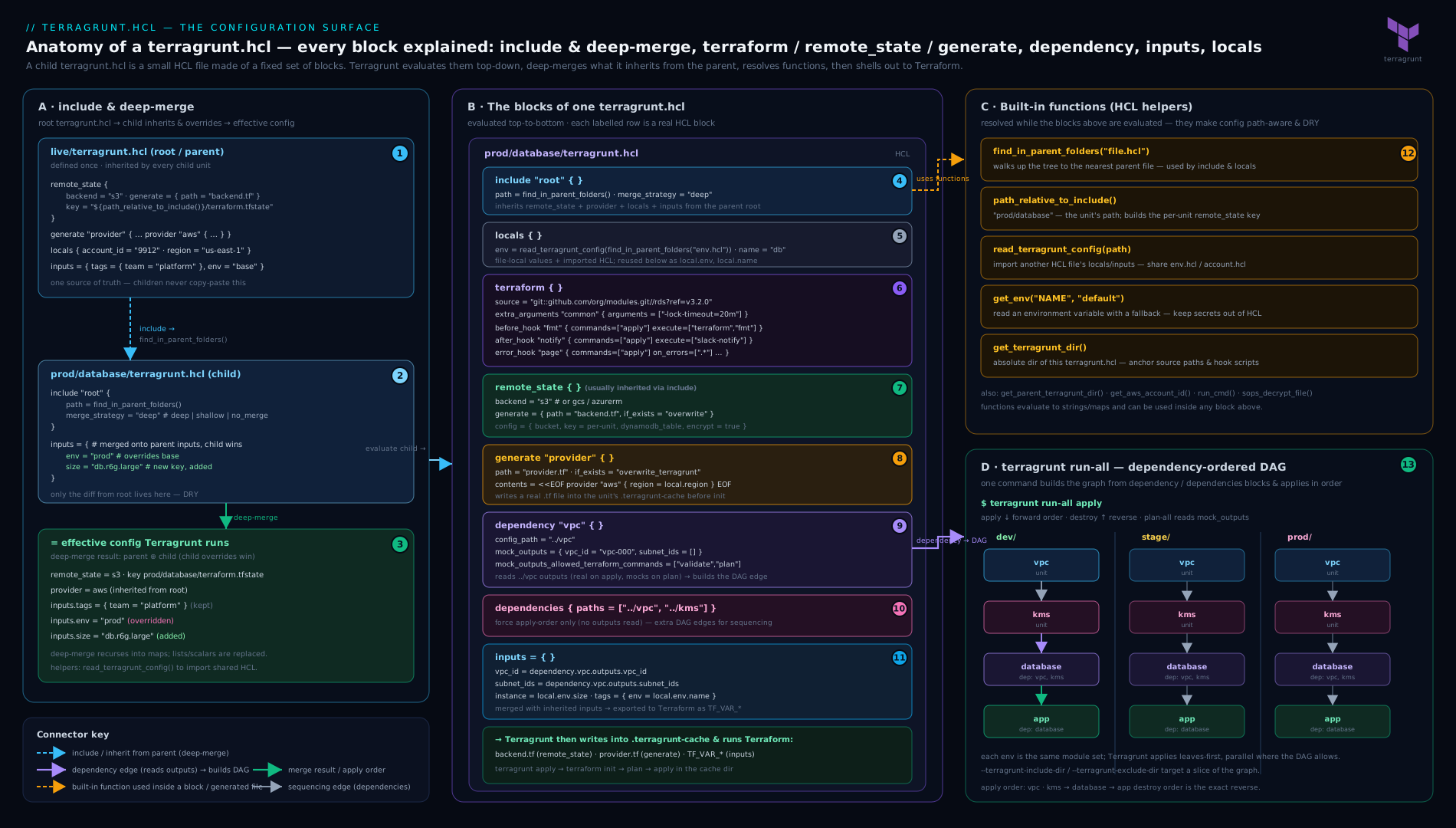
The diagram lays the whole config surface out at once: a single root.hcl carrying remote_state, generate, and errors; a unit’s terragrunt.hcl with its terraform block (and the before_hook/after_hook/error_hook ring around the Terraform command), include arrows up to the root and an env layer, dependency edges to sibling units feeding inputs, and the built-in functions (find_in_parent_folders, path_relative_to_include, read_terragrunt_config, get_env) annotated where each is used. It is the mental index for everything tabulated above — which block holds which attribute, and which function feeds which field.
Hands-on lab
This lab exercises the config language itself — include with expose/merge_strategy, generate with if_disabled/disable, a full set of hooks, the errors block, a feature flag, and a handful of functions — all on the local backend with the null/random providers, so it runs offline, costs nothing, and needs no cloud account. You need terragrunt and terraform (or tofu) on your PATH.
1. Scaffold.
mkdir -p tg-cfg-lab/modules/app tg-cfg-lab/live/dev/app
cd tg-cfg-lab
2. A tiny module. Create modules/app/main.tf:
variable "name"     { type = string }
variable "replicas" { type = number }
resource "random_id" "id" { byte_length = 4 }
resource "null_resource" "app" { triggers = { name = var.name, replicas = var.replicas } }
output "app_id" { value = "app-${random_id.id.hex}" }
3. Shared env locals. Create live/dev/env.hcl:
locals {
  environment = "dev"
  replicas    = 1
}
4. The DRY root — generate provider, an errors retry rule, a feature flag. Create live/root.hcl:
locals {
  env = read_terragrunt_config(find_in_parent_folders("env.hcl"))
}

remote_state {
  backend  = "local"
  generate = { path = "backend.tf", if_exists = "overwrite_terragrunt" }
  config   = { path = "${get_terragrunt_dir()}/terraform.tfstate" }
}

generate "versions" {
  path        = "versions.tf"
  if_exists   = "overwrite_terragrunt"
  if_disabled = "remove_terragrunt"
  contents    = <<-EOF
    terraform {
      required_providers {
        random = { source = "hashicorp/random" }
        null   = { source = "hashicorp/null" }
      }
    }
  EOF
}

feature "noisy_hooks" {
  default = true
}

errors {
  retry "transient" {
    retryable_errors   = [".*timeout.*", ".*temporarily unavailable.*"]
    max_attempts       = 2
    sleep_interval_sec = 1
  }
}

inputs = {
  name = "frachtline-${local.env.locals.environment}"
}
5. The unit — two includes (one exposed), hooks using if/suppress_stdout/run_on_error, and inputs that mix inherited and derived values. Create live/dev/app/terragrunt.hcl:
include "root" {
  path = find_in_parent_folders("root.hcl")
}
include "env" {
  path           = find_in_parent_folders("env.hcl")
  expose         = true
  merge_strategy = "deep"
}

terraform {
  source = "../../../modules//app"

  before_hook "announce" {
    commands        = ["plan", "apply"]
    execute         = ["bash", "-c", "echo '>> preparing ${path_relative_to_include()}'"]
    suppress_stdout = false
    if              = feature.noisy_hooks.value          # gated by the flag
  }
  after_hook "done" {
    commands     = ["apply"]
    execute      = ["bash", "-c", "echo '<< applied, run_on_error=true'"]
    run_on_error = true
  }
  error_hook "oops" {
    commands  = ["plan", "apply"]
    execute   = ["bash", "-c", "echo 'an error occurred'"]
    on_errors = [".*"]
  }
}

inputs = {
  replicas = include.env.locals.replicas    # read the exposed parent local
}
6. Plan — watch the hook, the generated files, and the functions resolve.
cd live/dev/app
terragrunt plan
Expected: the before_hook prints >> preparing dev/app (proving path_relative_to_include() and the feature-gated if), and the plan shows replicas = 1 (the exposed include.env.locals.replicas) and name = "frachtline-dev" (inherited from the root’s inputs).
7. Apply — confirm after_hook and the generated files in the cache.
terragrunt apply -auto-approve
ls .terragrunt-cache/*/*/backend.tf .terragrunt-cache/*/*/versions.tf
Expected: the after_hook prints << applied..., and both generated files exist inside the cache (not the unit dir) — the generate-vs-init mechanic made visible.
8. Toggle the feature flag off — the hook disappears.
terragrunt plan --feature noisy_hooks=false
Expected: the >> preparing ... line is gone, because the before_hook’s if = feature.noisy_hooks.value is now false.
9. Cleanup.
terragrunt destroy -auto-approve
cd ../../..
rm -rf tg-cfg-lab
Cost note: zero. The lab uses the local backend and the null/random providers — nothing is created in any cloud, so there is nothing to bill; cleanup is deleting the directory.
Common mistakes & troubleshooting
| Symptom | Cause | Fix |
|---|---|---|
find_in_parent_folders: no arguments deprecation warning |
Calling the no-arg form | Always pass the filename: find_in_parent_folders("root.hcl"). |
Generated .tf not where you expected |
Files are written to .terragrunt-cache/..., not the unit dir |
Look in the cache; .gitignore it. Use generate { path = ... } only to control the filename, not the location. |
Disabling a generate block breaks the next run |
The previously-generated file is orphaned in the cache | Set if_disabled = "remove_terragrunt" (with disable = true) so the stale file is cleaned up. |
Can’t read a parent’s locals |
include lacks expose = true |
Add expose = true and reference include.<name>.locals.*. |
Child inputs unexpectedly replaced/merged with parent |
merge_strategy mismatch (default is shallow) |
Set merge_strategy explicitly: no_merge (child only), shallow, or deep. |
retryable_errors/retry_max_attempts warns as deprecated |
Legacy top-level retry attributes | Move them into an errors { retry "..." { retryable_errors=... max_attempts=... } } block. |
dependency ... has not been applied yet on plan |
Reading outputs before the producer has state | Add mock_outputs + mock_outputs_allowed_terraform_commands = ["validate","plan"]. |
| A new output on an applied dependency breaks every downstream plan | mock_outputs_merge_strategy_with_state = "no_merge" (default) |
Set it to shallow so mocks fill only the absent new key while real values are used elsewhere. |
| Hook shell features (` | , &&, $VAR`) don’t work |
execute is exec-style, not a shell |
A shared .hcl/template change isn’t detected by --queue-include-units-reading |
Terragrunt can’t auto-detect the read | Call mark_as_read("<path>") in the units that consume it. |
Common beginner mistakes
These are misconceptions about the model, distinct from the symptom-cause-fix table above. Get the mental model right and most of those errors never happen.
- “Terragrunt is a different IaC tool that replaces Terraform.” It provisions nothing. It resolves config, prepares a working directory, and shells out to
terraform/tofu. Right model: Terragrunt is a thin orchestrator/wrapper, and its config language is a preparation language, not a provisioning one. - “
terragrunt.hclis HCL, so I can declareresource/datain it.” It is HCL, but a different schema. There is noresource,data, orvariableblock in aterragrunt.hcl. Right model: resources live in the module thatterraform { source }points at; theterragrunt.hclonly configures the run around that module. - “Generated
backend.tf/provider.tfshould show up in my unit folder.” They are written into.terragrunt-cache/<hash>/<hash>/. Right model: the cache is the real working directory — your unit directory stays clean, and you.gitignorethe cache. - “
executeruns in a shell, so I can use|,&&, and$VAR.”executeis exec-style — an argv list, not a shell string. Right model: wrap shell features in["bash", "-c", "<string>"]; a bare["echo", "$HOME"]prints the literal$HOME. - “A dependency’s
mock_outputsgive me real values I can rely on.” Mocks exist sovalidate/plancan parse before the producer has state. Right model: mocks are for shape, not truth — gate them withmock_outputs_allowed_terraform_commands = ["validate","plan"]so a realapplynever runs on fabricated data. - “
include-ing a parent lets me read itslocals.” Not by itself. Right model: you needexpose = trueon theinclude, then readinclude.<name>.locals.*. Without it you inherit the parent’s emergent config but cannot read its values. - “The examples I copied use
TERRAGRUNT_*env vars andrun-all.” Those were renamed in v0.88 (TG_*,terragrunt run --all). Right model: prefer the current names — the legacy ones still work but emit deprecation warnings, so a stale script looks healthy while quietly rotting. See Going deeper.
Best practices
- Put
remote_state,generate, anderrorsin the root andincludeit everywhere — that single source of truth is the whole point; never copy a backend or provider into a unit. - Derive, don’t hard-code.
key = "${path_relative_to_include()}/terraform.tfstate"; build paths withget_parent_terragrunt_dir()/get_repo_root(); let the directory be the identity. - Always pass a filename to
find_in_parent_foldersand pin everysourcewith?ref=/?version=. - Use
if_exists = "overwrite_terragrunt"so Terragrunt manages only the files it generated, and pairdisablewithif_disabled = "remove_terragrunt"to clean up disabled generates. - Wrap hook shell logic in
["bash","-c", ...], keep noisy linters behindsuppress_stdout, and gate optional hooks withif(often afeatureflag). - Migrate to the
errorsblock now — the legacy retry/skipattributes are removed at 1.0; seed patterns withget_default_retryable_errors(). - Prefer
dependencyover hand-wiredterraform_remote_statedata sources for cross-unit values — ordering for free, one place to mock; usemock_outputs_merge_strategy_with_state = "shallow"to survive added outputs. - Reach for
feature/excludeinstead of cleverlocalswhen config must be conditional — they are readable and CLI-overridable. - Format the config:
terragrunt hclfmtfor.hclandhcl_fmt = trueon generates so machine-written files pass a--check.
Security notes
- Generated files and
inputscan leak secrets. Anything interpolated into agenerate "provider"contentsor intoinputslands in a.tf/env in the cache. Pull secrets at runtime withsops_decrypt_file/get_env, never commit them, and.gitignore.terragrunt-cache/and generated files. - Hooks,
run_cmd, andsops_decrypt_fileexecute arbitrary code at config time — duringinit/plan, before any human approves anapply. Review changes to root/unit config like code and never run untrusted Terragrunt repositories. - Assert the blast radius in config. Use
get_aws_account_id()/get_aws_caller_identity_arn()(andconstraint_checkon tool versions) to fail fast when a unit is being applied against the wrong account or an unexpected binary. - State stays sensitive — and Terragrunt does not change where it lives. Use an encrypted, access-controlled, locked backend; the
remote_state.encryptionblock lets you make OpenTofu state/plan encryption DRY across every unit. The lab’slocalbackend is for offline learning only. - Least-privilege per environment. Generate a per-environment
assume_rolein the provider sodevcredentials cannot touchprod.
Going deeper
The body above is the complete field reference. This section is the version-and-production nuance underneath it — the things that bite experienced engineers rather than beginners.
The v0.88 CLI and env-var rename: TERRAGRUNT_* becomes TG_*
On the road to 1.0, Terragrunt v0.88 renamed its entire CLI surface: every TERRAGRUNT_* environment variable became TG_*, most flags dropped the --terragrunt- prefix, and the legacy *-all commands moved under a run subcommand. The old spellings still work for a transition window but emit deprecation warnings and are slated for removal — which is why a CI pipeline copied from a 2023 blog post keeps “working” while quietly rotting. A representative slice of the mapping (check the release notes for the complete list):
| Legacy (v0.87 and earlier) | Current (v0.88+) |
|---|---|
TERRAGRUNT_TFPATH |
TG_TF_PATH |
TERRAGRUNT_SOURCE |
TG_SOURCE |
TERRAGRUNT_NON_INTERACTIVE |
TG_NON_INTERACTIVE |
TERRAGRUNT_LOG_LEVEL |
TG_LOG_LEVEL |
TERRAGRUNT_PARALLELISM |
TG_PARALLELISM |
--terragrunt-non-interactive |
--non-interactive |
--terragrunt-working-dir |
--working-dir |
--terragrunt-include-dir / --terragrunt-exclude-dir |
--queue-include-dir / --queue-exclude-dir |
terragrunt run-all plan |
terragrunt run --all plan |
This is why the function catalogue above reads TG_SOURCE and TG_FEATURE rather than TERRAGRUNT_SOURCE/TERRAGRUNT_FEATURE, and why the orchestration lesson uses run --all and the --queue-* family: those are the current names. On an older binary you will meet the TERRAGRUNT_ forms — same behaviour, deprecated spelling.
Legacy config you will still meet in old repos
Two shapes predate the config this lesson documents, and long-lived repositories still carry them:
- The
terragrunt = {}wrapper block. Before Terragrunt v0.19, configuration lived inside aterraform.tfvarsfile under a single top-levelterragrunt = { ... }block. v0.19 introduced theterragrunt.hclfile with the top-level blocks (terraform,remote_state,include, …) you have been reading. There is no top-levelterragruntblock today — if you see one, the repository is on a pre-2019 layout and needs migrating, not patching. - Flat retry attributes. Retries were once top-level attributes rather than a block:
# Legacy — deprecated, removal planned for 1.0
retryable_errors         = [".*RequestLimitExceeded.*", ".*timeout.*"]
retry_max_attempts       = 3
retry_sleep_interval_sec = 5
Each maps cleanly into a retry sub-block of the modern errors block — retryable_errors keeps its name, retry_max_attempts becomes max_attempts, retry_sleep_interval_sec becomes sleep_interval_sec — and the move additionally buys you ignore rules, signals, and multiple independently-tuned retry policies.
How hooks actually execute
before_hooks are the pre-flight checklist and after_hooks the post-flight one, but the exact mechanics decide whether your run aborts or cleans up:
- Order and short-circuit. Multiple hooks of the same kind run in declaration order. A non-zero exit from a
before_hookaborts the run — the Terraform command never executes, and later hooks fire only if they carryrun_on_error = true. run_on_erroris the cleanup switch. Anafter_hookwith the defaultrun_on_error = falseis skipped when the command failed. Set ittrueto make the hook run on both success and failure, which is the idiom for teardown that must always happen.error_hookdiagnoses; it does not recover. It runs only on failure, only when anon_errorsregex matches, and it does not swallow the error — the run still fails. Use it for diagnostics and alerting. To genuinely suppress an expected error you want theerrorsblock’signoresub-block, which is a different mechanism at a different layer.suppress_stdouthides stdout only. The hook’s stderr and its exit code still propagate, so a quietened linter can still fail the run — which is usually exactly what you want.- Timing. Hooks fire around the engine invocation on every command that prepares a working directory, including
plan. That is the security note from the previous section restated as a mechanic: hook code executes long before any human approves anapply.
Composing the config-time functions
The dynamic functions earn their keep when composed — load shared config, pull a secret, and derive a path in a single locals block:
locals {
  env       = read_terragrunt_config(find_in_parent_folders("env.hcl"))
  region    = get_env("AWS_REGION", local.env.locals.default_region)   # CI env, else fallback
  secrets   = yamldecode(sops_decrypt_file("${get_terragrunt_dir()}/secrets.enc.yaml"))
  state_key = "${path_relative_to_include()}/terraform.tfstate"
}
Two caveats separate a robust config from a fragile one. First, evaluation order: locals and the functions inside them resolve before inputs, which is precisely why cross-unit values must come from dependency.<name>.outputs.* and never from a local — the dependency’s output call happens in a different phase. Second, these functions execute at parse time, on every command: get_env, run_cmd, and sops_decrypt_file run during plan exactly as they do during apply, so config behaviour depends on the runner’s environment and a sops_decrypt_file attempts decryption on every plan. Document those environmental dependencies, and fail fast with get_aws_account_id() or constraint_check() when the runner is not the one you expected.
Interview & exam questions
-
What is the difference between
get_terragrunt_dir()andget_working_dir()?get_terragrunt_dir()is your unit’s directory (where itsterragrunt.hcllives);get_working_dir()is the.terragrunt-cache/...directory Terragrunt copies the module into and actually runs the engine in. Generated files land in the latter. -
path_relative_to_include()vspath_relative_from_include()? The first returns the unit’s path relative to the included parent (e.g.prod/vpc) — used to derive the state key. The second is the inverse, the parent’s path relative to the unit (e.g.../../..) — used to build relativesourcepaths back to a shared modules directory. -
Name the three hook kinds and the attribute that makes an
after_hookfire on failure.before_hook,after_hook,error_hook.run_on_error = truemakes anafter_hookrun even when the command (or a prior hook) failed.error_hookruns only on failure, matchingon_errorsregexes. -
What replaced
retryable_errors/retry_max_attempts, and why? The structurederrorsblock withretry/ignoresub-blocks. It allows multiple rules with per-rulemax_attempts/sleep_interval_sec, plus ignoring expected errors and signalling external systems — capabilities the flat attributes lacked. The legacy attributes are deprecated, with removal planned for 1.0. -
What does
if_exists = "overwrite_terragrunt"mean, and how does it differ fromoverwrite?overwrite_terragruntonly manages/overwrites files Terragrunt itself generated (it will not clobber a hand-written file);overwriteclobbers any file. The other choices areskip(never touch an existing file) anderror(fail if it exists). -
You disable a
generateblock. What stops the previously-generated file breaking the next run? Settingif_disabled = "remove_terragrunt"(alongsidedisable = true) so Terragrunt removes the stale file it generated, rather than leaving an orphan in the cache. -
skip_outputsvsmock_outputson adependency?skip_outputs = truemeans never calloutputon the target (always use mocks / no data) while keeping the ordering edge.mock_outputsprovides fallback values used only when real outputs are unavailable. They answer different questions; do not expectskip_outputsto mean “mock only if absent.” -
What does
mock_outputs_merge_strategy_with_statesolve, and what’s the sensible value? When you add a new output to an already-applied dependency,no_merge(the default) makes every downstream plan fail until you re-apply the producer.shallowlets the plan use the mock for just the new key while using real values for the rest.deep_map_onlyrecurses into map outputs. -
How do you read a parent’s
localsfrom a child unit?includethe parent withexpose = trueand referenceinclude.<name>.locals.*. Withoutexpose, you inherit the parent’s emergent config but cannot read its values. -
Difference between Terragrunt Stacks and Terraform Stacks? Terragrunt Stacks (
terragrunt.stack.hcl,unit/stackblocks) are a Gruntwork feature that generates Terragrunt units from a declaration. Terraform/OpenTofu Stacks (*.tfstack.hcl/*.tfdeploy.hcl, components/deployments) are a native HashiCorp construct for multi-deployment orchestration. Different vendors, different layers — not interchangeable. -
What is
extra_argumentsfor, and how do you apply a-var-fileto only the var-taking commands? It conditionally appends CLI flags/var-files to specific commands. Setcommands = get_terraform_commands_that_need_vars()and list the file underrequired_var_files(must exist) oroptional_var_files(only if present). -
Why is
remote_statewithout agenerateattribute still valid? Withoutgenerate, Terragrunt passes the backend settings toterraform initas-backend-config=...flags instead of writing abackend.tf. Thegenerateform is only needed when you want the backend block as an on-disk file.
Quick check
- Where do
generate/remote_statewrite their files — your unit directory or somewhere else? - Which
includeattribute lets a child read the parent’slocals? - Name the modern block that replaced the deprecated
retryable_errorsattribute. - Which
dependencyattribute (and value) lets a newly-added output not break every downstream plan? - Which function returns the unit’s path relative to the included parent, used to build the state key?
Answers
- The cache —
.terragrunt-cache/<hash>/<hash>/, the working dir Terragrunt runs the engine in (not the unit dir)..gitignoreit. expose = true— then referenceinclude.<name>.locals.*.- The
errorsblock (withretry/ignoresub-blocks). mock_outputs_merge_strategy_with_state = "shallow"(the defaultno_mergeis what breaks them).path_relative_to_include()— used askey = "${path_relative_to_include()}/terraform.tfstate".
Practice challenges
Six graded exercises, beginner to advanced. Most run against the offline local-backend lab above. Try each before opening the solution.
1. (Beginner) Make the path the state key. In a root remote_state, write config.key so a unit at live/prod/vpc stores its state at prod/vpc/terraform.tfstate with nothing hard-coded.
<details><summary>Solution</summary>
config = { key = "${path_relative_to_include()}/terraform.tfstate" }
Why: path_relative_to_include() returns the unit’s path relative to the included parent, so the directory is the identity — no unit ever hard-codes its own key.
</details>
2. (Beginner) Read a parent’s local. Given an env.hcl containing locals { aws_region = "ap-south-1" }, make a child unit pass that region into inputs.
<details><summary>Solution</summary>
include "env" {
  path   = find_in_parent_folders("env.hcl")
  expose = true
}
inputs = { region = include.env.locals.aws_region }
Why: expose = true is the one attribute that makes a parent’s locals readable as include.<name>.locals.*.
</details>
3. (Intermediate) A cleanup hook that always runs. Add an after_hook on apply that deletes a temporary lock file whether the apply succeeds or fails.
<details><summary>Solution</summary>
after_hook "cleanup" {
  commands     = ["apply"]
  execute      = ["bash", "-c", "rm -f /tmp/${path_relative_to_include()}.lock"]
  run_on_error = true
}
Why: the default run_on_error = false skips the hook when the command failed; true makes teardown fire on both paths.
</details>
4. (Intermediate) Mock an unapplied dependency, safely. Wire app to db so app can plan before db has ever been applied, while guaranteeing a real apply can never run on the fake values.
<details><summary>Solution</summary>
dependency "db" {
  config_path  = "../db"
  mock_outputs = { endpoint = "mock-endpoint:5432" }
  mock_outputs_allowed_terraform_commands = ["validate", "plan"]
}
Why: excluding apply/destroy from the allowed-commands list is what guarantees mocks unblock planning only, never a real change.
</details>
5. (Advanced) Survive a newly-added output. You add a reader_endpoint output to an already-applied db, and every downstream plan starts failing. Fix it in the consumer’s dependency without re-applying db first.
<details><summary>Solution</summary>
mock_outputs_merge_strategy_with_state = "shallow"
Why: the default no_merge ignores mocks entirely once the target has state, so the brand-new key is simply missing until the producer is re-applied; shallow fills only the absent key from the mock while using real values for everything else.
</details>
6. (Advanced) Modernise a legacy config. A repo has top-level retryable_errors/retry_max_attempts/retry_sleep_interval_sec, plus a CI script that exports TERRAGRUNT_NON_INTERACTIVE=true and calls terragrunt run-all apply. Bring all of it to current Terragrunt.
<details><summary>Solution</summary>
errors {
  retry "transient" {
    retryable_errors   = [".*RequestLimitExceeded.*", ".*timeout.*"]
    max_attempts       = 3
    sleep_interval_sec = 5
  }
}
In CI, rename TERRAGRUNT_NON_INTERACTIVE to TG_NON_INTERACTIVE and change terragrunt run-all apply to terragrunt run --all apply.
Why: the flat retry attributes and the TERRAGRUNT_*/run-all spellings are deprecated — removed at 1.0 and renamed in v0.88 respectively — and the errors block is their structured, still-supported replacement.
</details>
Exercise
Take the lab’s dev/app unit and exercise the rest of the config surface:
- Add a second unit,
net, and wireappto it with adependencythat hasmock_outputs,mock_outputs_allowed_terraform_commands = ["validate","plan"], andmock_outputs_merge_strategy_with_state = "shallow". Prove withterragrunt run --all planthatappplans on the mock beforenetis applied, then on the real output after. - Add an
extra_argumentsblock toapp’sterraformblock that appends a-lock-timeout=10mto every var-taking command (useget_terraform_commands_that_need_vars()), and confirm it inTF_LOG=debugoutput. - Add an
excludeblock tonetwithactions = ["all_except_output"]gated on afeatureflag, and show that with the flag on,run --all applyskipsnet’s apply butappstill reads its real outputs. - Convert the root’s single retry into two
retryblocks (one for throttling, one for eventual-consistency) seeded withget_default_retryable_errors(), and agenerate "provider"whosedisableis driven by a feature flag withif_disabled = "remove_terragrunt"; toggle the flag and confirm the generated file appears and disappears in the cache.
Success looks like: a working dependency with merge-aware mocks, a -lock-timeout injected via extra_arguments, an exclude that freezes a unit while keeping its outputs readable, two targeted retry rules, and a feature-flag-driven generate block that cleans up after itself.
Certification mapping
This lesson supports the HashiCorp Certified: Terraform Associate (003) objectives — with the caveat that Terragrunt is a third-party tool and the exam tests Terraform itself; Terragrunt is the production wrapper that exercises those concepts:
- Objective 8 (read, generate, and modify configuration): the entire
terragrunt.hclsurface —generate/remote_statefile generation,locals,inputs, functions — is configuration generation and composition taken to production. - Objective 7 (state):
remote_state(backend,disable_init,encryption) and per-unit path-derived keys are the exam’s remote-state/locking topics applied for real; know the plain-Terraformbackend/-backend-configequivalents. - Objective 4 (modules): the
terraform { source }attribute,extra_arguments, and Stacks are module consumption/composition at scale. - Objective 5 (core workflow): hooks wrap the
init/plan/applyworkflow; theerrorsblock adds retry/ignore around it. - Cloud DevOps certs (AWS DOP-C02, Azure AZ-400, Google Cloud DevOps Engineer) test multi-environment IaC where this config language is directly applicable.
For the exam, be crisp on the Terraform primitives Terragrunt wraps: backends and locking, the terraform_remote_state data source (the manual alternative to dependency), -backend-config/-var-file flags (what extra_arguments injects), and module source pinning.
Glossary
- Working directory / cache — the
.terragrunt-cache/<hash>/<hash>/directory Terragrunt copies thesourcemodule into and runs the engine in; where generated files land.get_working_dir()returns it. terraformblock — points a unit at a module (source) and wraps it withextra_argumentsand hooks; alsoinclude_in_copy/exclude_from_copy/copy_terraform_lock_file/mutable.- Hook (
before_hook/after_hook/error_hook) — a shell command run around a Terraform command, withcommands,execute,working_dir,run_on_error,suppress_stdout,if, and (errors only)on_errors. remote_stateblock — declares the backend once and (optionally) generatesbackend.tfper unit; attributes includebackend,config,generate,disable_init,disable_dependency_optimization,encryption.generateblock — writes any file into the working dir;path,contents,if_exists,if_disabled,disable,comment_prefix,disable_signature,hcl_fmt.if_exists/if_disabled— collision rules for generated files:overwrite_terragrunt/overwrite/skip/error, and on disableremove/remove_terragrunt/skip.includeblock — inherits a parent config;path,expose(read parentlocals),merge_strategy(no_merge/shallow/deep, defaultshallow).dependencyblock — references another unit and exposes its outputs;config_path,enabled,skip_outputs,mock_outputs,mock_outputs_allowed_terraform_commands,mock_outputs_merge_strategy_with_state.dependenciesblock — ordering-only edges (paths); no data passing.mock_outputs— fallback outputs used when a dependency’s real outputs are unavailable; gated by the allowed-commands list, merged with state per the strategy.errorsblock — structured retry/ignore handling (retry/ignoresub-blocks) that replaced the deprecatedretryable_errors/skipattributes.featureblock — a CLI-overridable feature flag (default), read asfeature.<name>.value.excludeblock — dynamically excludes a unit from a run (if,actionsincl.all_except_output,exclude_dependencies,no_run).unit/stackblocks — Terragrunt Stacks vocabulary (interragrunt.stack.hcl) that generate a tree of units fromsource/path/values.- Terraform Stacks — HashiCorp’s native multi-deployment construct (
*.tfstack.hcl/*.tfdeploy.hcl); distinct from Terragrunt Stacks. find_in_parent_folders("name")— returns the nearest ancestor file of that name (always pass the name).read_terragrunt_config(path)— parses another.hclfile into an object you can read (.locals,.inputs).- Pre-flight / post-flight hook — the mental model for hooks: a
before_hookis the pre-flight checklist (runs before the Terraform command), anafter_hookthe post-flight checklist (runs after), and anerror_hookthe emergency procedure (runs only on a matching failure). run_on_error— hook attribute; whentrue, anafter_hookruns even after the command or a prior hook failed. The idiom for cleanup/teardown.suppress_stdout— hook attribute that swallows the hook command’s stdout only; its stderr and exit code still propagate, so a suppressed linter can still fail the run.- Exec-style command —
executetakes an argv list, not a shell string; pipes,&&, and$VARneed an explicit["bash","-c","..."]wrapper. - Config-time (parse-time) execution —
run_cmd,get_env,sops_decrypt_file, and hooks all run while Terragrunt evaluates config, i.e. duringinit/plan, before anyapplyis approved. get_env(name, [default])— function returning an environment variable’s value (or a default); makes a config’s behaviour depend on the runner’s environment.sops_decrypt_file(path)— function that decrypts a SOPS-encrypted file at config time so secrets enter the run without ever being committed in plaintext.TG_*environment variables — Terragrunt’s current env-var prefix (v0.88+), renamed from the legacyTERRAGRUNT_*(e.g.TG_SOURCE,TG_NON_INTERACTIVE,TG_FEATURE).- Legacy
terragrunt = {}block — the pre-v0.19 configuration wrapper that lived insideterraform.tfvars; superseded by the top-level blocks ofterragrunt.hcl. There is no top-levelterragruntblock today.
Next steps
You now have the complete terragrunt.hcl reference — every block and its attributes, every built-in function, hooks end to end, the errors retry/ignore model, and the generate-vs-init mechanics. To put the fundamentals in narrative context (the live/modules split, the DRY rationale, the on-ramp), see Terragrunt Fundamentals: DRY Configurations, Remote State & Dependencies. For the orchestration side — how run --all/run --graph walk the DAG, change-aware selective execution, parallelism, and CI at 200 units — read Scaling Terragrunt Monorepos with Dependency Graphs and run-all. Then apply all of it end to end in Multi-Environment 3-Tier Infrastructure with Terragrunt & CI/CD Approval Gates, where this config language drives a real dev→uat→staging→prod promotion pipeline behind graduated approval gates.