The most expensive Kubernetes mistake is not a misconfigured pod; it is building the wrong altitude of architecture for the requirement in front of you. One team reads too many “global active-active mesh” blog posts and stands up five clusters across three regions to serve an internal tool two hundred people use during office hours — then drowns in the operational tax. Another runs a regulated payments platform on a single hand-built cluster with one control-plane node and no backups, and finds the gap the morning that node dies. Same root cause: the architecture was chosen by aspiration or habit, not derived from requirements.
This lesson teaches Kubernetes architecture as a ladder — six rungs, each adding resilience, scale, or multi-team capability over the last. You start with a laptop cluster and climb only as far as requirements push you. For every rung we walk the same five questions: the scenario and its requirements (recovery objectives, scale, blast radius, team count), the design and its components, the key decisions and trade-offs, and the question most architecture articles skip — “when is this rung genuinely enough?” — so you know when to stop. We close with an explicit method for choosing your rung, because the right answer for most organisations is not the top of the ladder; it is the lowest rung that meets the requirement, operated well.
Four terms recur and are the levers that move you up the ladder. RTO (Recovery Time Objective): the maximum acceptable time to restore service after an incident. RPO (Recovery Point Objective): the maximum acceptable data loss, measured in time. AZ (Availability Zone): a physically isolated datacentre — independent power, cooling, network — within a cloud region. Blast radius: how much breaks when one thing fails.
Learning objectives
By the end of this lesson you will be able to:
- Map a set of business requirements (RTO, RPO, scale, tenant count, compliance) to a specific rung on the Kubernetes architecting ladder rather than guessing.
- Describe the component set, failure model, and SLA of each of the six rungs, from a single-node dev cluster to multi-region active-active.
- Explain why each rung exists — the specific failure or constraint the previous rung could not survive.
- Reason about the dominant trade-off at every step: cost and operational toil versus blast-radius reduction and recovery objectives.
- Recognise when an organisation has over-built (a fleet for one app) or under-built (production on a single control plane) and recommend the correct rung.
- Apply a repeatable decision method to choose the lowest rung that satisfies the requirement, and know the signals that justify climbing higher.
Prerequisites & where this fits
You should already understand Kubernetes’ core objects (Pods, Deployments, Services, Ingress) and the control-plane architecture — what the API server, etcd, scheduler, and kubelet do — because the ladder is fundamentally about how many copies of those pieces you run and how you keep them in sync. If those terms are not yet second nature, work through the Kubernetes Architecture Deep-Dive and the production-readiness checklist first. It also helps to have provisioned a cluster yourself; the HA control-plane provisioning lesson is the natural predecessor to this one. This lesson sits in the Architecture module of the Kubernetes Zero-to-Hero course: provisioning teaches you to build one cluster well; this teaches you how many to build and where to put them.
Core concepts: what actually changes as you climb
Before the rungs, internalise the four axes the ladder moves along. Every rung is a point in this space, and naming the axes lets you reason about a design you have never seen.
| Axis | What it means | How it changes up the ladder |
|---|---|---|
| Control-plane redundancy | How many API servers / etcd members, and whether you operate them | Laptop: one, self-run → managed single: 1 logical, cloud-run → multi-AZ: spread across zones → multi-cluster/region: many independent control planes |
| Data-plane (worker) spread | Where the nodes that run pods physically live | One machine → one zone → multiple zones → multiple clusters → multiple regions |
| State & data replication | How stateful data survives a failure | None / ephemeral → single-zone disk → zone-redundant storage + backups → cross-cluster backup/restore → cross-region replication |
| Blast radius & failure domain | What is lost when one thing dies | The whole thing → one cluster → one zone of one cluster → one cluster of a fleet → one region of many |
Two principles cut across all four axes and explain most of the ladder’s shape:
- You cannot make a single control plane more available than its weakest shared component. Three API servers behind a single etcd disk are only as resilient as that disk. Climbing the ladder is largely removing shared single points of failure — first within a cluster (spread etcd and nodes across zones), then by accepting that a cluster itself is a failure domain and running more than one.
- Replicating stateless compute is cheap; replicating stateful data is the hard part. A second region for your pods is a weekend of GitOps wiring. A second region for your database — keeping it consistent, handling split-brain, meeting an RPO in seconds — is the real engineering, and it is what separates rung 5 from rung 6. Most of the cost and risk at the top of the ladder is data, not compute.
With those in hand, climb.
Rung 1 — Single-node dev cluster
Scenario & requirements. A developer builds and debugs manifests on a laptop, or CI needs an ephemeral cluster for a ten-minute integration test, then throws it away. There is no availability requirement — if it dies, you recreate it in ninety seconds. RTO is “however long kind create cluster takes”; RPO is irrelevant because there is no data worth keeping. A handful of pods, one user, no tenants, no SLA.
The design & components. A single-node cluster running in containers or a VM on one machine: kind (Kubernetes-in-Docker), minikube, or k3d (k3s-in-Docker). Control plane and worker share the node — exactly one of everything. Storage is the laptop’s disk via the local-path provisioner; networking is the tool’s bundled CNI (kindnet, or Cilium if you swap it in to test policies); ingress is an optional add-on.
| Decision | Options | Pick when |
|---|---|---|
| Tool | kind / minikube / k3d | kind for CI and matching upstream conformance; minikube for a batteries-included desktop (dashboard, addons, hypervisor choice); k3d for the fastest start and lowest footprint |
| Nodes | Single-node vs multi-node (kind/k3d support faking multiple) | Single for speed; multi-node only to test scheduling, topology spread, or DaemonSets locally |
| Kubernetes version | Pin to match your real cluster | Always pin — test on the version you deploy to, not “latest” |
Key decisions & trade-offs. Optimise for recreate speed and fidelity to production, not durability. The trade-off is total — no resilience whatsoever — and that is correct; paying for any is waste. The one real decision is fidelity: a cluster on a different Kubernetes version, CNI, or admission config than production lets bugs through that surface later. Pin the version and, where it matters, mirror the CNI and policy engine.
When this rung is enough. It is the right answer for all local development, conformance and policy tests in CI, learning, and reproducing a bug. It is never enough for anything a second person depends on. The moment a teammate, a demo, or a scheduled job needs the cluster to be there when they arrive, you have left rung 1.
Rung 2 — A single managed cluster, one region, one node pool
Scenario & requirements. A small team wants a real, shared, always-on application — an internal tool, a startup’s first product, a staging environment everyone hits. It must survive a single node dying, and the team must not be patching control-plane VMs at 2 a.m. Requirements are modest: RTO of an hour or two is fine, RPO of a few hours (nightly backups acceptable), tens of pods, a handful of developers, no formal customer SLA yet.
The design & components. One managed cluster — AKS, EKS, or GKE — in a single region with a single node pool of two or three workers. “Managed” is the load-bearing word: the provider runs, patches, and makes the control plane (API server, etcd, scheduler) highly available for you, behind an SLA, at little or no cost — you bring only workers. Add an ingress controller (or the cloud’s managed ingress) for a front door, the cloud’s CSI driver for volumes, and its CNI for pod networking. Delivery can still be kubectl apply or a simple CI job here.
| Component | Choice at this rung | Why |
|---|---|---|
| Control plane | Managed (AKS/EKS/GKE) | Provider runs HA etcd + API server under an SLA; you stop owning the hardest, most dangerous part |
| Node pool | One pool, 2–3 nodes, one VM size | Survives one node failure; simple to reason about |
| Storage | Cloud CSI, single-zone disks | Persistent volumes that outlive pods; backups via volume snapshots |
| Ingress | One ingress controller + cloud load balancer | A stable external address for the app |
| Delivery | CI kubectl apply / Helm |
Sufficient for one cluster and a small team |
Key decisions & trade-offs. The defining decision is managed versus self-managed control plane, and here the answer is almost always managed — babysitting etcd to save a few rupees a day is a false economy. The trade-off you still accept is the single zone: all nodes in one AZ (the default for a simple pool) means a zone outage takes you down, and a regional one certainly does. You also accept the single cluster as a failure domain — a bad cluster-wide change, a botched upgrade, or control-plane exhaustion affects everything. Fine for an internal tool; not for revenue. The quiet trap is no backup story: a managed control plane does not back up your workloads or data, and “the cloud is reliable” is not a backup.
When this rung is enough. Internal tools, early-stage products before meaningful revenue, dev/staging, and any workload where a rare hour-long outage is annoying but not catastrophic. The signal to climb is the first time the business attaches a number to availability, or the first time a single-zone outage would be unacceptable. That is the doorway to rung 3.
Rung 3 — A production cluster: multi-AZ, autoscaling, ingress, GitOps
Scenario & requirements. You are serving customers under a real SLA — say 99.9% (about 43 minutes of downtime a month) or 99.95%. The service must survive a single Availability Zone failing with no human intervention. Load varies through the day, so you can neither fall over at peak nor pay for peak capacity at 3 a.m. Multiple engineers deploy daily and changes must be auditable, reviewable, revertable. RTO drops to minutes for a zone failure (automatic), RPO to minutes-to-an-hour. This is the workhorse rung — most production systems live here, happily, for years.
The design & components. One managed cluster, now engineered for production:
- Multi-AZ node pools. Workers spread across at least three AZs so losing one zone removes at most a third of capacity, matching the already zone-redundant control plane. Combine with topology spread constraints and PodDisruptionBudgets so a single zone — or a node drain during an upgrade — cannot take all replicas of a service at once.
- Cluster Autoscaler or Karpenter for nodes and the HorizontalPodAutoscaler (optionally KEDA for event-driven scale) for pods: two loops — pods scale on metrics, nodes scale to fit the pods.
- Production ingress: an ingress controller or Gateway API implementation behind a cloud load balancer with TLS termination (Gateway API separates the platform-owned
Gatewayfrom app-teamHTTPRoutes). - GitOps delivery: Argo CD or Flux reconciling from Git, so every change is a reviewed, revertable commit rather than a laptop
kubectl apply; Git is the source of truth and drift is corrected automatically. - Zone-redundant storage and real backups: zone-redundant volumes where supported, plus scheduled backups (e.g. Velero) of cluster objects and volume data, tested by restoring.
- Observability: metrics, logs, and traces (Prometheus/Grafana, the cloud’s native stack, or OpenTelemetry) with SLO alerts — you cannot operate to an SLA you cannot measure.
| Capability | Mechanism | What it buys |
|---|---|---|
| Survive one AZ failure | Multi-AZ node pools + topology spread + PDBs | ~99.95% availability; automatic, no human in the loop |
| Handle variable load | HPA/KEDA (pods) + Cluster Autoscaler/Karpenter (nodes) | Capacity follows demand; no peak over-provisioning |
| Auditable, revertable change | GitOps (Argo CD / Flux) | Every change reviewed; instant rollback; drift correction |
| Recover from data loss / mistake | Velero backups + zone-redundant volumes | RPO in minutes-to-an-hour; tested restore path |
| Operate to an SLA | Prometheus/Grafana + SLO alerting | You can see and prove health; alerts before users notice |
Key decisions & trade-offs. The defining decision is engineering one cluster for in-region resilience rather than reaching for multiple clusters. The trade-off you deliberately keep is that the cluster and the region remain single failure domains: a regional outage, a cluster-wide misconfiguration, or a control-plane problem still takes you down. For a 99.9–99.95% SLA that is acceptable residual risk — regional outages are rare, and a well-run single cluster is more reliable than a poorly-run fleet. Cost and complexity are moderate and well understood; toil is real but bounded, and GitOps plus autoscaling reduce it. The genuine risk here is self-inflicted: a bad change propagating cluster-wide — contained by progressive delivery (canary/blue-green via Argo Rollouts or a mesh) and CI guardrails, not by a second cluster.
When this rung is enough. Enough for the large majority of production SaaS, internal platforms, and customer-facing services with single-region 99.9–99.95% SLAs and minutes-to-tens-of-minutes RTO/RPO. Do not climb for resilience without a specific driver: an SLA a single region cannot meet, a regulatory geographic-redundancy requirement, low-latency users on another continent, or many teams bursting the single-cluster model. Those split into two next rungs — more teams → rung 4; more resilience or reach → rungs 5–6.
Rung 4 — A multi-tenant platform: many teams, one (or few) clusters
Scenario & requirements. The driver here is organisational, not availability. Your production cluster now hosts many teams and the trust-everyone model has broken down: teams starve each other’s resources, RBAC and secrets are a tangle, and onboarding a team is a ticket every time. You need self-service with guardrails — teams ship independently inside boundaries they cannot cross. Availability is inherited from rung 3 (you build this on a multi-AZ cluster); what is new is tenant isolation, fair resource sharing, policy enforcement, and a paved road.
The design & components. A platform layer on top of one or a few production clusters:
- Tenant isolation tiers. The core decision is how much isolation each tenant class needs, picked per class rather than once globally. The spectrum runs from namespace-per-tenant (cheapest, shared control plane, RBAC + quota boundaries) through hierarchical namespaces to virtual clusters (vCluster) (each tenant gets their own API server and view, far stronger isolation, still sharing the host’s nodes) and ultimately cluster-per-tenant (full isolation, highest cost — which is really rung 5 wearing a tenancy hat). The full decision framework lives in the multi-tenancy guide.
- Resource governance:
ResourceQuotaandLimitRangeper tenant so no team can exhaust the cluster, and fair-share scheduling. - Policy guardrails as code: Kyverno or OPA Gatekeeper enforcing the rules every tenant must obey — no privileged pods, required labels, allowed registries, mandatory resource requests — in the admission path, so they are unbypassable rather than documented-and-ignored.
- Network isolation: default-deny NetworkPolicies per tenant namespace so tenants cannot reach each other unless explicitly allowed.
- An Internal Developer Platform (IDP): a self-service layer — Backstage as a portal, plus templates and a GitOps backend — so a team can request a namespace, a database, or a new service through a paved road that already has the quotas, policies, and network rules baked in. The platform team curates the road; tenants drive on it without filing tickets.
| Isolation tier | Boundary | Isolation strength | Cost | Use for |
|---|---|---|---|---|
| Namespace-per-tenant | RBAC + ResourceQuota + NetworkPolicy | Soft (shared control plane & kernel) | Lowest | Trusted internal teams |
| Hierarchical namespaces | Inherited policy across a namespace tree | Soft, with structure | Low | Org with team/sub-team structure |
| vCluster (virtual cluster) | Per-tenant API server, shared nodes | Strong control-plane isolation | Medium | Mixed-trust tenants; teams needing their own CRDs/versions |
| Cluster-per-tenant | Separate cluster | Hard (nothing shared) | Highest | Untrusted or strict-compliance tenants |
Key decisions & trade-offs. The defining decision is soft multi-tenancy (share a cluster, enforce boundaries) versus hard multi-tenancy (a cluster per tenant), made per tenant class against a threat model. Soft tenancy is far cheaper and right for tenants you trust; hard tenancy is the only safe answer for untrusted code or strict compliance, and it pushes those tenants onto rung 5. The platform itself is up-front investment for long-run leverage: the IDP, policy library, and paved road only pay off above roughly five or six teams — below that, the machinery costs more than the toil it removes. And soft tenancy never fully removes shared-fate risk: tenants on one cluster share its control plane, kernel, and blast radius, which is exactly why high-isolation tenants graduate to their own cluster.
When this rung is enough. Enough when you have many cooperating internal teams needing independence, isolation is satisfied by soft boundaries (or a vCluster for the few that need more), and one or a few in-region clusters still serve everyone. Crucially, rung 4 is orthogonal to rungs 5–6: a platform can live on one cluster or be layered across a fleet. You climb to rung 5 when resilience demands more clusters, or when enough tenants need hard isolation that a fleet becomes the natural shape.
Rung 5 — A multi-cluster fleet
Scenario & requirements. Now you genuinely need more than one cluster, for one or more concrete reasons: a blast-radius limit (no single cluster’s failure or bad change may take down everything — so prod, staging, and per-region/per-BU clusters are separated); hard tenant isolation at scale (regulated or untrusted tenants each get their own cluster); scale beyond a single cluster’s limits (very large clusters strain etcd, the scheduler, and the API server — the practical answer is more clusters, not one giant one); or geographic reach (clusters near users on different continents, even if each is served independently). Requirements: tighter RTO via failing traffic from a sick cluster to a healthy one, fleet-wide consistency, and a global front door. RPO is still mostly a data-layer question carried into rung 6.
The design & components. Many clusters, operated as one fleet:
- Fleet GitOps / configuration as code: a single source of truth that delivers config to N clusters — Argo CD ApplicationSets or Flux with a cluster inventory — so a policy, an add-on, or a baseline lands identically on every cluster. Without this, a fleet becomes N snowflakes and the operational cost explodes.
- A fleet/management control layer: a hub that registers clusters and applies fleet-wide policy and placement (e.g. GKE Fleet/Config Management, Azure Arc + Fleet Manager, EKS with ACK/management tooling, or Cluster API to provision the clusters themselves declaratively).
- Cross-cluster service discovery and connectivity: a service mesh that spans clusters (Istio multi-cluster, Linkerd multi-cluster, or Cilium Cluster Mesh) so a service in cluster A can find and securely reach a service in cluster B, with mTLS and locality-aware routing.
- Global ingress / traffic management: a global load balancer or DNS-based traffic manager (e.g. a cloud global LB, or DNS with health checks) that routes users to the nearest healthy cluster and can shift traffic away from an unhealthy one.
- Fleet-wide observability and policy: centralised metrics/logs and a single policy plane (Kyverno/Gatekeeper distributed via the fleet GitOps) so you can see and govern all clusters at once.
| Concern | Single-cluster (rung 3) | Fleet (rung 5) |
|---|---|---|
| Failure domain | The cluster | One cluster of many; survivors carry on |
| Config delivery | GitOps to one cluster | GitOps to N clusters (ApplicationSets / inventory) |
| Service-to-service | In-cluster Service/DNS | Cross-cluster mesh (Istio/Linkerd/Cilium Cluster Mesh) |
| External traffic | One ingress + LB | Global LB / DNS steering to nearest healthy cluster |
| Scale ceiling | One control plane’s limits | Horizontal: add clusters |
| Operational model | One thing to run | A fleet — needs fleet tooling or it is N snowflakes |
Key decisions & trade-offs. The defining decision is how the clusters relate: independent (each self-contained, traffic steered between them — simplest, the basis of most real multi-region designs) or interconnected (a cross-cluster mesh letting services span clusters — powerful but a large jump in networking and failure-mode complexity). Start independent; add a mesh only for a real cross-cluster service-call need, because a multi-cluster mesh is one of the hardest things to operate. The dominant trade-off is blunt: cost and complexity multiply with cluster count, and the only thing that keeps it tractable is ruthless automation — fleet GitOps, declarative provisioning, one policy plane. A fleet run by hand is worse than a single cluster; a fleet run as code is what makes mission-critical possible. The subtle trap is assuming a fleet gives you DR for free — it does not: multiple clusters protect stateless compute and steer traffic, but if all of them read one regional database you have many clusters and one point of data failure. Closing that gap is rung 6.
When this rung is enough. Enough when your driver is blast-radius isolation, hard tenant separation, scale, or single-region-per-geography reach — and each cluster can fail independently with traffic steered away because your data is either not the bottleneck or handled per-region. Not enough — climb to rung 6 — when a single region failing must cause zero or near-zero downtime and near-zero data loss for stateful workloads, which is a data-replication problem the fleet topology alone does not solve.
Rung 6 — Multi-region active-active, mission-critical
Scenario & requirements. The top of the ladder — and most organisations should be certain they belong here before climbing. The requirement is unforgiving: survive the loss of an entire region with an RTO of seconds to a few minutes and an RPO of seconds or zero, while serving users globally with low latency. Think payment rails, a tier-1 trading or telecom system, a global marketplace at checkout, or a regulated platform with a contractual cross-region guarantee. Cost and engineering are an order of magnitude above rung 5, and the hard part — as flagged twice — is data, not compute.
The design & components. Multiple full production stacks in multiple regions, all serving live traffic (active-active) or one ready to take over instantly (active-passive / warm standby):
- Two-plus regional clusters, each a complete rung-3 (or rung-4/5) stack — multi-AZ, autoscaling, GitOps, observability — so each region can serve the whole load if its peers vanish. Capacity is planned so survivors can absorb the failed region’s traffic (this is the N+1 region cost: you pay for headroom you hope never to use).
- Global traffic management with health-based failover: a global load balancer / GeoDNS / Anycast front door that routes each user to the nearest healthy region and fails traffic out of a dead region automatically, within your RTO.
- The data tier — the actual mission-critical engineering. This is where the rung is won or lost, and the choice is fundamentally about the consistency-versus-latency trade-off (the practical face of the CAP theorem) across regions:
| Data strategy | Consistency | RPO | Write latency | Use when |
|---|---|---|---|---|
| Single-region primary + async replicas (active-passive) | Strong at primary; replicas lag | Seconds–minutes (lag) | Low (writes go to one region) | You can tolerate small data loss on failover and a brief promotion step |
| Synchronous multi-region replication | Strong, everywhere | ~Zero | Higher (writes wait for a remote quorum) | Zero data loss is mandatory and you can pay the write-latency tax |
| Globally-distributed / multi-master database (e.g. Spanner-class, Cosmos DB, CockroachDB, Cassandra-style) | Tunable (strong↔eventual) | ~Zero to seconds | Varies by consistency level chosen | True active-active writes in every region; you accept the database’s consistency model |
| Conflict-free / eventually-consistent + reconciliation | Eventual | Seconds | Low | Workloads that tolerate eventual consistency and can merge conflicts |
- Fleet GitOps and a single policy plane across regions (inherited from rung 5) so every regional stack is identical — drift between regions is how “active-active” quietly becomes “active and a broken standby nobody tested”.
- A continuously exercised failover and DR runbook: regular game-days that actually fail a region out and back, because untested failover is a story you tell yourself, not a capability you have.
Key decisions & trade-offs. The defining decision is the cross-region data-consistency model, and it is a business decision, not a technical one: how much data may you lose (RPO), and how much write latency will you pay to lose less? Synchronous replication buys RPO≈0 at the cost of every write waiting for a remote region; asynchronous buys low latency at the cost of seconds of potential loss on failover; a globally-distributed database hides much of this behind tunable consistency, at significant cost and with conflict semantics you must understand. The second decision is active-active versus active-passive: active-active serves from all regions (best latency and utilisation, but you handle write conflicts and split-brain) while active-passive keeps a warm standby (simpler, but idle capacity and a short promotion RTO). The overarching trade-off is stark — the highest resilience at the highest cost and complexity — where the marginal nine of availability is the most expensive nine you will ever buy.
When this rung is enough — and when it is too much. The right rung only when a region-level outage is genuinely catastrophic and a single region’s SLA (even a well-run rung 3) provably cannot meet your contractual or regulatory obligation. Otherwise it is over-engineering — which has its own failure mode: an active-active system you lack the maturity to operate is less reliable than a single region run well, because the complexity itself becomes the most common cause of outages. The honest test: if you cannot state the RTO/RPO in numbers and the revenue or compliance cost of missing them, you do not yet need rung 6.
How to choose your rung
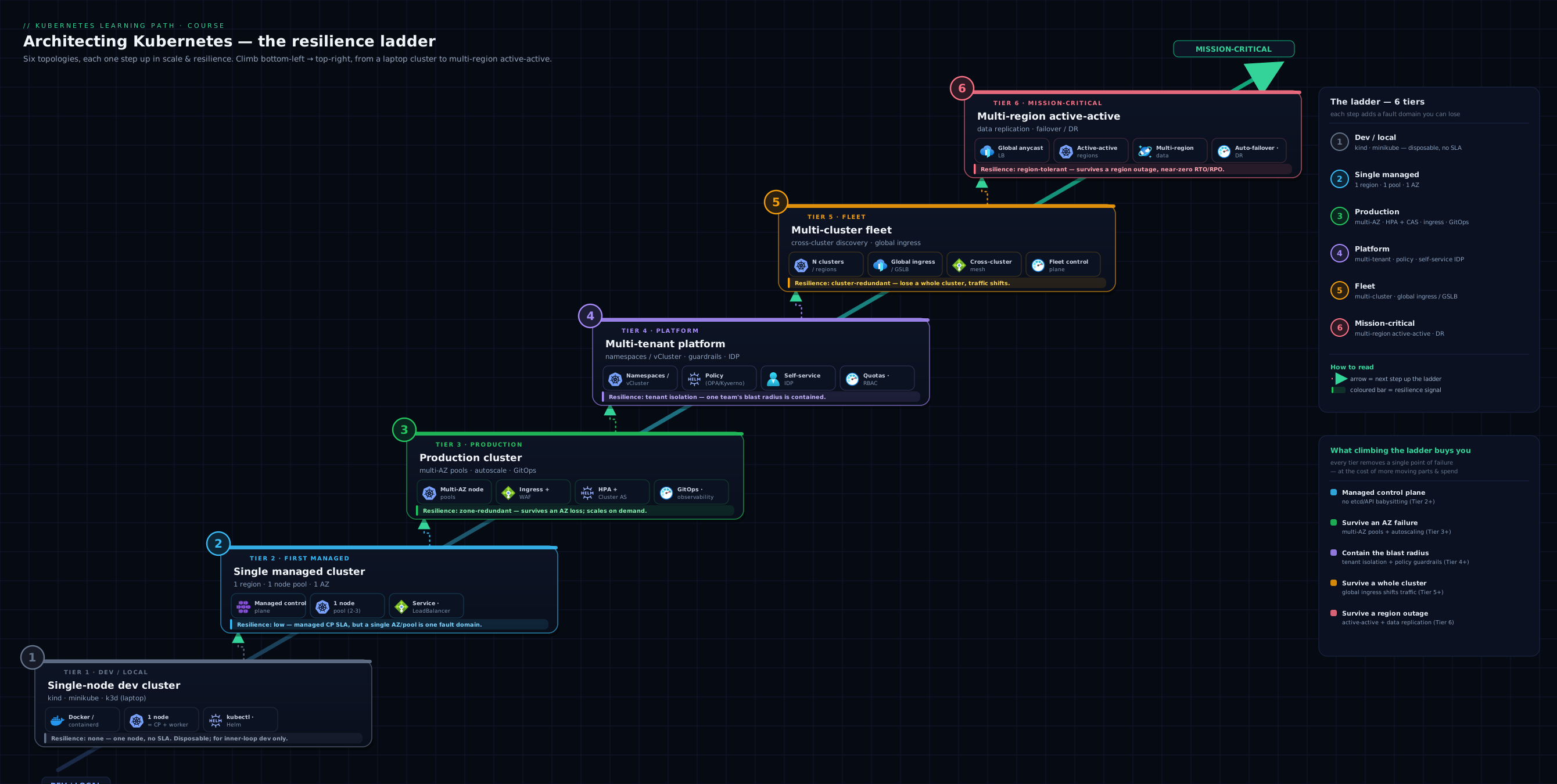
The diagram above shows the six rungs side by side — what each adds, the failure it survives, and its rough availability target — so you can locate your requirement on the ladder at a glance rather than defaulting to the top.
The method is deliberately boring, because boring is how you avoid both expensive failure modes — over-building and under-building:
- Write the requirements as numbers first, design second. State the RTO, RPO, target availability (and so the allowed downtime), scale, team count, and any compliance constraint before drawing architecture. If you cannot put numbers on these, you are not ready to choose a rung — go get the numbers.
- Map each requirement to the lowest rung that satisfies it. Availability and RTO/RPO drive rungs 1→3→6; team count and isolation drive the rung-4 platform; blast-radius, hard isolation, scale ceilings, and geographic reach drive the rung-5 fleet. Take the highest rung any single hard requirement forces — but no higher.
- Default to the lowest sufficient rung, operated well. A rung-3 cluster run with discipline beats a rung-6 fleet a team cannot keep healthy. The lowest sufficient rung minimises cost, toil, and the complexity that is itself a leading cause of outages.
- Separate the two independent climbs. Resilience (1→2→3→5→6) and multi-team platform capability (rung 4) are different axes — a rung-3 cluster can carry a rung-4 platform, and a rung-5 fleet can run without one. Do not let “we need a platform” stampede you into a fleet, or vice versa.
- Climb only on a concrete signal. The signals are specific: an SLA a region cannot meet, or a regional outage you cannot survive at near-zero RPO → rung 6; a zone outage you cannot survive → rung 3; more than ~5–6 teams contending → rung 4; a hard-isolation or scale-ceiling driver → rung 5. Re-run the assessment on material business change (a big customer SLA, a new region, a compliance regime), not continuously.
A useful sanity check is the reference architecture: the Azure AKS enterprise microservices design shows a single component set — mesh, registry, identity, GitOps, policy — that “scales down to a ten-service startup on one cluster and up to a regulated enterprise running hundreds of services across a fleet.” That is the ladder in practice: the shape of a good design is stable across rungs; what changes is the number of clusters and regions and the strictness of the data tier — not the fundamentals.
Hands-on lab: feel the bottom three rungs locally
You cannot stand up a multi-region fleet on a laptop, but you can viscerally experience the difference between rungs 1, 2, and 3’s failure models — single node, single “zone”, and spread-across-zones — using kind, which can fake a multi-node cluster with zone labels. This lab is free, runs in minutes, and makes the abstract concrete. Requirements: Docker and kind (v0.20+) and kubectl installed.
Step 1 — Rung 1: a single-node cluster (the disposable laptop cluster)
kind create cluster --name rung1
kubectl get nodes
# One node, both control-plane and worker. This is rung 1.
kind delete cluster --name rung1
You just experienced rung 1’s entire value proposition: it appeared in seconds and you threw it away with no ceremony. There is exactly one of everything; there is nothing to make resilient.
Step 2 — Rungs 2→3: fake a multi-zone cluster
Create a cluster with one control-plane node and three workers, then label the workers as if they were in three Availability Zones — this lets you simulate the rung-3 multi-AZ spread.
cat <<'EOF' > /tmp/rung3.yaml
kind: Cluster
apiVersion: kind.x-k8s.io/v1alpha4
nodes:
  - role: control-plane
  - role: worker
  - role: worker
  - role: worker
EOF

kind create cluster --name rung3 --config /tmp/rung3.yaml

# Label each worker with a fake zone — this is how multi-AZ is expressed in K8s
WORKERS=$(kubectl get nodes -l '!node-role.kubernetes.io/control-plane' -o name)
i=1
for n in $WORKERS; do
  kubectl label "$n" topology.kubernetes.io/zone=zone-$i --overwrite
  i=$((i+1))
done

kubectl get nodes -L topology.kubernetes.io/zone
Expected output: three worker nodes, each showing a distinct ZONE value (zone-1, zone-2, zone-3). You have now modelled a rung-3 data plane.
Step 3 — Deploy a workload that survives a “zone” failure
Deploy three replicas with a topology spread constraint that forces one replica per zone — the rung-3 mechanism that makes a zone failure survivable.
cat <<'EOF' > /tmp/spread-app.yaml
apiVersion: apps/v1
kind: Deployment
metadata:
  name: ladder-demo
spec:
  replicas: 3
  selector:
    matchLabels: { app: ladder-demo }
  template:
    metadata:
      labels: { app: ladder-demo }
    spec:
      topologySpreadConstraints:
        - maxSkew: 1
          topologyKey: topology.kubernetes.io/zone
          whenUnsatisfiable: DoNotSchedule
          labelSelector:
            matchLabels: { app: ladder-demo }
      containers:
        - name: app
          image: registry.k8s.io/pause:3.9
EOF

kubectl apply -f /tmp/spread-app.yaml
kubectl rollout status deploy/ladder-demo
kubectl get pods -o wide -L topology.kubernetes.io/zone
Expected output: three pods, one on a node in each of zone-1, zone-2, and zone-3. That even spread is rung 3 in miniature: lose a zone and you lose one replica, not all three.
Step 4 — Validation: simulate a “zone” failure
“Fail” a zone by cordoning and draining its node, then watch the workload survive on the remaining zones.
# Pick the node in zone-1 and take it out of service
ZONE1_NODE=$(kubectl get nodes -l topology.kubernetes.io/zone=zone-1 -o name)
kubectl cordon "$ZONE1_NODE"
kubectl drain "$ZONE1_NODE" --ignore-daemonsets --delete-emptydir-data --force

kubectl get pods -o wide -L topology.kubernetes.io/zone
# The app still has running replicas in zone-2 and zone-3. The "zone" outage
# did not take the service down — this is exactly why rung 3 exists.
Validation criterion: after draining zone-1, you still have running ladder-demo pods in the surviving zones, and the Deployment is not fully down. On a single-node rung-1/rung-2 cluster, the same node loss would have taken everything with it — that contrast is the whole lesson.
Cleanup
kind delete cluster --name rung3
rm -f /tmp/rung3.yaml /tmp/spread-app.yaml /tmp/rung1.yaml 2>/dev/null
Cost note. This lab is entirely free: kind runs in local Docker containers with no cloud resources, no load balancers, and no managed control plane to bill. The real rungs cost money — a managed control plane (rung 2+), multi-AZ egress and load balancers (rung 3), several clusters (rung 5), and duplicated regional stacks plus cross-region data (rung 6) — which is exactly why you climb only as far as requirements demand.
Common mistakes & troubleshooting
| Symptom / mistake | Cause | Fix |
|---|---|---|
| A multi-region fleet built for an internal tool nobody can keep healthy | Architecture chosen by aspiration, not requirements; complexity now causes the outages | Drop to the lowest rung that meets the numbers; a rung-3 cluster run well beats a rung-6 fleet run badly |
| “We’re highly available” but everything reads one regional database | Replicated stateless compute, single stateful data tier — the rung-5→6 trap | Treat data replication as the actual project; pick a cross-region data strategy with an explicit RPO |
| Single production cluster with one control-plane node / no backups | Under-built; “the cloud is reliable” mistaken for resilience and backup | Move to a managed (rung 2) or multi-AZ (rung 3) cluster; add and test Velero backups |
| All nodes in one AZ on a “production” cluster | Default single-zone node pool never spread | Use multi-AZ node pools + topology spread + PodDisruptionBudgets |
| Fleet has become N snowflakes, drifting apart | Clusters provisioned and configured by hand | Adopt fleet GitOps (ApplicationSets / Flux inventory) and declarative provisioning (Cluster API) as the first fleet investment |
| Failover “works” until you actually need it | DR runbook written but never exercised | Run regular game-days that fail a region out and back; untested failover is not a capability |
| Built a multi-tenant platform for three teams | Platform machinery below its payoff threshold | Below ~5–6 teams, use namespaces + quotas + a little policy; defer the IDP until the toil justifies it |
| Reached for a cross-cluster mesh on day one of going multi-cluster | Interconnected fleet chosen before independent fleet | Start with independent clusters and traffic steering; add a mesh only when services genuinely must call across clusters |
Best practices
- Derive the rung from written requirements — never from a blog post or a résumé-driven urge to run a fleet. The numbers (RTO, RPO, availability, scale, teams, compliance) come first; the architecture is downstream.
- Default to the lowest sufficient rung, operated with discipline. Reliability comes more from operating a simple design well than from owning a complex one. Each rung up multiplies cost and the complexity that itself causes outages.
- Keep the component set stable across rungs and change only the count. The same mesh, registry, identity, GitOps, and policy primitives serve a startup and an enterprise; only the number of clusters/regions and the strictness of the data tier change. Stability of shape makes climbing incremental, not a rewrite.
- Treat data replication as the hard, separate project at the top. Stateless compute scales trivially; stateful data is where multi-region is won or lost. Decide consistency-vs-latency explicitly.
- Be GitOps-first from rung 3 onward. Declarative, reviewed, revertable change is what lets you grow from one cluster to a fleet without the operational cost exploding — the single highest-leverage practice on the ladder.
- Re-assess on material business change, not continuously. A new SLA, region, big customer, or compliance regime is the signal to re-run the choice; absent those, resist the itch to climb.
- Test the resilience you claim. Drain a node, fail a zone in staging, game-day a regional failover. An untested mechanism is a hypothesis, not a guarantee.
Security notes
The ladder has a security dimension that tracks its resilience dimension, and it is easy to miss:
- Blast radius is a security boundary, not only an availability one. A compromise in a shared rung-3/4 cluster can move laterally across every tenant on it; separating workloads into different clusters (rung 5) shrinks the security blast radius as well. For untrusted or strictly-regulated workloads, cluster-per-tenant is a security requirement, not a luxury.
- Each new cluster and region is new attack surface. A fleet multiplies the control planes, credentials, and ingress points to secure. Centralise policy (Kyverno/Gatekeeper via fleet GitOps) and identity so hardening is uniform — an unpatched snowflake cluster is the weak link an attacker looks for.
- Cross-cluster connectivity must be mutually authenticated and encrypted. When services span clusters or regions, enforce mTLS so cross-cluster traffic is not implicitly trusted; treat the network between clusters as hostile.
- GitOps puts the Git repository and CD controller in your trust boundary. Once GitOps is how change reaches every cluster, the repo, its review gates, and the Argo/Flux controller’s permissions are high-value targets — protect them as you would direct cluster-admin.
- Encrypt cross-region replication in transit and at rest. The replication channel carries your most sensitive state; ensure both regions meet the same encryption-at-rest and data-residency obligations — a second region in the wrong jurisdiction is a compliance breach, not just an architecture choice.
Interview & exam questions
Q1. What is the single most common Kubernetes architecture mistake, and how do you avoid it? Choosing the wrong altitude for the requirement — over-building (a multi-region fleet for a low-stakes app) or under-building (production on a single control plane with no backups). Avoid it by deriving the design from written numbers (RTO, RPO, availability, scale, teams, compliance) and picking the lowest rung that satisfies them, operated well.
Q2. Define RTO and RPO and explain how they drive the choice of rung. RTO is the maximum acceptable time to restore service; RPO is the maximum acceptable data loss in time. Relaxed RTO/RPO (hours) is met at rungs 2–3; an RTO of minutes for a zone failure needs rung 3’s multi-AZ spread; an RTO of seconds and RPO near zero for a region failure forces rung 6 with cross-region data replication.
Q3. Why is a managed control plane the default from rung 2 onward? The control plane (HA etcd + API server) is the hardest, most dangerous part of Kubernetes to run, and managed offerings (AKS/EKS/GKE) run it under an SLA for little or no cost. Self-managing it to save money is a false economy until you have a specific reason — air-gap, regulatory, or extreme customisation — to own it.
Q4. A team has all nodes in one Availability Zone but calls the cluster “production.” What is wrong and how do you fix it? A single-zone data plane means a zone outage takes the whole service down, so it cannot meet a real SLA. The fix is rung 3: multi-AZ node pools so losing one zone removes only a fraction of capacity, plus topology spread constraints and PodDisruptionBudgets so replicas are actually distributed and not all drained at once.
Q5. You have a fleet across three regions but every cluster reads one regional database. Are you region-resilient? No. You replicated stateless compute and can steer traffic, but the single database is a regional single point of failure — if that region dies, every cluster loses its data tier. True region resilience (rung 6) needs a cross-region data strategy with an explicit RPO; the fleet topology alone does not provide it.
Q6. Contrast active-active and active-passive multi-region designs. Active-active serves live traffic from all regions — best latency and utilisation, but you must handle cross-region write conflicts and split-brain (typically via a globally-distributed or synchronously-replicated database). Active-passive keeps one region serving and another as a warm standby — simpler and conflict-free, but you pay for idle capacity and accept a promotion RTO and the replication-lag RPO on failover.
Q7. Explain the consistency-versus-latency trade-off in a multi-region data tier. For zero data loss you replicate synchronously, so each write waits for a remote region — adding latency. For fast writes you replicate asynchronously, so seconds of writes can be lost if a region dies first (non-zero RPO). It is the practical face of the CAP theorem: across regions you trade strong consistency against write latency, and the choice is a business decision about acceptable data loss.
Q8. When does a multi-tenant platform (rung 4) pay off, and how is it different from climbing for resilience? It pays off above roughly five or six contending teams, where the cost of an IDP, policy library, and paved road is less than the recurring toil of manual onboarding and contention firefighting. It is a different axis from resilience: rung 4 is about many teams sharing clusters safely and can sit on one rung-3 cluster or span a fleet — team count drives it, not RTO/RPO.
Q9. Independent fleet versus interconnected fleet — and which should you start with? Independent clusters are self-contained with traffic steered between them by a global LB/DNS — the basis of most real multi-region designs. An interconnected fleet adds a cross-cluster mesh so services call across clusters. Start independent; a multi-cluster mesh is one of the hardest things to operate, so add it only for a concrete cross-cluster service-call need.
Q10. Why can a multi-region active-active system be less reliable than a single well-run region? Because its marginal availability is bought with a large jump in complexity, and complexity is itself a leading cause of outages. A team without the maturity to operate cross-region failover, data replication, and a synchronised fleet suffers more self-inflicted incidents than a disciplined rung-3 setup. Reliability comes from operating a design well, not from owning a complex one.
Q11. Your single cluster is hitting scale limits (etcd pressure, scheduler latency). What is the architectural answer? Scale horizontally — split into more clusters (a rung-5 fleet) rather than building one ever-larger cluster, because a single control plane has practical ceilings on object count and churn. Use fleet GitOps to keep the new clusters consistent so you scale out without creating snowflakes.
Q12. How do you decide when to stop climbing the ladder? Stop at the lowest rung whose failure model and capabilities satisfy your written requirements. Climb only on a concrete signal — an SLA a region cannot meet, a zone or region outage you cannot survive, a team-count/isolation/scale driver — and re-assess on material business change, not continuously. If you cannot state the requirement in numbers and the cost of missing it, you do not yet need the next rung.
Quick check
- Which two axes of the ladder are independent of each other, such that you can be high on one and low on the other?
- At which rung do you first get automatic survival of a single Availability Zone failure, and what mechanism provides it?
- What is the genuinely hard engineering problem that separates a multi-cluster fleet (rung 5) from multi-region active-active (rung 6)?
- Above roughly how many teams does building a multi-tenant platform (IDP, policy library, paved road) typically start to pay off?
- State the decision rule for choosing a rung in one sentence.
Answers
- Resilience (rungs 1→2→3→5→6) and multi-team platform capability (rung 4) — a single rung-3 cluster can host a full platform, and a rung-5 fleet can run without one.
- Rung 3, via multi-AZ node pools combined with topology spread constraints and PodDisruptionBudgets (the managed control plane is already zone-redundant; rung 3 makes the data plane match it).
- Cross-region data replication — replicating stateless compute and steering traffic is comparatively easy; keeping stateful data consistent across regions within a tight RPO, and deciding the consistency-versus-latency trade-off, is the real work.
- Around five or six contending teams; below that, namespaces with quotas and a little policy cost less than the platform machinery.
- Choose the lowest rung whose failure model and capabilities satisfy your written requirements (RTO, RPO, availability, scale, teams, compliance), operated well, and climb only on a concrete signal.
Exercise
Take a system you know — at work, a side project, or a hypothetical “global ride-hailing checkout service” — and produce a one-page rung-selection memo:
- Write the numbers first. State its target availability (and the resulting allowed monthly downtime), RTO, RPO, current and peak scale, number of teams that deploy to it, and any compliance or data-residency constraint. If you have to guess, mark the guess — that itself is a finding.
- Place it on the ladder. For each requirement, name the lowest rung that satisfies it, then take the highest rung any single hard requirement forces. Note separately whether a rung-4 platform layer is justified by team count.
- Justify the stop. Write one paragraph on why you are not climbing higher — i.e. which next-rung capability you are deliberately forgoing and why the residual risk is acceptable.
- Name the climb trigger. State the single concrete signal that would justify moving up one rung (e.g. “a customer SLA that a single region cannot meet”, “a zone outage we cannot currently survive”).
- Stretch: if you landed on rung 5 or 6, sketch the data strategy explicitly — single-primary + async replicas, synchronous replication, or a globally-distributed database — and state the RPO each would give you.
The goal is to practise the discipline the lesson teaches: requirements first, lowest sufficient rung, an explicit reason to stop, and a defined trigger to climb.
Certification mapping
This lesson is architecture reasoning that underpins the practical CNCF exams rather than a single exam objective, and it maps across all three role-based certs:
- CKA (Certified Kubernetes Administrator): The cluster-level concerns — multi-AZ node placement, control-plane HA and etcd, upgrades, node lifecycle, and backup/restore — are core CKA domains. Rungs 2–3 (and the provisioning that precedes them) are CKA territory; understanding why you spread across zones and when one cluster is enough is the judgement layer above the mechanics.
- CKAD (Certified Kubernetes Application Developer): The workload-resilience primitives used at rung 3 — topology spread constraints, PodDisruptionBudgets, probes, resource requests/limits, and rolling updates — are CKAD content. The lab’s spread-and-drain exercise is CKAD muscle memory applied to an architectural point.
- CKS (Certified Kubernetes Security Specialist): The security dimension of the ladder — multi-tenancy isolation tiers, NetworkPolicy default-deny, policy-as-code guardrails, and treating blast radius as a security boundary — maps to CKS, especially as you reason about rung-4 multi-tenancy and rung-5 fleet attack surface.
The exams test the mechanisms; this lesson teaches the architecture judgement that decides which mechanisms a given requirement needs — exactly the kind of “design this for these requirements” question senior interviews open with.
Glossary
- Rung — one level of the architecting ladder; an architecture point defined by its control-plane redundancy, data-plane spread, data replication, and blast radius.
- RTO (Recovery Time Objective) — the maximum acceptable time to restore service after an incident.
- RPO (Recovery Point Objective) — the maximum acceptable data loss, measured in time (e.g. “5 minutes” means you may lose the last 5 minutes of writes).
- Availability Zone (AZ) — a physically isolated datacentre (independent power, cooling, network) within a cloud region; the unit of in-region fault isolation.
- Blast radius — how much is affected when one component fails; reducing it is the central theme of the ladder.
- Failure domain — the scope within which a single failure is contained (a node, a zone, a cluster, a region).
- Managed control plane — a control plane (API server, etcd, scheduler) operated by the cloud provider under an SLA (AKS/EKS/GKE), so you operate only workers and workloads.
- Multi-AZ node pool — workers spread across multiple AZs so a single zone outage removes only part of capacity.
- Topology spread constraints — a scheduling rule distributing a workload’s pods evenly across a topology (e.g. zones) so no single zone holds them all.
- PodDisruptionBudget (PDB) — a policy limiting how many of a workload’s pods may be voluntarily disrupted at once, protecting availability during drains and upgrades.
- vCluster (virtual cluster) — a tenant-scoped virtual control plane running inside a host cluster, giving strong control-plane isolation while sharing the host’s nodes.
- IDP (Internal Developer Platform) — a self-service layer (e.g. Backstage + templates + GitOps) letting teams provision conformant resources through a paved road without tickets.
- Fleet — a set of clusters operated as one unit via fleet GitOps, a management/hub layer, and centralised policy and observability.
- Cross-cluster service mesh — a mesh (Istio/Linkerd/Cilium Cluster Mesh) letting services discover and securely reach each other across cluster boundaries with mTLS.
- Global load balancer / GeoDNS — a traffic layer that routes users to the nearest healthy region and fails traffic away from an unhealthy one.
- Active-active / active-passive — multiple regions serving live traffic simultaneously (best latency/utilisation, but must handle write conflicts) versus one region serving while another stands by (simpler, but idle capacity and a failover RTO).
- CAP theorem — a distributed store cannot simultaneously guarantee consistency, availability, and partition tolerance; across regions it surfaces as the consistency-versus-latency trade-off.
Next steps
You can now place a requirement on the ladder and defend where you stopped. Turn that judgement into something hiring managers can see by building the matching portfolio: continue to Real-World Kubernetes Portfolio Projects: From First Deploy to a Multi-Cluster Platform, whose project ladder mirrors this one rung for rung.
Then deepen the rungs that matter most for your situation:
- Building Multi-Tenant Kubernetes: Virtual Clusters, Hierarchical Namespaces & Quotas — the full decision framework behind rung 4’s isolation tiers.
- Azure Enterprise Architecture: Production Microservices on AKS — a single reference component set shown scaling from one cluster up to a fleet, the ladder made concrete on a managed cloud.
- Provisioning Production Kubernetes: kubeadm, HA Control Plane, etcd Backup & Upgrades — how to build the resilient single cluster that rungs 2–3 depend on.
- Kubernetes Autoscaling in Depth: HPA, KEDA & Karpenter — the pod- and node-scaling loops that make rung 3 elastic.
- GitOps at Scale with Argo CD: App-of-Apps, ApplicationSets & Progressive Delivery — the delivery model that makes a rung-5 fleet operable rather than N snowflakes.