Sooner or later every team standardising on GitOps asks the same question: Argo CD or Flux? It is almost always asked as though one answer must be wrong. It is not. Both are Cloud Native Computing Foundation graduated projects — the CNCF’s highest maturity tier, the same shelf as Kubernetes, Prometheus, and Envoy — and both solve the identical core problem in the identical core way: a controller runs inside your cluster and continuously pulls desired state from Git, reconciling the live cluster toward it. Deploy the same application with each and the cluster ends up, object for object, the same.
This lesson sits inside a course about Argo CD, which is exactly why it leans the other way. A comparison you can trust has to be fair to the tool it is not selling — so we will be scrupulous about Flux’s real strengths, and it has several that Argo CD genuinely does not match. The point is not to crown a winner (there isn’t one) but to hand you a decision you can defend to your team: what each tool actually is, where the two diverge in ways that have consequences, and the small set of questions that should settle it.
We target Argo CD 2.13+/3.x and Flux 2.x on Kubernetes 1.29+. This machine has no cluster attached, so every command output below is representative and labelled as such — the manifests, CRDs, and commands are real and current, but the outputs illustrate shape, not a live run. If you have already read GitOps principles: push vs pull, the shared foundation here will feel familiar; this lesson is about what the two leading implementations of that idea do differently.
Why this matters
You will make this decision once and live with it for years. GitOps tooling is sticky: it wires into your repos, your RBAC, your CI hand-off, your on-call runbooks, and the muscle memory of every engineer who deploys. Picking on vibes — “Argo has a nice UI”, “Flux feels more Kubernetes-native” — and discovering the mismatch two years later is expensive. Picking on the right axes is cheap insurance.
The trap is treating this as a quality contest. It is not. Neither tool is buggier, slower, or “less GitOps” than the other; both are battle-tested at enormous scale (Flux underpins large fleets at cloud providers and enterprises; Argo CD runs some of the biggest single-pane GitOps deployments in existence). If someone tells you one is simply better, they are selling something. The honest framing is that they made different architectural bets, and those bets suit different teams.
Here is the one-sentence mental model to anchor everything: Argo CD is an application-centric platform you log into; Flux is a toolkit of composable controllers you assemble. Argo bundles a UI, an API, SSO, and multi-tenancy into one product; Flux gives you small Unix-philosophy controllers and delegates the UI and access control to Kubernetes and third parties. Almost every difference in this lesson is a downstream consequence of that single split.
So before the detail, the honest short answer — the things that, in practice, actually tip the decision:
| If this is your reality… | It tends to point to | Because |
|---|---|---|
| Developers need to see apps, diffs, sync status in a browser | Argo CD | First-class built-in UI; Flux ships none |
| You want the tightest possible Kubernetes-native, CLI/Git-only workflow | Flux | No server/UI to run; controllers + flux CLI + Git |
| Strong built-in multi-tenancy, RBAC, and SSO out of the box | Argo CD | AppProjects + argocd-rbac-cm + Dex/OIDC |
| Best-in-class automated image updates written back to Git | Flux | Dedicated image-reflector + image-automation controllers |
You want real Helm release semantics (helm list, hooks, rollback) |
Flux | helm-controller performs an actual Helm release |
| Fan-out to many clusters from one pane, with a UI | Argo CD | Hub-spoke + ApplicationSet + the web UI |
| Smallest attack surface / fewest moving server components | Flux | No API server or UI daemon to expose |
| Less-experienced team that benefits from guardrails and visibility | Argo CD | The UI lowers the GitOps learning curve |
Read those as tendencies, not laws — the rest of the lesson earns each row. And keep in mind the ending we are building toward: many mature orgs run both, because the two tools are good at different things.
Two tools, one job: pull-based GitOps
Start with what is identical, because it is most of what matters and it is easy to forget under the noise of the differences. Both tools implement the GitOps operating model: Git is the single source of truth for desired state, a controller in the cluster continuously reconciles live state toward Git, and drift is detected and (optionally) corrected automatically. Neither tool is a CI system; neither builds images. Both pull — nothing outside the cluster needs cluster credentials to deploy, which is the security property that makes GitOps attractive in the first place.
The guarantees they share are the whole reason GitOps works, and they are genuinely the same on both sides:
| GitOps guarantee | Argo CD | Flux | Notes |
|---|---|---|---|
| Git as source of truth | Yes | Yes | Desired state lives in Git, not in the cluster |
| Pull-based reconciliation | Yes (application-controller) | Yes (kustomize/helm-controller) | No external system holds cluster creds |
| Continuous drift detection | Yes | Yes | Both re-diff on an interval and on webhook |
| Automatic drift correction | Yes (selfHeal) |
Yes (default on Kustomization/HelmRelease) | Revert kubectl edit back to Git |
| Prune deleted resources | Yes (prune) |
Yes (prune: true) |
Remove-from-Git deletes from cluster |
| Rollback = revert Git | Yes | Yes | History is the Git log in both |
| Kustomize + Helm + plain YAML | Yes | Yes | Both render all three |
| Health assessment | Yes (built-in + Lua) | Yes (readiness / wait) |
Argo’s is richer out of the box |
| Not a CI system | Correct | Correct | Neither builds or pushes images |
That table is the point of this section: on the fundamentals, they are peers. If your worry is “will Flux reconcile as reliably as Argo?” or vice versa, stop worrying — both are CNCF-graduated precisely because they cleared the bar for security, governance, and production maturity.
A word on that graduation, because it matters for a decision you will defend to leadership:
| Governance fact | Argo CD | Flux |
|---|---|---|
| CNCF maturity | Graduated (the Argo project, late 2022) | Graduated (late 2022) |
| Original author / steward | Intuit, then a broad maintainer community | Weaveworks, then a broad maintainer community |
| Sibling projects under the umbrella | Argo Workflows, Rollouts, Events | Flagger, the GitOps Toolkit controllers |
| Corporate-shutdown risk | N/A — vendor-neutral, multi-company maintainers | Weaveworks shut down in early 2024; the project did not — it continued under CNCF with community + multiple companies maintaining it |
| Release cadence | Regular minor + patch releases | Regular minor + patch releases |
The Weaveworks shutdown is worth naming directly, because it gets used unfairly as a knock against Flux. The company that created Flux closed; the project is a CNCF-graduated, community-governed effort that kept shipping releases straight through and after the shutdown, with maintainers from several organisations. Graduated CNCF projects are explicitly structured to outlive any single vendor — that is what graduation means. Treat “is it maintained?” as answered for both.
Where they differ even in the shared loop is the reconcile trigger and cadence, and it is a real operational distinction:
| Reconcile behaviour | Argo CD | Flux |
|---|---|---|
| Default poll interval | ~3 min app resync (cluster-wide setting) | Per-resource spec.interval (e.g. 1m, 10m) |
| Where interval is set | Global (timeout.reconciliation) |
On each GitRepository/Kustomization/HelmRelease |
| Instant sync on push | Webhook to the API server | Webhook via notification-controller Receiver |
| Manual kick | argocd app sync |
flux reconcile kustomization <n> --with-source |
| Suspend reconciliation | argocd app set --sync-policy none / UI |
flux suspend kustomization <n> |
Flux’s per-resource interval is more granular — a fast-moving app can poll every minute while a stable one polls hourly — whereas Argo CD’s resync is one global knob (with webhooks for immediacy). Neither is better; it is toolkit-granularity versus platform-simplicity, the theme of the whole comparison.
Architecture, side by side
Now the divergence. Both tools turn Git into cluster state, but the shape of the machine that does it is different, and that shape is what you operate, secure, and debug for years.
Argo CD is an integrated platform. It is several components — but you install, run, upgrade, and reason about them as one product, sharing one UI, one API, and one RBAC model:
| Argo CD component | Role | Notes |
|---|---|---|
| application-controller | The reconcile engine: diff desired vs live, assess health, apply | The heart; scales via sharding |
| repo-server | Clones Git and renders manifests (kustomize build, helm template, plugins) |
Stateless; cache in Redis |
| api-server | Serves the web UI + gRPC/REST API; enforces auth and RBAC | The front door |
| redis | Ephemeral cache of rendered manifests and live state | Lose it → rebuilt from Git + cluster |
| applicationset-controller | Generates Applications from generators (Git, cluster, matrix…) |
Optional but standard |
| notifications-controller | Triggers + templates to Slack/Teams/webhook | Built in |
| dex-server | Bundled OIDC broker for SSO | Optional; skip for direct OIDC |
If you want the deep tour of these, the dedicated architecture lesson on the repo-server and controller covers each in depth. The key framing for this lesson: they ship together and present as a single control plane a team logs into.
Flux is a toolkit — the GitOps Toolkit. It is a set of independent, independently-versioned Kubernetes controllers. There is no server, no UI, no central process. Each controller watches its own CRDs and does one job:
| Flux controller | Role | CRDs it owns |
|---|---|---|
| source-controller | Fetch + verify artifacts from Git/Helm/OCI/Bucket, expose them internally | GitRepository, OCIRepository, HelmRepository, HelmChart, Bucket |
| kustomize-controller | Build + apply Kustomize/plain-YAML, prune, health-check | Kustomization |
| helm-controller | Perform real Helm releases from a source | HelmRelease |
| notification-controller | Emit events out (alerts) and ingest events in (receivers) | Provider, Alert, Receiver |
| image-reflector-controller | Scan registries, evaluate image policies | ImageRepository, ImagePolicy |
| image-automation-controller | Write updated image tags back to Git | ImageUpdateAutomation |
You run only the controllers you need — a minimal Flux is just source + kustomize controllers; add helm-controller for charts, add the image controllers for automation. That à-la-carte quality is the Unix philosophy applied to GitOps.
Line the two up and the mapping is clean — most concepts have a counterpart, they are just packaged differently:
| Concept | Argo CD | Flux |
|---|---|---|
| Fetch + render Git | repo-server | source-controller |
| Diff + apply (Kustomize/YAML) | application-controller | kustomize-controller |
| Helm handling | application-controller (renders template) | helm-controller (real release) |
| The unit you declare | Application (one CRD) |
GitRepository + Kustomization (or HelmRelease) |
| Fan-out / templating | ApplicationSet + generators |
Kustomization composition, flux per-tenant, external tooling |
| Multi-tenancy boundary | AppProject (Argo-internal) |
Namespaces + serviceAccountName impersonation (K8s-native) |
| Access control | argocd-rbac-cm (app-layer) |
Kubernetes RBAC (cluster-native) |
| SSO | Dex / direct OIDC → Argo UI/API | None built in → you use kubectl’s authn |
| UI | First-class, built in | None built in (third-party) |
| Notifications | notifications-controller | notification-controller |
| Image automation | Argo CD Image Updater (separate project) | image-reflector + image-automation controllers |
| Progressive delivery | Argo Rollouts (sibling project) | Flagger (sibling project) |
| Metrics | Prometheus endpoints per component | Prometheus endpoints per controller |
Notice there is a counterpart for nearly everything; the difference is cohesion. Argo pulls these into one product with one login; Flux keeps them as separate controllers wired together by CRDs and Git.
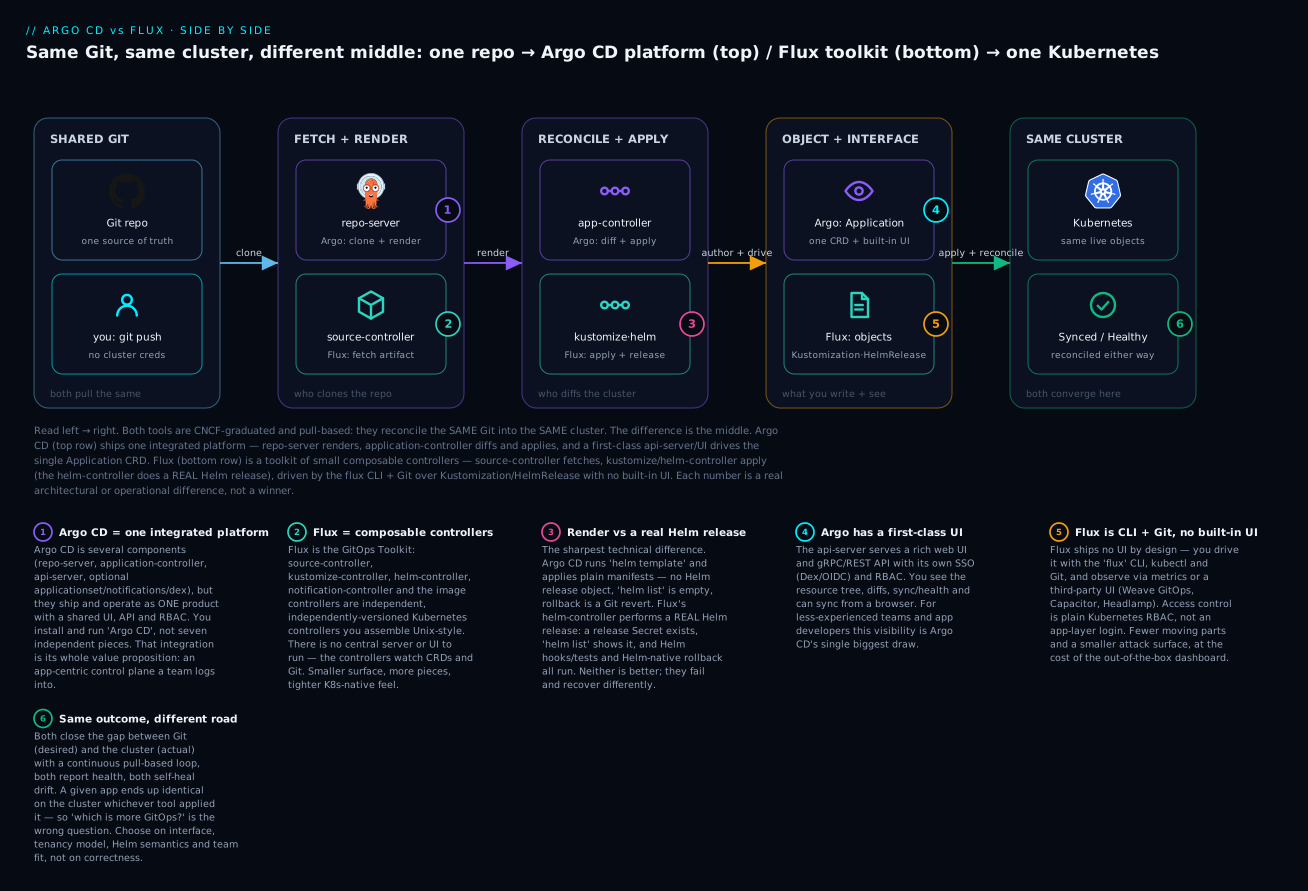
Here is the same idea as one picture. Read it left to right: both tools pull the same Git on the left and converge on the same cluster on the right — the difference is entirely the middle. The top row is Argo CD (repo-server → application-controller → the Application CRD plus a built-in UI); the bottom row is Flux (source-controller → kustomize/helm-controller → Kustomization/HelmRelease, driven by the CLI and Git). The numbered badges mark the real differences, not verdicts.
The philosophical contrast, stated plainly and fairly:
| Dimension | Argo CD (platform) | Flux (toolkit) |
|---|---|---|
| Design philosophy | Application-centric app-delivery platform | Unix-style composable controllers |
| What you operate | One product (several components, one login) | N independent controllers, no server |
| Mental model | “Log into Argo CD to see my apps” | “Commit to Git; the controllers reconcile” |
| Extensibility | Config Management Plugins, generators | Swap/add controllers, postBuild, Kustomize |
| Footprint | Larger (UI, API, Redis, controllers) | Smaller (controllers only) |
| Learning curve | Gentler — the UI teaches you | Steeper — you must understand the CRDs |
| Cultural fit | App teams, platform-as-product | Infra/platform engineers, K8s purists |
Neither column is the “right” one. If your organisation thinks of deployment as a product that developers use, Argo’s platform framing fits. If it thinks of deployment as infrastructure that should be as small and native as possible, Flux’s toolkit framing fits.
The CRDs, side by side
Concepts are easier to trust as YAML. Here is the same application — the podinfo demo app deployed from a Kustomize directory in Git — expressed in each tool.
Argo CD folds everything into one Application:
apiVersion: argoproj.io/v1alpha1
kind: Application
metadata:
  name: podinfo
  namespace: argocd
spec:
  project: default
  source:
    repoURL: https://github.com/acme/podinfo-config.git
    targetRevision: main
    path: kustomize
  destination:
    server: https://kubernetes.default.svc
    namespace: podinfo
  syncPolicy:
    automated:
      prune: true
      selfHeal: true
    syncOptions:
      - CreateNamespace=true
Flux splits the source from the application of that source into two objects — a GitRepository (what to fetch) and a Kustomization (what to build and apply from it):
apiVersion: source.toolkit.fluxcd.io/v1
kind: GitRepository
metadata:
  name: podinfo
  namespace: flux-system
spec:
  interval: 1m          # how often to re-fetch the repo
  url: https://github.com/acme/podinfo-config.git
  ref:
    branch: main
---
apiVersion: kustomize.toolkit.fluxcd.io/v1
kind: Kustomization
metadata:
  name: podinfo
  namespace: flux-system
spec:
  interval: 10m         # how often to re-apply/diff
  targetNamespace: podinfo
  prune: true           # delete-from-Git = delete-from-cluster
  wait: true            # block until applied resources are healthy
  sourceRef:
    kind: GitRepository
    name: podinfo
  path: ./kustomize
That two-object split is the single most visible day-one difference. In Argo, one Application carries both “where’s the source” and “what to do with it”. In Flux, the GitRepository is fetched once and can be referenced by many Kustomizations — a genuinely nice property when several apps live in one repo, because the clone happens once and each Kustomization points at a different path.
Mapping the fields you will actually touch:
| Intent | Argo CD (Application) |
Flux |
|---|---|---|
| Where the manifests live | spec.source.repoURL + path |
GitRepository.spec.url + Kustomization.spec.path |
| Which revision | spec.source.targetRevision |
GitRepository.spec.ref.{branch,tag,semver,commit} |
| Target cluster | spec.destination.server |
Kustomization spec.kubeConfig (default: local) |
| Target namespace | spec.destination.namespace |
Kustomization.spec.targetNamespace |
| Create the namespace | syncOptions: [CreateNamespace=true] |
Include a Namespace in the path (no auto-create) |
| Auto-apply | syncPolicy.automated |
On by default (reconcile loop) |
| Self-heal drift | syncPolicy.automated.selfHeal |
On by default |
| Prune | syncPolicy.automated.prune |
spec.prune: true |
| Wait for health | (health-gated by default) | spec.wait: true |
| How often | Global resync + webhook | spec.interval per object |
Two honest gotchas fall straight out of this table. First, Argo auto-creates the destination namespace with CreateNamespace=true; Flux does not create targetNamespace — you must ship a Namespace resource in the path or create it separately, and forgetting this is a classic first-Flux stumble. Second, Flux reconciliation is on by default — there is no automated: block to opt into; a Kustomization reconciles and self-heals unless you suspend it. Argo defaults to manual sync until you add syncPolicy.automated. That is a real difference in default posture: Flux is “GitOps on unless you stop it”; Argo is “you choose automated or manual per app”.
The API groups are worth committing to memory, since half of debugging is knowing which CRD (and which controller) owns a problem:
| Flux CRD | API group | Owned by |
|---|---|---|
GitRepository, HelmRepository, OCIRepository, Bucket |
source.toolkit.fluxcd.io/v1 |
source-controller |
Kustomization |
kustomize.toolkit.fluxcd.io/v1 |
kustomize-controller |
HelmRelease |
helm.toolkit.fluxcd.io/v2 |
helm-controller |
Provider, Alert, Receiver |
notification.toolkit.fluxcd.io/v1beta* |
notification-controller |
ImageRepository, ImagePolicy, ImageUpdateAutomation |
image.toolkit.fluxcd.io/v1beta2 |
image controllers |
Application, ApplicationSet, AppProject |
argoproj.io/v1alpha1 |
Argo CD |
(API versions are current as of Flux 2.x / Argo CD 3.x; some Flux groups such as helm and image advance their versions over time — check flux version and the CRD apiVersion on your cluster rather than trusting a tutorial.)
The interface: UI, SSO, and who logs in
This is the difference most teams feel first, and it is the clearest example of the platform-vs-toolkit split.
Argo CD has a first-class web UI, and it is genuinely excellent: a live resource tree per application, visual diffs of desired vs live, sync and health status at a glance, one-click sync and rollback, and a full audit of events. For app developers and less-experienced teams, this is Argo CD’s single biggest draw — you can see GitOps happening, which flattens the learning curve enormously.
Flux ships no UI, by design. You drive it with the flux CLI, kubectl, and Git; you observe it through metrics, flux get ..., and kubectl conditions. This is not an oversight — it is the toolkit philosophy, keeping the surface small. If you want a dashboard, you add a third-party one:
| Interface aspect | Argo CD | Flux |
|---|---|---|
| Built-in UI | Yes — rich, first-class | None |
| Third-party UIs | (n/a — has its own) | Weave GitOps (OSS), Capacitor, Headlamp Flux plugin |
| Primary driver | UI + argocd CLI + Git |
flux CLI + kubectl + Git |
| See live diff | In the UI | flux diff kustomization <n> --path ./... |
| See resource tree | In the UI | flux tree kustomization <n> |
| Trigger sync | Button, or argocd app sync |
flux reconcile kustomization <n> |
| Who it suits | Devs, mixed-skill teams | Platform engineers, CLI-first shops |
Be fair to both here. Argo’s UI is a real productivity and onboarding win and an extra component to run, secure, and keep patched. Flux’s lack of a UI is a smaller footprint and a genuine gap if your developers expect a dashboard — you either add Capacitor/Weave GitOps or you teach everyone the CLI. flux tree and flux diff are surprisingly good, but they are a terminal, not a shared screen the whole team watches during a release.
The UI decision drags authentication along with it. Because Argo CD serves a UI and API, it needs its own login, so it bundles SSO:
| AuthN / SSO | Argo CD | Flux |
|---|---|---|
| Login surface | Argo UI + API | None (no server to log into) |
| SSO mechanism | Dex (bundled OIDC broker) or direct OIDC | Delegates to Kubernetes authn |
| Identity providers | Entra ID, Google, Okta, Cognito, GitHub… via OIDC/SAML→Dex | Whatever your cluster/kubeconfig uses |
| “Who can deploy?” | Argo RBAC (argocd-rbac-cm) |
Kubernetes RBAC on the CRDs |
Flux has no concept of “Flux SSO” because there is nothing to log into — access to Flux is access to its CRDs, governed by ordinary Kubernetes RBAC and whatever OIDC your cluster’s API server already uses. That is elegantly minimal (one fewer identity system) but it means there is no app-layer, per-app UI login to hand a developer. Argo’s SSO is a real feature and a real thing to configure and secure.
Cloud edge, briefly: Argo CD’s SSO plugs into Entra ID (AKS), Cognito / IAM Identity Center (EKS), and Google (GKE) through OIDC — covered in the SSO lesson. Flux inherits whatever OIDC your managed cluster’s API server is configured with, so its “SSO” story is just your cluster’s story. This is one of only a few genuinely cloud-specific edges in the whole comparison; the tools themselves are cloud-agnostic.
Multi-tenancy and RBAC
If you are running one team’s apps, tenancy barely matters. If you are a platform team hosting many teams, it is one of the two or three decisions that dominate everything — and here the two tools take genuinely different, genuinely defensible approaches.
Argo CD’s boundary is the AppProject, enforced by Argo’s own RBAC. A project restricts which repos, destination clusters/namespaces, and resource kinds its Applications may touch, and you map SSO groups to project-scoped roles:
apiVersion: argoproj.io/v1alpha1
kind: AppProject
metadata:
  name: team-payments
  namespace: argocd
spec:
  sourceRepos:
    - https://github.com/acme/payments-config.git
  destinations:
    - server: https://kubernetes.default.svc
      namespace: 'payments-*'
  clusterResourceWhitelist: []          # deny all cluster-scoped resources
Flux’s boundary is Kubernetes itself. A Kustomization (or HelmRelease) can name a serviceAccountName, and Flux impersonates that ServiceAccount when it applies — so the tenant’s permissions are exactly what Kubernetes RBAC grants that SA, enforced by the API server, not by Flux:
apiVersion: kustomize.toolkit.fluxcd.io/v1
kind: Kustomization
metadata:
  name: team-payments
  namespace: flux-system
spec:
  interval: 10m
  serviceAccountName: team-payments     # Flux applies AS this SA → native K8s RBAC
  sourceRef:
    kind: GitRepository
    name: team-payments
  path: ./apps
  prune: true
The distinction is real and worth understanding:
| Tenancy aspect | Argo CD | Flux |
|---|---|---|
| Primary boundary | AppProject |
Namespace + serviceAccountName impersonation |
| Enforced by | Argo CD’s own RBAC engine | Kubernetes RBAC (the API server) |
| Restrict repos | spec.sourceRepos |
RBAC on GitRepository + repo structure |
| Restrict namespaces | spec.destinations glob |
The SA’s RBAC + namespace scoping |
| Block cluster-scoped resources | clusterResourceWhitelist: [] |
The SA simply lacks cluster-role perms |
| Map SSO groups → roles | argocd-rbac-cm policies |
Kubernetes RoleBindings to groups |
| “Escape the tenant” risk | Argo bug/misconfig in its RBAC | Would require a Kubernetes RBAC hole |
Here is the fair read. Flux’s model is arguably more robust in principle: tenancy is enforced by Kubernetes’ own battle-tested RBAC via impersonation, so a Flux bug is less likely to let a tenant escape — the API server is the guard, and the tenant genuinely cannot do what its SA cannot do. Argo CD’s model is arguably more convenient and more legible: AppProject gives you one object that says, in one place, “this team may deploy these repos to these namespaces”, plus a UI to see it, plus SSO-group mapping — but it is Argo enforcing that, so Argo’s RBAC correctness matters. If you deeply trust Kubernetes RBAC and want the smallest trusted computing base, Flux’s impersonation appeals. If you want a self-documenting, UI-visible tenancy boundary with SSO baked in, AppProject appeals. For the full Argo treatment see the AppProjects and multi-tenancy lesson’s companion material.
Templating and fan-out
The other platform-team pain is boilerplate: you do not want to hand-write one manifest per (app × environment × cluster). Both tools attack this, differently.
Argo CD’s answer is ApplicationSet — a controller that takes generators (Git directories, cluster list, matrix, pull-request, list, SCM) and stamps out one Application per generated element. One ApplicationSet with a matrix generator can fan every app across every matching cluster. This is a first-class, purpose-built fan-out engine, and it is a genuine Argo strength — the deep dive lives in the ApplicationSets and generators lesson.
Flux’s answer is composition, not a dedicated fan-out CRD. You fan out by structuring Git and composing Kustomizations: a base plus per-environment overlays, Kustomization objects that dependsOn each other, postBuild.substituteFrom for variable substitution from ConfigMaps/Secrets, and per-cluster directories that each cluster’s Flux reconciles. For multi-cluster, the common Flux pattern is each cluster runs its own Flux and reconciles its own path in a fleet repo.
| Fan-out need | Argo CD | Flux |
|---|---|---|
| App per Git directory | ApplicationSet Git generator | One Kustomization per path; repo structure |
| App per cluster | ApplicationSet cluster generator | Per-cluster Flux + per-cluster path |
| App × cluster matrix | ApplicationSet matrix generator | Compose overlays + per-cluster dirs |
| Ephemeral PR previews | ApplicationSet PR generator | External tooling / notification Receiver + automation |
| Variable substitution | Helm/Kustomize params in the template | postBuild.substituteFrom (ConfigMap/Secret) |
| Dedicated fan-out CRD | Yes (ApplicationSet) |
No — composition + Git layout |
The honest comparison: for large fan-out from a single control plane, Argo’s ApplicationSet is more turnkey — a matrix generator plus cluster labels genuinely is “add a cluster Secret, apps appear”, visible in one UI. Flux’s model of one-Flux-per-cluster is more decentralised: there is no central object generating a thousand apps, so there is no central blast radius, but you manage N Flux installs and a fleet repo layout instead. Which is better depends on whether you want a hub. A single Argo hub is a single pane and a single point of reconciliation; a fleet of self-reconciling Flux clusters has no hub to lose but no hub to look at either.
Multi-cluster: hub-spoke vs per-cluster
Following directly from fan-out, the multi-cluster topologies are the sharpest strategic difference:
| Multi-cluster aspect | Argo CD | Flux |
|---|---|---|
| Default topology | Hub-spoke — one Argo registers many clusters | Per-cluster — Flux installed in each cluster |
| Where credentials live | Hub holds a Secret per spoke |
Each cluster reconciles itself (no cross-cluster creds needed) |
| Single pane of glass | Yes — one UI for the whole fleet | No — each cluster is its own (unless you add tooling) |
| Cross-cluster reconcile | Native (application-controller → spoke API) | Possible via Kustomization.spec.kubeConfig (remote apply) |
| Blast radius of control plane | Hub down → no drift correction fleet-wide | One cluster’s Flux down → only that cluster affected |
| Scaling the control plane | Shard the application-controller | Independent per cluster (scales trivially) |
| Fleet bootstrapping | ApplicationSet cluster generator | flux bootstrap per cluster (or Cluster API + Flux) |
Both topologies are legitimate and widely run. Argo’s hub-spoke gives you one place to see and drive everything — fantastic for an ops team that wants a fleet dashboard — at the cost of a hub that concentrates power and risk (you HA it, and you keep break-glass kubectl to each spoke). Flux’s per-cluster model is inherently decentralised — no hub to compromise, each cluster self-heals independently, the control plane scales for free because there isn’t a shared one — at the cost of no single pane and more installs to manage. Flux can do remote reconciliation (a Kustomization with spec.kubeConfig applies to another cluster), so hub-style Flux is possible; it is just not the default the way it is for Argo.
For the Argo hub-spoke deep dive, the multi-cloud fleet lesson in this course walks the whole AKS+EKS+GKE hub topology end to end.
Helm: render vs a real release (the difference that bites)
If you remember one technical difference from this lesson, make it this one, because it silently changes behaviour and generates more confused tickets than anything else.
Argo CD does not run helm install. Its repo-server runs helm template to render the chart into plain manifests, and the application-controller applies and reconciles those manifests as if you had written them by hand. There is no Helm release object, helm list shows nothing, and Helm’s client-side lifecycle (hooks as Helm, helm rollback, helm test, revision history) does not exist — rollback is a Git revert, and Helm hooks are translated into Argo sync phases.
Flux’s helm-controller performs a real Helm release. It uses the Helm SDK to actually install/upgrade the chart, so a release Secret (sh.helm.release.v1.<name>.<rev>) exists, helm list shows it, Helm hooks and helm test run as Helm intends, and the controller can do Helm-native remediation and rollback.
Here is the same chart in each tool. Argo CD, Helm as a source:
apiVersion: argoproj.io/v1alpha1
kind: Application
metadata:
  name: podinfo
  namespace: argocd
spec:
  project: default
  source:
    repoURL: https://stefanprodan.github.io/podinfo
    chart: podinfo
    targetRevision: 6.7.1
    helm:
      valuesObject:
        replicaCount: 2
        ui:
          message: "hello from Argo CD"
  destination:
    server: https://kubernetes.default.svc
    namespace: podinfo
  syncPolicy:
    automated: { prune: true, selfHeal: true }
    syncOptions: [ CreateNamespace=true ]
Flux, a HelmRepository source plus a HelmRelease:
apiVersion: source.toolkit.fluxcd.io/v1
kind: HelmRepository
metadata:
  name: podinfo
  namespace: flux-system
spec:
  interval: 1h
  url: https://stefanprodan.github.io/podinfo
---
apiVersion: helm.toolkit.fluxcd.io/v2
kind: HelmRelease
metadata:
  name: podinfo
  namespace: podinfo
spec:
  interval: 10m
  chart:
    spec:
      chart: podinfo
      version: "6.7.1"
      sourceRef:
        kind: HelmRepository
        name: podinfo
        namespace: flux-system
  install:
    createNamespace: true
  values:
    replicaCount: 2
    ui:
      message: "hello from Flux"
The consequences are not cosmetic. They change what exists in the cluster and which Helm features work:
| Helm behaviour | Argo CD (helm template) |
Flux (real release) |
|---|---|---|
Release object / helm list |
None — helm list is empty |
Yes — release Secret exists, helm list shows it |
| Rollback | Git revert + resync | Git revert or Helm-native spec.rollback remediation |
| Helm hooks | Translated to Argo sync phases | Run as real Helm hooks |
helm test |
Not applicable | Supported (spec.test.enable) |
.Release.IsUpgrade |
Always false (every render looks fresh) | True on upgrades, as Helm intends |
lookup at render |
Empty (repo-server has no cluster access) | Works (real Helm dry-run against cluster) |
| Per-resource drift/diff | Yes — every rendered object is diffed in the UI | Coarser — drift tracked at the release level |
| Failure remediation | Sync fails; you see per-object errors | spec.upgrade.remediation retries/rolls back |
This is a genuine trade with costs on both sides — do not read the table as “Flux wins Helm”. Flux’s real release is better if you rely on Helm hooks, helm test, .Release.IsUpgrade, lookup, or Helm-native rollback/remediation, and if your team’s mental model is “it’s a Helm release, treat it like one”. Argo’s render is better if you want every rendered resource diffed and drift-corrected individually in a UI — because Argo treats the chart output as plain manifests, you see and self-heal each Deployment/Service/ConfigMap, which the release-level model does not surface as granularly. Many teams never hit the difference; the ones who do are usually running charts with meaningful hooks or expecting helm list/helm rollback to work. Know which camp you are in before you choose. (The Argo side of this is covered exhaustively in this course’s Helm integration lesson.)
Image automation, progressive delivery, and notifications
Three more areas where the packaging differs — and one of them is a clear Flux strength worth naming plainly.
Image automation is Flux’s standout capability. Flux ships two dedicated controllers: image-reflector-controller scans your registry and evaluates an ImagePolicy, and image-automation-controller writes the new tag back to Git as a real commit — closing the GitOps loop natively, so the newest image is always reflected in the source of truth.
apiVersion: image.toolkit.fluxcd.io/v1beta2
kind: ImagePolicy
metadata: { name: podinfo, namespace: flux-system }
spec:
  imageRepositoryRef: { name: podinfo }
  policy:
    semver: { range: ">=6.0.0" }
---
apiVersion: image.toolkit.fluxcd.io/v1beta2
kind: ImageUpdateAutomation
metadata: { name: podinfo, namespace: flux-system }
spec:
  interval: 30m
  sourceRef: { kind: GitRepository, name: podinfo }
  git:
    commit:
      author: { name: fluxcdbot, email: fluxcdbot@users.noreply.github.com }
    push: { branch: main }
  update:
    path: ./kustomize
    strategy: Setters
You mark the image field in your manifest with a # {"$imagepolicy": "flux-system:podinfo"} comment, and Flux edits it in place and commits. Argo CD’s equivalent, Argo CD Image Updater, is a separate project configured via annotations on the Application; it works and is widely used, but it is less integrated and generally considered less polished than Flux’s built-in pair:
metadata:
  annotations:
    argocd-image-updater.argoproj.io/image-list: podinfo=ghcr.io/stefanprodan/podinfo
    argocd-image-updater.argoproj.io/podinfo.update-strategy: semver
    argocd-image-updater.argoproj.io/write-back-method: git
| Image automation | Argo CD | Flux |
|---|---|---|
| Mechanism | Argo CD Image Updater (separate project) | image-reflector + image-automation controllers (built in) |
| Config location | Annotations on the Application |
Dedicated ImagePolicy / ImageUpdateAutomation CRDs |
| Write-back to Git | Yes (write-back-method: git) or to Argo |
Yes — real Git commit |
| Update strategies | semver, latest, digest, name | semver, alphabetical, numerical |
| Maturity / polish | Works; less integrated | Best-in-class; a Flux strength |
Give Flux this one squarely: if automated image updates written back to Git are central to your workflow, Flux does it better and more natively.
Registries are the one place image automation touches a cloud edge — and both tools authenticate to all three the same way (workload identity or a pull secret), so this is not a differentiator between the tools, only a per-cloud fact you configure once:
| Cloud registry | Auth approach (both tools) | Service |
|---|---|---|
| Azure (ACR) | Azure Workload Identity or ACR token | Azure Container Registry |
| AWS (ECR) | IRSA / EKS Pod Identity, or ECR credential helper | Elastic Container Registry |
| GCP (Artifact Registry) | Workload Identity or SA key | Artifact Registry |
Progressive delivery is a wash — both delegate to an excellent sibling project:
| Progressive delivery | Argo CD | Flux |
|---|---|---|
| Tool | Argo Rollouts (Rollout CRD) |
Flagger (Canary CRD) |
| Strategies | Canary, blue-green, experiments | Canary, blue-green, A/B |
| Traffic shaping | Istio, NGINX, ALB, Gateway API, SMI | Istio, Linkerd, App Mesh, NGINX, Gateway API |
| Metric-driven analysis | AnalysisTemplate (Prometheus, etc.) |
Metric checks (Prometheus, etc.) |
| Coupling | Independent of Argo CD (works standalone) | Independent of Flux (works standalone) |
Both are outstanding and, notably, decoupled — you can run Argo Rollouts with Flux, or Flagger with Argo CD. Progressive delivery should almost never decide your GitOps engine.
Notifications slightly favour Flux’s design. Argo CD’s notifications-controller emits triggers+templates outward to Slack/Teams/webhooks. Flux’s notification-controller does that and ingests inbound events via Receiver (a webhook that triggers reconciliation) — it is bidirectional:
| Notifications | Argo CD | Flux |
|---|---|---|
| Outbound alerts | notifications-controller | notification-controller (Provider/Alert) |
| Inbound webhooks | Webhook to API server (sync on push) | Receiver (first-class, many event sources) |
| Config style | ConfigMap triggers/templates | Dedicated CRDs |
Security posture and operations
The last comparison axis is the one security teams care about: attack surface, and how each behaves in production.
| Security / ops aspect | Argo CD | Flux |
|---|---|---|
| Network-exposed server | api-server + UI (must be secured) | None — controllers only |
| Attack surface | Larger (UI, API, its own authn/RBAC, admin user) | Smaller (no UI/API daemon) |
| Historical CVEs | Some in the API/UI auth path (patched) | Fewer surface-area vectors |
| Secrets handling | Sealed Secrets / ESO / SOPS / Vault plugin | Native SOPS decryption in kustomize-controller |
| RBAC model | App-layer (argocd-rbac-cm) + K8s |
Pure Kubernetes RBAC |
| Multi-tenancy enforcement | Argo’s RBAC | K8s impersonation |
| Observability | Prometheus metrics + UI + Grafana mixins | Prometheus metrics + Grafana dashboards |
| Bootstrap | Manifests/Helm + app-of-apps; Terraform helm_release |
flux bootstrap (Git-native) + Terraform flux provider |
Two things deserve fair emphasis. First, Flux’s smaller attack surface is a real security advantage — there is no UI or API server to expose, phish a login for, or find an auth-bypass in; access is entirely Kubernetes RBAC. Argo CD’s larger surface is the price of the UI, SSO, and multi-tenancy that many teams want — a fair trade, but a trade. Second, Flux decrypts SOPS secrets natively in the kustomize-controller, which is a clean, popular pattern; Argo CD reaches the same outcome with Sealed Secrets, External Secrets Operator, SOPS via a plugin, or a cloud secret store — more options, less built-in. Neither is insecure; they distribute the responsibility differently.
On bootstrap and Terraform, both fit an IaC hand-off. Flux’s flux bootstrap github/gitlab/git is delightfully Git-native — it commits Flux’s own manifests plus a sync Kustomization into your repo, so Flux manages itself from Git thereafter:
# Flux: Git-native bootstrap (commits Flux components into the repo)
flux bootstrap github \
  --owner=acme --repository=fleet \
  --branch=main --path=./clusters/dev --personal
# Argo CD: apply the install manifests, then an app-of-apps root
kubectl create namespace argocd
kubectl apply -n argocd -f https://raw.githubusercontent.com/argoproj/argo-cd/stable/manifests/install.yaml
There are first-class Terraform providers for both (flux provider for Flux; helm_release + kubernetes_manifest or a community provider for Argo CD), so either drops cleanly into a Terraform-provisioned cluster.
When to choose which
Pulling it together into the decision you actually have to make. This is the honest matrix — no thumb on the scale:
| Choose Argo CD when… | Choose Flux when… |
|---|---|
| Developers need a UI to see apps, diffs, health | You want a CLI/Git-only, no-server workflow |
| You want built-in multi-tenancy + RBAC + SSO | You want tenancy enforced by native K8s RBAC |
| You run a hub-spoke fleet from one pane | You want decentralised, per-cluster reconciliation |
You need turnkey fan-out (ApplicationSet) with a dashboard |
You compose via Kustomize + Git layout |
| Your team is mixed-skill; the UI lowers the barrier | Your team is platform/infra engineers who live in the CLI |
| You want an app-delivery platform | You want a small, K8s-native GitOps toolkit |
| — | You need best-in-class image automation to Git |
| — | You need real Helm release semantics (helm list, hooks, rollback) |
| — | You want the smallest attack surface (no UI/API) |
| — | You want native SOPS decryption |
Weight the rows by your context. A 200-developer product org with rotating on-call and app teams that expect a dashboard will feel Argo’s UI, SSO, and AppProject tenancy as daily wins. A tight platform team running a fleet of clusters, automating image bumps to Git, and valuing a minimal attack surface will feel Flux’s toolkit, image automation, and impersonation model as daily wins. Both teams would be correct.
And the ending the whole lesson has been building toward: many mature organisations run both. Flux to bootstrap clusters and reconcile the platform layer (its Git-native bootstrap and small footprint shine there), Argo CD as the developer-facing app-delivery plane (its UI and AppProject model shine there). They are not mutually exclusive — they are two good tools that are good at different things, and using each where it is strongest is a perfectly respectable architecture, not a failure to decide.
Migration considerations
Because tooling is sticky, teams often ask about switching — in both directions. The good news: since both reconcile the same Git and the same manifests, your Kustomize bases, Helm charts, and values files move over unchanged. What changes is the wrapper CRD.
| Migration concern | Argo CD → Flux | Flux → Argo CD |
|---|---|---|
| App-of-apps / ApplicationSet → ? | Rebuild as Kustomization composition + per-cluster dirs |
Recreate Kustomization/HelmRelease as Application/ApplicationSet |
| Helm apps | helm template render → real release (behaviour changes!) |
Real release → helm template render (behaviour changes!) |
| Namespaces | Add explicit Namespace (Flux won’t auto-create) |
Add CreateNamespace=true |
| Tenancy | AppProject → SA impersonation + K8s RBAC |
SA impersonation → AppProject + argocd-rbac-cm |
| Image automation | Image Updater annotations → ImagePolicy/ImageUpdateAutomation |
Flux image CRDs → Image Updater annotations |
| Cutover risk | Run side-by-side in separate namespaces first | Same — never point both at the same objects at once |
| Manifests themselves | Unchanged | Unchanged |
The one migration trap that bites hardest is the Helm model flip: moving a Helm app from Argo (render) to Flux (real release) means a Helm release object suddenly exists and hooks now run as Helm hooks; going the other way, helm list goes empty and your helm rollback muscle memory stops working. Plan that transition per-app, not fleet-wide. The universal safety rule for either direction: never let both tools reconcile the same objects simultaneously — they will fight, each reverting the other. Migrate app-by-app in separate namespaces, verify, then retire the old wrapper. If you are coming to GitOps from a script-driven pipeline rather than the other tool, the migrating from Jenkins/Helm-CLI to GitOps lesson covers that on-ramp.
Hands-on lab
Let us make the biggest difference — Helm render vs real release — concrete, by deploying the same app with each tool on a free local cluster. Nothing here bills: it is all kind. We deploy with Argo CD, observe, tear down, then deploy with Flux and observe the difference. We deliberately do not run both against the same objects at once (they would war). Outputs are representative — labelled shapes, not a live run on this machine.
Step 0 — A throwaway cluster.
kind create cluster --name gitops-compare
kubectl cluster-info --context kind-gitops-compare
# Kubernetes control plane is running at https://127.0.0.1:xxxxx
What just happened: one local cluster we will point each tool at in turn, then delete.
Step 1 — Install Argo CD and deploy podinfo as a Helm app.
kubectl create namespace argocd
kubectl apply -n argocd -f https://raw.githubusercontent.com/argoproj/argo-cd/stable/manifests/install.yaml
kubectl -n argocd rollout status deploy/argocd-server   # wait for it

# apply the Helm-source Application from the lesson above (saved as argo-podinfo.yaml)
kubectl apply -f argo-podinfo.yaml
argocd app get podinfo   # (after argocd login)
Representative argocd app get output:
Name:            argocd/podinfo
Project:         default
Sync Status:     Synced to 6.7.1
Health Status:   Healthy
What just happened: Argo CD’s repo-server ran helm template on the podinfo chart and the application-controller applied the rendered manifests. podinfo is running.
Step 2 — The tell: ask Helm what it sees.
helm list -n podinfo
# NAME  NAMESPACE  REVISION  STATUS  CHART  APP VERSION
# (no rows)
kubectl get secret -n podinfo | grep sh.helm.release || echo "no helm release secret"
# no helm release secret
What just happened: nothing. Argo CD never created a Helm release — it applied plain manifests. helm list is empty and that is correct, not broken. Your “release history” is the Git log. This is the render model, made visible.
Step 3 — Tear down the Argo side cleanly.
kubectl delete -f argo-podinfo.yaml     # removes the Application (and prunes podinfo)
kubectl delete namespace argocd
What just happened: we retire Argo entirely so the two tools never touch the same objects.
Step 4 — Install Flux and deploy the same chart as a HelmRelease.
flux install                            # installs the toolkit controllers into flux-system
flux check                              # verify controllers are ready
# apply the HelmRepository + HelmRelease from above (saved as flux-podinfo.yaml)
kubectl apply -f flux-podinfo.yaml
flux get helmreleases -n podinfo
Representative flux check and flux get output:
✔ source-controller: deployment ready
✔ kustomize-controller: deployment ready
✔ helm-controller: deployment ready
✔ all checks passed

NAME     REVISION  SUSPENDED  READY  MESSAGE
podinfo  6.7.1     False      True   Helm install succeeded for release podinfo/podinfo.v1
What just happened: Flux’s helm-controller performed a real Helm install of the same chart, and reports it as a release.
Step 5 — Ask Helm again — this time it answers.
helm list -n podinfo
# NAME     NAMESPACE  REVISION  STATUS    CHART          APP VERSION
# podinfo  podinfo    1         deployed  podinfo-6.7.1  6.7.1
kubectl get secret -n podinfo | grep sh.helm.release
# sh.helm.release.v1.podinfo.v1   helm.sh/release.v1   1
What just happened: the same chart, deployed by Flux, produced a genuine Helm release object — helm list shows it, the sh.helm.release.v1.podinfo.v1 Secret exists, and helm rollback would work. This is the render-vs-release difference from theory to your terminal, side by side. Nothing about the chart changed; only the tool’s model did.
Step 6 — Feel the developer experience. Try to answer “is my app synced and healthy, and what changed?” in each tool. With Argo you would open the UI and see the resource tree and a visual diff; with Flux you stay in the terminal:
flux get kustomizations                 # or helmreleases: status at a glance
flux tree helmrelease podinfo -n podinfo # the managed resource tree, in the CLI
flux diff kustomization <name> --path ./...  # (for a Kustomization) live vs desired
What just happened: you experienced the interface split first-hand — Argo’s browser dashboard vs Flux’s CLI. Neither is wrong; they suit different people.
Developer-experience contrast, from this lab:
| Task | Argo CD | Flux |
|---|---|---|
| See app health | UI dashboard (or argocd app get) |
flux get helmreleases |
| See a diff | Visual diff in UI | flux diff kustomization … --path |
| See the resource tree | UI tree view | flux tree helmrelease … |
| Trigger a sync | Button / argocd app sync |
flux reconcile helmrelease … |
Does helm list show it? |
No (render) | Yes (real release) |
Step 7 — Teardown.
kind delete cluster --name gitops-compare
What just happened: the whole experiment — both tools, both apps, the cluster — is gone. No cloud resources were ever created, so nothing bills.
Common mistakes and troubleshooting
The table doubles as a quick decision aid and a real error map. The top rows are the decisions; the lower rows are genuine failure modes with real states/messages from each tool.
| Symptom / question | Cause / meaning | Fix / answer |
|---|---|---|
| “I need a UI for developers” | Flux ships none | Argo CD (or add Weave GitOps/Capacitor to Flux) |
| “I want best-in-class image automation to Git” | Argo’s Image Updater is a separate, less-polished project | Flux (image-reflector + image-automation controllers) |
| “I need real Helm release semantics” | Argo renders helm template; no release object |
Flux (helm-controller does a real release) |
| “I want strong built-in multi-tenancy + RBAC + SSO” | Flux delegates to K8s RBAC, has no UI login | Argo CD (AppProject + argocd-rbac-cm + Dex) |
| “I want a composable, K8s-native toolkit” | Argo is an integrated platform | Flux (GitOps Toolkit controllers) |
| “Fan out to many clusters with one pane” | Flux default is per-cluster | Argo CD hub-spoke + ApplicationSet |
| “CLI/Git-only, no server to run” | Argo needs api-server + UI | Flux (flux CLI + Git) |
| “I need progressive delivery” | Both delegate to a sibling project | Either — Argo Rollouts or Flagger |
Argo app Synced/Healthy but helm list empty |
Argo used helm template; there is no release |
Working as designed — history is the Git log |
Flux Kustomization fails: namespace not found |
Flux does not auto-create targetNamespace |
Ship a Namespace in the path, or create it |
Flux HelmRelease Ready=False: install retries exhausted |
Chart failed to install; remediation gave up | flux logs --kind HelmRelease; fix values; flux reconcile |
Argo ComparisonError / Unknown on a Helm app |
Chart/values render failure in repo-server | Fix the chart/values; the blame is render, not cluster |
| Both tools flip an object back and forth | You pointed both at the same resource | Never co-manage; one owner per object |
Flux app stuck Reconciling, no change |
Source not ready or dependsOn unmet |
flux get sources git; check the referenced source |
Argo OutOfSync forever on a Helm chart |
A controller mutates a rendered field | ignoreDifferences, or move to Flux’s release model |
Three gotchas cost the most hours, so give them extra words:
1. The empty helm list panic (Argo). New GitOps engineers file a ticket: “Argo says Healthy but helm list shows nothing!” There is no bug. Argo rendered the chart and applied manifests; it never made a Helm release, so there is nothing for Helm to list. If your team needs helm list/helm rollback to mean something, that is a real reason to lean Flux — not a reason to think Argo is broken.
2. Flux won’t create your namespace. Argo’s CreateNamespace=true spoils you. Flux’s targetNamespace sets the namespace on the rendered objects but does not create the namespace itself — so the first apply fails with a not-found error until you include a Namespace resource in the path (or pre-create it). This is the single most common first-Flux stumble.
3. Two cooks, one kitchen. During any migration or evaluation, the tempting thing is to point both tools at the same app “just to compare”. Do not. Each will see the other’s changes as drift and revert them, and you get an infinite flap. Use separate namespaces, or do one tool then the other (as the lab does). One object, one owner — always.
Cheat-sheet
Component and CRD equivalents:
| Concept | Argo CD | Flux |
|---|---|---|
| Render Git | repo-server | source-controller |
| Reconcile | application-controller | kustomize-controller / helm-controller |
| Declare an app | Application |
GitRepository + Kustomization |
| Declare a Helm app | Application (helm source) |
HelmRepository + HelmRelease |
| Fan-out | ApplicationSet |
Kustomize composition + Git layout |
| Tenancy | AppProject |
serviceAccountName impersonation |
| Access control | argocd-rbac-cm |
Kubernetes RBAC |
| Image automation | Argo CD Image Updater | ImagePolicy + ImageUpdateAutomation |
| Progressive delivery | Argo Rollouts | Flagger |
| Notifications | notifications-controller | notification-controller |
| UI | Built-in | Weave GitOps / Capacitor (external) |
CLI equivalents (argocd ⟷ flux):
| Task | Argo CD | Flux |
|---|---|---|
| List apps | argocd app list |
flux get kustomizations / helmreleases |
| App detail | argocd app get <n> |
flux get kustomization <n> |
| Force sync | argocd app sync <n> |
flux reconcile kustomization <n> --with-source |
| Diff | argocd app diff <n> |
flux diff kustomization <n> --path ./... |
| Resource tree | (UI) | flux tree kustomization <n> |
| Pause | argocd app set <n> --sync-policy none |
flux suspend kustomization <n> |
| Resume | argocd app set <n> --sync-policy automated |
flux resume kustomization <n> |
| Logs / health | argocd app logs / UI |
flux logs / flux check |
| Bootstrap | apply manifests + app-of-apps | flux bootstrap github … |
Choose-which matrix (the one-line version):
| You want… | Pick |
|---|---|
| A UI, SSO, built-in multi-tenancy | Argo CD |
| A CLI/Git-only, minimal-surface toolkit | Flux |
Real Helm releases (helm list, hooks, rollback) |
Flux |
| Best image automation to Git | Flux |
| Hub-spoke fleet with one pane of glass | Argo CD |
| Decentralised per-cluster reconciliation | Flux |
| Turnkey fan-out with a dashboard | Argo CD (ApplicationSet) |
| Progressive delivery | Either (Rollouts / Flagger) |
Interview and exam questions
Q: Are Argo CD and Flux both “real” GitOps, or is one more legitimate? A: Both are equally legitimate — both are CNCF-graduated and both implement pull-based reconciliation with Git as the source of truth. Deploy the same app with each and the cluster is identical. “Which is more GitOps?” is the wrong question; they differ in interface, packaging, and Helm semantics, not in GitOps correctness.
Q: Describe the core architectural difference in one sentence.
A: Argo CD is an integrated, application-centric platform you log into (repo-server + application-controller + api-server/UI + its own RBAC, driving one Application CRD); Flux is a toolkit of small, independent, composable controllers (source, kustomize, helm, notification, image) driven by the flux CLI and Git with no built-in UI.
Q: What is the single biggest technical difference in how they handle Helm, and why does it matter?
A: Argo CD runs helm template and applies plain manifests — no Helm release object, helm list is empty, rollback is a Git revert, and Helm hooks become Argo sync phases. Flux’s helm-controller performs a real Helm release — a release Secret exists, helm list shows it, and Helm hooks/tests and Helm-native rollback all work. It matters because charts that rely on hooks, helm test, .Release.IsUpgrade, or lookup behave differently, and teams expecting helm list/helm rollback to work get surprised under Argo.
Q: A developer says “Argo shows Healthy but helm list is empty — something’s broken.” Are they right?
A: No — that is correct behaviour. Argo rendered the chart with helm template and applied manifests; it never created a Helm release, so there is nothing to list. The Git log is the history and a Git revert is the rollback.
Q: How does multi-tenancy differ between the two?
A: Argo CD uses AppProject (restricting repos, destinations, resource kinds) enforced by its own RBAC, mapped to SSO groups via argocd-rbac-cm. Flux names a serviceAccountName on the Kustomization/HelmRelease and impersonates it, so tenancy is enforced by native Kubernetes RBAC at the API server. Flux’s is arguably more robust (K8s enforces it); Argo’s is arguably more legible and UI-visible with SSO built in.
Q: How do the two approach multi-cluster, and what is the trade-off?
A: Argo CD favours hub-spoke — one control plane registers many clusters and ApplicationSet fans out — giving a single pane of glass at the cost of a hub that concentrates blast radius. Flux favours per-cluster — each cluster runs its own Flux and reconciles itself — giving decentralisation and no hub to lose, at the cost of no single pane and more installs. Flux can do remote reconciliation via Kustomization.spec.kubeConfig, but per-cluster is the default.
Q: Which has the stronger image automation, and why? A: Flux. It ships dedicated image-reflector and image-automation controllers that scan the registry and write the new tag back to Git as a real commit, closing the loop natively. Argo CD’s equivalent, Argo CD Image Updater, is a separate, less-integrated project. If image automation is central, that is a point for Flux.
Q: Which has the smaller attack surface, and why is that not automatically “better”? A: Flux — it runs only controllers, with no network-exposed UI or API server, and access is pure Kubernetes RBAC. But Argo CD’s larger surface is the price of the UI, SSO, and built-in multi-tenancy many teams want. Smaller surface is a security win only if you do not need the platform features you would be giving up.
Q: You are advising a 150-developer product org with app teams and rotating on-call. Which do you lean toward and why?
A: Argo CD, most likely — the built-in UI (visibility for mixed-skill developers), SSO, and AppProject multi-tenancy fit an app-delivery-as-a-platform model, and the UI flattens the GitOps learning curve for a large, rotating group. I would still confirm they do not have a hard requirement (real Helm releases, image-automation-to-Git) that tips it back to Flux.
Q: When would you genuinely recommend Flux over Argo CD? A: When the team is platform/infra engineers who want a CLI/Git-only, minimal-footprint, K8s-native toolkit; when best-in-class image automation written to Git matters; when real Helm release semantics are required; when a small attack surface is a priority; or when native SOPS decryption and per-cluster decentralised reconciliation fit the architecture better than a hub.
Q: Is running both Argo CD and Flux a sign of indecision?
A: No — it is a legitimate, common architecture. Flux often bootstraps clusters and reconciles the platform layer (Git-native bootstrap, small footprint), while Argo CD serves as the developer-facing app-delivery plane (UI, AppProject). Using each where it is strongest is sound, provided they never co-manage the same objects.
Q: What is the one rule you must never break when migrating between them or evaluating both? A: Never let both tools reconcile the same objects at once — they will each see the other’s writes as drift and revert them, flapping forever. Migrate app-by-app in separate namespaces (one owner per object), verify, then retire the old wrapper.
Key takeaways
- Both are CNCF-graduated, pull-based GitOps tools solving the same core problem; deploy the same app with each and the cluster ends up identical. There is no universal winner — choose on fit, not on quality.
- The mental model: Argo CD is an integrated platform you log into; Flux is a composable controller toolkit you assemble. Nearly every difference flows from that one architectural bet.
- Helm is the sharpest technical difference. Argo renders (
helm template, no release object,helm listempty, rollback = Git revert); Flux performs a real Helm release (release Secret,helm listworks, Helm hooks/tests/rollback run). Know which model your charts need before choosing. - Lean Argo CD for a first-class UI, built-in SSO/RBAC/multi-tenancy (
AppProject), hub-spoke multi-cluster with one pane, turnkeyApplicationSetfan-out, and mixed-skill teams the UI helps. - Lean Flux for a CLI/Git-only minimal-surface toolkit, best-in-class image automation written back to Git, real Helm semantics, native SOPS decryption, K8s-native tenancy via impersonation, and decentralised per-cluster reconciliation.
- Progressive delivery should not decide it — both delegate to excellent, decoupled sibling projects (Argo Rollouts, Flagger) that work with either engine.
- Many mature orgs run both — Flux for the platform layer, Argo CD as the developer-facing plane — and that is a respectable design, not a failure to decide.
- The universal safety rule: never let both tools (or two Applications/Kustomizations) reconcile the same objects simultaneously; one owner per object, always.