In a nutshell
Google’s Cloud Adoption Framework (CAF) is a report card and a roadmap for how ready your organization is to use Google Cloud well — not a technical checklist of services to switch on. It looks at four things (the themes): are your people skilled enough (Learn), does leadership back the move (Lead), can you grow and operate workloads repeatably (Scale), and are you governed and defensible (Secure). For each theme it rates you at one of three maturity phases: Tactical (ad hoc, project-by-project, held together by a few heroes), Strategic (planned, funded, org-wide), or Transformational (continuous, automated, measured).
A useful mental model: CAF is coaching a team, not buying better equipment. You can own the newest boots and the best ball (the cloud services), but whether you win depends on training, tactics, and discipline — the readiness of the organization. CAF measures that readiness across four positions on the field and tells you, honestly, whether you’re a pub side, a semi-pro club, or championship material — one rating per theme, and most orgs come out jagged (great in one theme, weak in another).
This lesson is part 2 of the series and zooms all the way into the first theme, Learn — because skills are the constraint that throttles everything else: you cannot Lead, Scale, or Secure on a platform your people do not understand. But to place Learn in context we first zoom out to the whole grid — the four themes, the three phases, how you assess yourself, and how the gaps you find become funded epics that move you up. Then we go deep on the four levers of Learn: learning programs at scale, working with partners, upskilling & certification, and standing up a Cloud Center of Excellence (CCoE).
Level: Advanced (with a beginner-friendly on-ramp) · Time: ~30 min
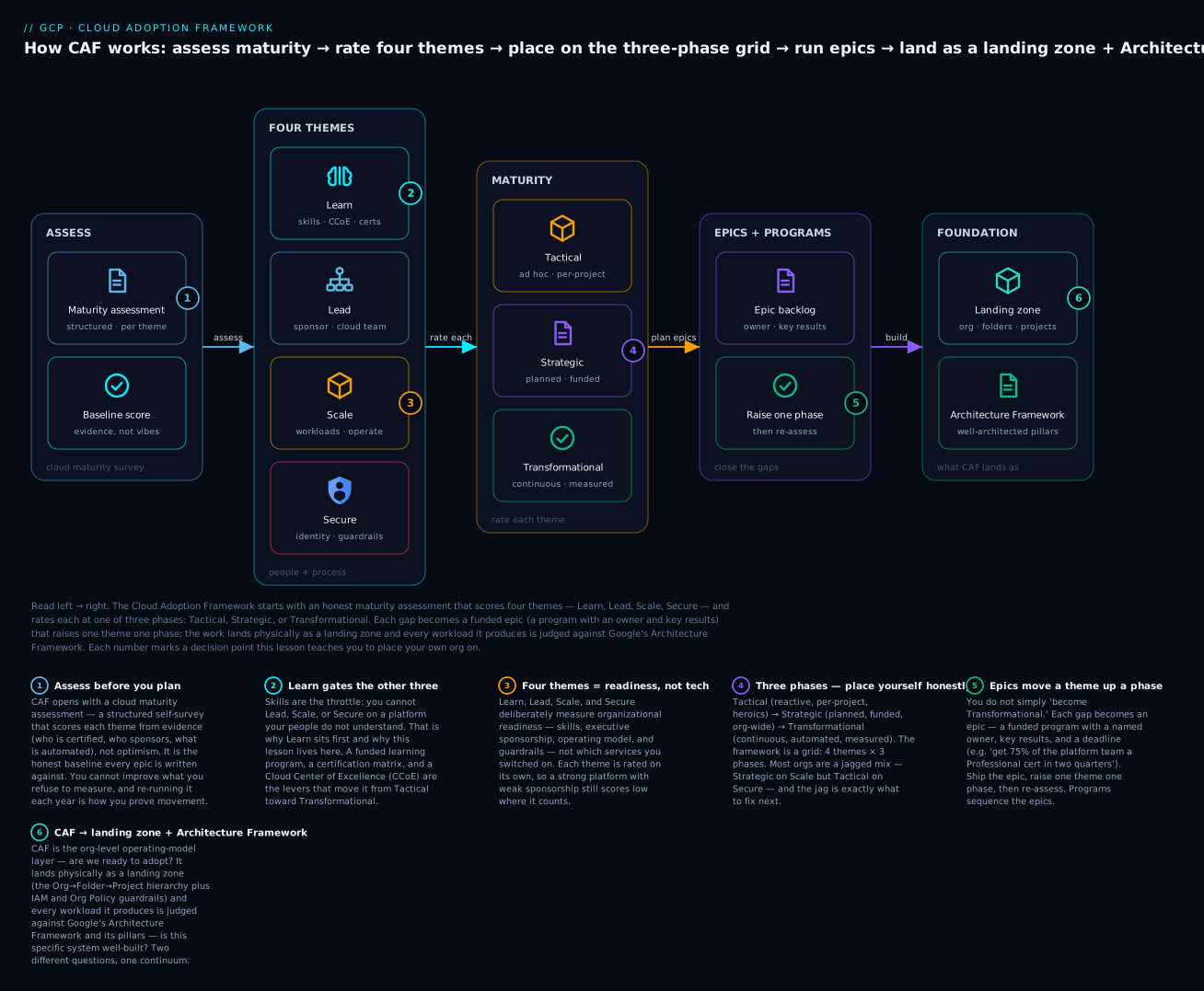
One-sentence walkthrough: Read left → right — an honest maturity assessment scores the four themes (Learn, Lead, Scale, Secure); each theme is rated on the three-phase grid (Tactical → Strategic → Transformational); every gap becomes a funded epic with an owner and key results; and the work lands physically as a landing zone whose every workload is then judged against Google’s Architecture Framework.
Prerequisites. You’ll get the most from this if you already know GCP’s basics — the resource hierarchy: Organization → Folder → Project, IAM, and roughly what a landing zone is. Brand-new to CAF as a whole? Skim the CAF overview & maturity model first, then come back here for the Learn deep dive. No hands-on GCP access is required — this is a strategy and governance lesson.
After this lesson you’ll be able to:
- Explain the four CAF themes and three maturity phases in your own words, and place your own org on the grid.
- Run a lightweight cloud-maturity self-assessment and read the (usually jagged) result honestly.
- Turn a maturity gap on the Learn theme into a funded epic with a named owner and key results.
- Design a role-based learning program, a certification matrix, and a partner engagement model that transfers knowledge in rather than creating dependency.
- Stand up a Cloud Center of Excellence with a real charter and a self-service “paved-road” catalog.
- Explain precisely how CAF connects to your landing zone and to Google’s Architecture Framework — and why they are different questions.
Where this fits
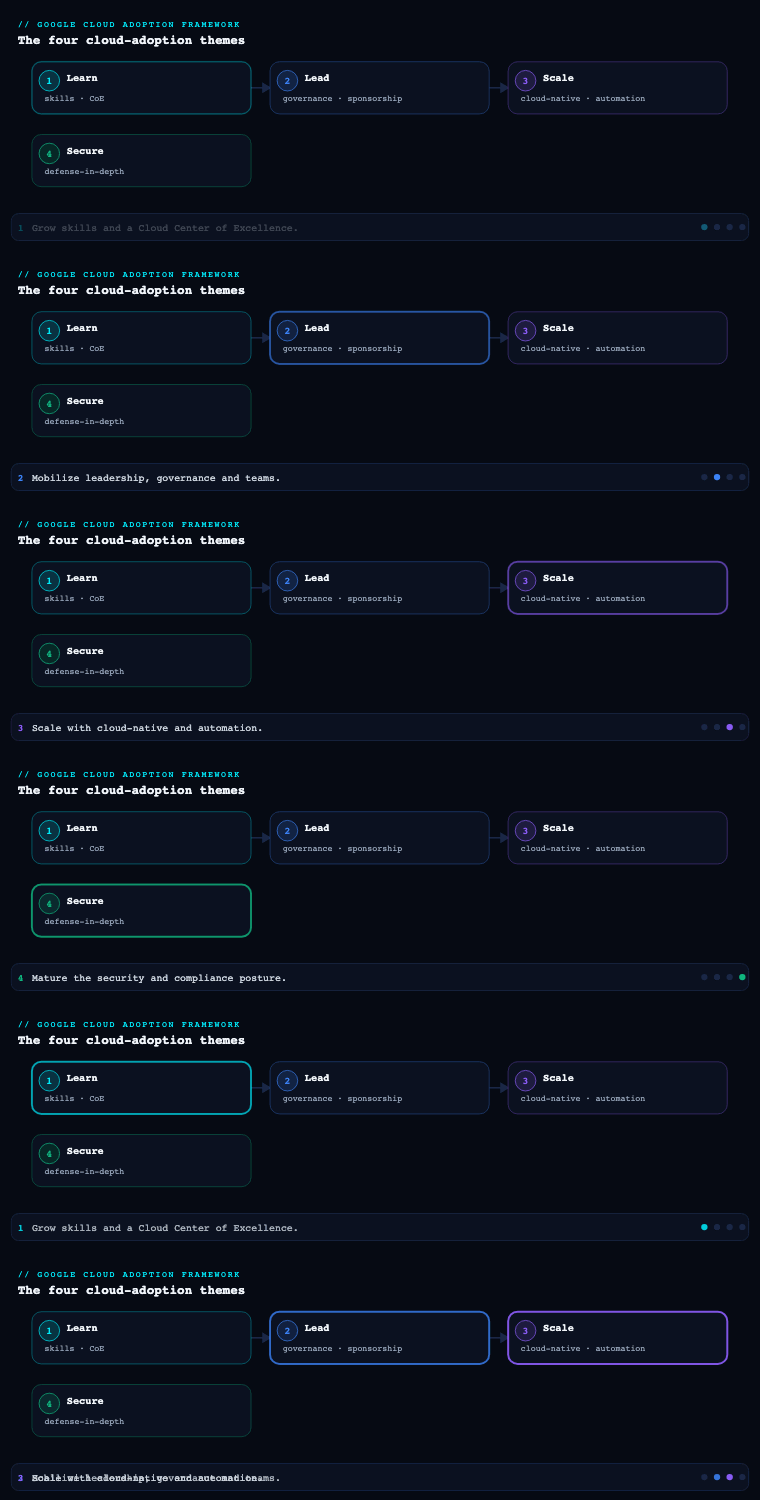
Google’s Cloud Adoption Framework (CAF) assesses your organization across four themes — Learn, Lead, Scale, and Secure — and rates each at one of three maturity phases: Tactical, Strategic, or Transformational. The Learn theme measures the quality and scale of your people-and-skills program: how well your technical teams keep up with Google Cloud, and how effectively you lean on Google and its partner ecosystem to close gaps. In Google’s own definition, Learn captures “the quality and scale of your learning programs” and “the extent to which you augment internal staff with experienced partners.” It is deliberately the first theme in the alphabet because skills are the constraint that throttles every other theme: you cannot Lead, Scale, or Secure on a platform your people do not understand. This article is part 2 of the series and goes deep on the four levers that move you from Tactical to Transformational on Learn — learning-program quality and scale, working with partners, upskilling and certification, and establishing a Cloud Center of Excellence (CCoE).
The whole framework in one grid (place your org here)
Before the deep dive on Learn, hold the whole framework in your head, because it is what makes the Learn theme make sense. CAF is a grid: the four themes down one axis, the three maturity phases across the other. You get one rating per theme — think of it as four cells lit up on a 4×3 board.
The four themes — the “what we measure.” Crucially, all four measure organizational readiness (skills, sponsorship, operating model, guardrails), not which products you turned on.
| Theme | The question it answers | What moves it up |
|---|---|---|
| Learn | Are our people skilled enough to keep up? | Learning programs, partners, certification, a CCoE — this lesson |
| Lead | Does leadership sponsor and steer the move? | Executive sponsorship, a cross-functional cloud team, a motivated workforce |
| Scale | Can we grow workloads repeatably and operate them? | Automation, a landing zone, paved roads, SRE/operations maturity |
| Secure | Are we governed, compliant, and defensible? | IAM baseline, Org Policy, VPC Service Controls, Security Command Center, compliance |
Learn is first for a reason: skills gate the other three. A brilliant landing zone that nobody on the team understands is a liability, not an asset.
The three maturity phases — the “how mature.” The same signal reads very differently at each phase. This table is your rubric for placing a theme:
| Signal | Tactical | Strategic | Transformational |
|---|---|---|---|
| Funding | per-project, one-off | a funded program with a budget line | continuous, treated as run-cost |
| Ownership | a few heroes | named owners per area | an accountable operating model (a CCoE) |
| Repeatability | manual, re-invented each time | standard patterns, mostly reused | automated, self-service, paved roads |
| Measurement | none, or vanity metrics | KPIs tracked | leading + lagging indicators, closed loop |
| Risk posture | reactive, found in incidents | baseline guardrails set | continuous, automated, measured |
The single most important insight: because you’re rated per theme, real organizations are almost always jagged — e.g. Strategic on Scale but Tactical on Secure. That jag is not a failure of the model; the jag is the point. It tells you exactly which theme to invest in next.
The cloud maturity assessment — how you get your score. The rating isn’t a gut call. It comes from a structured maturity assessment: a self-survey (Google publishes one; many orgs run their own or a partner-led version) that asks evidence-based questions per theme — “what percentage of the cloud team holds a relevant certification?”, “who is the named executive sponsor?”, “what percentage of new projects are provisioned by a project factory?” — and lands each theme in a phase. The output is not a grade to feel proud or ashamed of; it is the baseline every improvement is written against, and re-running it every 6–12 months is how you prove movement rather than assert it.
Epics and programs — how you actually move up. You don’t “decide to become Transformational.” Each gap the assessment finds becomes an epic: a scoped, funded work package with a named owner, key results, and a deadline (for example, “get 75% of the platform team a Professional-level certification within two quarters”). Related epics roll up into programs (say, a “Learn uplift” program). The loop is: assess → write epics → ship them → a theme moves one phase → re-assess. That loop is the entire engine of the framework. The operating-model & epics lesson treats the epic backlog as a first-class execution artifact.
Where CAF connects to everything else. CAF is the organizational readiness layer. It deliberately does not tell you how to design a specific VPC or size a database — that is the job of Google’s Architecture Framework (the workload-design pillars). And the paved roads a maturing org builds physically take the shape of a landing zone. We come back to both seams in Going deeper. For a fuller, standalone treatment of the grid itself, the phases, and the assessment, see the CAF overview linked above.
Sub-component 1: The quality and scale of learning programs
What it is. This is the breadth (how many people), depth (how rigorous), and durability (how repeatable) of your skilling effort. Google’s maturity model draws a sharp line between ad hoc learning — engineers Googling errors and watching random YouTube videos when a project demands it — and a managed, role-based curriculum that every relevant employee progresses through on a known cadence. Tactical organizations train reactively and per-project; Transformational organizations run learning as a continuously funded program with defined learning paths, internal champions, and measured outcomes.
Why it matters. Skills gaps are the single most common reason cloud programs stall after the first few workloads. A team that “lifted-and-shifted” three VMs onto Compute Engine but never learned IAM, VPC Service Controls, or Cloud Logging will plateau — and will quietly accumulate risk and cost. Scaling adoption means scaling competence at the same rate, which only a program (not heroics) can do.
How to do it well. Treat learning as a product with a backlog, owners, and a roadmap, not an HR line item. The mechanics that distinguish a high-quality program:
- Role-based learning paths. Map each persona (cloud engineer, data engineer, SRE/platform, security, developer, network, FinOps, leadership) to a concrete path rather than a generic “intro to GCP” for everyone.
- Blended modalities. Combine self-paced video, hands-on labs, instructor-led training (ILT), and real project work. Skills that are never used in anger evaporate within weeks.
- Hands-on by default. GCP’s killer learning asset is Google Cloud Skills Boost (the platform formerly branded Qwiklabs), which spins up real, temporary GCP projects with live credentials so learners operate against the actual console and
gcloud, not a simulator. Skill Badges validate hands-on competency in a domain. - Sandbox for safe practice. Give learners a dedicated sandbox folder in your resource hierarchy with guardrails (budgets, Organization Policy constraints, auto-cleanup) so they can experiment without touching production or blowing the bill.
- Measurement. Track completion, badge/cert attainment, and the lagging indicator that actually matters — time-to-productivity on real workloads.
GCP tools, artifacts, and decisions.
| Need | GCP asset / tool | Notes |
|---|---|---|
| Self-paced + hands-on labs | Google Cloud Skills Boost | Real sandboxed GCP projects; learning paths, courses, Skill Badges |
| Curated role tracks | Skills Boost Learning Paths | e.g. Cloud Engineer, Data Engineer, Cloud Architect, Security |
| Instructor-led depth | Authorized Training via Google Cloud Learning Partners | Deep multi-day courses, often delivered by partners |
| Org-wide assignment & reporting | Skills Boost for Business / subscriptions | Assign paths, track completion across teams |
| Safe practice environment | Sandbox folder + Organization Policy + budgets | Guardrailed experimentation space |
| Internal sharing | Internal “GCP Guild” wiki, brown-bags, recorded demos | Captures tribal knowledge as it forms |
Key decisions to make and write down: who owns the curriculum, what cadence (e.g. every engineer completes their path within 90 days of joining a cloud team), what budget (Skills Boost subscription seats + ILT days), and what counts as “done” (badge, certification, or a shipped workload).
Sub-component 2: Working with partners
What it is. This is the degree to which you deliberately augment internal staff with experienced external help — and, crucially, structure that engagement so capability transfers in rather than creating permanent dependency. Google’s CAF explicitly rewards mature use of partners; the goal of a Transformational organization is not “no partners” but partners used surgically to accelerate and teach.
Why it matters. Early in an adoption you have a chicken-and-egg problem: you need to ship cloud workloads to build skills, but you need skills to ship cloud workloads. Partners break that deadlock. They also de-risk specialized, infrequent work (landing zone design, large migrations, ML platform builds) that does not justify a permanent in-house team. The failure mode the framework warns against is using partners as staff augmentation forever — your people never learn, and the partner becomes a single point of failure.
How to do it well.
- Pick the right partner type for the work. Google’s ecosystem distinguishes broadly between Services Partners (who deliver consulting, migration, and managed services) and Technology/ISV Partners (whose software runs on or extends GCP). Within services, look for relevant Partner Specializations and Expertises — Google’s badges that certify a partner has proven, audited capability in a domain (e.g. Infrastructure, Data & Analytics, Cloud Migration, Machine Learning, Security). A Premier partner tier signals scale and depth.
- Use Google’s own delivery arm where it fits. Google Cloud Consulting (formerly Professional Services Organization, PSO) and Customer Engineering can lead the most critical foundational work and proactive design reviews.
- Engage the right programs. PSO/Consulting for hands-on build; Customer Career Programs / training credits; and incentive programs such as RAMP / Migration programs that can fund partner-led assessments and migrations.
- Contract for knowledge transfer. Make pairing, documentation, runbooks, and a defined exit/handover an explicit deliverable — not an afterthought. “Build with us, not for us.”
Partner-fit decision aid.
| Situation | Recommended approach |
|---|---|
| First landing zone / org foundation | Google Cloud Consulting or a Premier Infrastructure-specialized partner, with your platform team embedded |
| Large-scale migration of 100s of VMs/apps | Migration-specialized partner + Migration Center + funding via Google migration programs |
| Niche, one-off (e.g. SAP on GCP, anthos/GKE Enterprise) | Specialized partner with that exact Expertise |
| Steady-state run of a workload you want to own | In-house, with short partner advisory only |
| Capability you intend to keep forever | Hire/train internally; use partner only to bootstrap and teach |
Artifacts: a partner engagement model (RACI), statements of work with explicit knowledge-transfer deliverables and exit criteria, a partner scorecard, and a “skills we are keeping vs. outsourcing” decision register.
Sub-component 3: Upskilling and certification
What it is. The formal validation layer on top of learning — turning “we did some training” into a measurable, externally-recognized credential plan with role-specific certification targets and a funded path to reach them.
Why it matters. Certifications are not vanity. They (a) give you an objective, hire-able and benchmarkable signal of competence; (b) force genuine depth, because the role-based exams are notoriously practical; © are often required to unlock partner status and Google incentives (partner specializations require a threshold number of certified individuals); and (d) materially improve retention and morale when paired with a clear growth ladder. The CAF treats a deliberate certification strategy as a hallmark of Strategic-and-above maturity.
How to do it well. Map personas to the right certificate, set targets, fund the attempts, and protect study time. Google’s certification portfolio (as of 2026) breaks into Foundational, Associate, and Professional tiers:
| Certification | Tier | Primary persona it validates |
|---|---|---|
| Cloud Digital Leader | Foundational | Business stakeholders, leadership, sales |
| Associate Cloud Engineer | Associate | Cloud/infra engineers deploying & operating workloads |
| Associate Google Workspace Administrator | Associate | Workspace/collaboration admins |
| Associate Data Practitioner | Associate | Entry-level data analysts/engineers |
| Professional Cloud Architect | Professional | Architects designing GCP solutions |
| Professional Cloud Engineer pathway / Cloud Network Engineer | Professional | Network engineers (VPC, hybrid, Cloud Interconnect) |
| Professional Cloud Developer | Professional | App developers building cloud-native services |
| Professional Cloud DevOps Engineer | Professional | SRE / platform / CI-CD owners |
| Professional Data Engineer | Professional | Data pipeline & analytics engineers (BigQuery, Dataflow) |
| Professional Cloud Database Engineer | Professional | Database specialists (Cloud SQL, Spanner, AlloyDB) |
| Professional Cloud Security Engineer | Professional | Security engineers (IAM, VPC-SC, Security Command Center) |
| Professional Machine Learning Engineer | Professional | ML/AI engineers (Vertex AI) |
| Professional Google Workspace Administrator | Professional | Senior Workspace administrators |
Practical mechanics that work:
- Anchor to learning paths. Each Professional cert has a matching Skills Boost learning path; pair every cert target with the path and the relevant Skill Badges as milestones.
- Use cohorts, not lone wolves. Run study cohorts with a deadline; group accountability roughly doubles pass rates versus solo study.
- Fund it fully. Pay for the exam, a re-sit, and study hours during work time. The cost of a failed attempt is trivial next to the cost of an engineer who never certifies.
- Tie to a ladder. Make certifications a visible (if not mandatory) rung in your engineering progression so the effort pays the individual back.
- Track the partner threshold. If your org is a partner (or aspires to be), monitor your certified-headcount against the specialization requirement.
KPIs for this sub-component.
| KPI | Tactical | Strategic | Transformational |
|---|---|---|---|
| % of cloud team with a relevant Professional cert | < 15% | 40–60% | > 75% |
| Time from hire to first cert | unmanaged | ~6 months | < 90 days |
| Certs mapped to a funded learning path | none | most roles | every role |
| Re-cert / currency tracked | no | partial | yes, automated reminders |
Artifacts: a certification matrix (persona → target cert → path → deadline), a budget line for exams and vouchers, a tracking dashboard, and an internal recognition mechanism (badges on Slack/profiles, spot bonuses).
Sub-component 4: Establishing a Cloud Center of Excellence
What it is. A Cloud Center of Excellence (CCoE) is the small, cross-functional team that owns the cloud operating model: it sets standards, builds reusable platform assets, curates the learning program, governs guardrails, and acts as the internal consultancy that the rest of the organization pulls from. In a mature org it is the institutional home of everything in the Learn theme — and the connective tissue to Lead, Scale, and Secure. It is the difference between cloud capability living in a few people’s heads and living in the organization.
Why it matters. Without a CCoE, every team reinvents landing zones, re-debates IAM patterns, and re-learns the same lessons — adoption fragments and risk compounds. The CCoE concentrates scarce expertise, sets paved roads so product teams move fast safely, and is the accountable owner for the maturity ratings the CAF measures. It is the single most leverage-rich artifact of the Learn theme.
How to do it well.
- Staff it cross-functionally and keep it small. A starting CCoE is typically 4–8 people: a lead/architect, a platform/infra engineer, a security engineer, a FinOps/cost lead, a networking specialist, and an enablement/learning owner. Pull, don’t push — rotate engineers from product teams through it so knowledge diffuses back out.
- Give it a real charter. Define mandate, scope, decision rights (what it mandates vs. recommends), funding, and success metrics in writing. Ambiguity here is the most common cause of a CCoE being ignored.
- Operate the “paved road,” not the gate. The CCoE’s product is reusable, opinionated platform assets that make the secure/compliant path the easy path. On GCP this means:
| CCoE responsibility | GCP mechanism / asset |
|---|---|
| Landing zone & org foundation | Cloud Foundation Toolkit, Terraform Google modules, Fabric FAST, Cloud Setup checklist |
| Resource hierarchy & isolation | Organization → Folders → Projects, project factory patterns |
| Guardrails & policy-as-code | Organization Policy Service, IAM (custom roles, least privilege), VPC Service Controls |
| Standardized networking | Shared VPC, hub-and-spoke, Cloud Interconnect patterns |
| Cost governance / FinOps | Billing accounts, Budgets & alerts, BigQuery billing export, FinOps hub |
| Observability standards | Cloud Logging, Cloud Monitoring, log sinks, dashboards as code |
| Security posture | Security Command Center, org-level findings, baseline detections |
| Curated enablement | Owns the Skills Boost subscription, learning paths, and certification matrix |
| Reusable building blocks | Internal module registry / Service Catalog, golden Terraform |
- Publish a backlog and intake. Treat internal teams as customers: a request intake, a roadmap, and SLAs for design reviews. The CCoE should be a magnet, not a bottleneck.
- Measure it. Track adoption of paved-road assets (what % of new projects use the project factory), lead time for a compliant new environment, and the number of teams self-sufficient on GCP.
Artifacts: the CCoE charter, an operating model / RACI, a published platform/paved-road catalog (Terraform modules, golden landing zone), an intake-and-roadmap, governance standards (IAM, Org Policy, tagging/labeling), and the owned enablement plan.
Real-world enterprise scenario
Company: Meridian Mutual, a 14,000-employee insurer headquartered in Pune with a ~600-person technology org. Their estate is mostly on-prem VMware plus a sprawl of three teams who each independently spun up GCP projects for analytics. A CAF self-assessment rated them Tactical on Learn: training was per-project, only 9 engineers held any Google Cloud certification, two consulting firms were embedded as long-term staff-aug with no exit plan, and there was no central platform. The CTO sponsors a 9-month push to reach Strategic on Learn before a major BigQuery-and-Vertex-AI claims-analytics program kicks off.
Decisions per sub-component:
-
Learning programs at scale. Meridian buys 250 Google Cloud Skills Boost subscription seats and defines six role-based learning paths (Platform/SRE, Data Engineering, Security, App Dev, Network, Leadership). Every cloud-touching engineer is assigned a path with a 90-day completion target; Skill Badges are the milestones. A guardrailed sandbox folder is created with a ₹40,000/month budget cap per engineer enforced via Budgets & alerts and locked-down Organization Policy constraints so people can practice against live GCP safely. A fortnightly “GCP Guild” brown-bag captures patterns as they emerge.
-
Working with partners. They terminate the open-ended staff-aug arrangement and re-engage one Premier partner with Data & Analytics and Infrastructure Specializations under a fixed-scope SOW to build the landing zone with an embedded 4-person Meridian platform squad — knowledge transfer, runbooks, and a hard handover at month 5 are explicit deliverables. Google Cloud Consulting runs a two-day design review of the landing zone and the Vertex AI platform plan. A migration of the analytics workloads uses Migration Center for assessment, partly funded through a Google migration program.
-
Upskilling and certification. A certification matrix targets: all 16 platform/SRE engineers to Associate Cloud Engineer then Professional Cloud DevOps Engineer; 12 data engineers to Professional Data Engineer; 5 security engineers to Professional Cloud Security Engineer; 6 architects to Professional Cloud Architect; and Cloud Digital Leader for 30 managers and the leadership team. Exams, one free re-sit, and four hours/week of study time are fully funded. Engineers study in deadline-driven cohorts.
-
Cloud Center of Excellence. A 7-person CCoE is stood up with a written charter giving it mandate over the resource hierarchy, IAM baseline, Org Policy, and the billing/labeling standard, and advisory status on application architecture. It ships a paved-road catalog built on the Cloud Foundation Toolkit and Terraform Google modules: a project factory, Shared VPC pattern, baseline Security Command Center posture, Cloud Logging sinks, and BigQuery billing export dashboards. It owns the Skills Boost subscription and the certification matrix, and runs a weekly intake for design reviews.
Measurable outcome (month 9). Certified engineers go from 9 to 41 (52% of the cloud team holding a relevant Professional cert); time-from-hire-to-first-cert drops to ~75 days; 83% of new GCP projects are provisioned through the CCoE’s project factory rather than by hand; the claims-analytics platform launches on schedule on BigQuery + Vertex AI; and the next CAF assessment rates Meridian Strategic on Learn (with the CCoE and the funded certification program cited as the decisive evidence).
Deliverables & checklist
Common pitfalls
- Treating learning as one-and-done training, not a funded program. A two-week bootcamp at kickoff with no ongoing cadence decays fast. Fix: run learning as a product with an owner, a backlog, and a recurring budget — paths assigned on a known cadence.
- Using partners as permanent staff-augmentation. The CAF explicitly penalizes dependency. If your partner leaves and the lights go out, you failed the Learn theme. Fix: contract knowledge transfer, pairing, and a hard exit as deliverables; keep an in-house squad embedded in every partner build.
- Certifications without protected study time or sandbox practice. Telling engineers to “go get certified” on top of a full sprint load yields low pass rates and resentment. Fix: fund exams and protect 3–4 hours/week, run cohorts, and give hands-on sandbox access via Skills Boost.
- A CCoE with no charter or decision rights. A “center of excellence” that can only suggest becomes a wiki nobody reads. Fix: write the charter, define what it mandates vs. advises, fund it, and give it the org-policy and landing-zone ownership to be a paved road.
- A CCoE that becomes a bottleneck (the gate, not the road). If every project must queue behind the CCoE for manual approval, adoption stalls and shadow IT returns. Fix: ship self-service paved-road assets (project factory, golden Terraform) so the compliant path is the fast path; measure paved-road adoption %.
- Skilling without measurement. Counting “courses completed” while ignoring whether teams can actually ship and operate workloads. Fix: track lagging indicators — time-to-productivity, paved-road adoption, and certs that map to shipped workloads.
Going deeper
This section is for the reader who already gets the four themes and wants the seams, the sequencing logic, and the naming traps that separate a slide-deck understanding of CAF from an operating one.
CAF vs the Architecture Framework — two questions, one continuum
The most valuable distinction to internalize: CAF asks “is our organization ready to adopt cloud?” and the Architecture Framework asks “is this specific workload well-built?” They operate at different altitudes and are easy to conflate because Google publishes both.
| Cloud Adoption Framework (CAF) | Architecture Framework | |
|---|---|---|
| Question it answers | Is the organization ready to adopt? | Is this workload well-built? |
| Altitude | Organization / program | Workload / design |
| Unit of assessment | A theme rated by phase (Tactical→Transformational) | A pillar assessed per system |
| The axes | Learn, Lead, Scale, Secure | Operational excellence, security, reliability, cost optimization, performance optimization, sustainability |
| Output | A maturity grid + an epic backlog | Design recommendations + a review scorecard |
| Primary owner | Executive sponsor + CCoE | Architects + product teams |
| Cadence | Annual (or twice-yearly) re-assessment | Per design review / per launch |
The seam where they touch: a mature CCoE (a Learn-theme artifact) runs Architecture-Framework-based design reviews as a service for product teams. So the frameworks aren’t competitors — CAF builds the capability and mandate, and one thing that capability produces is disciplined, pillar-by-pillar workload reviews.
How CAF actually lands as a landing zone
The four themes are not parallel silos; they compose. Executed, the Scale and Secure themes literally are a landing zone — the Organization → Folder → Project hierarchy, Shared VPC, the IAM baseline, Org Policy guardrails, log sinks, and billing export. The Lead theme is what funds and mandates it. And the Learn theme’s CCoE is what owns and paves it (Cloud Foundation Toolkit, Terraform Google modules, a project factory). Read that way: Learn builds the capability, Lead unlocks it, and Scale + Secure are the tangible thing the capability produces. If you want to see the concrete foundation this produces, the landing-zone resource-hierarchy lesson is the other half of this story.
The assessment is a repeatable instrument, not a one-time audit
Advanced orgs treat the maturity assessment like a recurring health check: the same questions, the same evidence standard, run every 6–12 months, with results trended over time so you can show a theme moving from Tactical to Strategic. Three failure modes to design against:
- Grading on a curve — scoring aspirations instead of evidence. Anchor every answer to an artifact (a dashboard, a signed charter, a cert count), never to “we’re basically doing that.”
- Assessment theatre — a glossy consulting readout that nobody converts into epics. The assessment is worthless unless its gaps become a funded backlog.
- Averaging the grid — reporting “we’re Strategic overall” hides that Secure is Tactical. Never average across themes; report per theme and act on the lowest, most-gating one.
Why the themes interlock — the gating order
Learn → Lead → Scale → Secure is not just alphabetical; it hints at a sequencing logic. Skills (Learn) are the precondition. Executive sponsorship (Lead) unlocks the funding and mandate. Those two together make repeatable Scale possible. And only a skilled, sponsored, scaled org can make Secure continuous rather than a bolt-on. A very common anti-pattern is pouring money into Secure tooling — Security Command Center, VPC Service Controls, Cloud Armor — while Learn is still Tactical: the tools get misconfigured, ignored, or alert-fatigued because nobody deeply understands them. The framework’s ordering is a nudge about the order to sequence your epics: fix the gating theme first.
Naming and version caveats (2026)
A few things trip people up, and getting them wrong in a strategy doc undermines credibility:
- Three different Google artifacts, often conflated. The Cloud Adoption Framework (org readiness, rated by phase) is not the Architecture Framework (workload design, rated by pillar), and neither is the Enterprise Foundations blueprint / security blueprint (the opinionated, deployable reference landing zone). All three are Google publications; keep the vocabulary straight.
- Qwiklabs is now Google Cloud Skills Boost. If a colleague says “Qwiklabs,” they mean Skills Boost — same hands-on-labs lineage, current brand.
- Exam guides drift. Google periodically refreshes exams (objectives, and occasionally the roster). Always check the current exam guide before you commit a certification matrix to a budget cycle.
- Each cloud has its own CAF. AWS and Azure publish their own Cloud Adoption Frameworks with similar but not identical theme and phase names. Don’t cross-map Google’s phase definitions to another vendor’s verbatim in a multi-cloud shop.
Scale nuance: a CCoE that federates
At tens of thousands of engineers, one central CCoE becomes exactly the bottleneck this lesson’s pitfall #5 warns about. The Transformational pattern is hub-and-spoke / federated: a small central platform team/CCoE owns the paved roads and the standards, while embedded “cloud champions” in each business unit run local enablement and design reviews against the central standard. The center measures paved-road adoption; the spokes measure local time-to-productivity. This is how the Learn theme itself scales past the point where a single team could ever teach everyone.
FinOps and DORA as adjacent signals
Mature Learn/Scale programs wire in two external measurement systems. FinOps asks whether engineers are cost-aware — is there a cost pillar baked into the paved road, and a showback/chargeback loop closing back to the teams? DORA / DevOps metrics (deployment frequency, lead time for change, change-failure rate, time to restore) are the lagging proof that skills turned into shipping velocity. The trap is celebrating leading indicators — course completions, badges — while the lagging ones (time-to-productivity, DORA metrics, workloads actually shipped) flatline. A Transformational Learn theme is defined by the lagging outcomes, not the certificate count.
Practice challenges
Work these top to bottom — they escalate from “can you name the model” to “can you operate it.” Try each before opening the solution.
1. (Beginner) Name the axes. From memory, list the four themes and the three maturity phases. Then, in one sentence each, describe what evidence would put an org at Tactical versus Transformational on Learn.
<details><summary>Solution</summary>
Themes: Learn, Lead, Scale, Secure. Phases: Tactical, Strategic, Transformational. Tactical Learn = engineers Google errors per-project, <15% hold a relevant cert, no owner for enablement. Transformational Learn = funded role-based paths, >75% certified, a CCoE owns enablement, and time-to-productivity is tracked. Why: naming the two axes is the price of entry to placing any org on the grid. </details>
2. (Beginner) Read a jagged score. An org has a slick landing zone and polished Security Command Center dashboards, but training is whatever each team improvises and only 8% hold a certification. What phase is Learn, and why doesn’t the good tooling rescue the score?
<details><summary>Solution</summary>
Learn is Tactical. Themes are rated independently, so strong Secure/Scale tooling does not lift Learn — and un-understood tooling is precisely the risk CAF is flagging. Why: the grid is jagged; you fix the lowest theme, never the average. </details>
3. (Intermediate) Write the epic. Turn “we should get more certified” into a real epic for a 40-person platform team moving Learn from Tactical toward Strategic. It must have an owner, a measurable key result, and a deadline.
<details><summary>Solution</summary>
Example: “Owner: Head of Platform. Key result: 70% of the 40-person platform team holds Associate Cloud Engineer or higher, studied in deadline-driven cohorts on funded Skills Boost paths. Deadline: end of Q3.” Why: an epic is only real with a named owner, a measurable KR, and a date — everything else is a wish, and wishes don’t move a phase. </details>
4. (Intermediate) Guardrail the sandbox. Sketch the guardrails for a safe learner sandbox folder so engineers can practise against live GCP without risking prod or the bill. Give a folder-scoped Org Policy that blocks external IPs, and a per-project budget.
<details><summary>Solution</summary>
A dedicated folder with a deny-all external-IP policy, a gcp.resourceLocations allow-list pinned to your region, a per-project Budget with alert thresholds, and auto-cleanup. Representative, schema-correct artifacts:
# sandbox-no-ext-ip.yaml
name: folders/SANDBOX_FOLDER_ID/policies/compute.vmExternalIpAccess
spec:
  rules:
  - denyAll: true
gcloud org-policies set-policy sandbox-no-ext-ip.yaml

gcloud billing budgets create \
  --billing-account=BILLING_ACCOUNT_ID \
  --display-name="sandbox-cap" \
  --budget-amount=40000INR \
  --threshold-rule=percent=0.5 \
  --threshold-rule=percent=0.9 \
  --threshold-rule=percent=1.0 \
  --threshold-rule=percent=1.0,basis=forecasted-spend
Why: the sandbox is the Learn theme’s hands-on engine — but engineers only use it freely when guardrails make “experiment freely” genuinely safe. (Egress still works via Cloud NAT; only inbound-reachable public IPs are blocked.) </details>
5. (Advanced) Refuse the average. Your assessment returns: Learn Tactical, Lead Strategic, Scale Strategic, Secure Tactical. Leadership wants “a single number so we can report we’re Strategic.” What do you tell them, and how do you sequence the fix?
<details><summary>Solution</summary>
Refuse to average — a single number hides that Learn and Secure are Tactical and would misrepresent real risk to the board. Report per theme. Sequence: fix Learn first, because it gates the others — Secure is partly Tactical because nobody understands the security tooling, so a Learn uplift (CCoE + security-engineer certs) is the lever that raises Secure sustainably rather than bolting on more tools. Why: the grid’s value is the jag; attack the lowest, most-gating theme next. </details>
6. (Advanced) Structure a partner engagement that teaches. Design a partner SOW that raises your Learn maturity instead of creating dependency. What three things must it contain?
<details><summary>Solution</summary>
(1) An embedded in-house squad that pairs on every deliverable — build with, not for. (2) Knowledge-transfer artifacts as named deliverables — runbooks, recorded walkthroughs, documented decisions — not “best effort.” (3) A hard exit/handover milestone with acceptance criteria (“the in-house team operates X unaided”). Bonus: require the partner hold the relevant Specialization/Expertise. Why: CAF explicitly penalizes permanent staff-aug; the acid test is “if the partner leaves tomorrow, do the lights stay on?” </details>
Common beginner mistakes
These are conceptual misreadings of the framework (distinct from the organizational anti-patterns in Common pitfalls above) — the misconception, why it’s wrong, and the right mental model.
- “CAF is a technical checklist of services to enable.” It isn’t — CAF measures organizational readiness (skills, sponsorship, operating model, guardrails), not which products you switched on. The service checklist belongs to the landing zone and the Architecture Framework. Right model: CAF is the coaching report; the services are the equipment.
- “We must be Transformational on everything.” Transformational is expensive and rarely needed on every theme. Right model: aim each theme at the phase your business actually requires; a deliberately jagged grid beats uniform over-investment.
- “CAF and the Architecture Framework are the same thing.” No — CAF asks “is the org ready?” (rated by phase); the Architecture Framework asks “is this workload well-built?” (rated by pillar). Right model: two altitudes — organization vs. workload.
- “The four themes are the six Architecture pillars.” They’re different axes of different frameworks. Themes = Learn/Lead/Scale/Secure; pillars = operational excellence, security, reliability, cost, performance, sustainability. Right model: don’t cross the vocabularies.
- “The maturity score is a grade to feel good or bad about.” It’s a baseline to write epics against. An assessment you don’t convert into a funded backlog is theatre. Right model: score → epics → ship → re-score.
- “Learn just means sending people on courses.” Learn spans programs, partners, certification, and the CCoE that institutionalizes all of it. Course completions are a leading indicator; time-to-productivity and shipped workloads are what count. Right model: learning is a funded product measured by lagging outcomes.
- “A CCoE is a governance gate that approves everything.” A mature CCoE is a paved road (self-service golden assets), not a ticket queue. Right model: make the compliant path the fast path, and measure paved-road adoption.
Glossary
- Cloud Adoption Framework (CAF) — Google’s model for assessing how ready an organization is to adopt Google Cloud, across four themes, each rated at one of three maturity phases.
- Theme — one of the four things CAF measures: Learn (skills), Lead (leadership/sponsorship), Scale (repeatable operations), Secure (governance/security). Rated independently.
- Maturity phase — the rating a theme gets: Tactical (ad hoc, per-project, heroics), Strategic (planned, funded, org-wide), or Transformational (continuous, automated, measured).
- Maturity assessment — the structured, evidence-based self-survey that lands each theme in a phase; re-run periodically to trend progress. It produces the baseline, not a grade.
- Epic — a scoped, funded work package (named owner + key results + deadline) that closes one maturity gap; shipping it moves a theme up one phase.
- Program — a group of related epics sequenced together (e.g. a “Learn uplift” program) — the execution vehicle above individual epics.
- Cloud Center of Excellence (CCoE) — the small, cross-functional team that owns the cloud operating model: standards, paved-road assets, the enablement program, and guardrails. The institutional home of the Learn theme.
- Landing zone — the pre-built, governed GCP foundation (Organization → Folder → Project hierarchy, Shared VPC, IAM baseline, Org Policy guardrails, logging, billing export) that Scale + Secure, executed, produce.
- Architecture Framework — Google’s workload-design guidance, organized into pillars (operational excellence, security, reliability, cost, performance, sustainability). Answers “is this system well-built?” — a different question from CAF.
- Google Cloud Skills Boost — Google’s hands-on learning platform (formerly Qwiklabs) that spins up real temporary GCP projects with live credentials for practice.
- Skill Badge — a Skills Boost credential validating hands-on competency in a specific domain; used as a milestone inside a learning path.
- Learning path — a curated, role-based sequence of courses and labs (e.g. Cloud Engineer, Data Engineer) mapped to a persona.
- Organization Policy (Org Policy) — the service that sets configuration guardrails (constraints like
compute.vmExternalIpAccess) inherited down the resource hierarchy; governs what may exist. - Sandbox folder — a dedicated, guardrailed folder (budgets + Org Policy + auto-cleanup) where engineers can practise against live GCP without risking production or the bill.
- Shared VPC — a networking pattern where one host project shares subnets to many service projects, centralizing network control.
- Cloud Foundation Toolkit / Terraform Google modules — Google’s opinionated, reusable Terraform building blocks for standing up a landing zone and paved-road assets.
- Project factory — an automated, self-service pattern for provisioning new, already-compliant projects (rather than clicking them by hand).
- Paved road — an opinionated, self-service platform asset that makes the secure/compliant path the easy path; the CCoE’s core product.
- Security Command Center (SCC) — Google’s centralized security and risk platform: org-level findings, posture management, threat detection.
- VPC Service Controls (VPC-SC) — a security perimeter around GCP resources that mitigates data exfiltration.
- FinOps — the practice of making engineers cost-aware and closing a showback/chargeback loop on cloud spend.
- DORA metrics — the four DevOps delivery metrics (deployment frequency, lead time for change, change-failure rate, time to restore) used as lagging proof that skills became shipping velocity.
- Partner Specialization / Expertise — Google’s audited badges certifying a partner has proven capability in a domain (e.g. Data & Analytics, Infrastructure, Security); Premier is the top partner tier.
- Google Cloud Consulting (formerly PSO) — Google’s own professional-services delivery arm for critical foundational builds and design reviews.
- Knowledge transfer — contracting a partner engagement so capability moves into your team (pairing, runbooks, a defined handover) rather than leaving with the partner.
- Staff augmentation — filling seats with external contractors; a CAF anti-pattern when it becomes permanent, because your people never learn.
- RACI — a responsibility matrix (Responsible, Accountable, Consulted, Informed) used to write a CCoE or partner operating model.
- KPI / KR — Key Performance Indicator / Key Result; the measurable targets attached to a program or epic.
What’s next
Part 3 of “Google Cloud Adoption Framework” moves to the Lead theme — how executive sponsorship, the cross-functional cloud team, and a motivated workforce turn the skills you built here into organizational momentum.