Most Pulumi tutorials stop at aws.s3.Bucket. Real platforms run into two harder problems: there is no native provider for some internal or niche SaaS API you must manage, and your infrastructure is too large to live in one stack. Pulumi’s Python SDK has first-class answers for both. Dynamic providers let you implement a resource’s full lifecycle in plain Python, and StackReference lets independently-deployed stacks consume each other’s outputs without sharing state. This guide builds both correctly, including the serialization and secret-handling traps that bite people in production.
Everything here targets pulumi 3.x and the pulumi Python package 3.x on Python 3.9+.
In a nutshell
Picture two everyday problems on a real platform team. First: you need to manage something Pulumi has never heard of — an internal DNS appliance, a licensing SaaS, a feature-flag service — and there is simply no pulumi_<thing> package to pip install. Second: your infrastructure has outgrown a single deployment; the network team, the data team, and the app team each want to ship on their own cadence without stepping on one another.
Pulumi’s Python SDK answers both, and the mental models are simple:
- A dynamic provider is teaching Pulumi to manage a thing it has no native resource for. You write a small Python class that knows how to create, read, update, and delete that thing over its API, and from then on Pulumi treats it like any built-in resource — it shows up in
preview, it diffs, it gets destroyed onpulumi destroy. - A stack reference is importing another team’s published outputs. The networking stack publishes
vpc_idthe way a library publishes a function; your app stack imports it by name. No shared state file, no copy-pasted IDs — just a typed, dependency-tracked handoff between independently-deployed stacks.
If you have used Terraform, a dynamic provider is the spiritual cousin of an external-data hack done properly with a real lifecycle, and a stack reference is Pulumi’s terraform_remote_state — but returning first-class Output values that keep their secret and dependency flags across the boundary.
Level: Advanced · Time: ~28 min
Before this lesson you should be comfortable with Python classes and type hints, know what pulumi up / preview / destroy do, and have written at least one basic Pulumi program (a bucket, a VM). If StackReference and Output are brand new, skim Advanced Pulumi in TypeScript: Component Resources and the Automation API for the same ideas in a second language, or Terraform vs Terragrunt vs Ansible vs Pulumi for where Pulumi sits in the ecosystem.
After this lesson you will be able to:
- Explain how
Input[T]/Output[T]values flow and why you never read them synchronously. - Implement a dynamic provider’s full CRUD contract (
check,diff,create,read,update,delete) for an API with no native provider. - Avoid the pickling / serialization traps that corrupt state or leak secrets.
- Compose independently-deployed stacks with
StackReference, usingrequire_outputand secret-safe propagation. - Decide when a dynamic provider (vs a real provider) and micro-stacks (vs a monolith) are the right call.
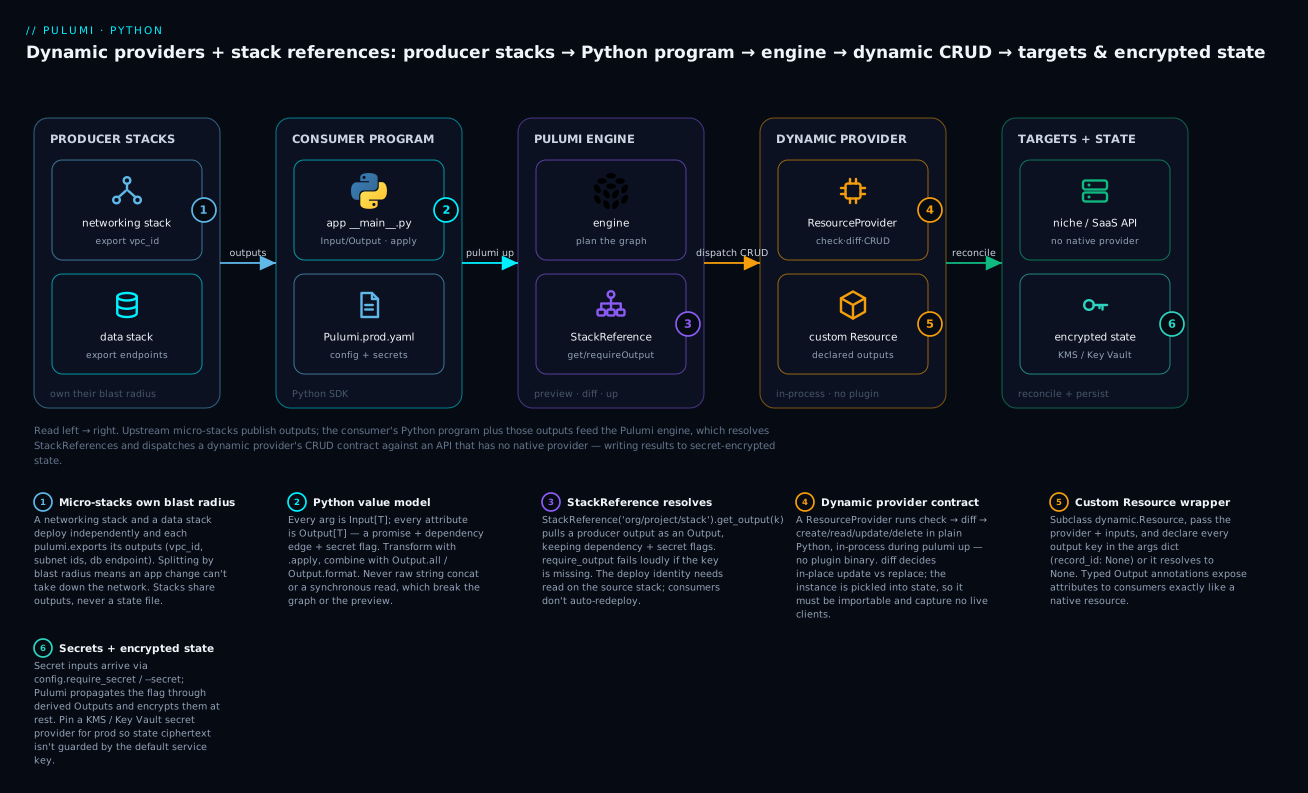
Read the diagram left → right: upstream producer stacks publish outputs, your consumer Python program plus those outputs feed the Pulumi engine, which resolves StackReferences and dispatches a dynamic provider’s CRUD contract against an API that has no native provider — writing the results into secret-encrypted state.
1. The resource model: inputs, outputs, and apply
Before writing a provider you must internalize how Pulumi values flow. Every resource argument is an Input[T]: it may be a plain value, an Output[T], or an Awaitable. Every resource attribute Pulumi gives back is an Output[T]. An Output is a promise plus a dependency edge plus a secret flag. You never read its value synchronously during pulumi up, because at preview time the value may be unknown.
import pulumi
from pulumi_aws import s3

bucket = s3.BucketV2("data")

# WRONG: bucket.id is an Output, not a str. This prints a wrapper.
# resource_name = bucket.id + "-logs"   # works by luck for str-like, but do not rely on it

# RIGHT: transform inside apply; the lambda runs only when the value is known.
log_name = bucket.id.apply(lambda bid: f"{bid}-logs")
Two rules that matter for the provider work below:
applycallbacks do not run during preview when their input is unknown. Never put side effects (API calls, file writes) inapply. Side effects belong in a resource provider.- Combine multiple outputs with
pulumi.Output.all(...)orpulumi.Output.concat(...), not Python string concatenation, so the dependency graph stays correct.
url = pulumi.Output.all(bucket.bucket, bucket.region).apply(
    lambda args: f"https://{args[0]}.s3.{args[1]}.amazonaws.com"
)
Output.format is the readable equivalent of concat:
url = pulumi.Output.format("https://{0}.s3.{1}.amazonaws.com", bucket.bucket, bucket.region)
2. Building a dynamic provider
A dynamic provider is a Python class implementing pulumi.dynamic.ResourceProvider. You subclass pulumi.dynamic.Resource and pass an instance of the provider plus the inputs. The engine calls your provider’s lifecycle methods over its diff loop. The methods you care about are create, update, delete, diff, and optionally check and read.
The example manages a “DNS record” in a fictional REST API that has no Pulumi provider. The principle generalizes to any CRUD API.
# dnsrecord.py
import requests
from pulumi.dynamic import (
    ResourceProvider,
    CreateResult,
    UpdateResult,
    DiffResult,
    CheckResult,
    CheckFailure,
)


class DnsRecordProvider(ResourceProvider):
    def check(self, _olds, news):
        failures = []
        if news.get("type") not in ("A", "AAAA", "CNAME", "TXT"):
            failures.append(CheckFailure("type", "type must be A, AAAA, CNAME, or TXT"))
        return CheckResult(news, failures)

    def create(self, props):
        resp = requests.post(
            f"{props['endpoint']}/zones/{props['zone']}/records",
            headers={"Authorization": f"Bearer {props['token']}"},
            json={"name": props["name"], "type": props["type"], "value": props["value"]},
            timeout=30,
        )
        resp.raise_for_status()
        record = resp.json()
        # outs becomes the resource's outputs; id is the physical identifier.
        return CreateResult(id_=record["id"], outs={**props, "record_id": record["id"]})

    def diff(self, _id, olds, news):
        replaces = []
        # Changing name or type forces replacement; value can be updated in place.
        for field in ("name", "type", "zone"):
            if olds.get(field) != news.get(field):
                replaces.append(field)
        changed = replaces or olds.get("value") != news.get("value")
        return DiffResult(
            changes=changed,
            replaces=replaces,
            delete_before_replace=True,
        )

    def update(self, id_, _olds, news):
        resp = requests.put(
            f"{news['endpoint']}/zones/{news['zone']}/records/{id_}",
            headers={"Authorization": f"Bearer {news['token']}"},
            json={"value": news["value"]},
            timeout=30,
        )
        resp.raise_for_status()
        return UpdateResult(outs={**news, "record_id": id_})

    def delete(self, id_, props):
        resp = requests.delete(
            f"{props['endpoint']}/zones/{props['zone']}/records/{id_}",
            headers={"Authorization": f"Bearer {props['token']}"},
            timeout=30,
        )
        if resp.status_code not in (200, 204, 404):  # 404 == already gone, treat as success
            resp.raise_for_status()
The typed resource wrapper exposes outputs as Output attributes via class-level annotations:
from typing import Optional
import pulumi
from pulumi.dynamic import Resource


class DnsRecord(Resource):
    record_id: pulumi.Output[str]
    name: pulumi.Output[str]

    def __init__(self, name, zone, record_name, type, value, endpoint, token,
                 opts: Optional[pulumi.ResourceOptions] = None):
        super().__init__(
            DnsRecordProvider(),
            name,
            {
                "zone": zone,
                "name": record_name,
                "type": type,
                "value": value,
                "endpoint": endpoint,
                "token": token,
                "record_id": None,  # declared so it is a known output key
            },
            opts,
        )
Why declare
record_id: Nonein the inputs? Any key you want back as an output must exist in the args dict. Pulumi populates it from theoutsyourcreate/updatereturns; if you omit the key, the output attribute resolves toNoneeven when the provider set it.
diff semantics matter
diff is where you control whether a change is an in-place update or a replacement. Get this wrong and you either orphan cloud resources or trigger needless rebuilds. replaces lists the properties whose change forces a new resource. delete_before_replace=True deletes the old resource before creating the new one, which you need when a unique constraint (like a DNS name) would collide if both existed at once. If you return changes=False, Pulumi shows no diff and skips update entirely.
3. Serialization pitfalls and secret inputs
This is the part that trips up nearly everyone. Pulumi serializes your dynamic provider instance, by pickling its __init__-captured state, and stores it in state. At update time it deserializes that pickle and calls your methods. Three consequences:
- The provider class must be importable by a stable path. Do not define the provider class inline in
__main__or inside a function. Put it in a module (dnsrecord.py) so unpickling can locateDnsRecordProvider. - Do not capture unpicklable or environment-specific objects (open sockets, live clients, file handles) in the provider’s
__init__. Build clients inside the lifecycle methods using values passed viaprops, as shown above. Anything the methods need must arrive through the serialized inputs. - Heavy or version-sensitive imports that you capture get pinned into state. Keep providers lean.
For secrets, never pass a raw token as a normal input that lands in plaintext state. Mark it secret so Pulumi encrypts it at rest and redacts it in logs and diffs:
import pulumi

cfg = pulumi.Config()
api_token = cfg.require_secret("dnsApiToken")  # Output[str], flagged secret

record = DnsRecord(
    "www",
    zone="example.com",
    record_name="www",
    type="A",
    value="203.0.113.10",
    endpoint="https://dns.internal.example.com/api",
    token=api_token,  # secret flows through; state encrypts it
)
You can also force individual output properties to be treated as secrets from inside the provider by listing them when constructing results. Pulumi propagates the secret flag through any Output derived from a secret input automatically, so the common case is handled for you as long as the input arrives as a secret.
Caveat: dynamic providers run in process during
pulumi up. Their dependencies are your program’s dependencies, so pinrequests(or whatever SDK) inrequirements.txt. There is no separate provider plugin binary to install.
4. Cross-stack architecture with StackReference
Large estates split into layers: a networking stack, a data stack, an app stack. Each is deployed independently and owns its blast radius. They communicate through stack outputs and StackReference, not shared state files.
Export outputs from the producing stack with pulumi.export:
# networking/__main__.py
import pulumi
from pulumi_aws import ec2

vpc = ec2.Vpc("main", cidr_block="10.0.0.0/16")
private = ec2.Subnet("private-a", vpc_id=vpc.id, cidr_block="10.0.1.0/24",
                     availability_zone="us-east-1a")

pulumi.export("vpc_id", vpc.id)
pulumi.export("private_subnet_ids", pulumi.Output.all(private.id).apply(list))
Consume them in another stack. The reference name is <org>/<project>/<stack> for Pulumi Cloud, or <project>/<stack> when using a self-managed backend without an org:
# app/__main__.py
import pulumi
from pulumi_aws import ec2

net = pulumi.StackReference("acme/networking/prod")

vpc_id = net.get_output("vpc_id")
subnet_ids = net.get_output("private_subnet_ids")

sg = ec2.SecurityGroup("app", vpc_id=vpc_id)
get_output returns an Output, preserving the dependency and secret flags across the boundary. A few operational notes:
- Use
require_output("vpc_id")instead ofget_outputwhen the key is mandatory; it fails loudly at runtime if the output is missing rather than handing you a null. - For values you genuinely need as a plain Python value at program-construction time (rare, and usually a smell),
get_output(...).apply(...)is still the right tool; do not block on outputs. - A consuming stack does not auto-redeploy when the producer changes. Re-run the consumer after the producer publishes new outputs. Wiring this ordering is a CI/CD concern (see section 8).
The StackReference resource needs read access to the referenced stack’s state. With Pulumi Cloud that means the deploying identity must have read permission on the source stack.
5. Per-environment config, ESC, and secret providers
Each stack carries its own config file (Pulumi.dev.yaml, Pulumi.prod.yaml). Set plain and secret values with the CLI:
pulumi config set aws:region us-east-1
pulumi config set app:replicas 3
pulumi config set --secret app:dnsApiToken 'tok_live_xxx'
Secrets are encrypted with the stack’s secret provider. The default is the Pulumi Cloud service, but for self-managed backends or stricter key custody you should pin a KMS-backed provider when you initialize the stack:
pulumi stack init prod --secrets-provider="awskms://alias/pulumi-prod?region=us-east-1"
# Azure Key Vault and GCP KMS are equivalent:
#   azurekeyvault://<vault>.vault.azure.net/keys/<key>
#   gcpkms://projects/<p>/locations/<l>/keyRings/<r>/cryptoKeys/<k>
ESC: Environments, Secrets, and Configuration
For secrets and config that span many stacks, Pulumi ESC centralizes them and can broker short-lived cloud credentials via OIDC instead of static keys. Define an environment once, then import it from any stack’s config under the environment key.
# imported via: pulumi env init acme/aws-prod, then edited
values:
  aws:
    login:
      fn::open::aws-login:
        oidc:
          roleArn: arn:aws:iam::111122223333:role/pulumi-deploy
          sessionName: pulumi
          duration: 1h
  environmentVariables:
    AWS_ACCESS_KEY_ID: ${aws.login.accessKeyId}
    AWS_SECRET_ACCESS_KEY: ${aws.login.secretAccessKey}
    AWS_SESSION_TOKEN: ${aws.login.sessionToken}
# Pulumi.prod.yaml
environment:
  - aws-prod
config:
  app:replicas: 5
This is how you stop storing long-lived cloud keys in CI: ESC mints temporary credentials per run, and aws:region-style config still lives in the stack file.
6. Component resources for reusable, typed abstractions
A ComponentResource groups child resources under one logical node and is your unit of reuse, the Pulumi answer to a Terraform module, but with types. Define typed args with a dataclass, register outputs, and always set parent on children.
from dataclasses import dataclass
from typing import Optional
import pulumi
from pulumi_aws import s3


@dataclass
class StaticSiteArgs:
    index_document: str = "index.html"
    versioned: bool = True


class StaticSite(pulumi.ComponentResource):
    bucket_name: pulumi.Output[str]
    website_endpoint: pulumi.Output[str]

    def __init__(self, name: str, args: StaticSiteArgs,
                 opts: Optional[pulumi.ResourceOptions] = None):
        super().__init__("acme:web:StaticSite", name, {}, opts)
        child = pulumi.ResourceOptions(parent=self)

        bucket = s3.BucketV2(f"{name}-bucket", opts=child)
        if args.versioned:
            s3.BucketVersioningV2(
                f"{name}-ver",
                bucket=bucket.id,
                versioning_configuration={"status": "Enabled"},
                opts=child,
            )
        website = s3.BucketWebsiteConfigurationV2(
            f"{name}-web",
            bucket=bucket.id,
            index_document={"suffix": args.index_document},
            opts=child,
        )

        self.bucket_name = bucket.bucket
        self.website_endpoint = website.website_endpoint
        # Surfaces these as outputs and finalizes the component in the graph.
        self.register_outputs({
            "bucket_name": self.bucket_name,
            "website_endpoint": self.website_endpoint,
        })
The first argument to super().__init__ is the component’s type token (package:module:Type). Setting parent=self on every child nests them in pulumi stack graph and ties their lifecycle to the component. Forgetting register_outputs leaves the component half-constructed in state.
7. Testing with mocks and policy with CrossGuard
Pulumi’s unit-test framework swaps the engine for a mock so tests run with no cloud calls and no real pulumi up. Implement pulumi.runtime.Mocks, set it before importing your program, then assert on resource properties resolved through apply.
# test_infra.py
import pulumi


class Mocks(pulumi.runtime.Mocks):
    def new_resource(self, args: pulumi.runtime.MockResourceArgs):
        # Return (id, state). state echoes inputs plus computed fields.
        return [args.name + "_id", {**args.inputs, "arn": "arn:fake:" + args.name}]

    def call(self, args: pulumi.runtime.MockCallArgs):
        return {}


pulumi.runtime.set_mocks(Mocks(), preview=False)

import infra  # import AFTER set_mocks so resources register against the mock


@pulumi.runtime.test
def test_bucket_is_versioned():
    def check(args):
        status = args[0]
        assert status == "Enabled", "production buckets must be versioned"
    return infra.site_versioning.versioning_configuration.apply(
        lambda c: pulumi.Output.from_input([c["status"]])
    ).apply(check)
The @pulumi.runtime.test decorator handles the async output resolution; return an Output (or a coroutine) so the framework waits for assertions inside apply. Run with pytest.
For org-wide guardrails that run during preview and up, write a CrossGuard policy pack in Python. Policies fail the deployment when violated, so they gate every stack, not just the ones with tests.
# policy/__main__.py
from pulumi_policy import (
    PolicyPack, ResourceValidationPolicy, EnforcementLevel, ReportViolation,
)


def s3_no_public_acl(args, report: ReportViolation):
    if args.resource_type == "aws:s3/bucketV2:BucketV2":
        if args.props.get("acl") == "public-read":
            report("S3 buckets must not be public-read")


PolicyPack(
    name="acme-baseline",
    enforcement_level=EnforcementLevel.MANDATORY,
    policies=[
        ResourceValidationPolicy(
            name="s3-no-public-acl",
            description="Disallow public-read S3 buckets",
            validate=s3_no_public_acl,
        ),
    ],
)
pulumi preview --policy-pack ./policy
8. CI/CD: preview gating and update with the GitHub Action
The discipline that makes this safe is: preview on every pull request, comment the diff, require approval, then update on merge. Use the official pulumi/actions@v6 action with OIDC so no static cloud or Pulumi tokens sit in the repo.
# .github/workflows/pulumi.yml
name: pulumi
on:
  pull_request:
    branches: [main]
  push:
    branches: [main]

permissions:
  id-token: write       # OIDC to cloud and to Pulumi
  contents: read
  pull-requests: write  # so the action can comment the preview

jobs:
  preview:
    if: github.event_name == 'pull_request'
    runs-on: ubuntu-latest
    steps:
      - uses: actions/checkout@v4
      - uses: actions/setup-python@v5
        with:
          python-version: "3.12"
      - run: pip install -r requirements.txt
      - uses: pulumi/actions@v6
        with:
          command: preview
          stack-name: acme/app/prod
          comment-on-pr: true

  update:
    if: github.event_name == 'push'
    runs-on: ubuntu-latest
    environment: production   # GitHub Environment protection rule = approval gate
    steps:
      - uses: actions/checkout@v4
      - uses: actions/setup-python@v5
        with:
          python-version: "3.12"
      - run: pip install -r requirements.txt
      - uses: pulumi/actions@v6
        with:
          command: up
          stack-name: acme/app/prod
Two gating mechanisms are doing the work. The pull_request job runs preview and posts the plan as a PR comment so a human reviews the diff. The push job is bound to a GitHub Environment (production) with a required-reviewers protection rule, so the merge-to-deploy step blocks until approved. For multi-stack ordering, run the producer stack’s up job before the consumer’s, gated on success, so StackReference consumers see fresh outputs.
Verify
Run these to confirm each piece behaves. The dynamic provider:
pulumi preview                       # should show the DnsRecord with known/unknown props
pulumi up --yes                      # create() runs; record_id appears in outputs
pulumi stack output --show-secrets   # token is encrypted at rest, decrypted only here
pulumi up --yes                      # change value only -> in-place update, no replace
pulumi destroy --yes                 # delete() runs; 404 tolerated as success
Confirm secrets never leak to plaintext state. With a self-managed backend you can inspect the export:
pulumi stack export | python -c "import json,sys; \
  s=json.load(sys.stdin); \
  print('SECRETS PRESENT' if 'ciphertext' in json.dumps(s) else 'NO CIPHERTEXT')"
Validate cross-stack wiring and policy:
pulumi stack output vpc_id --stack acme/networking/prod   # producer exports it
pulumi preview --stack acme/app/prod                      # consumer resolves the reference
pulumi preview --policy-pack ./policy                     # MANDATORY policy blocks violations
pytest -q                                                 # mocks run with zero cloud calls
Expected results: pulumi up on a value-only change reports ~ update (not +- replace); a public-read bucket fails preview under the policy pack with a non-zero exit; pytest passes offline; and the stack export shows ciphertext for the token, never the raw value.
Checklist
Going deeper
The sections above are the working code. This section is the why underneath it — the full lifecycle contract, where the code actually runs, and the architectural calls (dynamic vs real provider, micro-stacks vs monolith) that separate a demo from a platform.
The full ResourceProvider lifecycle contract
Section 2 showed the common methods. Here is the complete contract, in roughly the order the engine calls them, and the guarantee each one owes.
| Method | Signature | Called during | Returns | Purity / side effects |
|---|---|---|---|---|
check |
check(olds, news) |
every op, first | CheckResult(inputs, failures) |
pure — validate/normalize only, no API calls |
diff |
diff(id, olds, news) |
preview + up |
DiffResult(changes, replaces, stables, delete_before_replace) |
pure — deterministic, no API calls |
create |
create(props) |
first up, and after a replace |
CreateResult(id_, outs) |
side-effecting — the real POST |
read |
read(id, props) |
pulumi refresh |
ReadResult(id_, outs) |
read-only — GET current truth |
update |
update(id, olds, news) |
diff reported changes, no replaces |
UpdateResult(outs) |
side-effecting — PUT/PATCH |
delete |
delete(id, props) |
destroy, or before a replace |
None |
side-effecting — DELETE, tolerate 404 |
A few contract details people miss:
checkis your normalization hook, not just validation. Whateverinputsyou return inCheckResultbecomes thenewsthatdiffandcreatesee. Fill in defaults, lower-case a region, sort a list — do it here sodiffcompares apples to apples and doesn’t report phantom changes.checkmust be pure: no network calls, because it runs on every operation including a plainpreview.diffdecides the single most important thing: in-place update vs replacement.changes=True/Falsegates whetherupdateruns at all.replaces=[...]lists properties whose change forces a destroy-and-recreate.delete_before_replace=Trueflips the default create-then-delete ordering to delete-then-create — mandatory when a unique constraint (a DNS name, a unique slug) would collide if the old and new both existed for a moment.stables=[...]promises the engine that certain properties will not change, which sharpens preview output.diffmust be deterministic: given the sameolds/newsit must always return the same result, or previews and updates disagree.readis the method everyone skips and later regrets. It powerspulumi refresh: the engine callsreadto fetch the resource’s actual current state from the API and reconcile it against your model, which is how drift is detected. Omitreadandrefreshis effectively a no-op for your resource — you lose the ability to notice that someone changed the record by hand.create/updatereturnouts, and thoseoutsare all a consumer ever sees. If your API returns a computed field (a serial number, an FQDN), put it inoutsor it never reaches anOutput. And every key you want as an output must already exist in the resource’s args dict (therecord_id: Nonetrick from section 2).deletemust be idempotent against “already gone.” A 404 on delete means success, not failure — as the original example handles. Networks retry; a delete that half-succeeded and then retried should not wedge your stack.
Where the code runs, and the pickle boundary
A dynamic provider is not a plugin. There is no separate binary, no gRPC provider process, no pulumi plugin install. Your ResourceProvider subclass runs in the same Python runtime as your program, inside the language host the engine launches for pulumi up. Two things follow, and both bite in production:
- The provider’s dependencies are your program’s dependencies. If
createcallsrequests, thenrequestsmust be in the samerequirements.txtas your Pulumi program, pinned. There is no isolated plugin environment to hide a version in. - The provider instance is serialized (pickled) into your stack state, then deserialized and re-invoked on the next operation — possibly on a different machine (a CI runner). That is why the class must live at a stable, importable module path (never in
__main__or a closure), and why you must never capture live clients, sockets, or file handles in__init__. The safe pattern is the one the example uses: capture nothing heavy; build the HTTP client inside each lifecycle method from values passed throughprops.
The practical rule: treat the provider class as pure code and the resource inputs as the only data channel. Everything a method needs must arrive via props/news — including secrets, which arrive already decrypted inside the method but stay encrypted in state.
Dynamic provider vs a real provider — when to reach for which
| Dynamic provider | Real (native / bridged) provider | |
|---|---|---|
| Language reach | The one language you wrote it in (here, Python) | All Pulumi languages (TS, Python, Go, .NET, Java) |
| Distribution | Ships inside your program’s code + deps | Published plugin + generated SDKs, versioned |
| Where it runs | In-process, in your program’s runtime | Separate plugin process over gRPC |
| State footprint | Provider pickled into state | Only a plugin version reference |
| Effort to build | Minutes — one class | Days — schema, SDK gen, or a Terraform bridge |
| Best for | One internal / niche API, a Python-only team, a small surface | A reusable, multi-team, multi-language, large API surface |
Reach for a dynamic provider when the API is small, internal, and you just need it managed now from a Python codebase. Graduate to a real provider (write one with the provider SDK, or wrap an existing Terraform provider with the pulumi-terraform-bridge) when other teams in other languages need it, when the surface is large, or when you want a versioned, independently-releasable plugin. A dynamic provider that three teams start copy-pasting is a real provider waiting to be born.
StackReference in depth: names, require_output, and secrets
The reference name has two forms:
<org>/<project>/<stack>on Pulumi Cloud (organization-scoped).<project>/<stack>on a self-managed backend (S3 / Azure Blob / GCS / local) with no organization.
You can reference a stack in the same project or a different one, and across organizations if your identity has read access to the source stack’s state.
get_output(name) |
require_output(name) |
|
|---|---|---|
| Missing key | Returns an Output wrapping None — fails later, somewhere confusing |
Fails now, loudly, naming the key |
| Use for | Optional / best-effort values | Every mandatory dependency (the common case) |
| Return type | Output[Any] |
Output[Any] |
Prefer require_output for anything your stack cannot run without. A null vpc_id that surfaces three resources later as an opaque provider error costs far more debugging time than a clear “output vpc_id not found.”
Secret propagation is the subtle part. If the producer exports a secret —
# producer/__main__.py
db_password = pulumi.Config().require_secret("dbPassword")
pulumi.export("db_password", db_password)   # exported as a secret
— then the consumer’s stack_ref.require_output("db_password") comes back as a secret Output, and it stays encrypted in the consumer’s state automatically. The dependency edge and the secret flag both survive the crossing. The trap: .apply(lambda p: print(p)) (or logging it) will happily print the plaintext, because your apply callback receives the decrypted value. Secretness protects state and diffs, not your own print statements. Never log a value derived from a secret output.
One operational reality worth repeating: a consumer does not auto-redeploy when the producer publishes new outputs. StackReference reads the producer’s last committed outputs at the moment the consumer runs. If networking ships a new subnet, the app stack keeps using the old set until you re-run it. Wiring producer-then-consumer ordering is a CI/CD job (section 8).
Python’s output plumbing, precisely
value.apply(fn)transforms one output;fnruns only when the value is known (never during preview if unknown), and iffnreturns anOutput, Pulumi flattens it — no nestedOutput[Output[T]].pulumi.Output.all(a, b)combines outputs intoOutput[list]; the keyword formpulumi.Output.all(vpc=vpc.id, sn=subnet.id)returnsOutput[dict], which reads far better than positional indices inside theapply.pulumi.Output.concat(...)andpulumi.Output.format("{0}/{1}", a, b)build strings while preserving dependencies — always prefer these to Python+or f-strings on raw outputs.pulumi.Output.secret(x)/pulumi.secret(x)mark a value secret;pulumi.export(name, value)publishes a top-level stack output.- During
preview, outputs of not-yet-created resources are unknown; yourapplycallbacks are skipped for them, which is exactly why side effects must never live inapply.
# keyword Output.all reads cleanly and keeps the dependency graph intact
endpoint = pulumi.Output.all(host=db.address, port=db.port).apply(
    lambda a: f"postgres://{a['host']}:{a['port']}/app"
)
ComponentResource in Python, and multi-language reuse
Section 6 built one; the depth points: the first super().__init__ argument is the type token package:module:Type, and it must be globally unique and stable — it is how the resource shows up in state and in the graph. Always pass pulumi.ResourceOptions(parent=self) to every child so the component nests correctly and its children’s lifecycle ties to it. Call register_outputs(...) exactly once at the end; skip it and the component is left half-registered, which shows up as odd pulumi up behavior. A ComponentResource can be packaged as a multi-language component (MLC) so a TypeScript or Go stack can consume a component you authored in Python — the same graduation path as dynamic → real provider, applied to abstractions.
Provider and dependency versioning
Two different pinning stories, often conflated:
- Real providers: the plugin version is tied to the SDK package version. Pin
pulumi-aws==6.*(or an exact version) inrequirements.txt; Pulumi resolves the matching plugin. For surgical control, setversion=(andplugin_download_url=) on an explicit provider resource, or viapulumi.ResourceOptions(version=...)for a single resource. Never let prod float on “latest.” - Dynamic providers: there is no version recorded in state — the pickled provider references your module, so behavior tracks whatever your code says at the next
pulumi up. This cuts both ways. It means (a) pin the runtime libraries the provider calls (requests, an SDK) inrequirements.txt; and (b) treat the provider class path as an API — renaming or movingDnsRecordProviderbreaks unpickling of every existing resource in state, forcing a painful migration. Evolve behavior through inputs and additive fields, not by relocating the class.
Micro-stacks vs a monolith
Splitting one giant stack into a networking / data / app chain is the norm at scale, but each split has a cost.
| Axis | Monolith (one stack) | Micro-stacks (per layer) |
|---|---|---|
| Blast radius | One bad diff can touch everything | Isolated per layer — an app change can’t drop the VPC |
| Deploy speed | Whole graph every time | Only the changed layer |
| Ordering | Implicit (one graph) | Explicit — you sequence producer → consumer in CI |
| Coupling | Direct references | One StackReference per edge; re-run consumers after producers |
| Team ownership | Shared, contended | Clean per-team boundaries + cadence |
| Refactor cost | Low within the stack | Moving a resource across stacks needs pulumi state surgery |
Split on blast-radius, ownership, and lifecycle-cadence boundaries — the network changes monthly and is owned by one team; the app changes hourly and is owned by another; those belong in different stacks. Do not split arbitrarily: every seam adds a StackReference dependency and a CI ordering constraint, and a dozen chatty micro-stacks that must all deploy together is just a distributed monolith with extra latency.
Practice challenges
Work these in a scratch Pulumi project (pulumi new python -y in an empty directory). They escalate from output plumbing to a full dynamic-provider drift check. Each solution is one correct approach with a one-line reason — try it before you open the toggle.
Challenge 1 — Combine two outputs without breaking the graph (beginner)
Given bucket.bucket and bucket.region, build the virtual-hosted S3 URL as an Output[str]. Do not use a Python f-string on the raw outputs.
<details> <summary>Solution</summary>
url = pulumi.Output.format(
    "https://{0}.s3.{1}.amazonaws.com", bucket.bucket, bucket.region
)
# or: pulumi.Output.all(b=bucket.bucket, r=bucket.region).apply(
#         lambda a: f"https://{a['b']}.s3.{a['r']}.amazonaws.com")
Why: Output.format / Output.all keep the dependency edges; f-string concatenation on a raw Output stringifies the wrapper and drops the graph.
</details>
Challenge 2 — Hand a value between two stacks (beginner–intermediate)
The producer stack exports vpc_id. In a second stack, read it so the program fails immediately if the key is missing, and attach a security group to that VPC.
<details> <summary>Solution</summary>
# producer/__main__.py
pulumi.export("vpc_id", vpc.id)

# consumer/__main__.py
net = pulumi.StackReference("acme/networking/prod")
vpc_id = net.require_output("vpc_id")          # loud failure if absent
sg = ec2.SecurityGroup("app", vpc_id=vpc_id)
Why: require_output fails at resolution with a clear message; get_output would hand you a null that explodes confusingly downstream.
</details>
Challenge 3 — Validate input in a dynamic provider (intermediate)
Extend DnsRecordProvider so a ttl below 30 is rejected before any API call, with a clear per-property message.
<details> <summary>Solution</summary>
def check(self, _olds, news):
    failures = []
    if int(news.get("ttl", 0)) < 30:
        failures.append(CheckFailure("ttl", "ttl must be >= 30 seconds"))
    return CheckResult(news, failures)
Why: check runs first and is pure — rejecting bad input here stops it before create/update ever touch the network.
</details>
Challenge 4 — Force a replacement with correct ordering (intermediate)
Make changing a record’s name replace the resource, deleting the old one before creating the new one so the unique DNS name never collides.
<details> <summary>Solution</summary>
def diff(self, _id, olds, news):
    replaces = [f for f in ("name", "type", "zone") if olds.get(f) != news.get(f)]
    return DiffResult(
        changes=bool(replaces) or olds.get("value") != news.get("value"),
        replaces=replaces,
        delete_before_replace=True,
    )
Why: listing name in replaces forces a recreate; delete_before_replace=True avoids two records fighting over the same unique name.
</details>
Challenge 5 — Add drift detection with read (advanced)
Implement read so pulumi refresh reconciles the record against the live API and detects out-of-band edits.
<details> <summary>Solution</summary>
from pulumi.dynamic import ReadResult

def read(self, id_, props):
    resp = requests.get(
        f"{props['endpoint']}/zones/{props['zone']}/records/{id_}",
        headers={"Authorization": f"Bearer {props['token']}"},
        timeout=30,
    )
    if resp.status_code == 404:
        return ReadResult(id_=None, outs={})   # gone → engine drops it from state
    resp.raise_for_status()
    live = resp.json()
    return ReadResult(id_=id_, outs={**props, "value": live["value"], "record_id": id_})
Then run pulumi refresh. Why: refresh calls read to fetch actual state; returning the live value lets Pulumi surface drift, and id_=None tells it the resource no longer exists.
</details>
Challenge 6 — Prove a secret survives the stack boundary (advanced)
Export a secret from the producer, consume it in another stack, and prove the consumer’s state stores ciphertext, not plaintext.
<details> <summary>Solution</summary>
# producer/__main__.py
token = pulumi.Config().require_secret("apiToken")
pulumi.export("api_token", token)                       # secret export

# consumer/__main__.py
up = pulumi.StackReference("acme/producer/prod")
api_token = up.require_output("api_token")              # comes back SECRET
# ...use api_token as a secret input; never print it
pulumi stack export --stack acme/consumer/prod \
  | python -c "import json,sys; s=json.load(sys.stdin); \
    print('OK ciphertext' if 'ciphertext' in json.dumps(s) else 'LEAK plaintext')"
Why: Pulumi propagates the secret flag through require_output, so the value is encrypted in the consumer’s checkpoint — the export shows ciphertext, never the raw token.
</details>
Common beginner mistakes
- “
bucket.idis a string, I’ll just concatenate it.” It is anOutput[str]— a promise, not a value. Reading or+-ing it drops the dependency graph and may run before the value exists. Right model: every attribute is anOutput; transform inside.apply, combine withOutput.all/Output.format. - Defining the provider class inline in
__main__or a closure. It cannot be unpickled from state later, so the nextpulumi up(especially on a fresh CI runner) fails to locate the class. Right model: the provider lives in its own importable module at a stable path. - Capturing a live client, socket, or file handle in the provider’s
__init__. Those are not picklable and are machine-specific; deserialization breaks or misbehaves. Right model: capture nothing heavy; build clients inside each lifecycle method fromprops. - Forgetting to declare an output key in the args dict. If
record_idisn’t in the inputs (even asNone), the output attribute resolves toNoneno matter whatcreatereturns. Right model: declare every key you want back as an output. - Using
get_outputfor a mandatory dependency. A missing key silently becomesNoneand detonates far downstream. Right model:require_outputfor anything the stack can’t run without. - Passing a token as a normal input. It lands in plaintext in state and shows up in diffs and logs. Right model:
config.require_secret(...)/pulumi config set --secret, and let the secret flag propagate. - Putting side effects (API calls, writes) inside
.apply.applycallbacks are skipped during preview and run at unpredictable times; side effects belong in a provider’s lifecycle methods. Right model:applytransforms values; providers change the world. - Expecting a consumer to auto-redeploy when the producer changes.
StackReferencereads the last-published outputs; nothing re-runs the consumer for you. Right model: sequence producer → consumer in CI. - Splitting into micro-stacks for their own sake. Every seam adds a
StackReferenceand a CI ordering constraint; too many chatty stacks is a distributed monolith. Right model: split on blast-radius, ownership, and cadence — not arbitrarily. - Renaming or moving the dynamic provider class after resources exist. The class path is baked into pickled state; moving it breaks unpickling of live resources. Right model: treat the class path as a stable API and evolve behavior through inputs.
Glossary
Input[T]— A resource argument that may be a plain value, anOutput[T], or an awaitable. What you pass in.Output[T]— What Pulumi hands back: a promise of a future value, plus a dependency edge, plus a secret flag. Never read synchronously.apply—Output.apply(fn)transforms an output’s value once it is known and returns a newOutput. Auto-flattens iffnreturns anOutput.Output.all/Output.format/Output.concat— Combine multiple outputs while preserving dependencies (a list, or a dict via the keyword form). Use instead of Python string ops on raw outputs.- Secret (Output flag) — A marker that an output is sensitive; Pulumi encrypts it in state, redacts it in logs/diffs, and propagates the flag to derived outputs.
- Dynamic provider — A
pulumi.dynamic.ResourceProvidersubclass that implements a resource’s lifecycle in your program’s language, for an API with no native provider. Runs in-process. ResourceProvider— The interface whose methods (check,diff,create,read,update,delete) the engine calls over its diff loop.CheckResult/DiffResult/CreateResult/UpdateResult/ReadResult— The typed return values of the lifecycle methods; theoutsin the create/update/read results become the resource’s outputs.replaces/delete_before_replace—DiffResultfields: which property changes force a recreate, and whether to delete the old resource before creating the new (for unique-constraint fields).check— The pure, first-called method that validates and normalizes inputs before any diff or API call.read— The read-only method that fetches live state; powerspulumi refreshand drift detection.- Pickle / serialization boundary — A dynamic provider instance is serialized into state and re-invoked later, so it must be importable and capture no live objects.
- Stack — One independently-deployed instance of a Pulumi project + config (e.g.
dev,prod), with its own state and outputs. StackReference— A resource that reads another stack’s outputs asOutputs, named<org>/<project>/<stack>(Cloud) or<project>/<stack>(self-managed).get_output/require_output— Read a referenced stack’s output;require_outputfails loudly if the key is absent.pulumi.export— Publishes a top-level stack output for other stacks (or humans) to consume.ComponentResource— A logical grouping of child resources under one type-token node; Pulumi’s typed answer to a Terraform module.register_outputs— The call that finalizes a component and surfaces its outputs; skipping it half-registers the component.- Type token — The
package:module:Typeidentifier passed to a component/provider; must be unique and stable. - Secret provider — The key backend that encrypts a stack’s secrets (the Pulumi service, or KMS / Key Vault / GCP KMS via
--secrets-provider). - ESC (Environments, Secrets, Configuration) — Pulumi’s central store for cross-stack config and OIDC-brokered short-lived cloud credentials.
- CrossGuard — Pulumi’s policy-as-code framework; policy packs that fail
preview/upon violations. - Blast radius — The set of resources one change can affect; the primary axis for deciding stack boundaries.
- Micro-stack — A small, single-purpose stack (networking, data, app) wired to others via
StackReference, owning its own blast radius.