Quick take: A defect is cheapest to fix in the minute it was written and most expensive after it ships. Shift-left moves tests and security scans as early in the lifecycle as they can credibly run, and quality gates turn the results into a yes/no decision that stops bad code from advancing. Done well, this is fast feedback and a wall against regressions. Done badly, it’s a slow pipeline full of false positives that engineers learn to bypass.
A penetration test flags a SQL-injection vulnerability in production. It has been live for three months. Tracing it back, the flaw was in the very first commit of the feature — a string-concatenated query — and a SAST (static application security testing) scanner would have caught it in under a second on the pull request that introduced it. Nobody scanned, because scanning wasn’t wired in. The remediation now costs an emergency change, a customer notification, a post-incident review, and a week of an engineer’s time. The same finding, surfaced on the PR, would have cost ninety seconds and a one-line fix while the author still had the code in their head.
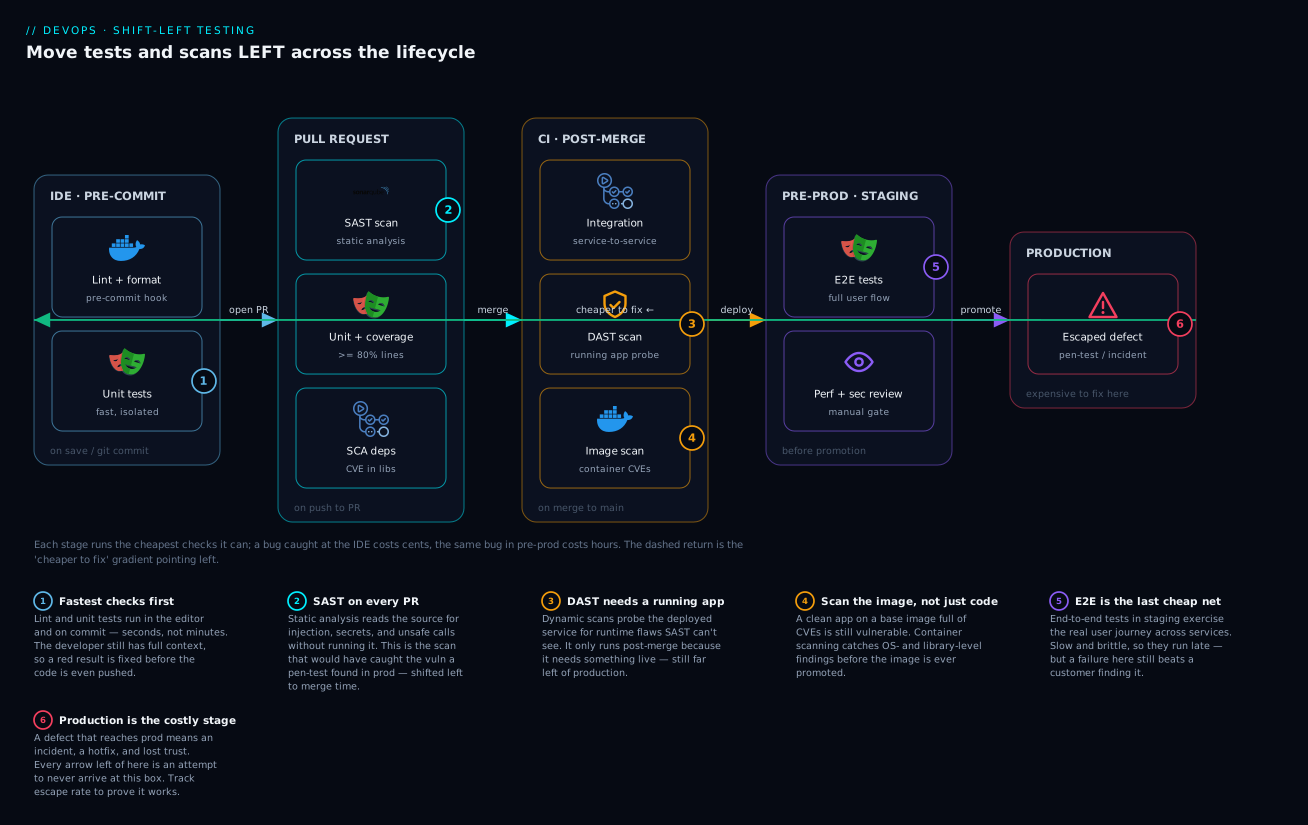
That gap — ninety seconds versus a week — is the entire economic argument for shift-left. “Left” is a direction on the timeline that runs left-to-right from idea → code → build → test → release → operate. Every check has a natural place it can run, and an earliest place it can run. Shift-left is the discipline of moving each check toward its earliest credible position: lint and unit tests at commit, SAST/SCA and integration tests on the pull request, DAST and end-to-end tests against a deployed staging build, and a thin layer of synthetic checks in production. A quality gate is the enforcement mechanism — a checkpoint that reads the results of those checks and either lets the change pass or fails the build with an actionable reason.
This article is the working playbook. You will learn the test pyramid and why its shape matters, exactly where each test type and each scan type runs across the lifecycle, how to define quality-gate thresholds (coverage, severity, duplication, new-code vs whole-code) that are strict without being theatrical, how SAST, DAST and SCA differ and where each belongs, how to handle the two hardest realities — flaky tests and a failed gate at the worst possible moment — and how to express all of it as real CI YAML in GitHub Actions, GitLab CI and Azure Pipelines. The goal is a pipeline your team trusts enough to not override, because every red gate has earned its red.
What problem this solves
The pain shift-left addresses is the cost curve of a defect. The same bug costs more at every stage it survives: trivial at authoring, a few minutes in code review, an hour in QA, a day in staging, and — once in production — an incident, a hotfix, a rollback, possibly a breach and a regulator. The numbers vary by study, but the shape is universal and steep: each stage rightward is roughly an order of magnitude more expensive than the last, because more people, more context-switching, and more blast radius get involved. Without shift-left, defects accumulate and surface late, in the most expensive place, at the worst time.
What breaks without it is predictable. Quality becomes a phase, not a property — a QA team at the end of the pipeline that’s perpetually behind, a security review that’s a release-blocking bottleneck nobody scheduled time for, and a “test environment” where bugs are found days after they were written by someone who no longer remembers the code. Defects escape to production not because the team is careless but because nothing between the keyboard and prod was empowered to say “no.” Releases become scary, so they become rare, so each one is huge, so each one is risky — the opposite of the small, frequent, boring deploys that high-performing teams ship.
Who hits this: essentially every team that ships software, but it bites hardest on teams under three specific pressures. Teams with compliance obligations (PCI-DSS, SOC 2, HIPAA) who must prove that code was scanned and reviewed and can’t if scanning is ad hoc. Teams with fast release cadence where there’s no time for a manual QA gate, so the gate must be automated or it doesn’t exist. And teams carrying security debt — a backlog of vulnerabilities that grows faster than anyone can triage it, because nothing stops new ones from arriving. Shift-left is how each of these turns quality from a heroic end-of-cycle scramble into a continuous, automated property of every change. The fix is almost never “add a bigger QA team at the end” — it’s “move the checks left and let a gate enforce them.”
Before the deep dive, here is the whole field in one frame: the check classes this article covers, the question each answers, and where it naturally runs.
| Check class | Question it answers | Earliest credible stage | Blocks what |
|---|---|---|---|
| Lint / format / typecheck | “Is this code well-formed and consistent?” | Pre-commit / commit | Style drift, obvious type errors |
| Unit tests | “Does each unit behave as specified?” | Commit / PR | Logic regressions |
| SCA (dependency scan) | “Are my third-party libraries vulnerable?” | PR (and continuously) | Known CVEs in dependencies |
| SAST (static code scan) | “Does my own code contain insecure patterns?” | PR | Injection, hardcoded secrets, weak crypto |
| Integration tests | “Do my components work together?” | PR (with services) | Contract / wiring breaks |
| Secret scanning | “Did a credential leak into the diff?” | Pre-commit + PR + push | Leaked keys before they merge |
| IaC / container scan | “Is my infra/image misconfigured?” | PR | Open S3 buckets, root containers |
| DAST (running-app scan) | “Is the deployed app exploitable?” | Staging (post-deploy) | Runtime auth / header / config flaws |
| End-to-end tests | “Do critical user journeys work?” | Staging (post-deploy) | Broken user-facing flows |
| Synthetic / smoke | “Is production actually serving?” | Production (post-deploy) | A bad deploy that passed everything else |
Learning objectives
By the end of this article you can:
- Explain the shift-left principle in cost-of-defect terms and identify the earliest credible stage for any given check.
- Draw and defend the test pyramid — unit, integration, end-to-end — and diagnose an “ice-cream cone” anti-pattern that makes a suite slow and flaky.
- Place every test type and every security scan (SAST, DAST, SCA, secret scanning, IaC/container scanning) at the right lifecycle stage and explain why it belongs there.
- Define quality-gate thresholds that hold the line — coverage on new code, severity cutoffs, duplication, and the new-code vs overall-code distinction that makes gates adoptable on legacy systems.
- Distinguish SAST, DAST and SCA by what they see, when they run, their false-positive profile, and what each one will and won’t catch.
- Tame flaky tests with quarantine, retries-with-caution, and root-cause categories — and explain why a high-flake suite silently destroys trust in the whole gate.
- Run a disciplined gate-failure playbook: triage a red gate, decide fix-forward vs revert vs break-glass override, and keep the override auditable.
- Write working quality-gate CI YAML for GitHub Actions, GitLab CI and Azure Pipelines, with the fast-checks-first ordering that keeps feedback under ten minutes.
Prerequisites & where this fits
You should be comfortable with a CI/CD pipeline as a concept — a series of automated stages triggered by a commit or pull request — and with the basic vocabulary of testing (a unit test, an assertion, code coverage). You should know what a pull request (or merge request) is and that branch protection can require checks to pass before merge. Hands-on familiarity with at least one CI system (GitHub Actions, GitLab CI, Jenkins or Azure Pipelines) helps, since the back half of this article is YAML. You do not need prior security-scanning experience; SAST/DAST/SCA are defined from first principles here.
This sits in the delivery quality track and is upstream of almost everything else in CI/CD. It assumes the pipeline mechanics from CI/CD Pipelines Explained: From Code Commit to Production and pairs tightly with CI/CD Secrets and Credential Management: Secure Your Pipelines, because secret scanning is a shift-left check and your scanners themselves need credentials handled correctly. The dependency side connects to Artifact Registries and Package Management in CI/CD (where SCA reads your lockfiles) and to Eliminating Secret Sprawl: Pipeline Scanning, Push Protection, and Leaked-Credential Remediation on the secrets axis. Downstream, the gate is what gives Deployment Strategies: Blue-Green, Canary and Rolling Updates and Progressive Delivery and Feature Flags: Release Without Fear something safe to promote, and the escape-rate metrics it produces feed DORA Metrics and Platform Engineering: Measure and Scale Delivery.
A quick map of who owns what, so you wire the right team into each check:
| Stage | What runs here | Who usually owns it | Typical budget |
|---|---|---|---|
| Local / pre-commit | Format, lint, secret scan, fast unit subset | Each developer | < 5 s, must feel instant |
| Commit / push CI | Lint, full unit tests, build, SCA, SAST | App team + platform | Target < 10 min |
| Pull request gate | All of the above + integration tests + coverage gate | App team (gate config: platform) | < 15 min to a verdict |
| Post-merge / staging | E2E, DAST, performance smoke | QA + security | Minutes to ~1 hr |
| Production deploy | Synthetic, smoke, canary analysis | SRE / on-call | Continuous |
Core concepts
Five mental models make every later decision obvious.
Left is earlier, and earlier is cheaper. Picture the lifecycle as a horizontal timeline. A bug introduced at the keyboard and caught at the keyboard costs almost nothing — the author fixes it before anyone else sees it. The same bug caught in code review costs a review round-trip. In QA, it costs a bug ticket and a context-switch back to code the author has half-forgotten. In production, it costs an incident. “Shift-left” literally means: take a check that today runs far to the right and move it as far left as it can credibly run. Credibly is the constraint — you cannot run a DAST scan on a commit because there’s no running app yet; the earliest credible place for DAST is a deployed staging build. The art is finding each check’s true leftmost home, not jamming everything into the commit hook.
The test pyramid is about ratio, speed and stability, not just types. A healthy suite has many fast, isolated unit tests at the base, fewer medium-speed integration tests in the middle, and a thin layer of slow, brittle end-to-end tests at the top. The shape matters because the cost and flakiness of a test rise as you go up: a unit test runs in milliseconds and never flakes; an E2E test drives a browser against a deployed stack, takes seconds-to-minutes, and flakes from timing, network and environment. Invert the pyramid — lots of E2E, few unit tests, the “ice-cream cone” — and your suite becomes slow, flaky, and expensive to maintain, which erodes trust in the gate. The pyramid is a budget: spend your test count where tests are cheap and stable.
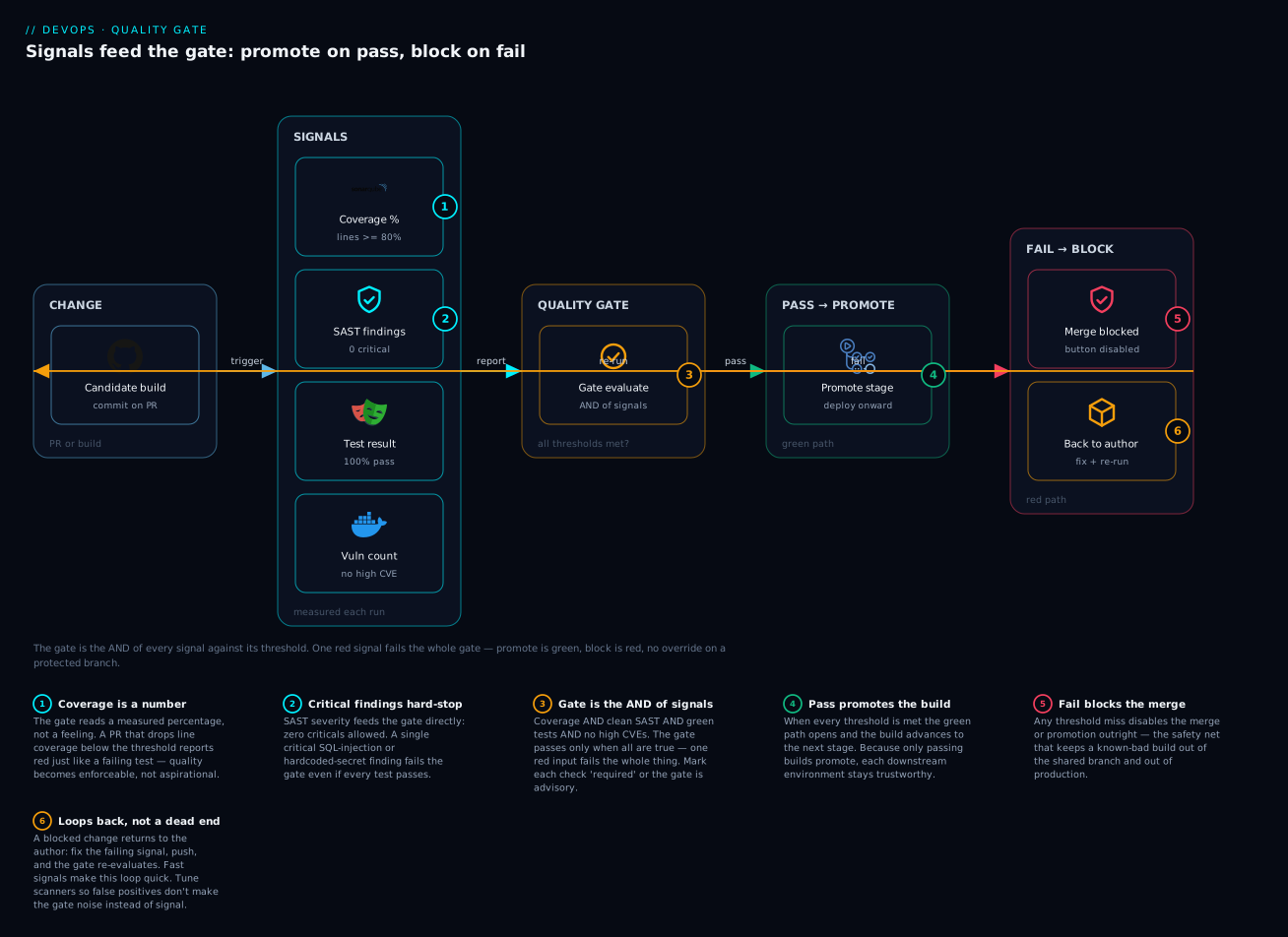
A quality gate is a function from results to a verdict. It is not a test; it is the policy that reads the tests’ and scanners’ outputs and returns pass or fail. Its inputs are things like “coverage on changed lines,” “count of new high-severity SAST findings,” “any known critical CVE in a production dependency,” “all required checks green.” Its output is a single boolean that branch protection enforces: merge allowed, or blocked. The gate’s whole value is that it is automated and consistent — it applies the same standard to every change, with no “we’ll let this one through, it’s Friday.” A gate is only as good as its thresholds: too loose and it waves through real defects; too strict and it blocks legitimate work, training the team to override it.
SAST, DAST and SCA see different things and belong at different stages. SCA (software composition analysis) reads your dependency manifests/lockfiles and matches them against vulnerability databases — it finds known CVEs in code you didn’t write. SAST (static application security testing) parses your source code without running it and flags insecure patterns — SQL injection, hardcoded secrets, weak crypto, unsafe deserialization. DAST (dynamic application security testing) attacks a running instance of the app from the outside, like an attacker would, and finds runtime issues — missing security headers, broken auth, reflected XSS — that static analysis can’t see because they only manifest at runtime. SCA and SAST are static and run early (PR); DAST needs a deployed app and runs later (staging). They overlap a little and complement a lot; you want all three.
Coverage is a proxy, and flakiness is a tax. Code coverage measures which lines/branches your tests executed — it tells you what is unverified, but high coverage does not prove correctness (you can execute a line with a useless assertion). Treat coverage as a floor that catches untested code, not a target that proves tested code, and gate on coverage of new/changed lines rather than the whole repo so you don’t punish a team for legacy gaps. Flaky tests — tests that pass and fail nondeterministically on the same code — are a corrosive tax on the entire system: each flake is a false alarm that wastes a re-run, and a suite that cries wolf trains engineers to hit “re-run” reflexively, which is the same muscle as ignoring a real failure. A 1% per-test flake rate across 500 tests means most pipeline runs fail for no reason. Managing flakiness is not hygiene; it’s what keeps the gate believable.
The vocabulary in one table
Pin down every moving part before the deep sections. The glossary repeats these for lookup; this is the mental model side by side.
| Term | One-line definition | Where it runs | Why it matters to the gate |
|---|---|---|---|
| Shift-left | Move a check to its earliest credible stage | Across the lifecycle | Cheaper fixes, faster feedback |
| Test pyramid | Many unit, fewer integration, few E2E | Commit → staging | Keeps the suite fast and stable |
| Unit test | Tests one unit in isolation, no I/O | Commit / PR | Bulk of fast feedback |
| Integration test | Tests components together (DB, queue) | PR (with services) | Catches wiring/contract breaks |
| E2E test | Drives the whole app like a user | Staging | Verifies critical journeys |
| SAST | Static scan of your own source | PR | Insecure code patterns |
| DAST | Attacks a running app from outside | Staging | Runtime/auth/config flaws |
| SCA | Scans dependencies for known CVEs | PR + continuous | Vulnerable third-party libs |
| Quality gate | Policy that turns results into pass/fail | PR / promotion | The enforcement point |
| Threshold | The numeric line a gate enforces | Gate config | Coverage %, severity cutoff |
| Coverage | % of code executed by tests | Test run | Floor for “untested” code |
| Flaky test | Nondeterministic pass/fail on same code | Anywhere | Erodes trust; false red |
| Break-glass | Audited manual override of a gate | PR / release | Escape hatch without chaos |
| Defect escape rate | Bugs that reach prod ÷ total found | Measured over time | The outcome metric for shift-left |
The test pyramid in depth
The pyramid is the backbone of shift-left because it dictates what kind of test catches a bug and how fast the feedback comes. Get the ratio right and most defects are caught by cheap, stable tests in seconds; get it wrong and you lean on slow, flaky tests that arrive too late and lie too often.
The three (or four) layers
From base to apex, each layer trades speed and stability for realism. You want the cheapest layer that can credibly catch a given class of bug to own it — push verification down the pyramid wherever possible.
| Layer | Scope | Speed (typical) | Stability | What it catches | What it can’t |
|---|---|---|---|---|---|
| Unit | One function/class, dependencies mocked | 1–50 ms each | Very high (deterministic) | Logic, edge cases, branches | Wiring, real I/O behaviour |
| Integration | A few real components (DB, cache, queue) | 50 ms–5 s each | High | Contracts, queries, serialization | Full user journeys, UI |
| Component / API | One service end-to-end, deps stubbed | 0.1–2 s each | High | Service behaviour, routing | Cross-service flows |
| End-to-end (E2E) | Whole system via UI/API | 2 s–2 min each | Low (timing, env, network) | Critical user journeys | Cheap, granular failures |
A common refinement adds a contract-test layer (e.g. Pact) between integration and E2E: instead of spinning up every downstream service, each service verifies it honours the contract its consumers expect. Contract tests give much of E2E’s cross-service confidence at integration-test speed and stability, and are a classic shift-left move — they turn “we’ll find the API mismatch in staging” into “we’ll find it on the PR.”
The anti-patterns
Most struggling suites are a recognizable shape. Naming the shape tells you what to fix.
| Anti-pattern | Shape | Symptom | Root cause | Fix |
|---|---|---|---|---|
| Ice-cream cone | Wide E2E top, thin unit base | Slow suite, constant flakes, hours to feedback | Testing only through the UI | Push logic down to unit/integration |
| Hourglass | Many unit + many E2E, no middle | Integration bugs escape to E2E or prod | Skipped integration layer | Add integration/contract tests |
| Cupcake | Heavy manual testing on top of automation | QA bottleneck, slow releases | Automation distrust | Automate the manual regression |
| Testing trophy (intended) | Heavy integration, solid unit, light E2E, static base | Healthy for many web apps | (this is a good target) | — |
| No base | Tests only at integration+ | Can’t localise a failure; slow | “Unit tests are too granular” | Add fast unit tests for logic |
The testing trophy (static analysis → unit → integration-heavy → thin E2E) is a deliberately different shape that many modern web teams prefer over a strict pyramid: it widens the integration layer because, for I/O-heavy apps, integration tests catch the most real bugs per unit of effort. Both are fine; the cone is the one that always hurts.
How the pyramid maps to the lifecycle
The pyramid isn’t just a ratio — each layer runs at a different stage, because each needs a different environment. This is where the pyramid and shift-left meet.
| Layer | Trigger | Environment it needs | Runs on every… | Allowed wall-clock budget |
|---|---|---|---|---|
| Lint / typecheck / format | Pre-commit + push | None (static) | Commit | Seconds |
| Unit | Push / PR | None (in-process mocks) | Commit / PR | < 2–3 min for the whole suite |
| Integration | PR | Ephemeral services (testcontainers, service containers) | PR | < 5–8 min |
| Contract | PR | Broker / stubs | PR | < 5 min |
| E2E | Post-merge / pre-release | Deployed staging stack | Merge to main / release | Up to ~30–60 min |
| Performance smoke | Pre-release | Staging at load | Release candidate | Minutes |
The rule of thumb: anything that can run without a deployed environment belongs on the PR; anything that needs the app actually running belongs after deploy to staging. That single dividing line determines most of your pipeline’s shape.
Where every check runs across the lifecycle
This is the heart of shift-left: a precise placement for each check. The lifecycle stages, left to right, are Local (the developer’s machine), Commit/Push (CI on every push), Pull Request (the merge gate), Staging (a deployed pre-prod environment), and Production (post-deploy verification). Each check has an earliest credible home; placing it earlier than that is impossible, placing it later than that wastes the cost-of-defect advantage.
| Check | Local (pre-commit) | Commit / Push | Pull Request | Staging (deployed) | Production | Earliest credible home |
|---|---|---|---|---|---|---|
| Format / lint | ✅ fast | ✅ enforce | ✅ enforce | — | — | Local |
| Type check | ✅ | ✅ | ✅ | — | — | Local |
| Secret scan (diff) | ✅ hook | ✅ | ✅ | — | — | Local |
| Unit tests | ✅ subset | ✅ full | ✅ full | — | — | Local (subset) / Push (full) |
| SCA (dependencies) | optional | ✅ | ✅ gate | ✅ continuous re-scan | — | Push / PR |
| SAST (your code) | optional (IDE) | ✅ | ✅ gate | — | — | PR |
| IaC / config scan | optional | ✅ | ✅ gate | — | — | PR |
| Container image scan | — | ✅ on build | ✅ gate | re-scan running image | — | Build (push/PR) |
| Integration tests | optional | optional | ✅ | ✅ | — | PR |
| Coverage gate | — | compute | ✅ gate (new code) | — | — | PR |
| License compliance | — | ✅ | ✅ gate | — | — | PR |
| DAST | — | — | — | ✅ | — (read-only smoke) | Staging |
| E2E tests | — | — | — | ✅ | smoke subset | Staging |
| Performance / load | — | — | optional micro | ✅ | canary analysis | Staging |
| Synthetic monitors | — | — | — | ✅ | ✅ | Staging + Prod |
The pre-commit layer (Local)
The leftmost checks run on the developer’s machine before a commit even exists, via a pre-commit hook framework. These must be fast (sub-5-second) or developers disable them. Keep them to formatting, linting, secret scanning on the diff, and a fast subset of unit tests — never the full suite. Pre-commit is for catching the embarrassing, instant stuff (a stray console.log, a leaked AWS key, a formatting drift) so it never reaches CI.
| Pre-commit check | Tool examples | Why it belongs here | Keep it under |
|---|---|---|---|
| Format | Prettier, gofmt, black, dotnet format | Instant, deterministic, no debate | 1 s |
| Lint (changed files) | ESLint, golangci-lint, Ruff | Catch obvious errors before CI | 3 s |
| Secret scan (diff) | gitleaks, detect-secrets, trufflehog | A leaked key must never be committed | 2 s |
| Fast unit subset | Affected-tests only | Cheap confidence without full run | 5 s |
| Commit-message lint | commitlint | Keeps conventional commits clean | < 1 s |
Pre-commit hooks are advisory, not authoritative — a developer can --no-verify past them and CI can’t trust they ran. So every pre-commit check must also run in CI as an authoritative gate. Pre-commit is a fast-feedback courtesy; the PR gate is the enforcement.
The PR gate (the centerpiece)
The pull request is where shift-left has the most leverage, because it’s the last point before code merges and the author still has full context. Everything that can run without a deployed app should run here and gate the merge: lint, full unit tests, integration tests, SCA, SAST, IaC/container scans, license checks, and the coverage gate. The PR gate is what branch protection enforces — “all required checks must be green to merge.”
Order matters enormously for developer experience. Run the fastest, most-likely-to-fail checks first so a doomed PR fails in 30 seconds, not after a 12-minute integration suite. The canonical ordering:
| Order | Stage | Typical time | Fail-fast rationale |
|---|---|---|---|
| 1 | Lint + format + typecheck | 20–60 s | Cheapest signal; most common failure |
| 2 | Secret scan on diff | 5–20 s | Catch a leak before anything else runs |
| 3 | Unit tests | 1–3 min | Fast logic feedback |
| 4 | SCA (dependencies) | 20–90 s | Often cached; quick CVE check |
| 5 | SAST (changed code) | 1–5 min | Incremental scan of the diff |
| 6 | Build + container scan | 1–4 min | Produces the artifact + image CVEs |
| 7 | Integration tests | 3–8 min | Slowest; runs only if the above passed |
| 8 | Coverage gate (new code) | seconds | Reads results; final verdict |
The staging layer (post-deploy)
Checks that require a running app live here: DAST, end-to-end tests, and performance/load tests. You deploy the merged build to a staging environment that mirrors production, then run these against it. They’re slower and flakier, so they run after merge (or on a release candidate), not on every PR — the PR gate already verified everything that didn’t need a deployment.
| Staging check | What it needs | Typical duration | Gate behaviour |
|---|---|---|---|
| Smoke / health | Deployed app responding | Seconds | Block promotion if down |
| E2E critical journeys | Full stack + test data | 5–30 min | Block promotion on failure |
| DAST (authenticated) | Running app + creds | 10–60 min | Gate on new high/critical |
| Performance smoke | App under representative load | 5–15 min | Gate on p95 / error-rate regression |
| Accessibility scan | Rendered pages | Minutes | Gate or warn per policy |
The production layer (verify, don’t test)
In production you don’t test (you don’t run destructive DAST against live customer data) — you verify the deploy with read-only synthetic monitors, smoke checks against canaries, and automated canary analysis that watches error rate and latency. This is the rightmost, thinnest layer: the last confirmation that what passed every earlier gate actually serves real traffic. It connects directly to progressive-delivery techniques where a bad canary auto-rolls-back before most users see it.
Quality gates and thresholds
A gate without a threshold is a suggestion. The threshold is the number — the line the gate enforces. The skill is setting numbers strict enough to catch real problems but achievable enough that the team doesn’t route around them. Here are the standard threshold types and how to reason about each.
| Threshold | What it measures | Sensible starting value | Trap to avoid |
|---|---|---|---|
| Coverage on new code | % of changed lines tested | 70–80% | Gating overall coverage on a legacy repo (unachievable) |
| Overall coverage (no decrease) | Whole-repo % must not drop | “≥ previous” (ratchet) | Demanding a high absolute number day one |
| New SAST findings (high/critical) | New insecure-code findings in the diff | 0 new high/critical | Gating the total backlog (blocks all work) |
| SCA: known critical/high CVEs | Vulnerable production dependencies | 0 critical; 0 high with fix available | Blocking on CVEs with no patch and no exploit path |
| Duplicated lines | % of copy-pasted code in new code | < 3% on new code | Punishing intentional, clear duplication |
| Test pass rate | All required tests green | 100% required tests | Counting flaky tests as real failures |
| Code smells / maintainability | Static maintainability rating | “no worse than A on new code” | Over-indexing on subjective smells |
| License policy | Disallowed licenses in dependencies | 0 GPL in a proprietary product (example) | Blocking permissive licenses by accident |
| Performance budget | p95 latency / bundle size | “no regression > X%” | Absolute budgets that ignore baseline |
The single most important idea: gate new code, not old code
The reason most quality gates fail to get adopted is that they’re applied to the entire codebase on day one. A ten-year-old repo with 30% coverage and 4,000 existing SAST findings cannot suddenly hit “80% coverage, zero findings” — so the team disables the gate. The fix is the new-code (or “leak period”) gate: the threshold applies only to lines you changed or added in this PR. New code must be 80% covered and introduce zero new high-severity findings; the existing 4,000 findings are tracked as debt but don’t block today’s work. This is how tools like SonarQube’s “Clean as You Code” model work, and it’s the difference between a gate that’s adopted and one that’s bypassed.
| Dimension | Whole-code gate | New-code gate (recommended) |
|---|---|---|
| Coverage target | “Repo ≥ 80%” — fails forever on legacy | “Changed lines ≥ 80%” — achievable now |
| Security findings | “0 findings total” — blocks all work | “0 new high/critical” — stops the bleeding |
| Adoption on legacy | Near-zero (team disables it) | High (only your diff is judged) |
| Debt strategy | Implicit, ignored | Explicit backlog, paid down deliberately |
| Psychological effect | “The gate is unfair” | “I own what I touch” |
Required vs optional (blocking vs informational) checks
Not every check should block a merge. Split checks into blocking (a failure stops the merge) and informational (a failure warns but lets the merge proceed). New checks should land as informational first — you measure their signal and false-positive rate for a sprint or two — and only get promoted to blocking once the team trusts them. Demote a check to informational the moment it produces more noise than value; that’s how you keep the blocking set believable.
| Check | Start as | Promote to blocking when | Keep informational if |
|---|---|---|---|
| Unit tests | Blocking | (always blocking) | — |
| Lint / format | Blocking | (always blocking) | — |
| SCA critical CVE | Blocking | (start blocking; allowlist exceptions) | — |
| SAST new high/critical | Informational → Blocking | FP rate is low, triage flow exists | Scanner is noisy on your stack |
| Coverage on new code | Informational → Blocking | Team has habituated to writing tests | Coverage tool double-counts generated code |
| Code smells / maintainability | Informational | (rarely fully blocking) | Subjective; warn instead |
| DAST findings | Informational → Blocking | You can reproduce + triage findings | High FP, no triage owner |
| Performance budget | Informational → Blocking | Baseline is stable | Noisy environment |
What a gate verdict actually reads
Concretely, a quality gate is a small policy evaluated against artifacts the pipeline produced. For example, a gate might pass only if all of these hold:
Gate "PR-to-main" passes  ⇔
  required_checks.all_green            == true
  AND coverage.new_code_percent        >= 80
  AND sast.new_findings(severity>=high)  == 0
  AND sca.vulns(severity=critical)       == 0
  AND sca.vulns(severity=high, fix=true) == 0
  AND duplication.new_code_percent     <  3
  AND license.violations               == 0
Each line is a threshold; the gate is their conjunction. The clearer and fewer the conditions, the easier it is for an engineer to understand why a gate is red and fix it fast — which is the whole point.
SAST, DAST and SCA — the security trio
Three scan families do most of the security work in shift-left. They are complementary, not interchangeable: each sees something the others can’t. Getting them placed and tuned correctly is most of what “DevSecOps” means in practice.
| Dimension | SAST | DAST | SCA |
|---|---|---|---|
| Full name | Static Application Security Testing | Dynamic Application Security Testing | Software Composition Analysis |
| What it scans | Your own source code | A running instance of the app | Your third-party dependencies |
| Needs app running? | No | Yes | No |
| Lifecycle stage | PR (early) | Staging (post-deploy) | PR + continuous |
| Sees | Code-level patterns, data flow | Runtime behaviour, responses | Known CVEs in libraries |
| Classic finds | SQLi, XSS sinks, hardcoded secrets, weak crypto | Missing headers, broken auth, reflected XSS, misconfig | Vulnerable log4j, outdated OpenSSL |
| Misses | Runtime/config/env issues | Code paths not exercised; source location | Vulns in your code |
| False-positive profile | High (flags unreachable/safe paths) | Lower count, but slower to run | Low (CVE match) but version-noisy |
| Language awareness | Per-language (needs a parser) | Language-agnostic (HTTP-level) | Per-ecosystem (npm, Maven, pip…) |
| Example tools | CodeQL, Semgrep, SonarQube, Checkmarx | OWASP ZAP, Burp, Nuclei | Dependabot, Trivy, Snyk, OWASP Dependency-Check |
SAST — scanning your own code
SAST parses your source (or compiled IR) without executing it and looks for insecure patterns and dangerous data flows — e.g. user input flowing into a SQL query without parameterization, a hardcoded credential, use of a broken hash like MD5 for passwords. Because it reads code, it runs early (on the PR) and points at the exact file and line, which is ideal for shift-left. Its weakness is false positives: static analysis can’t always tell that a “vulnerable” path is actually unreachable or already sanitized, so it over-reports. The two disciplines that make SAST adoptable are incremental scanning (scan only the diff, gate on new findings) and a triage flow (a way to mark a finding as a false positive or accepted risk, with a reason, so it doesn’t re-block).
| SAST decision | Options | Recommendation |
|---|---|---|
| Scope per PR | Whole repo vs changed files | Changed/new code (gate on new findings) |
| What blocks | All severities vs high+critical | High/critical new findings block; rest inform |
| FP handling | Ignore vs suppress-with-reason | Suppress in code with a justification comment |
| Engine | Single tool vs layered | One primary (CodeQL/Semgrep) + targeted rules |
| Languages | All vs your stack | Enable only your languages to cut noise |
DAST — attacking the running app
DAST treats the app as a black box: it sends crafted HTTP requests to a deployed instance and inspects the responses, exactly as an external attacker would. It finds things SAST structurally cannot — a missing Content-Security-Policy header, an auth check that’s bypassable via a forged token, a reflected XSS that only appears when the page actually renders, a verbose error page leaking stack traces. Because it needs the app running, its earliest credible home is staging, post-deploy. DAST runs slower (minutes to an hour for a full active scan) and you must give it authenticated access (a test login) to scan past the front door, or it only sees the public surface. The trade-off: a passive baseline scan is fast and safe to run often; a full active scan is thorough but slow and can mutate data, so it runs against a disposable staging dataset.
| DAST mode | Speed | Coverage | Risk | When to run |
|---|---|---|---|---|
| Passive baseline | Minutes | Headers, obvious issues, spidering | Safe (read-only) | Every staging deploy |
| Active (unauthenticated) | 10–30 min | Public attack surface | Low | Nightly / pre-release |
| Active (authenticated) | 20–60+ min | Behind-login surface | Medium (mutates data) | Pre-release on throwaway data |
| Targeted API scan | Minutes | One API per OpenAPI spec | Low–medium | On API changes |
SCA — the dependencies you didn’t write
Most of an application’s code is dependencies, and most exploited vulnerabilities are known CVEs in those dependencies (Log4Shell being the canonical example). SCA reads your lockfiles/manifests, resolves the full dependency tree (including transitive deps), and matches every package version against vulnerability databases, flagging known CVEs and often the fixed version. It’s cheap, accurate (it’s a database match, not heuristics), and belongs both on the PR and as a continuous scan — because a dependency that was clean when you merged becomes vulnerable the day a new CVE is published, with no code change on your side. That “scan continuously, not just at merge” property is unique to SCA and is why a nightly/weekly re-scan of main matters.
| SCA capability | Why it matters | Gate guidance |
|---|---|---|
| Transitive resolution | Most CVEs hide in deps-of-deps | Scan the full resolved tree, not just direct deps |
| Fix-version suggestion | Tells you the safe upgrade | Auto-PR the bump (Dependabot/Renovate) |
| Reachability (advanced) | Is the vulnerable function actually called? | Prioritise reachable CVEs; de-prioritise the rest |
| Continuous re-scan | New CVEs land daily | Nightly scan of main; alert on new criticals |
| License detection | License risk rides with deps | Combine with a license-policy gate |
| SBOM generation | A manifest of everything shipped | Produce per build; feed downstream verification |
These three plus secret scanning and IaC/container scanning form the full shift-left security set. Secret scanning belongs at every stage (pre-commit, PR, and push protection that rejects a leaked key at git push); IaC scanning (Checkov, tfsec, Terrascan) and container scanning (Trivy, Grype) belong on the PR and at build, catching an open security group or a root-running container before it ships. For the dependency and supply-chain depth — SBOMs, VEX, provenance — see Software Supply Chain Security: SBOM Consumption, VEX and Admission Verification.
Coverage and flaky tests — the two realities
Two practical realities decide whether your gate is trusted or worked around: how you treat coverage, and how you handle flaky tests. Get these wrong and even a well-designed gate becomes a thing engineers fight rather than rely on.
Coverage: a floor, not a trophy
Coverage tells you what your tests executed, expressed as line, branch, or (rarely) mutation coverage. The cardinal mistake is treating a coverage number as proof of quality. You can hit 100% line coverage with assertions that test nothing; conversely, 70% coverage of the right code beats 95% padded with trivial getter tests. Use coverage to find untested code, gate it on new code only, and never let “raise the number” become the goal — that breeds test-shaped noise.
| Coverage type | What it counts | Strength | Limitation |
|---|---|---|---|
| Line | Lines executed | Simple, ubiquitous | A line can run with a no-op assertion |
| Branch | Decision paths taken (if/else) | Catches untested branches | Still doesn’t check assertions |
| Function | Functions called | Coarse health check | Very coarse |
| Mutation | Whether tests catch injected bugs | The truest quality signal | Slow; run nightly, not per-PR |
The mature setup: branch coverage on new code as the PR gate (e.g. ≥ 80%), an overall ratchet that forbids the whole-repo number from dropping, and mutation testing nightly on critical modules to find tests that execute code without actually asserting on it. Mutation testing is the antidote to coverage theater — it’s the only metric that fails when your assertions are weak.
Flaky tests: the trust killer
A flaky test passes and fails nondeterministically on identical code. Flakiness is uniquely corrosive because it attacks the signal of the whole gate: every false red trains engineers to hit “re-run,” and that reflex is indistinguishable from ignoring a real failure. The math is brutal — with a 1% independent flake rate, a 300-test suite fails spuriously about (1 − 0.99³⁰⁰) ≈ 95% of the time. A gate that’s red 95% of the time for no reason is a gate nobody believes.
The causes are a small, recognizable set, and each has a specific fix:
| Flake cause | Typical symptom | Confirm it | Fix |
|---|---|---|---|
| Timing / async | Passes locally, fails in slow CI | Fails more under CI load | Wait for conditions, not fixed sleeps |
| Test order dependence | Fails only in a certain order | Run with --shuffle/random seed |
Isolate state; no shared globals |
| Shared mutable state | Two tests fight over a row/file | Fails when run in parallel | Per-test fixtures; transaction rollback |
| External dependency | Fails when a third-party API blips | Correlates with network/3p outages | Stub/mock the dependency |
| Time / timezone / clock | Fails at midnight or month-end | Fails on specific dates | Inject a clock; freeze time |
| Resource leak | Fails after N tests, not in isolation | Memory/handles climb | Tear down resources; cap pools |
| Nondeterministic data | Random/UUID/order-dependent asserts | Different value each run | Seed RNG; assert on sets not order |
The operational discipline that keeps flakiness from poisoning the gate:
| Tactic | What it does | The danger to manage |
|---|---|---|
| Quarantine | Move a known-flaky test out of the blocking set, into a tracked “fix me” lane | A quarantine that becomes a graveyard — set an SLA to fix or delete |
| Retry-with-caution | Auto-retry a failed test once; flag if it passes on retry | Masks real intermittent bugs — count retries as a flake signal, don’t hide them |
| Flake detection | Re-run the suite on main and flag tests that change verdict |
Costs CI minutes — run nightly, not per-PR |
| Flake budget | Track flake rate as a metric; alert past a threshold | Without a number, flakiness creeps invisibly |
| Root-cause, not re-run | Fix the cause using the table above | “Just re-run it” culture — the slowest poison |
The unforgivable mistake is blanket retries: configuring CI to retry the whole suite three times until it’s green. That doesn’t fix flakiness — it hides it, converts every real intermittent bug into a silent pass, and lets the flake rate climb without limit. Retry at most once, count the retry as a flake event, quarantine repeat offenders, and fix the root cause. A suite with a tracked, low, falling flake rate is the foundation everything else stands on.
Handling a failed gate
A gate’s job is to go red sometimes — a gate that never fails isn’t protecting anything. What separates a healthy team is the playbook for a red gate: a fast, calm, consistent response that fixes the problem without either blindly overriding the gate or panicking. Here is the decision flow.
| Situation | First question | Right move | Wrong move |
|---|---|---|---|
| Unit/integration test failed | Is the test correct? | Fix the code (test caught a real bug) | “Re-run until green” |
| Test failed but flaky | Is this a known flake? | Quarantine + file a fix ticket; re-run once | Add a blanket retry to hide it |
| New SAST high finding | Is it a true positive? | Fix it, or suppress-with-reason if FP | Disable the SAST step |
| SCA critical CVE, fix available | Can I bump the version? | Bump the dependency; merge | Add the CVE to a permanent allowlist |
| SCA critical CVE, no fix yet | Is it reachable/exploitable here? | Time-boxed allowlist + tracking ticket | Block the team indefinitely with no plan |
| Coverage on new code below gate | Is the new code testable? | Add the missing tests | Lower the global threshold to pass |
| Gate red during a Sev-1 hotfix | Is this a genuine emergency? | Break-glass override (audited) | Routine override for convenience |
Fix-forward vs revert
When a defect slips past and is found just after merge, the choice is fix-forward (a new commit/PR that corrects it) or revert (back out the offending change). The rule: if the fix is small, obvious and fast, fix forward; if it’s risky, unclear, or production is actively impacted, revert first to restore green, then diagnose at leisure. Reverting is not failure — it’s the fastest path back to a known-good state.
| Factor | Favours fix-forward | Favours revert |
|---|---|---|
| Production impact | None / low | Active incident |
| Fix clarity | Obvious one-liner | Unclear root cause |
| Time to fix | Minutes | Unknown / long |
| Change size | Small | Large, entangled |
| Reviewer availability | Available now | Nobody to review safely |
Break-glass: the audited override
There will be a moment — a Sev-1 outage, a security patch that must ship now — when a legitimate change must merge while a gate is red. You need a break-glass path: a way to override the gate that is possible but expensive and fully logged. The point is friction plus an audit trail, so it’s used only in real emergencies and is reviewed afterward. A break-glass override that requires a second approver, posts to an audit channel, and auto-files a follow-up ticket is healthy; a “force-merge” button anyone clicks on a slow Friday is the beginning of the end for the gate.
| Break-glass property | Why it’s required |
|---|---|
| Requires elevated permission / second approver | No single person can casually bypass |
| Logs who, when, why (reason mandatory) | Auditable; supports compliance |
| Posts to a visible channel | Social accountability |
| Auto-creates a follow-up remediation ticket | The skipped check still gets done |
| Reviewed in the next retro / incident review | Patterns of abuse surface |
| Time-boxed (the exception expires) | A bypass doesn’t become permanent |
The cultural rule underneath all of this: the gate is owned, not endured. When a gate is wrong (a false positive, a too-strict threshold), the response is to fix the gate in a reviewed change — not to override it repeatedly and resent it. A gate the team improves is a gate the team trusts; a gate the team routes around is theater.
Architecture at a glance
The first diagram traces the lifecycle as a left-to-right pipeline and pins each check to the earliest stage it can credibly run. Read it left to right: at the Local / pre-commit stage, fast formatting, linting and secret-on-diff scanning run on the developer’s machine in seconds. Pushing to a branch triggers the Commit/CI stage — the full unit suite, the build, and the first SCA and SAST passes. Opening a pull request assembles the gate: everything from the commit stage plus integration tests, IaC and container scans, and the coverage gate on new code, all of which must be green for branch protection to allow the merge. After merge, the build deploys to staging, where the checks that need a running app finally run — DAST against the live instance and end-to-end tests through the UI. Finally, production carries only the thin, read-only verification layer: synthetic monitors and smoke checks. The single organizing idea the diagram conveys is the dividing line: checks that need no deployed app sit left of the merge; checks that need a running app sit right of it.
The second diagram zooms into the quality gate itself — the decision node that turns all those results into a single verdict. It shows the gate consuming its inputs (test pass/fail, coverage on new code, SAST/SCA findings by severity, duplication, license policy), evaluating each against its threshold, and emitting one boolean: pass → merge/promote, or fail → block with an actionable reason. The fail path forks into the response playbook — fix-forward, revert, or audited break-glass — and loops back to the gate. The diagram makes concrete that a gate is a function from results to a verdict, and that every red outcome routes to a defined, calm response rather than an ad-hoc scramble.
Real-world scenario
Northwind Lending runs a loan-origination platform: a Java Spring backend, a React frontend, and Terraform-managed AWS infrastructure, shipped by twelve engineers across three squads. Eighteen months ago their pipeline was a single Jenkins job that built the app and ran a 40-minute test suite after merge to main. Security was an annual third-party pen-test. The numbers told the story: a defect escape rate around 22% (roughly one in five bugs reached production), a mean time to restore of four hours, and a release cadence of once every three weeks because each release was terrifying. The annual pen-test routinely found 30–40 issues, several critical, many of them months old.
The breaking point was an incident: a customer reported that another customer’s loan documents were visible by tweaking a URL — a broken object-level authorization flaw. It had been in production for four months. The root cause was a missing authorization check added in a single PR that nobody had the tooling to catch. The board asked the obvious question: how do we make sure this can’t happen again? The platform team’s answer was shift-left, rolled out deliberately over a quarter rather than as a big bang.
They started with the PR gate, because that’s where the leverage was. Week one: lint, full unit tests, and SCA (Dependabot + OWASP Dependency-Check) became required checks, gating on zero new critical CVEs. The SCA scan alone surfaced a vulnerable transitive jackson-databind that the pen-test had also flagged the prior year — now it was caught on the PR that would have shipped it. Week three: SAST (CodeQL) landed as informational first; the team watched its findings for two sprints, tuned out a class of false positives on a logging wrapper, then promoted “zero new high/critical” to blocking. The broken-authorization class of bug now had a tripwire. Week five: a coverage gate on new code at 75% (not the whole repo — their legacy coverage was 41% and gating on that would have stopped all work) plus an overall ratchet so the number could only climb.
The staging layer came next. Every merge to main deployed to a staging environment and ran OWASP ZAP (DAST, authenticated) and a focused Playwright E2E suite covering the six critical loan-application journeys. The DAST baseline immediately flagged three missing security headers and a verbose error page leaking stack traces — runtime issues CodeQL had structurally never seen. Crucially, they fought the flakiness problem head-on: the first E2E suite was 18% flaky and the team’s instinct was a blanket 3× retry. The platform lead vetoed it, instituted a quarantine lane with a one-week fix-or-delete SLA, and added a nightly flake-detection run. Within a month the flake rate was under 2% and the gate was trusted enough that nobody reflexively re-ran it.
The outcome over two quarters: defect escape rate fell from 22% to 6%; the annual pen-test dropped from 30–40 findings to 9, none critical and none older than the current sprint; release cadence went from every three weeks to daily, because small changes that passed a trusted gate were boring to ship. There were costs — about three weeks of platform-engineering time to wire it up, a modest CI-minutes increase, and real effort tuning SAST false positives — but the broken-authorization incident, repeated, would have cost more than all of it. The lesson Northwind wrote down: “Move the check to where the author still has the context, make the gate trustworthy enough that nobody wants to override it, and the rest takes care of itself.”
The rollout as a timeline, because the order was the strategy:
| Phase | What landed | Gate behaviour | Result |
|---|---|---|---|
| Week 1 | Lint + unit + SCA on PR | SCA blocking (critical CVEs) | Caught the jackson-databind CVE pre-merge |
| Week 3 | CodeQL SAST | Informational → blocking after tuning | Tripwire for the auth-bug class |
| Week 5 | Coverage gate (new code 75%) | Blocking, new-code only | Adoptable on a 41%-coverage legacy repo |
| Week 7 | Staging DAST (ZAP) + E2E (Playwright) | Block promotion on new high/critical | Found header/error-page leaks SAST missed |
| Week 9 | Flake quarantine + nightly detection | (No blanket retries) | Flake rate 18% → < 2%; gate trusted |
| +2 quarters | Steady state | Stable blocking set | Escape rate 22% → 6%; daily releases |
Advantages and disadvantages
Shift-left and quality gates are not free, and pretending otherwise is how teams end up with a slow, resented pipeline. Weigh the trade-off honestly.
| Advantages (why it pays off) | Disadvantages (why it bites) |
|---|---|
| Defects caught at authoring cost a fraction of production defects | Pipeline wall-clock grows with every added check; needs active management to stay < 10–15 min |
| Fast feedback while the author still has full context | False positives (especially SAST/DAST) frustrate developers and erode trust if untuned |
| Security becomes continuous and provable (audit-friendly) | Up-front investment to wire, tune thresholds, and own the gate |
| A trusted gate makes small, frequent, boring releases possible | A badly tuned gate trains the team to override it — worse than no gate |
| Defect escape rate becomes a measurable, improvable metric | Flaky tests can poison the whole signal if not actively managed |
| Quality is everyone’s property, not a downstream QA phase | Cultural shift required — “you build it, you test it” isn’t automatic |
| The gate enforces consistency no human reviewer can match at scale | Over-strict whole-repo gates are unadoptable on legacy code |
The model is right for essentially any team shipping software that matters, but it bites hardest when adopted carelessly: a gate dumped on a legacy repo with whole-code thresholds, scanners left at default sensitivity spewing false positives, and flaky tests papered over with retries. Every one of those disadvantages is manageable — new-code gates, tuned scanners, quarantine over retry, fast-checks-first ordering — but only if you treat the gate as a product the team owns and improves, not a bureaucratic obstacle imposed on it. The failure mode is never “too much quality”; it’s a gate the team doesn’t trust and therefore routes around.
Hands-on lab
Wire a real quality gate on a pull request using GitHub Actions — fast checks first, a coverage gate on new code, and SCA — so a PR that adds untested or vulnerable code is blocked. It uses only free-tier GitHub features and a sample Node project; adapt the language steps to your stack. Delete the repo at the end.
Step 1 — Create a repo and a trivial app with a test. Locally:
mkdir shift-left-lab && cd shift-left-lab
git init -b main
npm init -y
npm pkg set scripts.test="jest --coverage --coverageReporters=json-summary text"
npm install --save-dev jest >/dev/null 2>&1
mkdir src test
cat > src/math.js <<'EOF'
function add(a, b) { return a + b; }
function risky(a, b) { return a - b; } // intentionally untested later
module.exports = { add, risky };
EOF
cat > test/math.test.js <<'EOF'
const { add } = require('../src/math');
test('add', () => { expect(add(2, 3)).toBe(5); });
EOF
add is tested; risky is not — that gap is what the coverage gate will catch on a later PR.
Step 2 — Add a CI workflow with fast-checks-first ordering. Create .github/workflows/quality-gate.yml:
name: quality-gate
on:
  pull_request:
    branches: [ main ]

permissions:
  contents: read

jobs:
  fast-checks:
    runs-on: ubuntu-latest
    steps:
      - uses: actions/checkout@v4
        with: { fetch-depth: 0 }          # full history so diff coverage works
      - uses: actions/setup-node@v4
        with: { node-version: '20', cache: 'npm' }
      - run: npm ci

      # 1. Lint / format would go here (fastest, fail-first) — omitted for brevity.
      # 2. Secret scan on the diff (catch a leaked key before anything else).
      - name: Secret scan (diff)
        uses: gitleaks/gitleaks-action@v2
        env: { GITLEAKS_ENABLE_UPLOAD_ARTIFACT: "false" }

      # 3. Unit tests with coverage.
      - name: Unit tests + coverage
        run: npm test

      # 4. SCA — fail on high/critical advisories in dependencies.
      - name: SCA (npm audit)
        run: npm audit --audit-level=high

      # 5. Coverage gate on NEW code (not the whole repo).
      - name: Coverage gate (new code)
        uses: barecheck/code-coverage-action@v1
        with:
          barecheck-github-app-token: ${{ secrets.GITHUB_TOKEN }}
          minimum-ratio: 0          # overall: don't regress
          minimum-coverage-changed-files: 80   # NEW code must be ≥ 80%
The ordering is deliberate: secret scan (seconds) → unit tests (fast) → SCA (cached, quick) → coverage gate (reads results). A doomed PR fails on the cheapest check.
Step 3 — Push and protect the branch. Create the repo on GitHub, push main, then require the check:
gh repo create shift-left-lab --private --source=. --push
# Require the quality-gate job before merge (GitHub CLI / API):
gh api -X PUT repos/:owner/shift-left-lab/branches/main/protection \
  -F required_status_checks.strict=true \
  -F 'required_status_checks.contexts[]=fast-checks' \
  -F enforce_admins=false \
  -F required_pull_request_reviews.required_approving_review_count=1 \
  -F restrictions= 2>/dev/null || echo "Set branch protection in Settings → Branches if the API call needs adjusting."
Expected: branch protection now lists fast-checks as a required status check.
Step 4 — Open a PR that should FAIL the gate. On a new branch, use the untested risky function and add nothing testing it:
git checkout -b feature/untested
cat >> src/math.js <<'EOF'
function divide(a, b) { return a / b; }   // new, untested → drops new-code coverage
module.exports.divide = divide;
EOF
git add -A && git commit -m "feat: add divide (no test)"
git push -u origin feature/untested
gh pr create --fill
Expected on the PR: the fast-checks job runs, unit tests pass, but the coverage gate reports new-code coverage below 80% (the new divide line is uncovered) and the check goes red — merge is blocked. This is the gate doing its job.
Step 5 — Fix forward to make the gate pass. Add the missing test:
cat >> test/math.test.js <<'EOF'
const { divide } = require('../src/math');
test('divide', () => { expect(divide(6, 2)).toBe(3); });
EOF
git add -A && git commit -m "test: cover divide"
git push
Expected: the workflow re-runs, new-code coverage clears 80%, the fast-checks check goes green, and the PR becomes mergeable. You just experienced the fix-forward path.
Validation checklist. You built a gate that runs fastest-first, blocks a PR for adding untested code, and turns green when the test is added — without ever touching a whole-repo coverage number. The steps mapped to the principles:
| Step | What you did | Principle it proves |
|---|---|---|
| 2 | Ordered secret-scan → unit → SCA → coverage | Fast-checks-first keeps feedback quick |
| 3 | Required the check via branch protection | A gate is only real if it blocks merge |
| 4 | PR with untested code went red | New-code coverage catches the gap |
| 5 | Added the test → green | Fix-forward is the normal response |
Cleanup.
gh repo delete shift-left-lab --yes
cd .. && rm -rf shift-left-lab
Cost note. GitHub Actions is free for public repos and includes a generous monthly minutes allowance for private repos; this lab uses a few minutes. No paid services were required — gitleaks, jest and npm audit are all free.
Common mistakes & troubleshooting
The failure modes below are what actually go wrong when teams adopt shift-left. Read the table at a glance, then the expanded reasoning for the ones that bite hardest.
| # | Symptom | Root cause | Confirm it | Fix |
|---|---|---|---|---|
| 1 | Developers routinely override / force-merge | Gate has too many false positives or unfair (whole-code) thresholds | Count overrides per week; survey the team | Switch to new-code gates; tune scanners; remove low-value blocking checks |
| 2 | Pipeline takes 30+ min; people stop reading it | Slow checks run first; E2E/DAST on every PR | Time each stage; find the long pole | Fast-checks-first; move E2E/DAST to post-merge/staging |
| 3 | Suite is red ~half the time for no reason | Flaky tests, papered over with blanket retries | Nightly flake-detection run; check retry config | Quarantine flakes with a fix SLA; retry once and count it; fix root cause |
| 4 | Coverage gate blocks all work on a legacy repo | Gating whole-repo coverage instead of new code | Read the gate config; check the threshold scope | Gate new/changed lines only; ratchet overall |
| 5 | SAST findings ignored entirely | Scanner left at default sensitivity → noise | Look at the FP-to-TP ratio | Scan diff only; gate new high/critical; suppress FPs with a reason |
| 6 | A critical CVE shipped despite SCA | SCA only ran at merge, CVE published after | Was the dep clean at merge time? | Add a nightly SCA re-scan of main; alert on new criticals |
| 7 | DAST finds nothing useful | Scanning unauthenticated / wrong target | Check DAST is given a test login + correct URL | Authenticate the scan; point at staging, not a stub |
| 8 | “100% coverage” but bugs still escape | Coverage theater — tests execute but don’t assert | Run mutation testing on a module | Add mutation testing nightly; review weak assertions |
| 9 | Pre-commit hooks bypassed (--no-verify) |
Treating hooks as authoritative | Are the same checks enforced in CI? | Mirror every pre-commit check as a required CI gate |
| 10 | Gate green, prod still breaks | Missing a check class (e.g. no integration tests) | Map escaped bugs to which check would catch them | Add the missing layer at its earliest credible stage |
| 11 | SCA blocks on an unfixable CVE forever | No exception process for no-patch CVEs | Is the CVE reachable/exploitable here? | Time-boxed allowlist + tracking ticket; review on expiry |
| 12 | New scanner doubled the build time and noise | Promoted straight to blocking | When did the build slow down? | Land new checks as informational; promote only after tuning |
1. Developers routinely override the gate. This is the single most important failure to catch, because an overridden gate is worse than no gate — it costs CI minutes and provides false assurance. The root cause is almost always untrustworthiness: false positives from untuned scanners, or unfair whole-code thresholds on a legacy repo. Confirm by counting overrides per week and asking the team which checks they don’t trust. Fix by making the gate believable — switch to new-code thresholds, tune or remove the noisy checks, and treat each override as a signal that the gate (not the developer) needs fixing.
3. The suite is red half the time for no reason. Flakiness, hidden by blanket retries. Confirm with a nightly run that executes the suite against unchanged main and flags any test that changes verdict — those are your flakes. Fix by quarantining them into a tracked lane with a fix-or-delete SLA, retrying at most once and counting the retry as a flake event, and fixing root causes from the flake-cause table. Never configure “retry 3×” — it converts real intermittent bugs into silent passes and lets the flake rate climb invisibly.
4. The coverage gate blocks all work on a legacy repo. A team enables “80% coverage” against a repo sitting at 40% and nothing can merge. Confirm by reading whether the threshold applies to the whole repo or to changed lines. Fix by gating new code only (changed/added lines ≥ 80%) plus an overall ratchet that forbids the number from dropping. The legacy gap becomes tracked debt, not a wall.
6. A critical CVE shipped despite having SCA. SCA ran on the PR, the dependency was clean then, and the CVE was disclosed afterward — your main is now vulnerable with no code change on your side. Confirm by checking the CVE’s disclosure date against your merge date. Fix with a continuous (nightly) SCA re-scan of main and an alert on any new critical, plus auto-PRs (Dependabot/Renovate) for the bump. This continuous property is unique to SCA — code-based scanners don’t have it.
8. “100% coverage” but bugs still escape. Coverage theater: the tests execute the lines but assert nothing meaningful. Confirm by running mutation testing on a suspect module — if injected bugs survive, your assertions are weak. Fix by adding nightly mutation testing on critical modules and reviewing the surviving mutants. Coverage tells you what ran; mutation testing tells you what your tests would actually catch.
Best practices
- Find each check’s earliest credible home — no earlier, no later. Lint and unit tests at commit, SAST/SCA on the PR, DAST/E2E on staging, synthetics in prod. Don’t force DAST onto a commit (no app yet) or defer SCA to staging (it cost you nothing to run on the PR).
- Fast checks first, always. Order the PR pipeline cheapest-and-most-likely-to-fail first so a doomed change fails in seconds. Keep the time-to-verdict under ~10–15 minutes or developers stop watching it.
- Gate new code, not old code. Apply coverage and security thresholds to changed lines, with an overall ratchet. This is what makes a gate adoptable on a legacy repo — and adoption beats strictness.
- Land new checks as informational, then promote. Measure a new scanner’s signal and false-positive rate for a sprint before making it blocking. Demote anything that becomes noisier than it is useful.
- Run all three security families. SAST (your code), SCA (your dependencies), DAST (your running app) see different things — none substitutes for another. Add secret scanning and IaC/container scanning to complete the set.
- Tune scanners ruthlessly; suppress false positives with a reason. An untuned SAST tool that cries wolf trains the team to ignore all its findings. Scan the diff, gate new high/critical, and suppress confirmed FPs in code with a justification.
- Treat flakiness as a first-class metric. Track flake rate, quarantine repeat offenders with a fix SLA, retry at most once and count it, and never use blanket retries. A trusted gate requires a stable suite.
- Coverage is a floor, not a target. Use it to find untested code; never make “raise the number” the goal. Add nightly mutation testing on critical modules to catch coverage theater.
- Make break-glass possible but expensive and audited. A red gate during a real Sev-1 needs an override path — one that requires a second approver, logs the reason, and auto-files a remediation ticket. Friction plus audit, not a force-merge button.
- Mirror pre-commit checks in CI. Hooks are an advisory courtesy a developer can bypass; the PR gate is the authoritative enforcement. Every pre-commit check must also run as a required CI check.
- Own the gate; fix it when it’s wrong. When a gate produces a false positive or a too-strict threshold, change the gate in a reviewed PR — don’t override it repeatedly and resent it. A gate the team improves is a gate the team trusts.
- Measure the outcome: defect escape rate. The point of all this is fewer bugs reaching production. Track escape rate over time; it’s the metric that tells you whether the gates are earning their cost.
Security notes
- Secret scanning is non-negotiable and belongs at every stage. Run it pre-commit (catch before commit), on the PR (catch before merge), and as push protection that rejects a leaked credential at
git push. A key that reaches the remote history must be treated as compromised and rotated — scanning prevents that. See Eliminating Secret Sprawl: Pipeline Scanning, Push Protection, and Leaked-Credential Remediation. - Least-privilege the scanners and the pipeline itself. A CI job that runs SAST/DAST needs only read access to code and write access to post results — not broad cloud credentials. Scope tokens tightly (e.g. GitHub Actions
permissions: contents: read) so a compromised workflow can’t pivot. The pipeline’s own secrets are covered in CI/CD Secrets and Credential Management: Secure Your Pipelines. - Don’t leak scanner output to the world. SAST/DAST findings are a map of your vulnerabilities — keep reports in the private CI/security tooling, not in public build logs or PR comments on a public repo.
- Gate on supply-chain integrity, not just code. SCA plus container/image scanning catches vulnerable dependencies and base images; pair them with provenance and SBOM verification for a real supply-chain posture — see Software Supply Chain Security: SBOM Consumption, VEX and Admission Verification.
- DAST needs careful credentials and a safe target. Authenticated DAST holds a real (test) login and can mutate data — run it against a disposable staging dataset, never production, and store its credentials as protected CI secrets, not in the workflow file.
- Keep the break-glass path itself secure. The override that bypasses gates is a high-value capability — restrict it to a small group, require a second approver, and audit every use. An unguarded force-merge is a way to ship unscanned code on purpose.
- Make security findings actionable, not just visible. A finding with no owner and no triage flow is noise. Route SAST/DAST/SCA results to a tracking system with severity, owner, and SLA so the gate produces remediation, not a dashboard nobody reads.
Cost & sizing
The costs of shift-left are real but modest, and they’re dwarfed by the cost of the production incidents it prevents. The drivers:
- CI minutes are the recurring cost. More checks mean more compute per pipeline run; the lever is parallelism and caching (run independent checks concurrently, cache dependencies and scanner databases) and placement (don’t run a 30-minute DAST on every PR — run it post-merge). A well-ordered pipeline keeps PR feedback under 15 minutes on a few CI-minutes per run.
- Tooling licenses range from free to enterprise. Plenty of excellent tools are free/OSS (CodeQL on public repos, Semgrep CE, Trivy, OWASP ZAP, gitleaks, OWASP Dependency-Check, jest); commercial platforms (Snyk, Checkmarx, SonarQube enterprise) add scale, support and triage workflows. Most teams start free and buy only what the free tools don’t cover.
- Engineering time is the largest up-front cost: wiring the pipeline, tuning thresholds, and the ongoing work of triaging findings and fixing flakes. Northwind spent ~3 weeks of platform time; a smaller team might spend days. This is an investment, not a fee — it amortizes across every future change.
- The cost it offsets is the steep right side of the defect curve: a single production security incident (breach notification, emergency response, regulatory exposure, reputation) routinely costs more than a year of the entire shift-left toolchain.
| Cost driver | What you pay | Rough magnitude | The lever |
|---|---|---|---|
| CI compute minutes | Per-run pipeline time | Cents–₹ per run; scales with traffic | Parallelize, cache, place checks correctly |
| SAST/SCA/DAST tooling | License or free OSS | ₹0 (OSS) → enterprise per-seat | Start free; buy only the gap |
| Setup engineering | Days–weeks once | One-time platform effort | Reusable templates across repos |
| Ongoing triage | Findings + flake fixes | Hours/week, falling as it stabilizes | Tune scanners; quarantine + fix flakes |
| Offset (the point) | Production incidents avoided | One incident > a year of toolchain | The whole ROI |
A rough picture for a mid-size team: free-tier OSS scanners + a CI platform’s included minutes covers the direct cost at near zero; the spend is engineering time. Buy commercial tooling only when free tools can’t keep up (large monorepo SAST, enterprise triage, support SLAs). The honest framing: shift-left is cheap to run and expensive to not run.
Interview & exam questions
1. What does “shift-left” actually mean, and what’s the economic argument for it? Shift-left means moving each quality/security check to the earliest stage of the lifecycle where it can credibly run — lint and unit tests at commit, SAST/SCA on the PR, DAST/E2E on staging. The argument is the cost-of-defect curve: a bug costs roughly an order of magnitude more to fix at each successive stage (authoring → review → QA → staging → production), so catching it early, while the author still has context, is dramatically cheaper than catching it in a production incident.
2. Describe the test pyramid and what’s wrong with inverting it. The pyramid has many fast, stable, isolated unit tests at the base, fewer integration tests in the middle, and a thin layer of slow, flaky end-to-end tests at the top — because cost and flakiness rise as you go up. Inverting it (the “ice-cream cone”: lots of E2E, few unit tests) makes the suite slow, flaky, and expensive to maintain, gives feedback too late, and produces false failures that erode trust in the gate.
3. Differentiate SAST, DAST and SCA. SCA scans your dependencies for known CVEs (a database match, runs early and continuously). SAST scans your own source statically for insecure patterns like injection or hardcoded secrets (runs on the PR, higher false positives). DAST attacks a running instance of the app from the outside to find runtime issues like missing headers or broken auth (runs on staging, needs the app deployed). They’re complementary — each sees something the others can’t — so you want all three.
4. Why gate on “new code” coverage instead of whole-repo coverage? A legacy repo with low existing coverage can’t suddenly meet a high whole-repo threshold, so the team disables the gate. Gating only changed/added lines (plus an overall ratchet so the number can’t drop) is achievable today and applies the standard to what the author actually touched — “clean as you code.” This is the key to making a gate adoptable rather than bypassed.
5. What is a flaky test and why is it so damaging? A flaky test passes or fails nondeterministically on identical code. It’s damaging because it attacks the signal of the entire gate: each false red trains engineers to hit “re-run,” and that reflex is indistinguishable from ignoring a real failure. With even a 1% per-test flake rate across a few hundred tests, most pipeline runs fail spuriously, and the gate becomes untrusted.
6. How should you handle flaky tests — and what should you never do? Quarantine known flakes into a tracked lane with a fix-or-delete SLA, retry a failed test at most once while counting the retry as a flake event, run nightly flake-detection, and fix root causes (timing, shared state, external deps). Never configure blanket retries (e.g. “retry 3×”) — that hides flakiness, converts real intermittent bugs into silent passes, and lets the flake rate climb without limit.
7. A new SAST scanner produces hundreds of findings on day one. What’s your rollout strategy? Land it as informational (non-blocking) first, scanning the diff and reporting only new findings. Measure its true-positive vs false-positive ratio for a sprint or two, tune out the noisy rules, and only then promote “zero new high/critical findings” to blocking. Promoting a noisy scanner straight to blocking trains the team to override it.
8. When does DAST run, and why can’t it run on a commit? DAST attacks a running application, so its earliest credible home is a deployed staging environment — it physically cannot run on a commit because there’s no running app yet. It also needs authenticated access (a test login) to scan past the public surface, and a full active scan can mutate data, so it runs against a disposable staging dataset.
9. What is a quality gate, concretely? It’s not a test — it’s the policy that reads the tests’ and scanners’ results and returns a single pass/fail verdict that branch protection enforces. Its inputs are thresholds (new-code coverage ≥ 80%, zero new high SAST findings, zero critical CVEs, etc.); its output is one boolean: merge allowed or blocked. Its value is automated consistency — the same standard on every change, no exceptions.
10. A critical CVE reaches production even though you have SCA on every PR. How? The dependency was clean when the PR merged; the CVE was disclosed afterward, so main became vulnerable with no code change. The fix is a continuous (nightly) SCA re-scan of main plus an alert on any newly-disclosed critical — SCA is the one scan family that must run continuously, not just at merge, because the vulnerability database changes under you.
11. What’s the right response when a gate goes red during a Sev-1 incident? Use a break-glass override — an override path that’s possible but expensive and fully audited: requires a second approver, logs who/when/why, posts to a visible channel, and auto-files a follow-up to complete the skipped check. The point is friction plus an audit trail so it’s used only in genuine emergencies and reviewed afterward — not a casual force-merge.
12. Fix-forward or revert — how do you choose? If the fix is small, obvious and fast, fix forward (a corrective commit). If production is actively impacted, or the fix is risky/unclear/slow, revert first to restore a known-good state, then diagnose at leisure. Reverting isn’t failure; it’s the fastest path back to green.
These map to DevOps/DevSecOps practice areas across certifications: the GitHub Actions/Advanced Security and GitLab Security paths (SAST/DAST/SCA, secret scanning, branch protection), the AZ-400 Designing and Implementing Microsoft DevOps Solutions objectives on continuous quality and security, and the general CKAD/AWS DevOps Engineer emphasis on automated testing in pipelines. A compact cert-mapping:
| Question theme | Maps to | Objective area |
|---|---|---|
| Shift-left, cost of defect | AZ-400 / DevOps foundations | Continuous quality strategy |
| Test pyramid, flaky tests | AZ-400 / AWS DevOps | Automated testing in pipelines |
| SAST/DAST/SCA placement | GitHub Advanced Security / AZ-400 | Implement security in the pipeline |
| Quality gates & thresholds | AZ-400 / SonarQube | Configure quality gates |
| Secret scanning, break-glass | GitHub Advanced Security | Secret protection; secure delivery |
Quick check
- A check needs a running instance of your application to do its job. Which of SAST, DAST and SCA is it, and at what lifecycle stage does it earliest belong?
- Your team enables an “80% coverage” gate on a ten-year-old repo currently at 40%, and suddenly nothing can merge. What’s the one change that fixes adoption without lowering standards on new work?
- True or false: configuring CI to retry the whole test suite three times until it’s green is a reasonable way to deal with flaky tests.
- You have SCA running on every pull request, yet a critical CVE ends up live in production with no code change on your side. How did that happen, and what’s the fix?
- Name the two things that make a break-glass gate override healthy rather than a free-for-all.
Answers
- DAST (Dynamic Application Security Testing) — it attacks the app from the outside over HTTP, so it needs the app deployed and running. Its earliest credible stage is staging (post-deploy); it cannot run on a commit because there’s no running app yet.
- Gate on new/changed code only (e.g. changed lines ≥ 80%) plus an overall ratchet so the whole-repo number can’t drop. The legacy 40% becomes tracked debt rather than a wall, and every new change is held to the high bar — “clean as you code.”
- False. Blanket retries hide flakiness rather than fix it, turn real intermittent bugs into silent passes, and let the flake rate climb without limit. Retry at most once, count the retry as a flake event, quarantine repeat offenders with a fix SLA, and fix root causes.
- The dependency was clean when the PR merged; the CVE was disclosed afterward, so
mainbecame vulnerable with no change from you. The fix is a continuous (nightly) SCA re-scan ofmainwith an alert on newly-disclosed criticals — SCA must run continuously, not only at merge, because the vulnerability database changes over time. - (a) It’s expensive/restricted — requires elevated permission or a second approver, so it can’t be used casually; and (b) it’s fully audited — logs who/when/why, posts to a visible channel, and auto-files a remediation ticket so the skipped check still gets done and abuse is visible.
Glossary
- Shift-left — moving a quality or security check to the earliest stage of the lifecycle where it can credibly run, to catch defects cheaply and fast.
- Quality gate — a policy that reads test and scan results and returns a single pass/fail verdict, enforced by branch protection before merge or promotion.
- Threshold — the numeric line a gate enforces (e.g. new-code coverage ≥ 80%, zero new high-severity findings).
- Test pyramid — the healthy ratio of many fast unit tests, fewer integration tests, and few slow end-to-end tests.
- Ice-cream cone — the anti-pattern of inverting the pyramid (mostly E2E, few unit tests); produces a slow, flaky suite.
- Unit test — a fast, isolated test of one unit of code with dependencies mocked; deterministic, runs in milliseconds.
- Integration test — a test of several real components together (database, queue, cache); catches wiring and contract breaks.
- End-to-end (E2E) test — a test that drives the whole system as a user would, against a deployed stack; slow and the most flake-prone.
- Contract test — a test that verifies a service honours the interface its consumers expect, giving cross-service confidence at integration-test speed.
- SAST — Static Application Security Testing: scans your own source code (without running it) for insecure patterns; runs early, higher false-positive rate.
- DAST — Dynamic Application Security Testing: attacks a running instance of the app from the outside for runtime/config/auth flaws; runs on staging.
- SCA — Software Composition Analysis: scans your dependencies for known CVEs by matching versions against vulnerability databases; runs on the PR and continuously.
- Secret scanning — detecting credentials (API keys, tokens) in code or diffs; belongs pre-commit, on the PR, and as push protection.
- Code coverage — the percentage of code lines/branches executed by tests; a floor for finding untested code, not proof of correctness.
- Mutation testing — injecting small bugs to check whether tests actually catch them; the truest test-quality signal, run nightly.
- Flaky test — a test that passes or fails nondeterministically on identical code; erodes trust in the gate.
- Quarantine — moving a known-flaky test out of the blocking set into a tracked “fix me” lane with an SLA.
- New-code (leak-period) gate — applying thresholds only to changed/added lines so a gate is adoptable on a legacy codebase.
- Break-glass — an audited, restricted override path that lets a change merge while a gate is red, used only in genuine emergencies.
- Defect escape rate — the proportion of defects that reach production out of all defects found; the outcome metric for shift-left.
- SBOM — Software Bill of Materials: a manifest of every component a build ships, produced for supply-chain verification.
Next steps
You can now place every check at its earliest credible stage and build a gate the team trusts. Build outward:
- Next: CI/CD Pipelines Explained: From Code Commit to Production — the pipeline mechanics every one of these checks plugs into.
- Related: CI/CD Secrets and Credential Management: Secure Your Pipelines — handle the credentials your scanners need, and the secret-scanning that’s a shift-left check itself.
- Related: Eliminating Secret Sprawl: Pipeline Scanning, Push Protection, and Leaked-Credential Remediation — the secret-scanning axis of shift-left in depth.
- Related: Software Supply Chain Security: SBOM Consumption, VEX and Admission Verification — extend SCA into full supply-chain integrity.
- Related: Deployment Strategies: Blue-Green, Canary and Rolling Updates — what a trusted gate lets you safely promote.
- Related: DORA Metrics and Platform Engineering: Measure and Scale Delivery — measure the defect-escape and lead-time impact of your gates.