Quick take: Google Cloud gives you four asynchronous primitives — Pub/Sub for events, Eventarc for routing Google-generated events, Cloud Tasks for rate-controlled commands, Workflows for orchestrated sagas — plus Cloud Scheduler for time. Most production failures trace back to using one where another belonged, or to skipping the disciplines none of them can skip: idempotency, schema contracts, and observability of flows no stack trace will ever show you.
Every team that moves to Google Cloud eventually draws the same whiteboard picture: boxes for services, arrows labelled “event” between them. Six months later the picture is real and the pain starts — a duplicate payment.captured event double-charges a customer, a poison message wedges an ordered subscription, nobody can say where a stuck refund actually is across five services, and the notification service hammers a legacy SMTP relay into the ground because Pub/Sub fan-out has no per-consumer rate limit. None of these are bugs in Pub/Sub. They are architecture decisions that were never consciously made: event or command? Choreography or orchestration? Who owns the schema, and who owns the dead-letter queue?
This article is the pattern piece that sits above the plumbing. The deep mechanics of topics, subscriptions, ordering keys and exactly-once delivery live in GCP Pub/Sub and Event-Driven Architecture: Decouple and Scale — here we recap them only far enough to build on, then spend our time on the decisions that shape the whole system: events vs commands (and why Cloud Tasks exists at all when Pub/Sub already exists), choreography vs orchestration (and when a saga must move from emergent event chains into an explicit Workflows definition with compensation steps), Eventarc as the router that turns Google Cloud itself into an event producer, Cloud Scheduler as the time-based producer, and the cross-cutting disciplines — idempotency, the transactional outbox, schema management, trace propagation through async hops, backpressure — that decide whether your event mesh is a nervous system or a haunted house.
By the end you will be able to look at any async requirement — “when an invoice lands in the bucket, process it”; “charge the card, reserve the seat, and undo both if issuing the ticket fails”; “send 100,000 emails but never more than 50 per second”; “re-run reconciliation at 02:00 IST” — and name the right primitive, delivery semantics, failure path and observability hooks, with the gcloud, YAML and Terraform to build it. This assumes you have shipped at least one Pub/Sub consumer and are now designing the system around it.
What problem this solves
Synchronous architectures fail loudly and locally: a call times out, a stack trace points at the line. Event-driven architectures fail quietly and globally: everything returns 200, and three hours later finance asks why 4% of orders have no invoice. This article closes the gap between “we use Pub/Sub” and “we run a correct, observable, cost-sane event-driven system.” Concretely, these are the production failures you prevent by making its decisions deliberately:
| Coupling / correctness failure | What it looks like in production | The missing decision | Primary tool |
|---|---|---|---|
| Slow consumer stalls producer | Checkout p99 rises when analytics lags | Events, not synchronous calls | Pub/Sub |
| Duplicate side effects | Double email, double charge, double stock decrement | At-least-once ⇒ idempotent handlers | Dedup markers, exactly-once, outbox |
| Downstream crushed by fan-out | Legacy API dies at 400 req/s from a burst of events | Commands need rate control, not fan-out | Cloud Tasks |
| Nobody knows where the flow is | “Where is order o-88123’s refund?” takes 40 minutes | Orchestration for multi-step money paths | Workflows |
| Partial failure leaves debris | Inventory reserved, payment failed, seat never released | Saga with explicit compensation | Workflows try/except |
| Event and DB state disagree | Row committed, publish failed (or vice versa) | Transactional outbox | Cloud SQL/Firestore + relay |
| Consumers break on producer change | New field renames amount → value, five services 500 |
Schema contract + evolution rules | Pub/Sub schemas |
| Incidents are undebuggable | No trace crosses the topic; logs don’t correlate | Trace propagation through messages | Cloud Trace + OTel |
| Infra events need polling | Cron polls buckets/APIs for changes every minute | Google Cloud is already a producer | Eventarc |
| “It ran twice” / “it never ran” | Scheduled job fired on two instances or none | Single, observable time source | Cloud Scheduler |
If you have hit three or more rows of that table, you are the audience. The rest of the article works through the toolbox in order: the concepts, the backbone (Pub/Sub), the router (Eventarc), the command channel (Cloud Tasks + Scheduler), the orchestrator (Workflows), then the cross-cutting disciplines.
Learning objectives
By the end of this article you can:
- Classify any async interaction as an event or a command, and route it to Pub/Sub or Cloud Tasks with a defensible reason.
- Choose choreography or orchestration per flow, arguing coupling, visibility and failure handling rather than fashion.
- State the architecture-shaping Pub/Sub settings — push vs pull, ordering keys, exactly-once delivery, dead-letter topics, retry policy — with each one’s limit and cost.
- Build Eventarc triggers from all three source classes (direct, Cloud Audit Logs, custom Pub/Sub), explain the CloudEvents envelope, and wire destinations to Cloud Run, GKE, Workflows and internal HTTP endpoints.
- Write a Workflows saga with retries,
exceptblocks and compensation steps, call Google APIs through connectors, and defend Workflows vs Cloud Composer. - Implement idempotent consumers and a transactional outbox, and explain why exactly-once delivery alone does not make a flow exactly-once.
- Manage message schemas (Avro/Protobuf revisions, compatibility) so producers evolve without breaking consumers.
- Instrument an async flow end to end: trace context through Pub/Sub, the four metrics that page you, and deliberate backpressure at every layer.
Prerequisites & where this fits
You should be comfortable with core GCP mechanics: projects and IAM (members, roles, bindings), service accounts and OIDC tokens (service accounts & least privilege), deploying a container to Cloud Run (Cloud Run explained), and the Pub/Sub fundamentals from the Pub/Sub deep dive. The gcloud cheat sheet covers the CLI conventions used throughout. All examples use asia-south1 (Mumbai); substitute your region.
The division of labour, one line each: Pub/Sub is the event backbone (fan-out, backlog, DLQ); Eventarc routes Google Cloud and custom events to your services as CloudEvents; Cloud Tasks carries rate-controlled commands; Cloud Scheduler produces time; Workflows orchestrates sagas; Cloud Run hosts most handlers; BigQuery is the analytical sink; and Cloud Monitoring & Trace watch the whole mesh. If you come from AWS, map mentally: Pub/Sub ≈ SNS+SQS fused, Eventarc ≈ EventBridge, Cloud Tasks ≈ SQS with a managed dispatcher, Workflows ≈ Step Functions, Scheduler ≈ EventBridge Scheduler — the same patterns as AWS Lambda event-driven patterns, with different physics where this article flags them.
Core concepts
Four ideas carry everything else. Get these straight and every later decision becomes mechanical.
A message is not an event, and an event is not a command. A message is the transport unit — bytes plus attributes moving through a broker. An event is a statement of fact about the past: order.placed, object.finalized. The producer does not know or care who reacts; zero, one or ten consumers is a choice made after publish, by adding subscriptions. A command is an instruction aimed at a specific handler: send-this-email. It has exactly one intended executor, the sender cares that it happens, and duplicating it is harmful. GCP embodies the split in hardware: events ride Pub/Sub (fan-out, no per-consumer rate control), commands ride Cloud Tasks (one target, explicit rate and concurrency caps, scheduled delivery). Teams that push commands through Pub/Sub end up reimplementing Cloud Tasks badly in application code.
Delivery semantics are a contract you pay for. Every async system chooses between at-most-once (fast, lossy — never acceptable for business events), at-least-once (the Pub/Sub default: nothing is lost, retries create duplicates), and exactly-once (Pub/Sub can enforce non-redelivery of acked messages on regional pull subscriptions — but it cannot stop your publisher retrying, or your handler failing after the side effect). The consequence: end-to-end exactly-once is an application property, built from at-least-once delivery plus idempotent handlers plus, where the DB and the event must agree, a transactional outbox.
Choreography and orchestration are visibility trade-offs, not religions. In choreography, services react to each other’s events; the flow is emergent, coupling minimal, adding a consumer free — but nobody owns the end-to-end outcome, and partial failure leaves silent debris. In orchestration, a central definition (a Workflows program) calls each step, holds state, retries, and runs compensation on failure — at the cost of a component that knows every participant. Mature systems use both: choreography between bounded contexts (“order placed” is everyone’s business), orchestration inside a money-critical flow (reserve → charge → issue is one owner’s business).
The envelope matters as much as the payload. GCP’s routing layer, Eventarc, standardises every event — a Storage upload, an audit-log entry, your own Pub/Sub message — into a CloudEvents 1.0 envelope: id, source, type, subject, time as ce-* HTTP headers, payload in the body. One Cloud Run service can consume storage events today and Firebase events tomorrow without new parsing code, and the envelope is where trace context and idempotency keys ride.
The vocabulary in one table
| Term | One-line definition | Lives in | Why it matters architecturally |
|---|---|---|---|
| Event | Immutable fact: “X happened” | Pub/Sub topic | Fan-out; producer ignorant of consumers |
| Command | Targeted instruction: “do X” | Cloud Tasks queue | One executor; rate/schedule control |
| Topic | Named event stream producers publish to | Pub/Sub | The unit of contract + schema |
| Subscription | One consumer’s cursor + backlog + retry state | Pub/Sub | The unit of independence and failure isolation |
| Trigger | Filter + destination binding for Google events | Eventarc | Turns platform activity into your events |
| CloudEvents | CNCF envelope standard (ce-id, ce-type…) |
Eventarc → HTTP | Uniform parsing, filtering, tracing |
| Queue | Rate-limited command buffer with retry config | Cloud Tasks | The throttle you aim at fragile targets |
| Saga | Multi-step transaction via local steps + undo steps | Workflows | Correctness without distributed locks |
| Compensation | The undo action paired with a forward step | Workflows except |
Cleans up partial failure |
| Connector | Built-in Workflows call to a Google API with auth+retry | Workflows | No glue code, handles long-running ops |
| Idempotency key | Business identifier that dedupes retries | Message attribute / header | Makes at-least-once safe |
| Outbox | Event row committed in the same DB transaction as state | Cloud SQL/Firestore/Spanner | DB and event stream can’t disagree |
| DLQ (dead-letter topic) | Parking lot after max delivery attempts | Pub/Sub | Poison messages can’t wedge a flow |
| Backlog | Unacked messages awaiting a consumer | Subscription | The pressure gauge of the system |
And the delivery-semantics contract, since every later section leans on it:
| Semantics | Guarantee | Where you get it on GCP | What it costs you |
|---|---|---|---|
| At-most-once | May lose, never duplicates | Nothing native (don’t build this) | Data loss — unacceptable for business events |
| At-least-once | Never loses, may duplicate | Pub/Sub default, Tasks, Scheduler, Eventarc | Handlers must be idempotent |
| Exactly-once delivery | No redelivery of successfully acked message | Pub/Sub regional pull subscriptions (opt-in) | Pull only; regional; lower throughput ceiling; publisher dupes still possible |
| Exactly-once effect | Side effect happens exactly once | You build it: idempotent handler + outbox | Engineering discipline, a dedup store |
| In-order | Per-key sequence preserved | Pub/Sub ordering keys; Tasks queue ≈ FIFO-ish (not guaranteed) | ~1 MiB/s per key; head-of-line blocking |
Events vs commands, choreography vs orchestration
These are the two axes of every event-driven design review I run. Every arrow on your whiteboard should be classifiable in ten seconds on both axes; arrows that resist classification are where incidents live.
Axis 1 — event or command?
| Dimension | Event (Pub/Sub) | Command (Cloud Tasks) |
|---|---|---|
| Tense / meaning | Past fact: “order placed” | Imperative: “send email” |
| Intended receivers | 0…N, unknown to producer | Exactly 1, addressed explicitly |
| Adding a consumer | New subscription; producer untouched | New queue + new sender code |
| Rate control per receiver | None (consumer must scale/absorb) | First-class: dispatch/s + concurrency caps |
| Scheduled/delayed delivery | No (deliver ASAP) | Yes — scheduleTime up to 30 days ahead |
| Cancellation before execution | No (published is published) | Yes — delete the task by name |
| Duplicate tolerance | Consumer’s job (idempotency) | Named tasks dedupe (~1 h window) + idempotent target |
| Payload nature | Domain fact, schema-governed | Instruction + parameters, private contract |
| Failure ownership | Each subscription retries independently | Queue retry config; sender can inspect/purge |
| Typical GCP wiring | Topic → subscriptions → Cloud Run/BQ/GCS | Queue → HTTP target with OIDC |
The classic smell: a topic named send-email-requests — a command wearing an event costume. No second consumer will ever subscribe, the SMTP relay needs a rate cap, and queued sends should be cancellable on unsubscribe: all three are Cloud Tasks features and Pub/Sub non-features.
Axis 2 — choreography or orchestration?
| Dimension | Choreography (event chain) | Orchestration (Workflows) |
|---|---|---|
| Flow definition | Emergent from subscriptions | Explicit program (YAML), versioned |
| Coupling | Minimal — services know only events | Orchestrator knows every participant |
| End-to-end visibility | Reconstructed from logs/traces | One execution record with state + history |
| Partial failure | Each service handles its own; debris possible | except + compensation, centrally owned |
| Adding a step | New subscriber — zero touch elsewhere | Edit the workflow definition |
| Long waits (human approval, callback) | Awkward — park state somewhere | Native: callbacks, sys.sleep, up to 1 year |
| Timeout for the whole flow | Nobody enforces it | Execution-level, explicit |
| Testing the flow | Integration test across N services | Execute the workflow with test inputs |
| Risk profile | Silent incompleteness | Orchestrator = single point of coordination |
| Best for | Broadcast facts across contexts | Money paths, SLAs, anything needing an owner |
The decision table
| If the flow is… | Choose | GCP building blocks |
|---|---|---|
| A fact many teams react to (order placed, user signed up) | Choreography | Pub/Sub topic + N subscriptions |
| A multi-step transaction where partial failure has a cost | Orchestration (saga) | Eventarc/Pub/Sub → Workflows → services |
| One fragile downstream that must be fed slowly | Command queue | Cloud Tasks with rate limits |
| “Do X at time T” (seat-hold expiry, delayed retry) | Scheduled command | Cloud Tasks scheduleTime |
| “Do X every day at 02:00” | Scheduled event/command | Cloud Scheduler → Pub/Sub or HTTP |
| React to GCP platform activity (bucket, BQ job, IAM change) | Routed event | Eventarc trigger → Cloud Run/Workflows |
| Batch data movement with DAG dependencies, data engineers on Airflow | Heavy orchestration | Cloud Composer (see Workflows comparison) |
| Sub-second streaming transformation at scale | Neither — streaming | Pub/Sub → Dataflow → BigQuery |
Rule of thumb I hold teams to: facts fan out, money gets orchestrated, fragile things get queued, time goes through Scheduler. Print it on the whiteboard; it settles 80% of design arguments.
Pub/Sub: the backbone, recapped for architects
The Pub/Sub deep dive covers mechanics message by message; here is the architect’s working summary — the settings that change your system design, with their limits and costs. If any row surprises you, read the deep dive before building.
First, delivery models, because the choice cascades into scaling, ack deadlines and observability:
| Subscription type | How messages arrive | Scale driver | Ack deadline reality | Best for |
|---|---|---|---|---|
| Pull / StreamingPull | Client opens stream, receives, acks | Your consumer’s flow control | 10–600 s, extendable by client lease mgmt | High-throughput workers on GKE/GCE, exactly-once |
| Push | Pub/Sub POSTs to your HTTPS endpoint | Pub/Sub’s adaptive push rate | Response is the ack; ≤600 s to respond | Cloud Run/Functions consumers, scale-to-zero |
| BigQuery | Pub/Sub writes rows directly | Managed | N/A (managed) | Analytics sink with zero consumer code |
| Cloud Storage | Pub/Sub writes batched objects | Managed (batch by size/time) | N/A (managed) | Cheap archive / replay source |
| Export to other topic | (via Dataflow templates) | Managed pipeline | N/A | Cross-project/region distribution |
Push nuance that bites architects: a push endpoint acks with 102, 200, 201, 202 or 204; anything else is a nack that schedules a retry. Pub/Sub adapts its push rate to your endpoint’s success rate, so a failing consumer automatically gets fewer requests — good for the consumer, invisible-backlog-shaped for you. Alert on backlog, not on consumer error rate alone.
The design-shaping settings in one matrix:
| Setting | Values / range | Default | Change it when | Trade-off / gotcha |
|---|---|---|---|---|
ackDeadlineSeconds |
10–600 s | 10 s | Handler regularly needs >10 s | Too low ⇒ duplicate deliveries mid-processing; watch expired_ack_deadlines_count |
| Message retention (subscription) | 10 min–7 days | 7 days | Shorten for cost only with strong reasons | Backlog older than retention is gone |
| Topic retention | Off, up to 31 days | Off | Need replay for late-added subscriptions | Billed per GiB-month on the topic |
enableMessageOrdering + ordering key |
On/off + per-message key | Off | Per-entity sequence matters (orderId) |
~1 MiB/s publish per key; head-of-line blocking per key |
enableExactlyOnceDelivery |
On/off (regional pull only) | Off | Redelivery of acked msgs is unacceptable | Not for push; throughput ceiling; publisher dupes remain |
| Retry policy | Immediate, or exp. backoff 10–600 s | Immediate redelivery | Always set backoff on real consumers | Immediate retry + failing handler = hot loop |
| Dead-letter policy | maxDeliveryAttempts 5–100 |
Off (5 when enabled) | Every production subscription | Pub/Sub service agent needs publisher on DLQ + subscriber on source |
| Subscription filter | Attribute expressions (=, !=, hasPrefix()) |
None | Consumer wants a slice of a topic | Filtered-out messages are auto-acked and still billed |
| Expiration policy | 1 day–never | 31 days idle ⇒ deleted | Set never on everything in prod |
An expired subscription silently discards its future |
| Max message size | 10 MB hard limit | — | Never exceed; link to GCS object instead | Oversized publish fails INVALID_ARGUMENT |
And the minimal production-grade pair, CLI and Terraform — note the DLQ, backoff and non-expiring subscription, which I consider the floor for anything carrying business events:
gcloud pubsub topics create order-events --message-retention-duration=7d
gcloud pubsub topics create order-events-dlq

gcloud pubsub subscriptions create order-events-notify \
  --topic=order-events \
  --push-endpoint="https://notify-svc-xyz-el.a.run.app/pubsub" \
  --push-auth-service-account=push-invoker@$PROJECT_ID.iam.gserviceaccount.com \
  --ack-deadline=60 \
  --min-retry-delay=10s --max-retry-delay=600s \
  --dead-letter-topic=order-events-dlq --max-delivery-attempts=10 \
  --expiration-period=never
resource "google_pubsub_subscription" "notify" {
  name  = "order-events-notify"
  topic = google_pubsub_topic.order_events.id

  ack_deadline_seconds = 60

  push_config {
    push_endpoint = google_cloud_run_v2_service.notify.uri
    oidc_token {
      service_account_email = google_service_account.push_invoker.email
    }
  }
  retry_policy {
    minimum_backoff = "10s"
    maximum_backoff = "600s"
  }
  dead_letter_policy {
    dead_letter_topic     = google_pubsub_topic.order_events_dlq.id
    max_delivery_attempts = 10
  }
  expiration_policy { ttl = "" } # never expire
}
Consequences to carry forward: fan-out is free at the producer; each subscription is an independent failure domain (own backlog, retry, DLQ); there is no per-subscription rate limit (that is Cloud Tasks’ job); and at-least-once is the baseline contract everything downstream must survive.
Eventarc: the router that makes GCP itself a producer
Without Eventarc, reacting to platform activity means polling or hand-wiring service-specific notification channels (GCS Pub/Sub notifications, BQ log sinks), each with a different payload shape. Eventarc replaces that zoo with one model: a trigger matches events from a provider using filters and delivers them to a destination as a CloudEvents 1.0 HTTP POST, over a Pub/Sub transport it manages for you. Delivery is at-least-once, retried with backoff for up to 24 hours via the underlying subscription.
Source classes — where events come from
| Source class | Event type looks like | Latency | Coverage | Use when |
|---|---|---|---|---|
| Direct events | google.cloud.storage.object.v1.finalized |
Seconds | Selected services (GCS, Firebase, IoT-ish sources, growing list) | The service offers it — always prefer direct |
| Cloud Audit Logs | google.cloud.audit.log.v1.written + serviceName/methodName filters |
Tens of seconds to minutes (log pipeline) | Nearly every GCP API call | No direct event exists (BQ job done, IAM change, VM created) |
| Custom (Pub/Sub) | google.cloud.pubsub.topic.v1.messagePublished |
Seconds | Anything you publish | Your own apps, standardised into CloudEvents |
| Third-party / channels | Partner-defined types | Provider-dependent | Registered partners | SaaS providers emitting into your project |
| Eventarc Advanced bus | Any CloudEvents you publish/enroll | Seconds | Cross-project mesh with CEL filters + transformation pipelines | Central event mesh across many teams/projects |
The direct-vs-audit-log decision deserves its own comparison because teams habitually reach for audit logs when a direct event exists (slower, noisier) or assume a direct event exists when it doesn’t:
| Dimension | Direct events | Cloud Audit Logs events |
|---|---|---|
| Trigger filter fields | type, provider-specific (e.g. bucket) |
type + serviceName + methodName (+ resourceName) |
Path patterns (*, **) |
Supported on some fields | Supported on resourceName |
| Prerequisite | None beyond IAM | Data Access audit logs enabled for that service |
| Payload | Typed proto (e.g. StorageObjectData) |
LogEntryData — you parse protoPayload |
| Latency | Seconds | Log-pipeline latency; can be minutes |
| Noise | Precise | One API call can emit several entries; dedupe |
| Cost side effect | None | Data Access logs volume in Cloud Logging (billable) |
| Example | GCS object finalized | bigquery.googleapis.com / JobService.InsertJob |
The CloudEvents envelope
Every Eventarc delivery is an HTTP POST in binary content mode: attributes as ce-* headers, payload as the body. This is what your Cloud Run service actually receives for a GCS upload:
POST /events HTTP/1.1
Host: invoice-processor-xyz-el.a.run.app
Authorization: Bearer <OIDC token for the trigger's service account>
Content-Type: application/json
ce-id: 8632110139364665
ce-source: //storage.googleapis.com/projects/_/buckets/invoices-raw
ce-specversion: 1.0
ce-type: google.cloud.storage.object.v1.finalized
ce-subject: objects/2026/07/inv-88123.pdf
ce-time: 2026-07-07T05:41:22.719Z

{ "bucket": "invoices-raw", "name": "2026/07/inv-88123.pdf", "size": "482113", ... }
The attributes you will actually use:
| CloudEvents attribute | Header | Meaning | Architectural use |
|---|---|---|---|
id |
ce-id |
Unique per event (per source) | Idempotency key — source+id dedupes retries |
source |
ce-source |
Emitting resource path | Multi-tenant routing, authz checks |
type |
ce-type |
Versioned event type string | The switch statement / router key |
subject |
ce-subject |
The specific object within source | Fine-grained dispatch without body parsing |
time |
ce-time |
Emission timestamp | Latency SLO measurement, out-of-order detection |
specversion |
ce-specversion |
Always 1.0 |
Envelope compatibility |
datacontenttype |
Content-Type |
Payload MIME | Parser selection |
Destinations and the IAM triangle
| Destination | How it receives | Auth requirement | Notes |
|---|---|---|---|
| Cloud Run service | HTTPS POST to path you choose | Trigger SA needs roles/run.invoker |
The default, scale-to-zero consumer |
| Cloud Functions (gen2) | Same (gen2 is Cloud Run) | Same | CloudEvents SDK signatures |
| GKE service | Via Eventarc event forwarder in-cluster | Enable GKE destinations; forwarder pulls | Good for existing in-cluster consumers |
| Workflows | Event becomes the execution argument | Trigger SA needs roles/workflows.invoker |
Event → saga in one hop, no glue service |
| Internal HTTP endpoint (VPC) | POST to internal IP/ILB | Network attachment config | Reach private receivers without public ingress |
Three IAM grants cover 90% of Eventarc setups — the triangle: the trigger’s service account needs roles/eventarc.eventReceiver plus invoker rights on the destination; and for GCS direct events, the Cloud Storage service agent needs roles/pubsub.publisher on the project. Miss the third and trigger creation fails with a quotable error; miss the second and events flow into a 403 black hole — the permission-denied decision tree applies verbatim.
# The GCS service agent must be able to publish (once per project)
GCS_SA=$(gcloud storage service-agent --project=$PROJECT_ID)
gcloud projects add-iam-policy-binding $PROJECT_ID \
  --member="serviceAccount:${GCS_SA}" --role=roles/pubsub.publisher

# Trigger: invoice PDFs landing in a bucket → Cloud Run
gcloud eventarc triggers create invoice-uploaded \
  --location=asia-south1 \
  --destination-run-service=invoice-processor \
  --destination-run-region=asia-south1 \
  --destination-run-path=/events \
  --event-filters="type=google.cloud.storage.object.v1.finalized" \
  --event-filters="bucket=invoices-raw" \
  --service-account=eventarc-sa@$PROJECT_ID.iam.gserviceaccount.com
resource "google_eventarc_trigger" "invoice_uploaded" {
  name     = "invoice-uploaded"
  location = "asia-south1"

  matching_criteria {
    attribute = "type"
    value     = "google.cloud.storage.object.v1.finalized"
  }
  matching_criteria {
    attribute = "bucket"
    value     = google_storage_bucket.invoices_raw.name
  }
  destination {
    cloud_run_service {
      service = google_cloud_run_v2_service.invoice_processor.name
      region  = "asia-south1"
      path    = "/events"
    }
  }
  service_account = google_service_account.eventarc.email
}
Trigger options that shape behaviour
| Option / behaviour | Values | Default | Gotcha |
|---|---|---|---|
--event-filters |
Exact-match attribute=value pairs | Required (type mandatory) |
Filters are AND-ed; no OR — make two triggers |
--event-filters-path-pattern |
* (segment), ** (multi-segment) |
None | Audit-log resourceName and some direct fields only |
| Location | Region of trigger | — | Must match source scope: GCS trigger in bucket’s region (or matching multi-region); audit-log triggers can be global |
| Transport topic | Eventarc-managed or your own (custom source) | Managed | Managed subscription retains ~24 h — slower fixes lose events; add a DLQ to the transport subscription for critical flows |
| Retry | Exponential backoff via transport subscription | On | Endpoint must return 2xx; 4xx also retries (it’s a nack) until retention expires |
| Payload encoding (custom) | JSON / protobuf per provider | JSON | Consumers should parse by ce-type, never by topic name |
Eventarc Standard vs Advanced: Standard is trigger-per-route, project-scoped, free apart from the Pub/Sub transport. Advanced adds a central message bus, enrollments that filter with CEL, and pipelines that transform payloads and deliver across projects — an event mesh rather than point wiring, with per-event pricing. Single team/project → Standard; a platform team offering events-as-a-service across many teams → evaluate Advanced.
Cloud Tasks vs Pub/Sub: commands need a different tool
This is the most common architecture-review correction I make on GCP, so it gets the full matrix. Both services move messages and retry until acked — the resemblance ends there.
| Dimension | Pub/Sub | Cloud Tasks |
|---|---|---|
| Model | Publish → fan-out to N subscriptions | Enqueue → dispatch to one HTTP target |
| Receiver knowledge | Producer unaware of consumers | Sender chooses target URL per task |
| Rate limiting | None per subscription | maxDispatchesPerSecond up to 500/queue |
| Concurrency cap | None (consumer self-limits) | maxConcurrentDispatches up to 5,000 |
| Scheduled delivery | No | scheduleTime up to 30 days ahead |
| Deduplication | None at publish | Named tasks rejected ALREADY_EXISTS (~1 h window; named creates add latency) |
| Cancel before run | No | Yes — delete task; pause/purge queue |
| Visibility into pending work | Backlog metrics only | List/inspect individual tasks |
| Ordering | Ordering keys (opt-in) | Best-effort — no FIFO guarantee |
| Max payload | 10 MB | 1 MB (HTTP task), 100 KB (App Engine task) |
| Handler deadline | Ack deadline ≤600 s (push response) | dispatchDeadline 15 s–30 min (default 10 min) |
| Retry control | Sub-level backoff 10–600 s + DLQ | Per-queue: attempts, backoff, doublings, duration — no DLQ (park failures yourself) |
| Replay history | Seek to time/snapshot | None — executed tasks are gone |
| Free tier / price | 10 GiB/mo, then ~$40/TiB throughput | 1 M ops/mo, then ~$0.40/M operations |
| Reach for it when | Facts, fan-out, streams, analytics | Throttled/deferred/cancellable work at one target |
The queue configuration is the whole point of Cloud Tasks, so enumerate it properly:
| Queue setting | Range | Default | When to change | Gotcha |
|---|---|---|---|---|
maxDispatchesPerSecond |
0.001–500 | 500 | Match the downstream’s real capacity | This is dispatch rate; retries count too |
maxConcurrentDispatches |
1–5,000 | 1,000 | Downstream is concurrency-bound (DB pools) | Both limits apply simultaneously |
maxAttempts |
1–∞ (-1 unlimited) |
100 | Business tolerance for retry | After exhaustion the task is deleted — log it first |
maxRetryDuration |
0 (unlimited)–∞ | 0 | Cap total retry wall-clock | Wins over remaining attempts |
minBackoff / maxBackoff |
0.1 s–1 h / up to 1 h | 0.1 s / 1 h | Slow down hammering on failure | Defaults retry very hot at first |
maxDoublings |
0–16 | 16 | Shape the exponential curve | After doublings cap, backoff grows linearly |
dispatchDeadline (per task) |
15 s–30 min | 10 min | Long handlers on Cloud Run | Deadline exceeded = failed attempt = retry |
| Queue state | RUNNING / PAUSED / DISABLED | RUNNING | Pause during incidents; purge to drop all | Purge is irreversible; named tasks recently purged can’t be re-created briefly |
gcloud tasks queues create email-commands \
  --location=asia-south1 \
  --max-dispatches-per-second=50 \
  --max-concurrent-dispatches=100 \
  --max-attempts=8 --min-backoff=2s --max-backoff=300s --max-doublings=5

# Enqueue: send one email, no earlier than 09:00 IST, dedup by task name
gcloud tasks create-http-task email-o-88123-confirmation \
  --queue=email-commands --location=asia-south1 \
  --url="https://email-svc-xyz-el.a.run.app/send" \
  --method=POST \
  --header="Content-Type: application/json" \
  --body-content='{"orderId":"o-88123","template":"confirmation"}' \
  --schedule-time="2026-07-08T03:30:00Z" \
  --oidc-service-account-email=tasks-invoker@$PROJECT_ID.iam.gserviceaccount.com
resource "google_cloud_tasks_queue" "email_commands" {
  name     = "email-commands"
  location = "asia-south1"

  rate_limits {
    max_dispatches_per_second = 50
    max_concurrent_dispatches = 100
  }
  retry_config {
    max_attempts  = 8
    min_backoff   = "2s"
    max_backoff   = "300s"
    max_doublings = 5
  }
}
Two design notes engineers miss. First, Cloud Tasks has no dead-letter queue: when maxAttempts exhausts, the task disappears. For work you cannot lose, have the handler detect the final attempt (the X-CloudTasks-TaskRetryCount header) and persist the failure — a Firestore row or a “failed-commands” Pub/Sub topic you triage like a DLQ. Second, scheduled tasks are a state-machine primitive: “hold this seat for 10 minutes, release unless confirmed” is one named task with scheduleTime = now+10m, deleted on confirmation — no cron sweep, no polling, no race.
Cloud Scheduler: the time producer
Cloud Scheduler is deliberately tiny: a managed unix-cron firing at-least-once per tick into one of three target types. Its architectural role is to be the only source of time in the system — replacing the “leader-elected cron container” every team eventually builds and breaks.
| Scheduler option | Values | Default | Notes / gotcha |
|---|---|---|---|
| Schedule | unix-cron (0 2 * * *) |
— | Minimum granularity 1 minute |
--time-zone |
IANA (e.g. Asia/Kolkata) |
UTC (Etc/UTC) | DST-aware; always set it explicitly |
| Target | HTTP / Pub/Sub topic / App Engine | — | Pub/Sub target = fan-out cron; HTTP for single action |
| Auth (HTTP) | OIDC / OAuth token, SA-signed | None | OIDC for Cloud Run; SA needs run.invoker |
--attempt-deadline |
15 s–30 min | 3 min (HTTP) | Long jobs: fire-and-ack a Workflows execution instead |
| Retry config | count, backoff, doublings, duration | 0 retries | Configure ≥1 retry; ticks are at-least-once anyway |
| Pricing | 3 free jobs/billing acct, then ~$0.10/job/month | — | Jobs, not invocations, are billed |
gcloud scheduler jobs create pubsub nightly-reconciliation \
  --location=asia-south1 \
  --schedule="0 2 * * *" --time-zone="Asia/Kolkata" \
  --topic=reconciliation-runs \
  --message-body='{"window":"daily"}'
Pattern guidance: Scheduler → Pub/Sub → workers when the tick fans out (per-tenant reconciliation: one tick, N tenant messages); Scheduler → Workflows execution when the tick starts an orchestrated job; never Scheduler → long synchronous handler (the 30-minute attempt deadline becomes your job’s invisible timeout). Ticks are at-least-once, so the job itself must be idempotent — the recurring theme.
Workflows: orchestration, sagas and compensation
Workflows is GCP’s serverless orchestrator: you declare steps in YAML, Google runs the state machine — durable across failures, scale-to-zero, priced per step (~$0.01 per 1,000 internal steps, 5,000/month free; external calls ~$0.025 per 1,000 after 2,000 free), with executions allowed to run up to one year. That last number is the quiet superpower: a workflow can sys.sleep for days or park on a callback awaiting human approval with no infrastructure existing in the meantime.
The language surface you actually use
| Construct | What it does | Note / limit |
|---|---|---|
steps: + named step |
Ordered execution units | Source ≤128 KB; step count drives price |
assign: |
Set/compute variables | Total variable memory ≤512 KB per execution |
call: http.get/post/… |
HTTP call with auth: OIDC/OAuth2 |
Response size ≤2 MB; result into result: var |
call: googleapis.* (connectors) |
Typed Google API calls | Handle auth, retries, long-running op polling |
switch: |
Conditional branching | Conditions are ${} expressions |
for: |
Iterate lists/maps | Combine with parallel for fan-out |
parallel: branches / for |
Concurrent steps with shared vars | Explicit shared: declaration required |
try / retry / except |
Error handling + backoff + catch | The saga machinery — detailed below |
raise |
Throw custom or re-throw caught errors | Payload becomes catchable error map |
| Subworkflows | Named reusable blocks with params | Compose sagas from tested pieces |
events.create_callback_endpoint / await_callback |
Pause for an external POST | Human-in-the-loop, webhook waits — up to execution lifetime |
sys.sleep |
Durable timer | Days-long sleeps cost nothing while sleeping |
Error handling and the saga pattern
Error handling composes from four pieces. Predefined retry policies — retry: ${http.default_retry} (retries 429/502/503/504 and connection errors; safe for idempotent calls) and retry: ${http.default_retry_non_idempotent} (when a POST must not re-fire) — or a custom policy with predicate, max_retries and backoff: {initial_delay, max_delay, multiplier}. Catches use except: as: e, where e is a map carrying code, message, tags (HttpError, TimeoutError, ConnectionError) and the HTTP body/headers where applicable — branch compensation on tags, never on message strings — and end with raise: ${e} so the execution fails honestly.
The saga pattern in Workflows is exactly this: each forward step is a try with a bounded retry; the except ladder runs compensations for every already-completed step in reverse order, then re-raises. Here is a complete, deployable order saga — reserve inventory, charge payment, issue ticket; any failure unwinds cleanly:
main:
  params: [event]
  steps:
    - init:
        assign:
          - order: ${json.decode(base64.decode(event.data.message.data))}
          - orderId: ${order.orderId}
          - project: ${sys.get_env("GOOGLE_CLOUD_PROJECT_ID")}
    - reserveInventory:
        try:
          call: http.post
          args:
            url: https://inventory-svc-xyz-el.a.run.app/v1/reserve
            auth: { type: OIDC }
            headers: { X-Idempotency-Key: '${orderId + "-reserve"}' }
            body: { orderId: '${orderId}', items: '${order.items}' }
          result: reservation
        retry:
          predicate: ${http.default_retry_predicate}
          max_retries: 4
          backoff: { initial_delay: 2, max_delay: 30, multiplier: 2 }
    - chargePayment:
        try:
          call: http.post
          args:
            url: https://payments-svc-xyz-el.a.run.app/v1/charge
            auth: { type: OIDC }
            body:
              orderId: ${orderId}
              amountMinor: ${order.amountMinor}
              idempotencyKey: '${orderId + "-charge"}'
          result: charge
        retry: ${http.default_retry_non_idempotent}
        except:
          as: e
          steps:
            - compensateReserve:            # undo step 1
                call: http.post
                args:
                  url: https://inventory-svc-xyz-el.a.run.app/v1/release
                  auth: { type: OIDC }
                  body: { orderId: '${orderId}' }
            - publishFailed:
                call: googleapis.pubsub.v1.projects.topics.publish
                args:
                  topic: ${"projects/" + project + "/topics/order-failed"}
                  body:
                    messages:
                      - data: ${base64.encode(json.encode(e))}
            - failSaga:
                raise: ${e}
    - publishConfirmed:
        call: googleapis.pubsub.v1.projects.topics.publish
        args:
          topic: ${"projects/" + project + "/topics/order-confirmed"}
          body:
            messages:
              - data: ${base64.encode(json.encode(charge.body))}
              - attributes: { orderingKey: '${orderId}' }
    - done:
        return: ${charge.body}
gcloud workflows deploy order-saga --location=asia-south1 \
  --source=order-saga.yaml \
  --service-account=saga-runner@$PROJECT_ID.iam.gserviceaccount.com

# Wire events to the saga: Eventarc trigger with a Workflows destination
gcloud eventarc triggers create order-placed-to-saga \
  --location=asia-south1 \
  --destination-workflow=order-saga --destination-workflow-location=asia-south1 \
  --event-filters="type=google.cloud.pubsub.topic.v1.messagePublished" \
  --transport-topic=projects/$PROJECT_ID/topics/order-events \
  --service-account=eventarc-sa@$PROJECT_ID.iam.gserviceaccount.com
Map every forward step to its compensation before you write YAML — if a step has no possible undo (an email cannot be unsent), it must move to the end of the saga, after every failure-prone step:
| Saga step | Forward action | Compensation | Ordering rule it implies |
|---|---|---|---|
| 1. Reserve inventory | POST /reserve (idempotent key) |
POST /release |
Reversible → can go early |
| 2. Charge payment | POST /charge (idempotency key) |
POST /refund |
Reversible but costly → after cheap steps |
| 3. Issue ticket | Insert + publish ticket.issued |
Void ticket | Reversible → middle |
| 4. Send confirmation email | Cloud Tasks enqueue | None — irreversible | Must be last, after all can-fail steps |
Connectors: the underrated half of Workflows
Connectors (googleapis.pubsub.v1, googleapis.tasks.v2, googleapis.bigquery.v2, googleapis.firestore.v1, and dozens more) are not just typed HTTP wrappers — they authenticate as the workflow’s service account, apply sane retries, and block on long-running operations (a BigQuery job, a Cloud Build) until completion, turning “submit + poll loop” into one step. A nightly “run BQ load job → verify row count → publish dataset.refreshed” pipeline is ~5 steps and costs fractions of a paisa per run.
Workflows vs the other orchestrators
| Dimension | Workflows | Cloud Composer (Airflow) | Dataflow | Application Integration |
|---|---|---|---|---|
| Model | Serverless step machine | Managed Airflow DAGs | Beam data pipelines | iPaaS visual flows |
| Unit of work | API calls / service steps | Python tasks, operators | Records/streams at scale | SaaS connectors, mappings |
| Idle cost | Zero | Environment runs 24×7 (≈US$350+/mo ≈ ₹30,000+) | Zero (batch) / job-time | Per-connection/flow |
| Latency to start | Milliseconds | Scheduler tick + worker pickup | Job spin-up minutes | Seconds |
| Long waits | Callbacks/sleep up to 1 yr | Sensors occupy workers | N/A | Built-in waits |
| Best at | Sagas, service glue, event-triggered flows | Data-engineering DAGs, backfills, Airflow ecosystem | ETL/streaming transforms | SaaS-to-SaaS integration |
| Wrong for | Heavy data movement in-band | Low-latency event reactions | Business sagas | Core domain logic |
The one-line rule: Workflows orchestrates services; Composer orchestrates data engineering; Dataflow transforms data; none of them replace Pub/Sub — they sit beside it.
Idempotency and the outbox pattern on GCP
Everything upstream — Pub/Sub, Eventarc, Tasks, Scheduler, Workflows retries — is at-least-once. Idempotency is therefore not a nice-to-have; it is the load-bearing wall. Two separate problems hide under the word:
Problem 1 — consuming twice. The same logical event arrives twice (ack-deadline miss, publisher retry, replay); the handler must make the second arrival a no-op. Strategies, weakest to strongest:
| Strategy | How | Survives | Fails when | Cost |
|---|---|---|---|---|
| Naturally idempotent op | SET status='paid', upsert by key |
Everything | Op has side effects (email, charge) | Free — prefer designing for this |
Dedup on messageId |
Marker row keyed by Pub/Sub messageId |
Broker redelivery | Publisher retries (new messageId, same fact) |
One read+write per event |
| Dedup on business key | Marker keyed by orderId + eventType |
Publisher dupes, replays, cross-topic dupes | Key not derivable from payload | Same, plus key discipline |
| Exactly-once delivery (Pub/Sub) | Regional pull sub, ack tracking | Broker redelivery of acked msgs | Push subs; publisher dupes; handler crash after side effect | Throughput ceiling |
| Transactional marker | Marker + business write in one transaction | Crash between effect and marker | Side effect lives outside the DB (HTTP call) | The gold standard for DB effects |
The transactional-marker shape on Firestore (the same idea works as a unique-constraint insert on Cloud SQL):
from google.cloud import firestore

db = firestore.Client()

@firestore.transactional
def apply_event(tx: firestore.Transaction, event_key: str, order: dict):
    marker_ref = db.collection("processed_events").document(event_key)
    if marker_ref.get(transaction=tx).exists:
        return "duplicate"                       # second delivery: no-op
    tx.set(db.collection("orders").document(order["orderId"]),
           {"status": "confirmed"}, merge=True)  # business write
    tx.set(marker_ref, {"at": firestore.SERVER_TIMESTAMP})
    return "applied"

# event_key = business key, NOT messageId: survives publisher duplicates
result = apply_event(db.transaction(), f'{order["orderId"]}-confirmed', order)
Give the marker collection a TTL policy (say 14 days — longer than max retention + replay window) so it doesn’t grow forever.
Problem 2 — publishing and committing must agree. The classic dual-write bug: the service commits the order row, then crashes before publishing order.placed (event lost) — or publishes first and the commit fails (phantom event). The fix is the transactional outbox: write the event into an outbox table in the same database transaction as the state change; a relay publishes outbox rows to Pub/Sub and marks them done. The relay is at-least-once — fine, because consumers are idempotent by Problem 1.
CREATE TABLE outbox (
  id            BIGSERIAL PRIMARY KEY,
  aggregate_id  TEXT        NOT NULL,        -- becomes the ordering key
  event_type    TEXT        NOT NULL,        -- e.g. order.placed.v1
  payload       JSONB       NOT NULL,
  created_at    TIMESTAMPTZ NOT NULL DEFAULT now(),
  published_at  TIMESTAMPTZ                  -- NULL = pending
);

BEGIN;
INSERT INTO orders (id, status, amount_minor) VALUES ('o-88123', 'placed', 249900);
INSERT INTO outbox (aggregate_id, event_type, payload)
VALUES ('o-88123', 'order.placed.v1',
        '{"orderId":"o-88123","amountMinor":249900}');
COMMIT;   -- state and event now succeed or fail together
Relay options on GCP, in ascending order of sophistication:
| Relay approach | Mechanism | Publish latency | Effort | Watch out |
|---|---|---|---|---|
| Poller (Cloud Run job / Scheduler every minute) | SELECT … WHERE published_at IS NULL FOR UPDATE SKIP LOCKED |
Up to poll interval | Hours | Batch size + index on published_at |
| In-process post-commit publisher + poller sweep | Publish after commit; poller catches crashes | Milliseconds (happy path) | Low | The sweep is the correctness; the inline publish is just speed |
| Cloud SQL + Datastream/Debezium (CDC) | Log-based capture of outbox inserts | Seconds | Medium | Schema of outbox is now an interface |
| Spanner change streams → Dataflow → Pub/Sub | Native change streams | Seconds | Medium | The Rolls-Royce; use if you’re on Spanner |
Firestore trigger (Eventarc document.created on outbox collection) |
Function publishes on write | Seconds | Low | Trigger delivery itself at-least-once — fine |
| “Publish then commit and hope” | — | — | The anti-pattern this section exists to kill |
Schema management: the contract between strangers
An event-driven system is a set of teams communicating through payloads with no compiler between them. Pub/Sub schemas put the compiler back: attach an Avro or Protocol Buffer schema to a topic and Pub/Sub rejects non-conforming publishes with INVALID_ARGUMENT — at the source, protecting every subscriber at once. Validation happens on publish only (delivery is unvalidated bytes), and schemas support up to 20 revisions with commit-time compatibility ranges on the topic (--first-revision-id / --last-revision-id pinning).
| Aspect | Avro | Protocol Buffers | Notes |
|---|---|---|---|
| Encoding on the wire | JSON or binary | JSON or binary | --message-encoding set on the topic |
| Evolution ergonomics | Defaults enable add/remove | Field numbers sacred; add optional fields | Both workable; Avro friendlier for analytics |
| BigQuery-subscription synergy | use_topic_schema maps fields → columns |
Same | Schema-less topics need data blob columns |
| Revision limit | 20 revisions per schema | 20 | Prune old revisions as you roll forward |
| Validation point | Publish time only | Publish time only | Bad old retained messages still deliverable |
| Enforcement gap | Attributes are not validated | Same | Keep routing metadata in attributes, contract in payload |
gcloud pubsub schemas create order-events-schema --type=avro \
  --definition-file=order-placed-v1.avsc
gcloud pubsub topics create order-events \
  --schema=order-events-schema --message-encoding=json
The rules that keep evolution boring — encode them in CI as a lint job diffing .avsc/.proto before deploy:
- Version the
type, not the topic —order.placed.v1→.v2as an attribute/ce-type; a new topic only for a new domain concept. - Additive changes only within a major version: new optional fields with defaults. Rename = remove + add = major bump.
- Consumers ignore unknown fields — mandatory reader behaviour, test it.
- Producers own the schema; consumers own contract tests pinning the fields they read, run against the producer’s schema in CI.
- Attributes are never schema-validated — document attribute conventions in the same repo as the schema.
Observability of async flows
A synchronous request carries its own story in the stack. An async flow’s story is scattered across a publisher, a broker, three consumers and a workflow — you must stitch it. Three instruments, in priority order.
1. The metrics that page you — alert on the first four per production subscription (Terraform for one shown, clone for the rest):
Metric (prefix pubsub.googleapis.com/) |
Meaning | Alert threshold (starting point) | What firing means |
|---|---|---|---|
subscription/num_undelivered_messages |
Backlog depth | > 10× normal for 10 min | Consumer down/slow, or burst beyond capacity |
subscription/oldest_unacked_message_age |
Staleness of head | > your flow’s latency SLO | Head-of-line blocking, stuck ordered key, dead consumer |
subscription/dead_letter_message_count |
Msgs parked to DLQ | > 0 (yes, zero) | Poison messages exist — triage now, replay after fix |
subscription/expired_ack_deadlines_count |
Acks that timed out | Sustained > 0 | Handler slower than ack deadline ⇒ duplicate storm |
cloudtasks.googleapis.com/queue/depth |
Pending commands | > expected watermark | Target throttled/down; check attempt response codes |
workflows.googleapis.com/finished_execution_count (label status) |
Saga outcomes | FAILED rate > 1% |
Compensations firing — inspect execution history |
resource "google_monitoring_alert_policy" "stale_backlog" {
  display_name = "order-events-notify: oldest unacked > 10 min"
  combiner     = "OR"
  conditions {
    display_name = "oldest_unacked_message_age"
    condition_threshold {
      filter          = "resource.type = \"pubsub_subscription\" AND resource.labels.subscription_id = \"order-events-notify\" AND metric.type = \"pubsub.googleapis.com/subscription/oldest_unacked_message_age\""
      comparison      = "COMPARISON_GT"
      threshold_value = 600
      duration        = "300s"
      aggregations {
        alignment_period   = "60s"
        per_series_aligner = "ALIGN_MAX"
      }
    }
  }
  notification_channels = [google_monitoring_notification_channel.oncall.id]
}
2. Trace propagation through the broker. Cloud Trace stitches HTTP hops automatically; a Pub/Sub hop breaks the chain unless context rides in the message. Modern Pub/Sub client libraries ship OpenTelemetry integration: enabled on publisher and subscriber, they emit publish/deliver spans and propagate W3C context in a googclient_traceparent message attribute automatically. Where you can’t use it (raw REST publishes, legacy libs), the manual pattern is one attribute:
| Hop | What carries the context | Your responsibility |
|---|---|---|
| Producer → Pub/Sub | traceparent/googclient_traceparent attribute |
Inject current span context at publish |
| Pub/Sub → push consumer | Attribute in the push body (message.attributes) |
Extract → start consumer span as child |
| Eventarc → Cloud Run | traceparent header on the POST (plus attributes) |
Most OTel HTTP middleware picks it up free |
| Consumer → Workflows execution | Pass into the execution argument | Log it from step 1; Workflows has no native OTel |
| Any service → Cloud Logging | logging.googleapis.com/trace structured field |
projects/PROJECT/traces/TRACE_ID on every log line |
3. Log correlation as the floor. Even with zero tracing, a correlation ID discipline — the business key (orderId) plus the event id logged as structured fields at every hop — turns “where is o-88123’s refund” into one Logs Explorer query: jsonPayload.orderId="o-88123". Put the field names in the schema repo and the code-review checklist; the Cloud Monitoring deep dive covers the dashboards and SLOs to hang off these signals.
Throttling, backpressure and flow control
Every event system eventually meets a consumer that cannot keep up. The design question is where the pressure goes. GCP gives you a knob at every layer — the failure mode is not knowing which one is actually in charge:
| Layer | Mechanism | Knob | Where pressure goes | Gotcha |
|---|---|---|---|---|
| Publisher | Client flow control / batching | Publisher lib settings | Producer slows/buffers | Unbounded producer buffer = OOM at the edge |
| Pub/Sub (buffer) | Retention absorbs bursts | 7 d sub / 31 d topic retention | Backlog grows harmlessly | Backlog age > retention = data loss |
| Push delivery | Adaptive push rate on failures | None (automatic) | Backlog | Looks like “Pub/Sub is slow”; it’s your 5xx rate |
| Pull consumer | Client flow control | maxOutstandingMessages / bytes |
Backlog | Set both; message-count alone under-protects on big msgs |
| Cloud Run consumer | Concurrency + max instances | --concurrency, --max-instances |
429s → Pub/Sub retries | Max-instances is your real throughput cap: instances × concurrency × (1/latency) |
| Cloud Tasks | Explicit dispatch caps | rate + concurrency per queue | Queue depth (visible, fine) | The only intentional throttle in the family |
| Workflows | Serialised steps per execution | parallel branches when safe |
Execution duration | Fan-out via Pub/Sub, not 10k-iteration loops |
| Quotas | Regional publish/subscribe caps | Quota increase requests | RESOURCE_EXHAUSTED errors |
Watch quota dashboards before launch days |
The architecture rule: let the backlog be the buffer. Consumers don’t need sizing for peak — they need backlog drain time after peak to meet the SLO (drain ≈ backlog ÷ (consumer throughput − arrival rate)), with the observability section’s alerts telling you when that math breaks. And never simulate throttling with sleeps inside Pub/Sub handlers — route that leg through Cloud Tasks and give the number to the queue.
Architecture at a glance
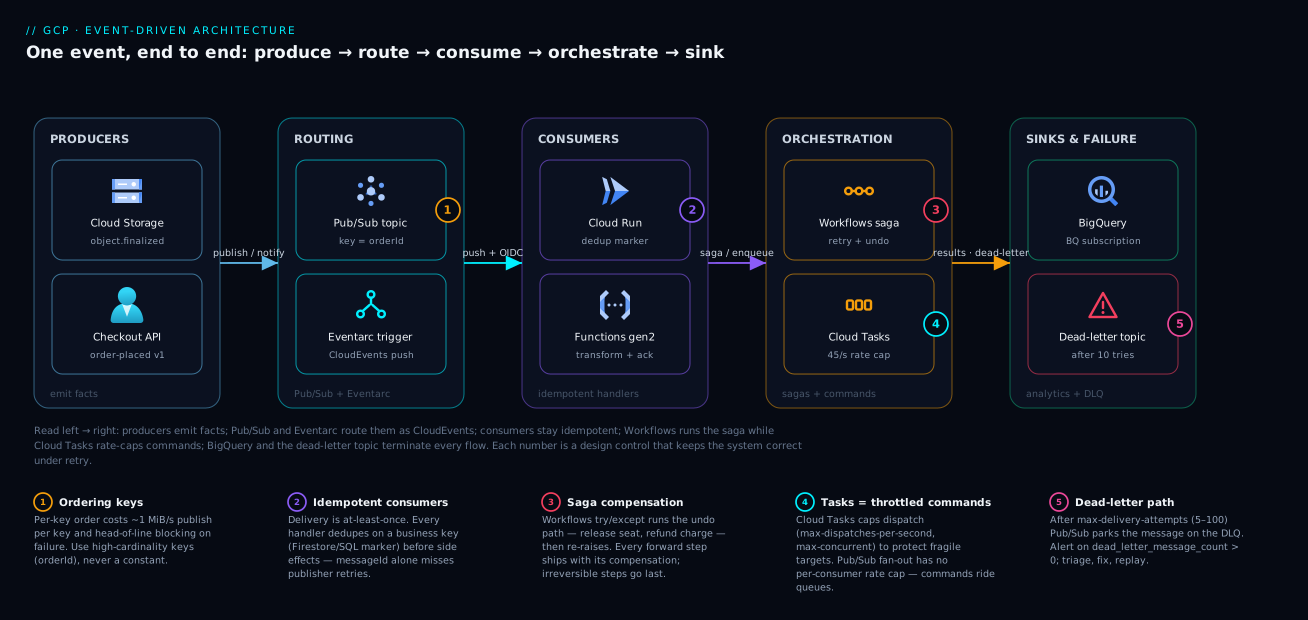
The diagram reads left to right as one event’s life. Producers: a Cloud Storage upload emits object.finalized, and the checkout API publishes order-placed v1 — both become traffic in the routing column, where the Pub/Sub topic (carrying an orderId ordering key, badge 1) fans out to subscriptions and the Eventarc trigger wraps platform events into CloudEvents pushed with OIDC auth. Consumers — a Cloud Run service and a gen2 function — are deliberately boring: idempotent handlers (badge 2) that dedupe on a business key before side effects, transform, and ack. Anything transactional hands off to the orchestration column: the Workflows saga owns the money path with retries and compensation (badge 3), while Cloud Tasks rate-caps commands aimed at fragile targets (badge 4). Every flow terminates in the sinks column: BigQuery ingests the analytical copy through a native subscription, and the dead-letter topic (badge 5) catches what ten delivery attempts could not process — alarmed, triaged, replayed.
Notice what the picture does not contain: no synchronous call crosses a column boundary, every hop is a place where a backlog can absorb a burst, and both failure paths — compensation and DLQ — are drawn as first-class citizens. The whole doctrine in one image.
Real-world scenario
UtsavSeats, a Mumbai-based event-ticketing platform (14 engineers, ~₹1.8 lakh/month GCP spend), sells concert and festival tickets with brutal traffic shape: near-zero baseline, then 15,000 checkout attempts per minute for the first ten minutes of a big on-sale. Their v1 was pure choreography: checkout published seat.held, payment.captured, ticket.issued events; every service reacted to every other service’s events; email rode the same Pub/Sub topics as everything else.
Two incidents in one on-sale exposed the design. First, the payment provider’s webhook fired twice for ~0.7% of captures (documented at-least-once behaviour); the ticket service had no idempotency, so 214 customers received two tickets for one seat — found via support tickets, fixed by manual audit. Second, the email service — fan-out from the same events — pushed 300 requests/second at a legacy SMTP relay contractually capped at 50/s; the relay IP-banned them mid-on-sale, and transactional receipts queued behind 40,000 marketing notifications with no way to cancel any of it. Meanwhile “where is order X?” meant three engineers grepping three services’ logs in parallel: choreography had no owner for the end-to-end flow.
The redesign took one sprint plus a two-week burn-in, and it is essentially this article. The money path moved to orchestration: an Eventarc trigger starts an order-saga Workflows execution per checkout; reserve-seat → charge → issue-ticket became explicit steps with try/retry, and compensation (release-seat, refund) in except blocks. The duplicate-webhook problem died twice over: the payment callback dedupes on providerEventId with a Firestore transactional marker, and the charge step carries an idempotencyKey the provider honours. Email became commands: a Cloud Tasks queue at maxDispatchesPerSecond=45 (5/s headroom under the contract), OIDC dispatch, marketing sends in a second queue paused during on-sales — a one-command incident lever. Seat holds became scheduled tasks: hold creation enqueues a named task release-{holdId} at now+10m, confirmation deletes it; the cron sweep and its races were deleted. Analytics stayed choreographed — a BigQuery subscription on order-events, zero consumer code.
The next comparable on-sale: checkout p99 held at 180 ms while the saga ran behind it; the SMTP relay saw a flat 45/s for six hours (queue depth peaked at 31,000 — invisible to customers, drained by 02:00); zero duplicate tickets. When one poison message (malformed UTF-8 venue name) failed ten deliveries, it parked in the DLQ, paged via dead_letter_message_count > 0, and was fixed and replayed the same evening — 26 minutes, one engineer, no customer impact. Monthly cost of the new machinery: Workflows ≈ ₹1,400, Cloud Tasks ≈ ₹350, Eventarc/Pub/Sub delta ≈ ₹2,100 — noise against one prevented incident.
| Phase | Design | Failure observed | Fix applied | Result |
|---|---|---|---|---|
| v1 on-sale | Pure choreography, email on fan-out | 214 double tickets (dup webhooks) | Idempotency markers + provider idempotency keys | 0 duplicates next on-sale |
| v1 on-sale | Email fan-out, no rate cap | SMTP relay banned at 300 req/s | Cloud Tasks queue @45/s + separate marketing queue | Flat 45/s, pausable |
| v1 incident | No flow owner | 3 engineers × log grep per “where is order X” | Workflows saga = one execution record | One console lookup |
| v1 seat holds | Cron sweep every minute | Races + zombie holds | Named scheduled tasks, delete-on-confirm | Exact-time release, no sweep |
| v2 burn-in | DLQ + alerts | Poison message (bad UTF-8) | Park → fix → replay runbook | 26-min MTTR, no impact |
Advantages and disadvantages
| Advantages | Disadvantages |
|---|---|
| Failure isolation: a slow/down consumer grows its own backlog; producers and siblings unaffected | Eventual consistency: “is it done?” has no synchronous answer; UX must be designed for async |
| Elastic absorption: 100× bursts become backlog + drain time, not outages | Duplicates are the contract: every handler carries idempotency machinery |
| Independent evolution: new consumers attach without touching producers; schemas police the contract | Debugging is distributed: without deliberate tracing/correlation, incidents are archaeology |
| Right-sized semantics per leg: fan-out (Pub/Sub), throttled commands (Tasks), sagas (Workflows), time (Scheduler) | Four services to operate instead of one call stack; IAM/quota/config surface multiplies |
| Failure paths are first-class: DLQs, compensation, replay — recoverable by design | Orchestrator discipline needed: a sloppy central workflow re-creates the monolith’s coupling |
| Serverless economics: scale-to-zero consumers + per-step orchestration ≈ ₹ hundreds/month at mid scale | Latency floor: broker hops add tens of ms; wrong for request/response paths |
The disadvantages dominate in small systems with no burst profile, hard synchronous UX requirements, or teams without the maturity for distributed debugging. An honest monolith with a job queue beats a cargo-culted event mesh — the compute decision guide pairs well with that conversation.
Hands-on lab
Build the full toolbox in ~30 minutes in Cloud Shell: a GCS→Eventarc→Cloud Run event path, a Pub/Sub topic with DLQ, a Workflows saga with visible compensation, and a rate-limited Cloud Tasks queue. Everything fits comfortably in the free tier if torn down after.
Step 1 — project, APIs, variables.
export PROJECT_ID=$(gcloud config get-value project)
export REGION=asia-south1
export PROJECT_NUMBER=$(gcloud projects describe $PROJECT_ID --format='value(projectNumber)')
gcloud services enable pubsub.googleapis.com eventarc.googleapis.com \
  run.googleapis.com workflows.googleapis.com cloudtasks.googleapis.com \
  cloudscheduler.googleapis.com
Step 2 — a consumer that shows you its events. Deploy the echo-friendly hello container; it logs every request body.
gcloud run deploy event-sink --region=$REGION \
  --image=us-docker.pkg.dev/cloudrun/container/hello --no-allow-unauthenticated
Step 3 — service account + the IAM triangle.
gcloud iam service-accounts create eventarc-lab
gcloud run services add-iam-policy-binding event-sink --region=$REGION \
  --member="serviceAccount:eventarc-lab@$PROJECT_ID.iam.gserviceaccount.com" \
  --role=roles/run.invoker
gcloud projects add-iam-policy-binding $PROJECT_ID \
  --member="serviceAccount:eventarc-lab@$PROJECT_ID.iam.gserviceaccount.com" \
  --role=roles/eventarc.eventReceiver
GCS_SA=$(gcloud storage service-agent --project=$PROJECT_ID)
gcloud projects add-iam-policy-binding $PROJECT_ID \
  --member="serviceAccount:${GCS_SA}" --role=roles/pubsub.publisher
Step 4 — Eventarc trigger on a bucket, then fire it.
gcloud storage buckets create gs://$PROJECT_ID-eda-lab --location=$REGION
gcloud eventarc triggers create lab-object-finalized --location=$REGION \
  --destination-run-service=event-sink --destination-run-region=$REGION \
  --event-filters="type=google.cloud.storage.object.v1.finalized" \
  --event-filters="bucket=$PROJECT_ID-eda-lab" \
  --service-account=eventarc-lab@$PROJECT_ID.iam.gserviceaccount.com
echo "hello eda" > sample.txt && gcloud storage cp sample.txt gs://$PROJECT_ID-eda-lab/
# Wait ~1–2 min for the first delivery, then:
gcloud run services logs read event-sink --region=$REGION --limit=20
# Expected: a POST with ce-type: google.cloud.storage.object.v1.finalized
Step 5 — topic + DLQ + production-grade subscription.
gcloud pubsub topics create lab-orders
gcloud pubsub topics create lab-orders-dlq
gcloud pubsub subscriptions create lab-orders-sub --topic=lab-orders \
  --ack-deadline=30 --min-retry-delay=10s --max-retry-delay=120s \
  --dead-letter-topic=lab-orders-dlq --max-delivery-attempts=5 \
  --expiration-period=never
gcloud pubsub subscriptions create lab-orders-dlq-sub --topic=lab-orders-dlq
# Grant the Pub/Sub service agent its DLQ roles (forwarder identity):
gcloud pubsub topics add-iam-policy-binding lab-orders-dlq \
  --member="serviceAccount:service-${PROJECT_NUMBER}@gcp-sa-pubsub.iam.gserviceaccount.com" \
  --role=roles/pubsub.publisher
gcloud pubsub subscriptions add-iam-policy-binding lab-orders-sub \
  --member="serviceAccount:service-${PROJECT_NUMBER}@gcp-sa-pubsub.iam.gserviceaccount.com" \
  --role=roles/pubsub.subscriber
gcloud pubsub topics publish lab-orders --message='{"orderId":"o-1"}' \
  --attribute=type=order.placed.v1
gcloud pubsub subscriptions pull lab-orders-sub --auto-ack --limit=1
Step 6 — a saga that compensates before your eyes. Save as lab-saga.yaml — amountMinor over 50,000 triggers a simulated payment failure, and you watch the compensation run:
main:
  params: [input]
  steps:
    - init:
        assign:
          - orderId: ${input.orderId}
          - compensated: false
    - reserve:
        assign:
          - reservation: ${"seat-held-" + orderId}
    - charge:
        try:
          steps:
            - maybeFail:
                switch:
                  - condition: ${input.amountMinor > 50000}
                    raise:
                      code: 402
                      message: "card declined"
            - ok:
                assign:
                  - charge: ${"charged-" + orderId}
        except:
          as: e
          steps:
            - compensateReserve:
                assign:
                  - compensated: true
            - failSaga:
                raise: ${e}
    - done:
        return: { orderId: '${orderId}', charge: '${charge}', compensated: '${compensated}' }
gcloud workflows deploy lab-saga --location=$REGION --source=lab-saga.yaml
gcloud workflows run lab-saga --location=$REGION \
  --data='{"orderId":"o-1","amountMinor":19900}'      # succeeds
gcloud workflows run lab-saga --location=$REGION \
  --data='{"orderId":"o-2","amountMinor":99900}'      # fails AFTER compensating
gcloud workflows executions list lab-saga --location=$REGION --limit=2
# Expected: one SUCCEEDED, one FAILED — describe the failed one and find
# "card declined" plus the compensateReserve step in its history.
Step 7 — a throttled command queue.
gcloud tasks queues create lab-commands --location=$REGION \
  --max-dispatches-per-second=1 --max-concurrent-dispatches=1 --max-attempts=3
SINK_URL=$(gcloud run services describe event-sink --region=$REGION --format='value(status.url)')
for i in 1 2 3 4 5; do
  gcloud tasks create-http-task lab-cmd-$i --queue=lab-commands --location=$REGION \
    --url="$SINK_URL/cmd" --method=POST --body-content="{\"n\":$i}" \
    --oidc-service-account-email=eventarc-lab@$PROJECT_ID.iam.gserviceaccount.com
done
gcloud run services logs read event-sink --region=$REGION --limit=20
# Expected: the five POSTs arrive ~1 second apart — the queue, not the sender, sets the pace.
Step 8 — teardown.
gcloud eventarc triggers delete lab-object-finalized --location=$REGION --quiet
gcloud storage rm -r gs://$PROJECT_ID-eda-lab
gcloud run services delete event-sink --region=$REGION --quiet
gcloud workflows delete lab-saga --location=$REGION --quiet
gcloud tasks queues delete lab-commands --location=$REGION --quiet
for s in lab-orders-sub lab-orders-dlq-sub; do gcloud pubsub subscriptions delete $s --quiet; done
for t in lab-orders lab-orders-dlq; do gcloud pubsub topics delete $t --quiet; done
gcloud iam service-accounts delete eventarc-lab@$PROJECT_ID.iam.gserviceaccount.com --quiet
Common mistakes & troubleshooting
The playbook — symptom first, because that is what you have at 02:00:
| # | Symptom | Root cause | Confirm (exact command / path) | Fix |
|---|---|---|---|---|
| 1 | Eventarc trigger exists, consumer never invoked | Trigger SA lacks roles/run.invoker |
gcloud eventarc triggers describe T --location=R → find transport topic; check its subscription’s push_request_count response classes in Metrics Explorer |
Grant run.invoker on the destination service to the trigger SA |
| 2 | GCS trigger creation fails mentioning the service agent | Storage service agent can’t publish to transport | Error text names it; gcloud storage service-agent |
Grant that SA roles/pubsub.publisher at project level |
| 3 | Audit-log trigger never fires | Data Access audit logs disabled for the service | IAM & Admin → Audit Logs → service; Logs Explorer for matching protoPayload.methodName |
Enable Data Read/Write audit logs, accept the logging cost |
| 4 | Double emails / double stock decrements | At-least-once + non-idempotent handler (often ack deadline too short) | subscription/expired_ack_deadlines_count > 0; handler p99 vs ackDeadlineSeconds |
Raise ack deadline; add dedup marker keyed on business key |
| 5 | Backlog grows, consumer logs look idle | Push backoff after error streak, or Cloud Run at max-instances returning 429s |
push_request_count grouped by response_class; Cloud Run “container instance count” at ceiling |
Fix handler errors; raise --max-instances; consider pull with flow control |
| 6 | Ordered subscription frozen for one entity | Poison message head-of-line blocks its ordering key | oldest_unacked_message_age climbing while other keys flow |
DLQ on the sub (it un-wedges the key); fix consumer; replay |
| 7 | Messages “vanish”, no consumer error | Subscription created after publish, or 31-day-idle expiration deleted it | gcloud pubsub subscriptions describe → NOT_FOUND, or check expirationPolicy |
Create subs with the topic (IaC); set --expiration-period=never |
| 8 | DLQ configured but redelivery loops forever | Pub/Sub service agent missing DLQ publisher / source subscriber roles | Sub details page shows a warning banner; check IAM on DLQ topic | Grant service-PROJECT_NUMBER@gcp-sa-pubsub… the two roles (lab step 5) |
| 9 | Saga double-charged a customer | http.default_retry on a non-idempotent POST |
Workflows execution history shows retried charge step |
Use default_retry_non_idempotent + idempotency key the provider honours |
| 10 | Tasks dispatch far below configured rate | Queue paused, or target 429/5xx streak triggering queue backoff | gcloud tasks queues describe Q --location=R → state; queue/task_attempt_count by response code |
Resume queue; fix target; retune maxDispatchesPerSecond to target reality |
| 11 | Scheduler “ran” but nothing happened | Job succeeded against wrong URL/topic, or 2xx from an error-swallowing handler | Scheduler job → View execution logs; target-side request logs | Fix target; make handlers return non-2xx on failure (never swallow) |
| 12 | Push handler gets gibberish payload | Forgot base64-decode of message.data in the push envelope |
Log the raw body once: {"message":{"data":"eyJvcmRlcklkIjoi..."}} |
Decode base64 then JSON-parse; write a shared envelope parser lib |
| 13 | Duplicates with exactly-once enabled | Publisher retries created two distinct messages (different messageId) |
Compare payload business keys vs messageIds in logs |
Outbox/idempotent publish + business-key dedup — exactly-once ≠ publisher dedup |
| 14 | Workflows execution fails ResourceLimitError |
>512 KB of variables (usually a big HTTP response held in a var) | Execution error names the limit; find the fat result: |
Don’t carry payloads through steps — pass GCS/BQ references instead |
And the error-string reference for the family — what the API actually returns and what it means in this context:
| Error / status | Service | Real meaning here | First move |
|---|---|---|---|
INVALID_ARGUMENT on publish |
Pub/Sub | Message >10 MB, or schema validation failed | Check size; validate against topic schema revision |
NOT_FOUND on publish |
Pub/Sub | Topic deleted/wrong project — publishes are NOT queued | Fix producer config; alert on publish error rate |
RESOURCE_EXHAUSTED |
Pub/Sub / Tasks | Regional quota or queue throughput cap | Check quota dashboard; request increase pre-launch |
FAILED_PRECONDITION publish w/ ordering key |
Pub/Sub | Prior publish failure paused the key; client must resume | Call resumePublish for the key (client lib method) |
ALREADY_EXISTS on task create |
Cloud Tasks | Named task recently created/executed (dedup working) | Expected — treat as success in enqueue code |
HTTP 429 from *.a.run.app target |
Cloud Run | max-instances ceiling hit |
Raise ceiling or lower queue/push pressure |
PERMISSION_DENIED on trigger create |
Eventarc | Caller or SA missing role in the IAM triangle | Walk the decision tree |
Execution FAILED with TimeoutError tag |
Workflows | HTTP call exceeded its timeout arg | Set timeout on the call; wrap in retry with backoff |
deadline exceeded task attempt |
Cloud Tasks | Handler exceeded dispatchDeadline |
Raise deadline ≤30 min or split the work |
400 schema validation failed |
Pub/Sub | Payload doesn’t match topic schema revision range | Roll schema revision forward; fix producer serialisation |
Best practices
- Classify every arrow: event → Pub/Sub, command → Cloud Tasks, time → Scheduler, saga → Workflows. Write the classification into the design doc; review it like an API.
- DLQ everything in production — every subscription gets a dead-letter topic,
max-delivery-attempts5–10, a monitored DLQ subscription, and a written replay runbook. Alert atdead_letter_message_count > 0. - Idempotency is a code-review gate: no consumer merges without a dedup strategy named in the PR description (natural, marker, or transactional).
- Outbox for anything where DB state and events must agree — payments, inventory, entitlements. Dual writes are a standing incident invitation.
- Version event types (
order.placed.v1) and enforce schemas at the topic. Additive evolution within a version; contract tests in consumer CI. - Give every fragile downstream its own Tasks queue with a rate 10% under its real capacity — and use
pauseas an incident lever (practise it). - Compensation is designed with the step, not after the outage: each saga step lands with its undo; irreversible steps go last.
- Propagate trace context in message attributes (enable the client libraries’ OTel support) and log the business key at every hop.
- Set
--expiration-period=neverand create subscriptions in Terraform alongside topics — the 31-day idle reaper and the “subscribed too late” gap both vanish under IaC. While you’re there: ack deadlines ≥ 2× handler p99. - One event mesh doctrine per org: naming (
<domain>.<entity>.<verb>.v<N>), attribute conventions, DLQ policy, replay procedure — documented once, linted in CI.
Security notes
Event meshes multiply the identities that can invoke things, so least privilege does the heavy lifting. Per-leg service accounts: each trigger, push subscription, queue and workflow runs as its own SA with exactly the invoker/publisher roles that leg needs — never the default compute SA (see service accounts & least privilege). Authenticated push everywhere: Cloud Run consumers stay --no-allow-unauthenticated; Pub/Sub push, Eventarc, Tasks and Scheduler all sign OIDC tokens, and Cloud Run’s IAM check does the rest — there is no reason for an unauthenticated event endpoint on GCP.
| Principal | Minimum role(s) | On |
|---|---|---|
| Producer service SA | roles/pubsub.publisher |
Its topics only (topic-level binding) |
| Push/trigger invoker SA | roles/run.invoker |
The one destination service |
| Eventarc trigger SA | roles/eventarc.eventReceiver (+ invoker) |
Project / destination |
| Cloud Storage service agent | roles/pubsub.publisher |
Project (GCS direct events) |
| Pub/Sub service agent | roles/pubsub.publisher + subscriber |
DLQ topic + source subscription |
| Task enqueuer SA | roles/cloudtasks.enqueuer (+ roles/iam.serviceAccountUser on the dispatch SA) |
The queue |
| Workflow runner SA | Exactly the APIs its connectors touch | Per-resource |
| Scheduler job SA | roles/pubsub.publisher or run.invoker |
Its one target |
Data protection: messages are encrypted at rest and in transit by default; use CMEK on topics where compliance demands key custody, and keep PII out of attributes (they surface in logs, filters and metric labels far more readily than payloads). Regulated perimeters: all five services respect VPC Service Controls, and Eventarc’s internal-HTTP destinations reach private receivers without public ingress. Finally, treat replay as privileged: seek/replay re-triggers side effects at scale, so gate pubsub.subscriptions.seek behind a break-glass role.
Cost & sizing
The family is cheap at mid-scale and its costs are load-shaped, not idle-shaped — the expensive mistakes are architectural (chatty events, payloads that should be GCS references, Composer where Workflows would do).
| Cost driver | Rate (approx, USD) | The lever |
|---|---|---|
| Pub/Sub throughput | ~$40/TiB (publish + each delivery leg); first 10 GiB/mo free | Payload size discipline; references not blobs; subscription filters still bill filtered messages |
| Topic/acked retention | Per GiB-month extra | Retain 7 d only where replay is a real requirement |
| Eventarc (Standard) | Pass-through Pub/Sub transport | Free-ish; Advanced bills per event — model before adopting |
| Cloud Tasks | ~$0.40/M operations; 1 M free/mo | Ops = create+dispatch+mgmt; batch tiny commands |
| Cloud Scheduler | ~$0.10/job/month; 3 free | Jobs are billed, not ticks — consolidate micro-crons |
| Workflows | ~$0.01/1k internal steps (5k free); ~$0.025/1k external calls (2k free) | Connectors count as steps; avoid per-item loops — fan out via Pub/Sub |
| Cloud Run consumers | vCPU-s + GiB-s while handling | Concurrency > 1 for IO-bound handlers; min-instances=0 |
| Cloud Logging/Monitoring | Ingest per GiB | Audit-log triggers can 10× log volume — sample/exclude |
A worked month for a mid-size platform — 50 M events, 2 KB average payload, three consumers per event, 5 M commands, 1 M saga executions of ~12 steps:
| Component | Math | ≈ USD | ≈ INR |
|---|---|---|---|
| Pub/Sub (publish + 3 deliveries) | 50 M × 2 KB × 4 legs ≈ 0.38 TiB × $40 | $15 | ₹1,350 |
| Cloud Tasks | 5 M ops × $0.40/M | $2 | ₹180 |
| Workflows | 12 M steps × $0.01/1k | $120 | ₹10,800 |
| Cloud Scheduler | 12 jobs | $1.2 | ₹110 |
| Cloud Run (consumers) | ~3 vCPU avg utilised | $70–120 | ₹6,300–10,800 |
| Total event machinery | ~$210–260 | ~₹19,000–23,500 |
Sizing heuristics: keep payloads ≤ ~10 KB (larger → GCS object + reference event); size Cloud Run as instances × concurrency × (1/handler-seconds) ≥ arrival rate + drain margin; and multiply your hottest saga’s step count by monthly volume before committing — a 40-step saga at 10 M executions/month is $4,000; restructure or batch. Baseline for perspective: one always-on Composer environment costs more than this entire worked example.
Interview & exam questions
Relevant to the Professional Cloud Architect and Professional Cloud Developer certs; also standard system-design interview territory.
-
Q: When would you choose Cloud Tasks over Pub/Sub? A: When the message is a command with one intended executor and I need controls Pub/Sub lacks: per-queue rate limiting, concurrency caps, scheduled delivery up to 30 days, named-task deduplication, and cancellation of pending work. Pub/Sub wins for facts that fan out to unknown consumers.
-
Q: Explain choreography vs orchestration and when each fits. A: Choreography lets services react to each other’s events — minimal coupling, easy consumer addition, but no owner of the end-to-end outcome. Orchestration (Workflows) centralises the flow: explicit steps, retries, compensation and one execution record. Broadcast facts choreograph; money paths and SLA-bound flows orchestrate.
-
Q: What is a saga and how does Workflows implement compensation? A: A saga replaces a distributed transaction with local transactions, each paired with an undo. In Workflows each forward step is a
trywith a retry policy; theexceptblock runs compensations for already-completed steps (release reservation, refund charge) and re-raises so the execution fails honestly. -
Q: Pub/Sub exactly-once delivery is enabled — can duplicates still occur end to end? A: Yes. Exactly-once applies to redelivery of acked messages on a regional pull subscription. A publisher retry creates a second message with a new
messageId, and a handler crash after its side effect but before ack still repeats the effect. End-to-end exactly-once needs idempotent handlers and, where DB state and events must agree, an outbox. -
Q: What problem does the transactional outbox solve? A: The dual-write inconsistency: committing state and publishing an event are two systems that can’t share a transaction. Writing the event to an outbox table in the same DB transaction, with an at-least-once relay publishing it, guarantees state and event agree; consumer idempotency absorbs relay duplicates.
-
Q: Three ways Eventarc gets events, and when do you use audit-log triggers? A: Direct events from integrated sources (fastest, typed — e.g. GCS
object.finalized), Cloud Audit Logs events (near-universal API coverage, higher latency, Data Access logs required), and custom Pub/Sub topics. Audit-log triggers are the fallback when no direct event exists — e.g. reacting to a BigQuery job completion. -
Q: How do you stop a burst of events from crushing a rate-limited legacy system? A: Don’t fan Pub/Sub directly into it. Route that leg through a Cloud Tasks queue whose
maxDispatchesPerSecond/maxConcurrentDispatchessit under the target’s real capacity; the burst becomes queue depth. Pub/Sub can feed an enqueuer, keeping fan-out semantics upstream. -
Q: An ordered subscription has stopped delivering for one customer but others flow. Why? A: Head-of-line blocking on that customer’s ordering key — a message that keeps failing blocks everything behind it on the same key (ordering also caps publishes ~1 MiB/s per key). Attach a dead-letter policy so the poison message parks after max attempts, unblocking the key, then fix and replay.
-
Q: Workflows vs Cloud Composer? A: Workflows is serverless, per-step billed, millisecond-start, year-long executions with callbacks — built for service orchestration and sagas. Composer is managed Airflow: an always-on environment (hundreds of dollars monthly) with the operator/backfill ecosystem data engineering expects. Orchestrate microservices with Workflows; orchestrate data pipelines with Composer.
-
Q: How does trace context survive a Pub/Sub hop? A: It must travel in the message, not the connection — the client libraries’ OpenTelemetry integration propagates W3C context via a
googclient_traceparentattribute and emits publish/deliver spans; consumers extract it and start child spans. Logs correlate via thelogging.googleapis.com/tracefield. -
Q: Design “release unsold seat holds after exactly 10 minutes” without cron sweeps. A: On hold creation, enqueue a named Cloud Tasks task
release-{holdId}withscheduleTime = now+10mtargeting the release endpoint; on purchase, delete the task. Exact-time dispatch, per-hold cancellation, named-task dedup — no polling, no sweep races. -
Q: What belongs in message attributes vs payload? A: Attributes carry routing and infrastructure metadata — event type/version, tenant, trace context, idempotency key — filterable without deserialising. The payload carries the schema-governed domain fact. Never PII in attributes.
Quick check
- A team publishes
generate-invoice-pdfmessages to a Pub/Sub topic consumed by one service that keeps overloading a PDF API. What two properties do they need that Pub/Sub can’t give them? - Your saga’s email step cannot be undone. Where does it go in the workflow and why?
dead_letter_message_countjust went above zero. Is that an error in the DLQ setup?- Exactly-once delivery is on, yet finance sees duplicate ledger entries. Name two remaining duplicate sources.
- Which Eventarc source class reacts to any GCP API call, and what must be enabled first?
Answers
- Per-consumer rate limiting and concurrency caps (plus cancellation) — it’s a command, so it belongs in a Cloud Tasks queue with
maxDispatchesPerSecondtuned to the PDF API. - Last, after every step that can fail — irreversible actions run only once all compensable steps have succeeded, so no compensation ever needs to “unsend” it.
- No — it means the system worked: a poison message parked after max delivery attempts instead of wedging the subscription. The action is triage, fix, replay.
- Publisher retries (new
messageId, same fact) and handler crash after the side effect but before ack; exactly-once only prevents redelivery of already-acked messages on that pull subscription. - Cloud Audit Logs triggers (
google.cloud.audit.log.v1.writtenfiltered byserviceName/methodName) — Data Access audit logs must be enabled for the service, with their logging cost accepted.
Glossary
- Event: immutable statement that something happened, published without knowledge of consumers.
- Command: targeted instruction to one executor, typically rate-controlled and cancellable.
- Choreography: flow emerging from services reacting to each other’s events; no central owner.
- Orchestration: a central definition (Workflows) driving steps, state, retries and compensation.
- Saga: multi-step business transaction built from local transactions plus compensating undo steps.
- Compensation: the paired undo of a saga step (release, refund, void), run on downstream failure.
- CloudEvents: the CNCF envelope standard (
ce-id,ce-source,ce-type…) Eventarc delivers in. - Eventarc trigger: filter + destination binding routing Google Cloud or custom events to a service.
- Ordering key: per-message key giving in-order delivery per key at ~1 MiB/s publish per key.
- Exactly-once delivery: Pub/Sub regional pull feature preventing redelivery of acked messages — not end-to-end effect-exactly-once.
- Dead-letter topic (DLQ): topic receiving messages after
maxDeliveryAttemptsfailures, for triage and replay. - Idempotency key: business identifier letting a handler detect and no-op duplicate deliveries.
- Transactional outbox: event row committed atomically with state, published by an at-least-once relay.
- Connector: Workflows’ typed call to a Google API handling auth, retries and long-running operations.
Next steps
- Go deep on the backbone’s mechanics — subscription types, ordering, exactly-once, DLQ internals — in GCP Pub/Sub and Event-Driven Architecture: Decouple and Scale.
- Harden the consumers: Cloud Run explained — serverless containers that scale to zero, then the Cloud Run vs GKE vs Compute Engine decision for where handlers should live.
- Wire the identities correctly with GCP IAM service accounts & least privilege — the IAM triangle in this article is 90% of Eventarc tickets.
- Build the dashboards and SLOs from the observability section with Cloud Monitoring & operations, and land the analytical sink via BigQuery as your analytics warehouse.
- Porting patterns from AWS? Map EventBridge/SQS/Step Functions habits across with AWS Lambda event-driven patterns.